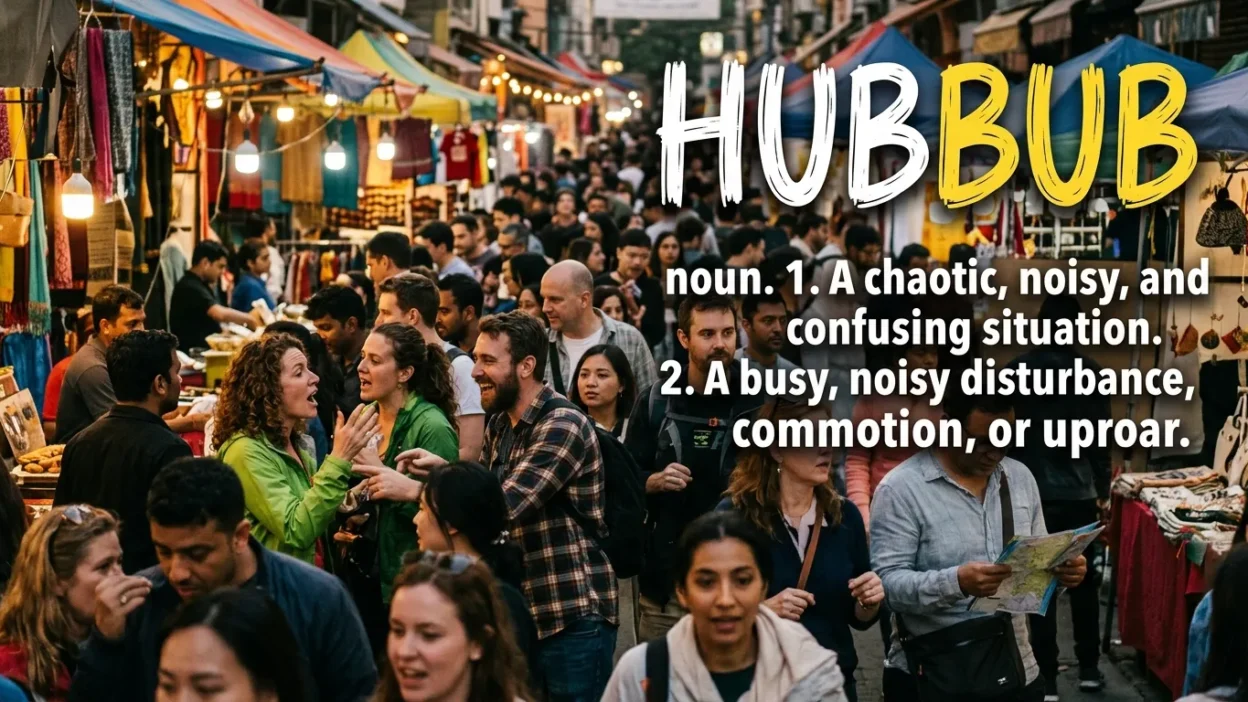
Have you ever walked into a busy room where everyone was talking, laughing, moving around, and making noise at once? That busy sound and activity can be called hubbub.
The hubbub meaning is mainly a loud mix of voices or other noises, often caused by many people talking at the same time. The word can also describe a busy or excited situation filled with noise and activity. Cambridge and Oxford both give these two closely related uses.
You may see hubbub in books, news stories, conversations, and phrases such as “all the hubbub” or “the hubbub of city life.”
In this guide, you will learn what hubbub means, how to pronounce it, when to use it, its synonyms, common phrases, and simple examples. You will also learn the small difference between hubbub, noise, bustle, uproar, and hustle and bustle.
Quick Answer
Hubbub means a loud, busy mix of sounds, especially when many people talk at the same time.
It can also mean a situation full of noise, excitement, confusion, and activity.
Example:
“I could not hear my friend over the hubbub in the crowded restaurant.”
In simple words, hubbub = noisy and busy activity.
Hubbub Definition and Meaning
The word hubbub is a noun. It usually refers to a loud mixture of sounds made by people or a busy situation filled with activity.
Oxford defines it as the loud sound made when many people talk at the same time. It also uses the word for a situation with a lot of noise, excitement, and activity.
Cambridge gives a similar definition. It describes hubbub as loud noise, especially noise caused by many people talking together. It also uses the word for general excitement and activity.
So, the meaning can depend on the sentence.
Two main meanings are:
- A loud mixture of sounds
- A busy, noisy, or exciting situation
For example:
- “The hubbub made it hard to hear the speaker.”
- “She enjoyed the hubbub of the busy market.”
In the first sentence, hubbub focuses on sound. In the second, it describes the whole busy atmosphere.
Hubbub Pronunciation
The standard pronunciation of hubbub is:
/ˈhʌbʌb/
It has two syllables, and the stress falls on the first syllable. Oxford and Cambridge both list this pronunciation.
The word sounds the same in both parts, which makes it fairly easy to say once you hear it.
If you are learning English, listen for the strong first syllable when practicing the word.
What Does Hubbub Mean in Simple English?
In very simple English, hubbub means lots of noise and activity happening at the same time.
Imagine these scenes:
- Students talking between classes
- A busy train station
- A crowded shopping mall
- People cheering at an event
- Guests talking at a large party
- A busy city street
All these places can have a hubbub.
The word does not always suggest something bad. A hubbub can be fun, exciting, normal, or annoying, depending on the situation.
For example:
Positive:
“The joyful hubbub of the festival filled the streets.”
Neutral:
“There was a lot of hubbub in the hallway.”
Negative:
“The constant hubbub made it hard for me to study.”
Hubbub vs. Noise
These words are close, but they are not exactly the same.
Noise is a broad word. It can describe almost any unwanted or noticeable sound.
Hubbub is more specific. It often suggests a mixture of sounds and activity, especially from many people.
Compare:
- “The machine is making a strange noise.”
- “The children created a hubbub in the classroom.”
You would not normally call a single machine sound a hubbub. The word works better when several sounds or people create a busy atmosphere.
Hubbub vs. Uproar
Uproar can mean loud noise, but it often suggests strong anger, protest, excitement, or disagreement.
Hubbub usually has a softer meaning. It can simply describe the normal noise of a busy place.
For example:
- “There was a hubbub in the cafeteria.”
- “The decision caused an uproar.”
The cafeteria may simply be busy. The second sentence suggests that people reacted strongly to something.
This distinction can help you choose the right word.
Hubbub vs. Bustle
Bustle often describes busy movement and activity.
Hubbub puts more focus on noise, although it can also describe general activity.
For example:
- “She loved the bustle of downtown.”
- “She loved the hubbub of downtown.”
Both sentences work, but bustle highlights movement and activity, while hubbub gives a stronger sense of sound and lively noise.
Cambridge lists bustle and hustle and bustle among related words for activity.
Common Hubbub Synonyms
Several words can replace hubbub, but each one has its own shade of meaning.
| Word | Basic meaning | Best use |
| Noise | Any noticeable sound | General sound |
| Commotion | Confused activity | A sudden busy event |
| Uproar | Loud reaction or disturbance | Anger or excitement |
| Bustle | Busy movement | Busy places |
| Clamor | Loud, repeated noise or demands | Strong or persistent noise |
| Ruckus | Noisy disturbance | Informal situations |
| Turmoil | Confusion and disorder | Serious situations |
| Din | Very loud, unpleasant noise | Strong focus on sound |
Not every synonym works in every sentence.
For example, din can sound stronger and more unpleasant than hubbub. Ruckus is more informal. Turmoil can describe serious disorder, so it often goes beyond the simple meaning of hubbub.
How to Use Hubbub in a Sentence
The easiest way to use hubbub is to connect it with a busy place, group, event, or situation.
Here are some natural examples:
- “The hubbub in the cafeteria was hard to ignore.”
- “I could barely hear her above the hubbub.”
- “The children added to the cheerful hubbub.”
- “He stepped outside to escape the hubbub.”
- “The hubbub of the market continued all morning.”
- “The speaker waited for the hubbub to die down.”
- “She enjoyed the friendly hubbub of the party.”
- “The sudden hubbub drew everyone’s attention.”
- “The library was quiet despite the hubbub outside.”
- “After the hubbub ended, the room became calm.”
These examples show an important pattern: hubbub often appears with words that describe sound, activity, or a change in noise.
Common Phrases With Hubbub
Some expressions appear naturally with hubbub.
“All the hubbub”
This means all the noise, excitement, or activity around something.
Example:
“I could not understand all the hubbub about the new store.”
Here, the phrase can refer to more than physical noise. It can mean all the attention and excitement surrounding an event.
“The hubbub of city life”
This describes the constant noise and activity found in a busy city.
Example:
“She enjoys the hubbub of city life.”
Oxford gives this type of use as an example of the word’s broader meaning.
“Above the hubbub”
This means something is louder than, or heard despite, the surrounding noise.
Example:
“He raised his voice above the hubbub.”
“The hubbub died down”
This means the noise and activity became quieter.
Example:
“Once the hubbub died down, the teacher began speaking.”
This is a useful phrase because die down means to become less strong or less intense.
Is Hubbub Formal or Informal?
Hubbub is a standard English word, but it can feel more colorful than simple words such as noise or activity.
You can use it in everyday conversation:
“What’s all the hubbub about?”
You can also see it in more formal writing:
“The hubbub surrounding the announcement soon faded.”
It is not limited to slang or texting. It appears in dictionaries, journalism, literature, and general English.
That said, noise may be clearer for very simple writing. Use hubbub when you want to show a mix of noise, activity, and excitement.
Is Hubbub a Negative Word?
Not always.
The word itself does not automatically mean something bad. The feeling depends on the context.
A happy hubbub can describe people laughing and talking at a celebration.
A confusing hubbub can describe noise that makes it hard to think.
So, the word can have a positive, neutral, or negative tone.
This flexibility makes hubbub useful when you want to describe the atmosphere of a place rather than simply label a sound as “loud.”
When Should You Use Hubbub?
Use hubbub when several sounds, people, or activities create a busy atmosphere.
It works especially well for:
- Schools
- Markets
- Restaurants
- Parties
- Festivals
- Airports
- Train stations
- City streets
- Sporting events
- Crowded workplaces
For example:
School:
“The hubbub between classes filled the hallway.”
Market:
“I loved the lively hubbub of the street market.”
Restaurant:
“The hubbub made conversation difficult.”
Festival:
“The joyful hubbub continued late into the evening.”
When Should You Avoid Hubbub?
Avoid hubbub when you need to describe one specific sound.
For example, these sentences are not natural:
“The hubbub of the alarm clock woke me.”
A better choice would be:
“The alarm clock made a loud noise.”
You should also avoid using hubbub when the situation involves serious disorder unless the context truly fits. Words such as chaos, turmoil, or uproar may work better.
The key is simple: use hubbub when you picture a mix of sounds or lively activity.
Common Mistakes With Hubbub
Here are some mistakes English learners may make.
| Mistake | Better choice | Why |
| “A hubbub sound” | “A hubbub” | Hubbub already refers to noisy activity |
| “Many hubbubs” | “A lot of hubbub” | It is usually uncountable |
| “The hubbub was one noise” | “The hubbub was loud” | It describes a mixture of sounds |
| Using it for one beep | Use “noise” or “sound” | Hubbub usually suggests multiple sounds |
| Using it for serious chaos | Consider “turmoil” or “uproar” | These may better express strong disorder |
Cambridge and Oxford both classify hubbub as an uncountable noun, which explains why phrases such as “a lot of hubbub” are natural.
Hubbub Meaning: Quick Reference
| Question | Answer |
| What does hubbub mean? | Loud, mixed noise or busy activity |
| Part of speech | Noun |
| Pronunciation | /ˈhʌbʌb/ |
| Main idea | Noise caused by many people or busy activity |
| Is it countable? | Usually uncountable |
| Common phrase | “all the hubbub” |
| Similar words | Noise, bustle, commotion, uproar |
| Can it be positive? | Yes |
| Can it be negative? | Yes |
| Example | “The hubbub made it hard to hear.” |
Hubbub Examples in Everyday English
Here are more examples to help you understand the word naturally.
- At school:
- “The hubbub in the hallway stopped when the bell rang.”
- At a wedding:
- “The cheerful hubbub continued while guests greeted each other.”
- At a sports game:
- “The announcer’s voice disappeared beneath the hubbub of the crowd.”
- At an airport:
- “She found a quiet corner away from the hubbub.”
- At a busy office:
- “The morning hubbub faded after everyone settled at their desks.”
At home:
“The house was full of the happy hubbub of visiting relatives.”
Notice how the word often works with of, in, or around:
- the hubbub of the city
- the hubbub in the hallway
- the hubbub around the event
A Simple Trick to Remember Hubbub
Think of a crowded place where many people are speaking at once.
You hear:
talking + laughing + movement + activity = hubbub
You do not need to remember a long dictionary definition.
Just remember:
Hubbub = a noisy mix of people and activity.
Then look at the context. If the sentence talks about excitement and activity rather than sound alone, hubbub can still fit.
Why “Hubbub” Can Mean More Than Noise
One useful point often missed in basic definitions is that hubbub does not always describe sound alone.
Oxford and Cambridge both show a broader use involving excitement and activity.
Consider:
“She missed the hubbub of the city.”
The speaker may not simply miss loud voices. They may miss the whole lively feeling of city life: people moving around, conversations, traffic, shops, and constant activity.
That broader meaning gives hubbub more emotional color than the plain word noise.
FAQs:
1. What is the simple meaning of hubbub?
Hubbub means a loud mixture of sounds, especially when many people talk at the same time. It can also mean a busy situation full of noise, excitement, and activity.
2. Is hubbub a positive or negative word?
It can be either. A hubbub may describe happy activity at a party or an annoying amount of noise in a classroom. The surrounding words show the tone.
3. What is a synonym for hubbub?
Common synonyms include noise, commotion, bustle, uproar, clamor, din, and ruckus. The best choice depends on the situation.
4. How do you pronounce hubbub?
The word is pronounced /ˈhʌbʌb/. It has two syllables, with the main stress on the first syllable.
5. Is hubbub a formal word?
Hubbub is a standard English word. It can appear in both everyday speech and written English. It often sounds more vivid than the basic word noise.
6. What does “all the hubbub” mean?
“All the hubbub” means all the noise, excitement, attention, or activity surrounding a person, event, or situation.
For example: “I do not understand all the hubbub about the announcement.”
7. What is the difference between hubbub and bustle?
Hubbub focuses more on noise and lively activity, while bustle focuses more on busy movement and activity. They can overlap when describing a crowded place.
Conclusion:
The hubbub meaning is simple: it describes a loud mix of sounds or a busy situation filled with activity and excitement. It often appears when many people talk, move, laugh, or react at the same time.
Unlike noise, hubbub usually gives you a picture of a lively group or place. Unlike uproar, it does not always suggest anger or serious disorder.
If you want to use the word naturally, think of a crowded market, busy school hallway, lively party, or noisy city street. When many sounds and activities blend together, hubbub may be the perfect word.

I am Ernest Angelou, the heart and voice behind prayersvibe.com.
I am someone who believes that prayers are not just words, but a deep conversation between the soul and God.
I am here to share faith-filled prayers that bring peace, hope, and divine comfort into everyday life.