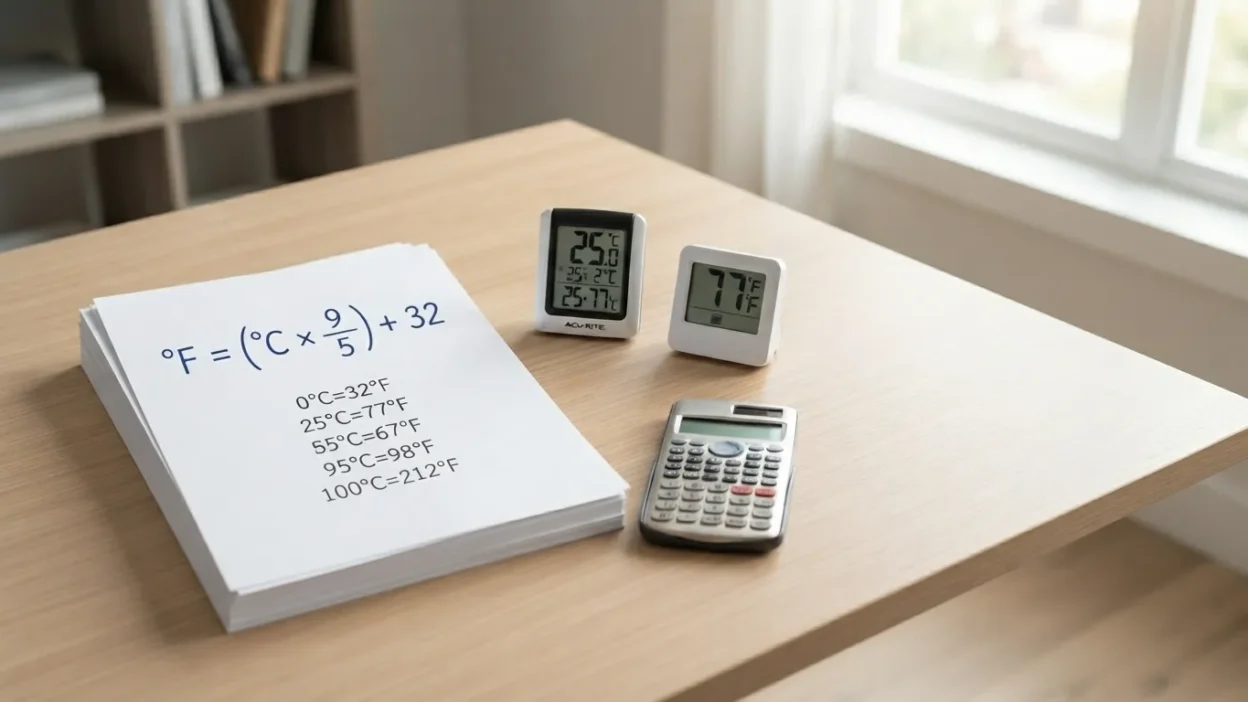
Have you ever seen 25°C on a weather app and wondered, “How warm is that in Fahrenheit?” You are not alone. Celsius and Fahrenheit are two of the most common temperature scales, and switching between them can feel confusing at first.
The good news is that the conversion is simple once you know one basic formula.
If you are checking the weather, following a recipe, studying science, traveling, or converting a temperature for school, this guide makes Celsius to Fahrenheit easy to understand.
You will learn the exact formula, see step-by-step examples, explore a useful conversion chart, and discover quick ways to estimate temperatures in your head.
By the end, you should be able to convert almost any Celsius temperature to Fahrenheit with confidence.
Quick Answer
To convert Celsius to Fahrenheit, use this formula:
°F = (°C × 9/5) + 32
In simple steps:
- Take the Celsius temperature.
- Multiply it by 9.
- Divide the answer by 5.
- Add 32.
- The result is Fahrenheit.
Example
Convert 20°C to Fahrenheit:
20 × 9/5 + 32
36 + 32 = 68°F
So:
20°C = 68°F
What Is Celsius?
Celsius, written as °C, is a temperature scale used in most countries around the world.
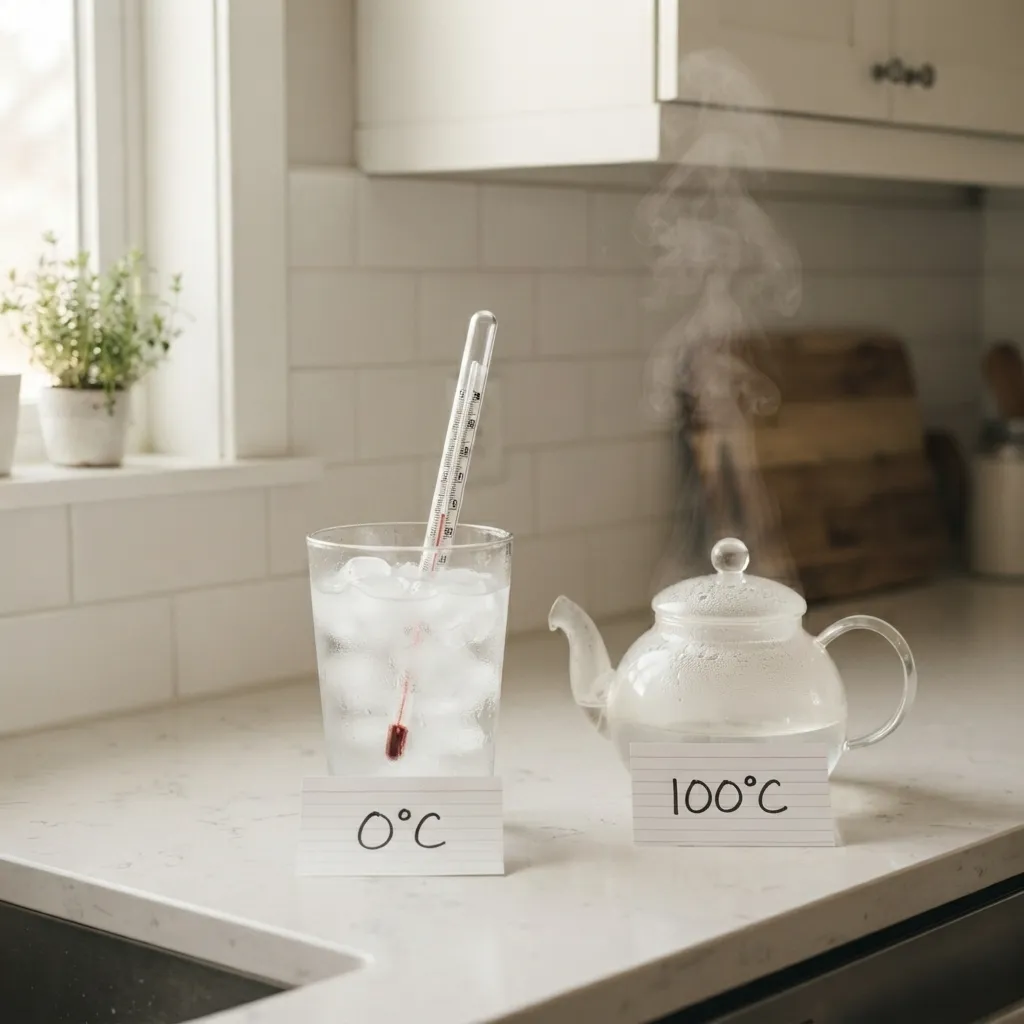
The scale is based on water’s freezing and boiling points under standard atmospheric pressure:
- 0°C = water freezes
- 100°C = water boils
The Celsius scale is widely used for weather reports, science, medicine, cooking, and everyday temperatures.
The scale was named after Swedish astronomer Anders Celsius, who developed a temperature scale in the 18th century.
Today, Celsius is also the common temperature unit used within the International System of Units for expressing temperature.
What Is Fahrenheit?
Fahrenheit, written as °F, is another temperature scale.
It is named after Daniel Gabriel Fahrenheit, a physicist and instrument maker who developed the scale in the early 18th century.
Fahrenheit is mainly used for everyday temperatures in the United States and a few other places.
On the Fahrenheit scale:
- 32°F = water freezes
- 212°F = water boils
That means there are 180 Fahrenheit degrees between the freezing and boiling points of water.
Celsius vs. Fahrenheit: What Is the Difference?
The biggest difference is where the scales place common reference points.
| Temperature | Celsius | Fahrenheit |
| Water freezes | 0°C | 32°F |
| Cool room | 15°C | 59°F |
| Comfortable room | 20°C | 68°F |
| Warm day | 25°C | 77°F |
| Hot day | 30°C | 86°F |
| Very hot | 35°C | 95°F |
| Water boils | 100°C | 212°F |
The scales also have different-sized degrees.
A change of 1°C is equal to a change of 1.8°F.
So, Celsius and Fahrenheit do not increase at the same rate.
Celsius to Fahrenheit Formula
The standard formula is:
°F = (°C × 9/5) + 32
You may also write it as:
°F = (°C × 1.8) + 32
Both formulas give the same answer.
Why Do You Multiply by 9/5?
The Celsius scale has 100 degrees between water’s freezing and boiling points.
The Fahrenheit scale has 180 degrees between those same points.
The ratio is:
180 ÷ 100 = 1.8
That is why the Celsius temperature is multiplied by 1.8.
Then you add 32 because 0°C corresponds to 32°F.
How to Convert Celsius to Fahrenheit Step by Step
Let’s make the process as easy as possible.
Suppose you want to convert 25°C.
Step 1: Start With Celsius
Your temperature is:
25°C
Step 2: Multiply by 1.8
25 × 1.8 = 45
Step 3: Add 32
45 + 32 = 77
Final Answer
25°C = 77°F
That is the entire process.
Celsius to Fahrenheit Examples
Here are several common conversions.
0°C to Fahrenheit
0 × 1.8 + 32 = 32°F
Answer: 0°C = 32°F
This is the freezing point of water.
5°C to Fahrenheit
5 × 1.8 + 32 = 41°F
Answer: 5°C = 41°F
10°C to Fahrenheit
10 × 1.8 + 32 = 50°F
Answer: 10°C = 50°F
15°C to Fahrenheit
15 × 1.8 + 32 = 59°F
Answer: 15°C = 59°F
20°C to Fahrenheit
20 × 1.8 + 32 = 68°F
Answer: 20°C = 68°F
25°C to Fahrenheit
25 × 1.8 + 32 = 77°F
Answer: 25°C = 77°F
30°C to Fahrenheit
30 × 1.8 + 32 = 86°F
Answer: 30°C = 86°F
35°C to Fahrenheit
35 × 1.8 + 32 = 95°F
Answer: 35°C = 95°F
40°C to Fahrenheit
40 × 1.8 + 32 = 104°F
Answer: 40°C = 104°F
100°C to Fahrenheit
100 × 1.8 + 32 = 212°F
Answer: 100°C = 212°F
Celsius to Fahrenheit Conversion Chart
This chart can save you time when you need a common conversion quickly.
| Celsius (°C) | Fahrenheit (°F) |
| -40°C | -40°F |
| -30°C | -22°F |
| -20°C | -4°F |
| -10°C | 14°F |
| -5°C | 23°F |
| 0°C | 32°F |
| 5°C | 41°F |
| 10°C | 50°F |
| 15°C | 59°F |
| 20°C | 68°F |
| 21°C | 69.8°F |
| 22°C | 71.6°F |
| 23°C | 73.4°F |
| 24°C | 75.2°F |
| 25°C | 77°F |
| 26°C | 78.8°F |
| 27°C | 80.6°F |
| 28°C | 82.4°F |
| 29°C | 84.2°F |
| 30°C | 86°F |
| 35°C | 95°F |
| 37°C | 98.6°F |
| 38°C | 100.4°F |
| 40°C | 104°F |
| 50°C | 122°F |
| 60°C | 140°F |
| 70°C | 158°F |
| 80°C | 176°F |
| 90°C | 194°F |
| 100°C | 212°F |
Common Celsius to Fahrenheit Conversions
Some temperatures appear again and again in everyday life.
18°C to Fahrenheit
18 × 1.8 + 32 = 64.4°F
So:
18°C = 64.4°F
22°C to Fahrenheit
22 × 1.8 + 32 = 71.6°F
So:
22°C = 71.6°F
23°C to Fahrenheit
23 × 1.8 + 32 = 73.4°F
So:
23°C = 73.4°F
27°C to Fahrenheit
27 × 1.8 + 32 = 80.6°F
So:
27°C = 80.6°F
32°C to Fahrenheit
32 × 1.8 + 32 = 89.6°F
So:
32°C = 89.6°F
37°C to Fahrenheit
37 × 1.8 + 32 = 98.6°F
So:
37°C = 98.6°F
What Is -40°C in Fahrenheit?
This is one of the most interesting temperature conversions.
At -40 degrees, the Celsius and Fahrenheit scales meet.
-40°C = -40°F
You can prove it with the formula:
(-40 × 1.8) + 32
-72 + 32 = -40
So -40°C and -40°F are exactly the same temperature.
This is the only temperature at which the two scales have the same numerical value.
How to Convert Negative Celsius to Fahrenheit
The same formula works for negative temperatures.
Use:
°F = (°C × 1.8) + 32
Example: -10°C
-10 × 1.8 + 32
-18 + 32 = 14°F
Therefore:
-10°C = 14°F
Example: -20°C
-20 × 1.8 + 32
-36 + 32 = -4°F
Therefore:
-20°C = -4°F
The important thing is to keep the negative sign during the multiplication.
How to Convert Decimal Celsius to Fahrenheit
Celsius temperatures do not always come as whole numbers.
You can use the same formula for decimals.
Example: 21.5°C
21.5 × 1.8 + 32
38.7 + 32 = 70.7°F
Therefore:
21.5°C = 70.7°F
Example: 36.5°C
36.5 × 1.8 + 32
65.7 + 32 = 97.7°F
Therefore:
36.5°C = 97.7°F
The formula works for whole numbers, negative numbers, and decimals.
How to Convert Fahrenheit Back to Celsius
Sometimes you need to go in the opposite direction.
The formula for Fahrenheit to Celsius is:
°C = (°F – 32) × 5/9
Notice the order.
For Celsius to Fahrenheit, you:
Multiply, then add 32.
For Fahrenheit to Celsius, you:
Subtract 32, then multiply by 5/9.
Example: 77°F to Celsius
Start with:
77°F
Subtract 32:
77 – 32 = 45
Multiply by 5/9:
45 × 5/9 = 25
Therefore:
77°F = 25°C
Celsius to Fahrenheit vs. Fahrenheit to Celsius
It is easy to mix up the formulas.
| Conversion | Formula |
| Celsius → Fahrenheit | °F = (°C × 9/5) + 32 |
| Celsius → Fahrenheit | °F = (°C × 1.8) + 32 |
| Fahrenheit → Celsius | °C = (°F – 32) × 5/9 |
Easy Memory Trick
Think:
C → F: Multiply, then add 32.
F → C: Subtract 32, then multiply by 5/9.
This simple trick can help prevent mistakes.
Celsius to Fahrenheit for Weather
Temperature conversion is especially useful when traveling between countries that use different scales.
For example, if a weather report says:
30°C
You can convert it:
30 × 1.8 + 32 = 86°F
So 30°C is 86°F.
Here are some useful weather references:
| Celsius | Fahrenheit | General Feel |
| 0°C | 32°F | Freezing |
| 5°C | 41°F | Cold |
| 10°C | 50°F | Cool |
| 15°C | 59°F | Mild |
| 20°C | 68°F | Comfortable |
| 25°C | 77°F | Warm |
| 30°C | 86°F | Hot |
| 35°C | 95°F | Very hot |
| 40°C | 104°F | Extremely hot |
These descriptions are general because wind, humidity, sunlight, clothing, and personal comfort can change how a temperature feels.
Celsius to Fahrenheit for Cooking
Temperature conversion is also common in recipes.
A recipe from one country may list an oven temperature in Celsius, while your oven uses Fahrenheit.
For example:
180°C
Convert it:
180 × 1.8 + 32
324 + 32 = 356°F
So mathematically:
180°C = 356°F
However, cooking recipes often use practical oven settings such as 350°F rather than the exact mathematical equivalent.
This is why you may see approximate conversions in cooking charts.
Always follow the temperature guidance provided with the specific recipe or appliance when accuracy matters.
Celsius to Fahrenheit for Science
Scientists and students often work with temperature conversions.
The Celsius scale is commonly used in everyday scientific measurements, while Fahrenheit appears more often in everyday American contexts.
The conversion formula allows temperatures to be compared across different systems.
For example:
100°C = 212°F
This represents the boiling point of water under standard atmospheric pressure.
Likewise:
0°C = 32°F
This represents the freezing point of water under standard atmospheric pressure.
These two points make useful reference values when learning the relationship between the scales.
Celsius to Fahrenheit for Body Temperature
Body temperature is another area where people often see both Celsius and Fahrenheit.
A commonly cited reference temperature is:
37°C = 98.6°F
The conversion is:
37 × 1.8 + 32 = 98.6°F
However, normal body temperature can vary from person to person and can change based on factors such as time of day and measurement method.
So a temperature number should always be interpreted in context rather than treated as a universal cutoff.
How to Convert Celsius to Fahrenheit Without a Calculator
You can estimate some Celsius temperatures mentally.
A common quick estimate is:
°F ≈ (°C × 2) + 30
This is not exact, but it is useful for a fast estimate.
Example: 20°C
Quick estimate:
20 × 2 + 30 = 70°F
The exact answer is:
68°F
So the estimate is close.
Example: 30°C
Quick estimate:
30 × 2 + 30 = 90°F
The exact answer is:
86°F
Again, the estimate gives you a quick idea.
For schoolwork, scientific work, recipes, or anything that requires accuracy, use the exact formula instead.
Why the Quick “Double and Add 30” Trick Is Not Exact
The mental shortcut uses:
°F ≈ 2°C + 30
But the actual formula uses:
°F = 1.8°C + 32
The difference comes from replacing 1.8 with 2 and 32 with 30.
That makes the shortcut easier but less precise.
It is useful when you only need a rough idea of the temperature.
Common Mistakes
1. Forgetting to Add 32
A common mistake is multiplying Celsius by 1.8 and stopping.
For example:
20 × 1.8 = 36
But 36°F is not the correct answer.
You still need to add 32:
36 + 32 = 68°F
2. Using the Wrong Order
For Celsius to Fahrenheit:
Multiply first. Add 32 second.
Correct:
°F = (°C × 1.8) + 32
Do not subtract 32 first.
3. Mixing Up 5/9 and 9/5
Remember:
Celsius → Fahrenheit = 9/5
Fahrenheit → Celsius = 5/9
They are reciprocal ratios.
4. Forgetting Negative Signs
When converting temperatures below zero, keep the negative sign.
For example:
-10°C × 1.8 = -18
Then:
-18 + 32 = 14°F
So:
-10°C = 14°F
5. Confusing Temperature With Temperature Change
This is a subtle but important point.
A temperature conversion includes the 32-degree offset.
But when you are converting a change in temperature, the offset does not matter.
For example, a change of:
10°C
corresponds to:
18°F
because:
10 × 1.8 = 18
You do not add 32 when converting a temperature difference.
Why Is 0°C Equal to 32°F?
The Celsius and Fahrenheit scales use different starting points.
Celsius sets the freezing point of water at 0 degrees.
Fahrenheit sets the same point at 32 degrees.
That is why the conversion needs an offset.
Using the formula:
0 × 1.8 + 32 = 32°F
Therefore:
0°C = 32°F
Why Is 100°C Equal to 212°F?
Water boils at 100°C under standard atmospheric pressure.
Using the conversion formula:
100 × 1.8 + 32
180 + 32 = 212°F
Therefore:
100°C = 212°F
This also shows why the Fahrenheit scale has 180 degrees between water’s freezing and boiling points.
Celsius to Fahrenheit Formula in Fraction Form
Some students prefer fractions.
Instead of:
°F = (°C × 1.8) + 32
you can use:
°F = (°C × 9/5) + 32
For example, convert 25°C:
25 × 9/5 + 32
First:
25 × 9 = 225
Then:
225 ÷ 5 = 45
Finally:
45 + 32 = 77°F
So:
25°C = 77°F
Both versions are mathematically identical.
Celsius to Fahrenheit Formula for Excel and Spreadsheets
If you are working with a spreadsheet, you can use a simple formula.
If the Celsius value is in cell A1, the Fahrenheit conversion is:
=A1*9/5+32
You can also use:
=A1*1.8+32
This is useful when you have a long list of temperatures and need to convert them quickly.
Celsius to Fahrenheit Formula in Programming
The same mathematical rule can be used in software.
The basic logic is:
Fahrenheit = Celsius × 1.8 + 32
For example, if the Celsius value is 25:
Fahrenheit = 25 × 1.8 + 32
Fahrenheit = 77
The important part is the formula, regardless of the programming language or calculator being used.
Useful Temperature Benchmarks to Remember
You do not need to memorize hundreds of conversions.
A few reference points can make mental estimates much easier:
- -40°C = -40°F
- 0°C = 32°F
- 10°C = 50°F
- 20°C = 68°F
- 25°C = 77°F
- 30°C = 86°F
- 37°C = 98.6°F
- 40°C = 104°F
- 100°C = 212°F
Once you know these, you can quickly understand many temperatures around them.
Quick Reference
For everyday use, this short list is worth saving:
-20°C = -4°F
-10°C = 14°F
0°C = 32°F
10°C = 50°F
20°C = 68°F
25°C = 77°F
30°C = 86°F
35°C = 95°F
37°C = 98.6°F
40°C = 104°F
50°C = 122°F
100°C = 212°F
FAQs:
Q1. What is the formula for Celsius to Fahrenheit?
The formula is:
°F = (°C × 9/5) + 32
You can also use:
°F = (°C × 1.8) + 32
Both formulas produce the same result.
Q2. What is 20°C in Fahrenheit?
20°C = 68°F.
Using the formula:
20 × 1.8 + 32 = 68°F
Q3. What is 25°C in Fahrenheit?
25°C = 77°F.
It is a common temperature used in weather and everyday examples.
Q4. What is 30°C in Fahrenheit?
30°C = 86°F.
This is generally considered a hot temperature for many people, although how it feels depends on humidity, wind, sunlight, and other conditions.
Q5. What is 0°C in Fahrenheit?
0°C = 32°F.
This is the freezing point of water under standard atmospheric pressure.
Q6. What is 100°C in Fahrenheit?
100°C = 212°F.
This is the boiling point of water under standard atmospheric pressure.
Q7. At what temperature are Celsius and Fahrenheit equal?
Celsius and Fahrenheit are equal at:
-40 degrees
Therefore:
-40°C = -40°F
This is the only temperature where the numerical values are the same.
Final Thoughts:
Converting Celsius to Fahrenheit is much easier than it first appears. The key formula is °F = (°C × 9/5) + 32, or simply °F = (°C × 1.8) + 32.
Once you remember a few useful points, such as 0°C = 32°F, 20°C = 68°F, and 30°C = 86°F, you can estimate many everyday temperatures quickly.
For exact answers, use the full formula. For a rough estimate, doubling Celsius and adding 30 can give you a quick idea.
If you are checking weather, cooking, studying, traveling, or working with temperature data, understanding both scales makes temperature conversion simple and practical.

I am Jane Austen, a soul that believes faith speaks best through quiet words and honest prayers.
I share reflections that blend timeless wisdom, gentle hope, and heartfelt devotion.
On PrayersVibe.com, my words are written to comfort hearts, strengthen faith, and remind you that you are never alone.