Have you seen someone write, “I’m feening for it” and wonder what they mean? You are not alone. Feening meaning is easy once you know the context.
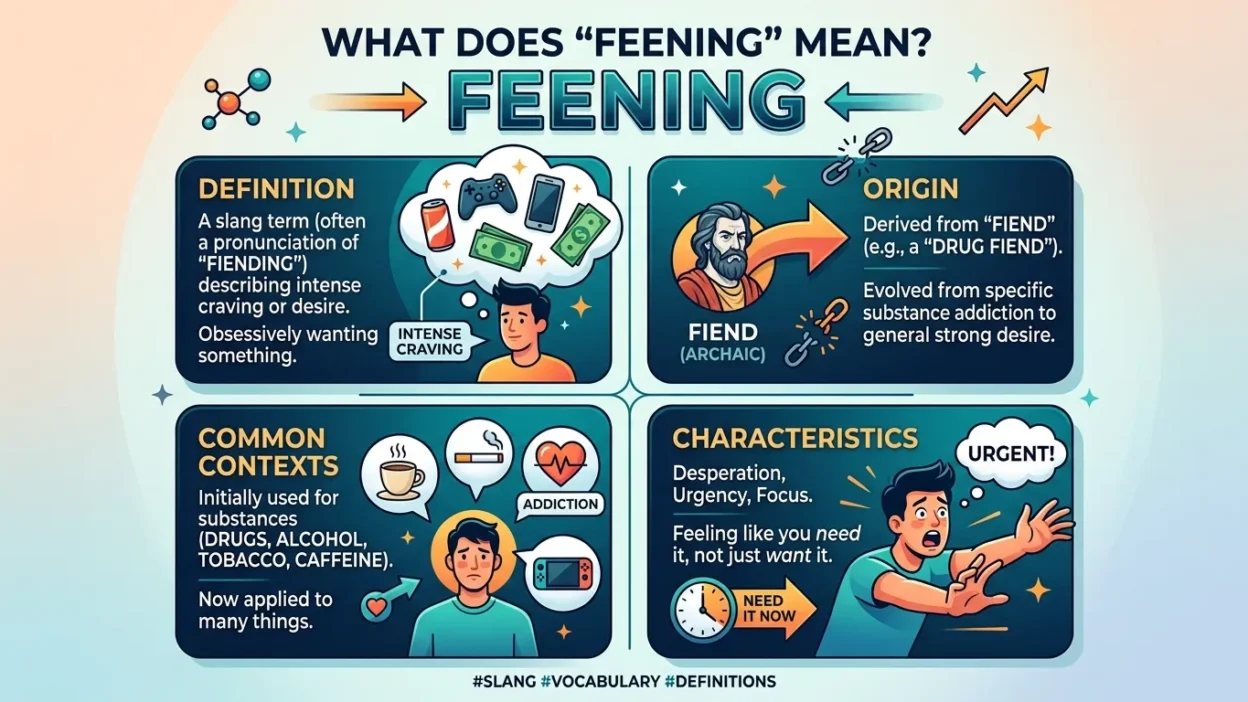
In simple terms, feening means wanting or craving something very strongly. It can describe food, attention, a person, entertainment, or another strong desire. In some contexts, it can also refer to a serious craving linked to substance use.
You may see feening in texts, social media posts, casual chats, rap, and online slang. The spelling is informal, and you may also see feenin’ or fiending.
This guide explains the word in plain English. You will learn what it means, where it comes from, how people use it, and how to tell which meaning fits the context.
Quick Answer
Feening means craving, wanting, or desiring something very badly.
For example:
“I’m feening for pizza.”
This means:
“I really want pizza.”
The word can have a light, playful meaning. But it can also describe a strong or urgent craving, especially in contexts related to addiction or substance use. So, context matters.
Definition & Meaning
The basic feening meaning is having a strong desire or craving for something.
It is an informal slang term. The related verb feen means to want something obsessively or to have a strong desire for it. Wiktionary traces this slang use to fiend, while its examples show that people have used the verb for strong desires for both people and things.
Think of these words as a simple scale:
- Want = you would like something.
- Really want = you have a strong desire.
- Crave = you strongly desire something.
- Feening = you are strongly craving or longing for something.
The exact feeling can change with the situation.
If someone says, “I’m feening for ice cream,” they may simply be joking about how much they want dessert.
If someone says, “He is feening for a cigarette,” the meaning may be more serious because the context can point to an intense substance craving.
Feening Meaning in Slang
In slang, feening usually means wanting something badly.
People often use it to make a normal desire sound stronger or more dramatic.
For example:
- “I’m feening for tacos.”
- “She’s feening for attention.”
- “We’re feening for the weekend.”
- “He’s feening to see his friends.”
- “I’m feening for that new game.”
The word does not always mean addiction. Modern informal use can describe many kinds of strong desire. Current dictionary-style references list meanings that range from intense craving to more serious substance-related cravings.
That is why you should look at the words around feening before deciding what the speaker means.
What Does Feening Mean in Texting?
In texting, feening usually means really wanting something or someone.
People use it because it sounds more emotional than simply saying “want.”
For example:
Text:
“I’m feening for some fries.”
Meaning:
“I really want some fries.”
Another example:
Text:
“I’m feening to go home.”
Meaning:
“I really want to go home.”
The word can also describe emotional longing:
“I’m feening to talk to you.”
This can mean:
“I really want to talk to you.”
Texting slang often depends on the relationship between the people. A close friend may use feening as a joke, while the same word in another conversation may sound more serious.
Feening Meaning on Social Media
On social media, feening often has a playful or exaggerated tone.
Someone may post:
“I’m feening for summer.”
They may simply mean they are very excited for summer.
You may also see it in comments about:
- Food
- Clothes
- Music
- Movies
- Games
- Attention
- Relationships
- Travel
- Trends
Social media makes slang flexible. People often use strong words for humor or emphasis.
So if someone says, “I’m feening for this new phone,” it does not automatically mean they have an unhealthy obsession. It may just mean they really like the phone and want it.
Feening Meaning in a Relationship
When feening refers to a person, it can mean strongly wanting, missing, or longing for that person.
For example:
“She’s feening for him.”
Depending on the situation, this could mean:
- She really likes him.
- She misses him.
- She wants his attention.
- She strongly wants to see him.
- She is thinking about him a lot.
Another example is:
“I’m feening to see you.”
This usually means:
“I really want to see you.”
The romantic meaning can sound playful, flirty, or intense. You should read the whole message before deciding which shade of meaning the speaker intends.
Feening Meaning in Rap and Music
Feening also appears in rap and other music.
In this setting, the word can describe an intense craving, desire, obsession, or addiction. Rap-dictionary sources commonly define it as craving or being addicted to something.
Music can also use slang in a more intense way than everyday conversation.
For example, if a song uses feening while talking about drugs, the word may refer to a serious drug craving.
If the song talks about love, the same word may describe strong romantic desire.
So when you see feening in lyrics, do not translate it as one fixed word. Look at the subject of the song.
Is Feening the Same as Fiending?
Feening and fiending are closely related, and people often use them to express the same basic idea.
The difference is mainly spelling, usage, and tone.
| Mistake or Form | Better Understanding |
| “Feening” is always about drugs | Not always. It can mean any strong desire. |
| “Feening” and “fiending” have nothing in common | They are closely related slang forms. |
| Every use means addiction | Context decides the meaning. |
| Feening is formal English | It is mainly informal slang. |
| The word always has a negative meaning | It can be playful or serious. |
The spelling fiending has a clearer connection to the standard word fiend. The slang verb feen is traced to that word, while feening is its present-participle form.
So you may see:
- feening
- feenin’
- fiending
- fiendin’
In casual speech, these forms can overlap.
Where Did Feening Come From?
The slang verb feen comes from fiend in this sense. Wiktionary lists the slang verb as coming from fiend, with the meaning of wanting something obsessively or having a strong desire.
The older word fiend has a much broader history. In modern English, it can describe someone who is extremely devoted to something, as in “a sports fiend.” It has also had darker meanings.
The slang sense became linked with intense craving, especially in drug-related language. From there, the term spread into wider informal speech.
Today, people can use feening for ordinary things such as food, entertainment, attention, or seeing someone they miss.
That wider use is important. The word’s older and more serious associations do not mean every modern use refers to addiction.
Is Feening a Bad Word?
Feening is not usually a swear word. It is informal slang.
However, it can sound inappropriate in some settings because of its connection to addiction and intense craving.
You can normally use it in:
- Text messages
- Casual conversations
- Social media
- Online comments
- Informal chats
Avoid it in:
- Academic papers
- Formal reports
- Professional documents
- Job applications
- Formal business writing
Instead, use words such as:
- Craving
- Wanting
- Desiring
- Longing
- Eager
- Strongly wanting
For example, instead of:
“I’m feening for a vacation.”
A formal version would be:
“I strongly want to take a vacation.”
When Does Feening Have a Serious Meaning?
Context becomes very important when the word appears around drugs, alcohol, nicotine, withdrawal, or addiction.
In addiction-related language, feening can refer to an intense craving for a substance. Some treatment sources use the term in this sense and distinguish it from ordinary casual use.
For example:
“He was feening for a cigarette.”
That could mean a strong nicotine craving.
But:
“I’m feening for chocolate.”
Usually has a much lighter meaning.
This distinction matters because slang can hide a serious issue when people use it in a health or addiction context.
If someone talks about severe cravings, withdrawal, or difficulty controlling substance use, it is better to treat the situation seriously rather than assume the word is only a joke.
Feening vs. Craving
The words feening and craving are close, but they do not always feel the same.
Craving is a standard English word. It can describe a strong desire for food, an experience, or a substance.
Feening is more informal and slang-heavy.
For example:
“I’m craving pizza.”
This sounds normal and neutral.
“I’m feening for pizza.”
This sounds more casual and expressive.
In serious writing, craving is usually the safer choice.
In a text to a friend, feening may sound more natural.
How to Use Feening in a Sentence
Here are some simple examples:
- “I’m feening for a burger.”
- “She’s feening for some attention.”
- “We are feening for the weekend.”
- “I’m feening to see my family.”
- “He’s been feening for coffee all morning.”
- “They’re feening for the new game.”
- “I’m feening for a beach trip.”
- “She was feening to hear the new song.”
Each sentence shows a strong desire.
The object of the desire tells you more about the meaning.
If the object is food or entertainment, the word may be playful. If the object is a substance and the sentence discusses withdrawal or addiction, it may have a serious meaning.
Common Mistakes When Using Feening
One common mistake is assuming that feening always means drug addiction.
That is too narrow. Modern slang uses the word for many forms of strong desire.
Another mistake is treating feening as formal English. It is better suited to casual speech and online communication.
A third mistake is ignoring context.
If someone says:
“I’m feening for pizza.”
You probably do not need to read much into it.
If someone says:
“I’m feening because I have not had my usual substance.”
That has a very different meaning.
The surrounding words help you understand the speaker’s intent.
Quick Reference: Feening Meaning
| Situation | Likely Meaning | Tone |
| “Feening for pizza” | Really craving pizza | Playful |
| “Feening for attention” | Strongly wanting attention | Casual |
| “Feening to see you” | Really wanting to see you | Emotional |
| “Feening for a new game” | Really wanting the game | Casual |
| “Feening for a cigarette” | Strong nicotine craving | Potentially serious |
| “Feening for drugs” | Strong drug craving | Serious |
| “Feening in a song” | Strong desire or craving | Depends on lyrics |
How to Understand Feening in Any Sentence
You can understand the word in three easy steps.
Step 1: Find what the person is feening for.
Look at the word or phrase after for.
For example:
“I’m feening for coffee.”
The object is coffee.
Step 2: Ask what kind of desire it shows.
Is the person joking? Are they excited? Are they missing someone? Or are they describing a serious craving?
Step 3: Read the whole conversation.
One sentence may not give enough information.
The same word can have a light meaning in one chat and a serious meaning in another.
This simple method can help you understand slang without jumping to the wrong conclusion.
Why Do People Use Feening Instead of Wanting?
People use feening because it gives more emotion to a sentence.
Compare:
“I want pizza.”
with:
“I’m feening for pizza.”
The second sentence suggests a stronger craving.
Slang also makes conversations feel more casual. People often choose words that match the way their friends talk online or in person.
That does not make feening better than wanting. It simply gives the speaker another way to express strong desire.
Is Feening Correct English?
Feening is accepted as informal slang, but it is not the best choice for formal English.
If you are writing a school essay, business email, or professional report, use a standard term.
Good alternatives include:
- Craving
- Desiring
- Wanting
- Longing
- Eager for
- Yearning for
For casual communication, however, feening can be clear when the audience knows the slang.
FAQs:
1. What does feening mean in simple words?
Feening means wanting or craving something very badly. It can describe food, attention, a person, entertainment, or other things. In some contexts, it can refer to a serious substance craving.
2. Is feening the same as fiending?
They are closely related slang forms. Feening comes from the slang verb feen, which is linked to fiend. Both can describe an intense desire or craving.
3. What does “I’m feening” mean?
“I’m feening” means “I really want or crave something.” The missing object may be clear from the earlier conversation. For example, if friends are talking about pizza, it may mean the person really wants pizza.
4. What does feening mean in texting?
In texting, feening usually means really wanting something or someone. It often has a casual, dramatic, or playful tone. The exact meaning depends on the conversation.
5. What does feening mean in a relationship?
In a relationship or dating context, feening can mean strongly wanting, missing, or longing for someone. It may also mean wanting their attention. The exact meaning depends on the message and relationship.
6. Is feening a bad word?
No. Feening is not normally considered a swear word. It is informal slang. Still, it can have a serious meaning when people use it while talking about drugs, addiction, or withdrawal.
7. Can I use feening in formal writing?
It is better not to. Feening works best in casual speech, texts, social media, and other informal settings. In formal writing, use “craving,” “wanting,” “desiring,” or “longing” instead.
Conclusion:
The simplest feening meaning is wanting or craving something very strongly. It is informal slang and often appears in texts, social media, music, and casual conversations.
The word can describe something harmless, such as craving pizza, or something more serious, such as a substance craving. That is why context matters.
Feening is closely related to fiending, and both forms can express intense desire. If you are writing formally, choose a standard word like craving or strongly wanting.
If you are chatting with friends, feening can be a natural way to show that you really want something.
The key is simple: look at what the person wants and read the full context.

I am Jane Austen, a soul that believes faith speaks best through quiet words and honest prayers.
I share reflections that blend timeless wisdom, gentle hope, and heartfelt devotion.
On PrayersVibe.com, my words are written to comfort hearts, strengthen faith, and remind you that you are never alone.