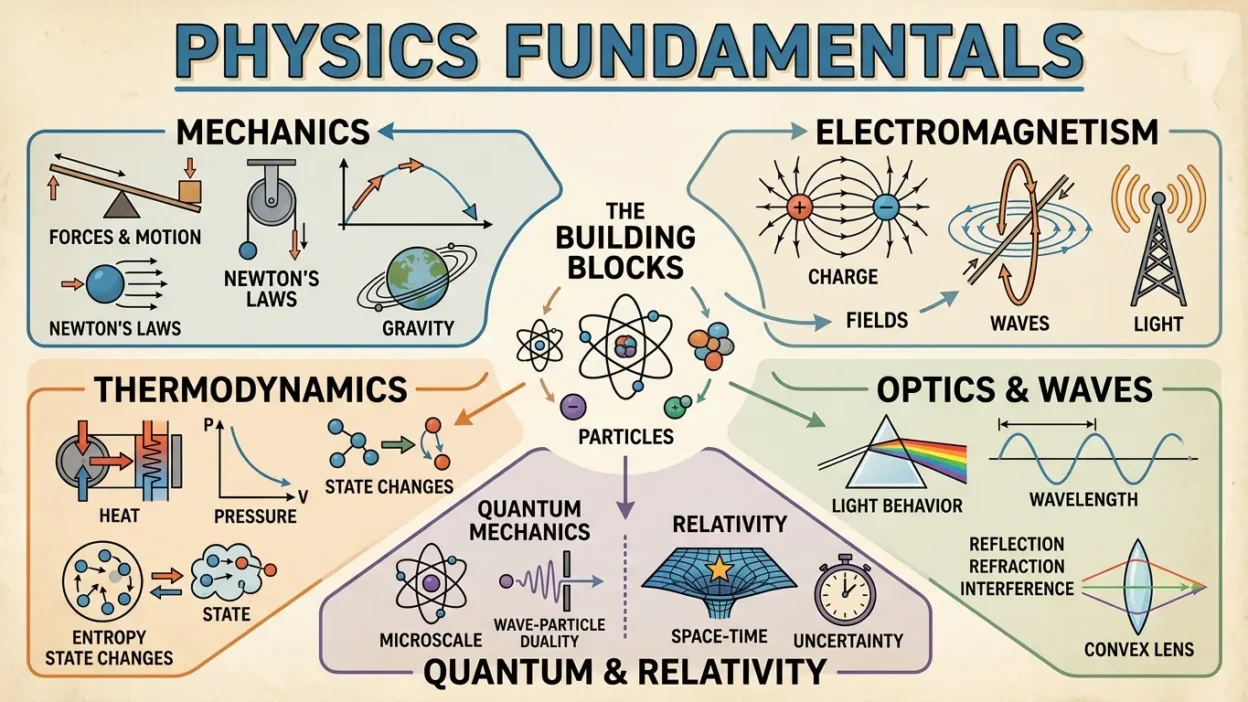
Physics is the science of how the physical world works.
It helps us understand motion, force, energy, matter, heat, light, sound, electricity, magnetism, and much more.
You see physics every day.
A ball falls because of gravity. A car moves because forces act on it. A fan spins because electrical energy changes into mechanical energy. A phone works because of electricity, electromagnetism, and modern physics.
The good news is that you do not need to learn everything at once.
The best way to learn physics is to start with the basic ideas. Once these ideas are clear, formulas and harder topics become much easier.
This first part covers the foundation of physics. It explains what physics is, how scientists measure things, the SI system, physical quantities, dimensions, scalars, vectors, scientific notation, significant figures, uncertainty, and the role of mathematics in physics.
What Is Physics?
Physics is the study of the basic rules that control the physical world.
It looks at matter and energy and asks how they behave and interact.
For example, physics can explain:
- Why objects fall toward Earth
- Why a moving car slows down
- How a rocket moves upward
- Why ice melts
- How sound reaches your ears
- How light travels
- How electricity flows
- Why magnets attract or repel
- How planets move around stars
- How atoms and particles behave
Physics uses observation, measurement, experiments, models, and mathematics to study these questions.
A simple way to think about physics is this:
Physics connects causes with effects.
If you push an object, its motion may change.
If you heat something, its temperature may rise.
If an electric current passes through a suitable device, it can produce light, heat, or motion.
Physics tries to describe these relationships with clear rules.
Why Do We Study Physics?
Physics is important because it gives us a deeper understanding of nature.
It also supports many other fields.
Engineering uses physics to design bridges, buildings, vehicles, machines, and aircraft.
Medicine uses physics in areas such as medical imaging, radiation treatment, ultrasound, and other technologies.
Astronomy uses physics to study stars, planets, galaxies, black holes, and the universe.
Modern electronics also depend heavily on physics.
Computers, smartphones, solar panels, lasers, electric motors, and communication systems all use physical principles.
So physics is not only a school subject.
It is a basic language for understanding much of the technology and nature around us.
The Main Branches of Physics
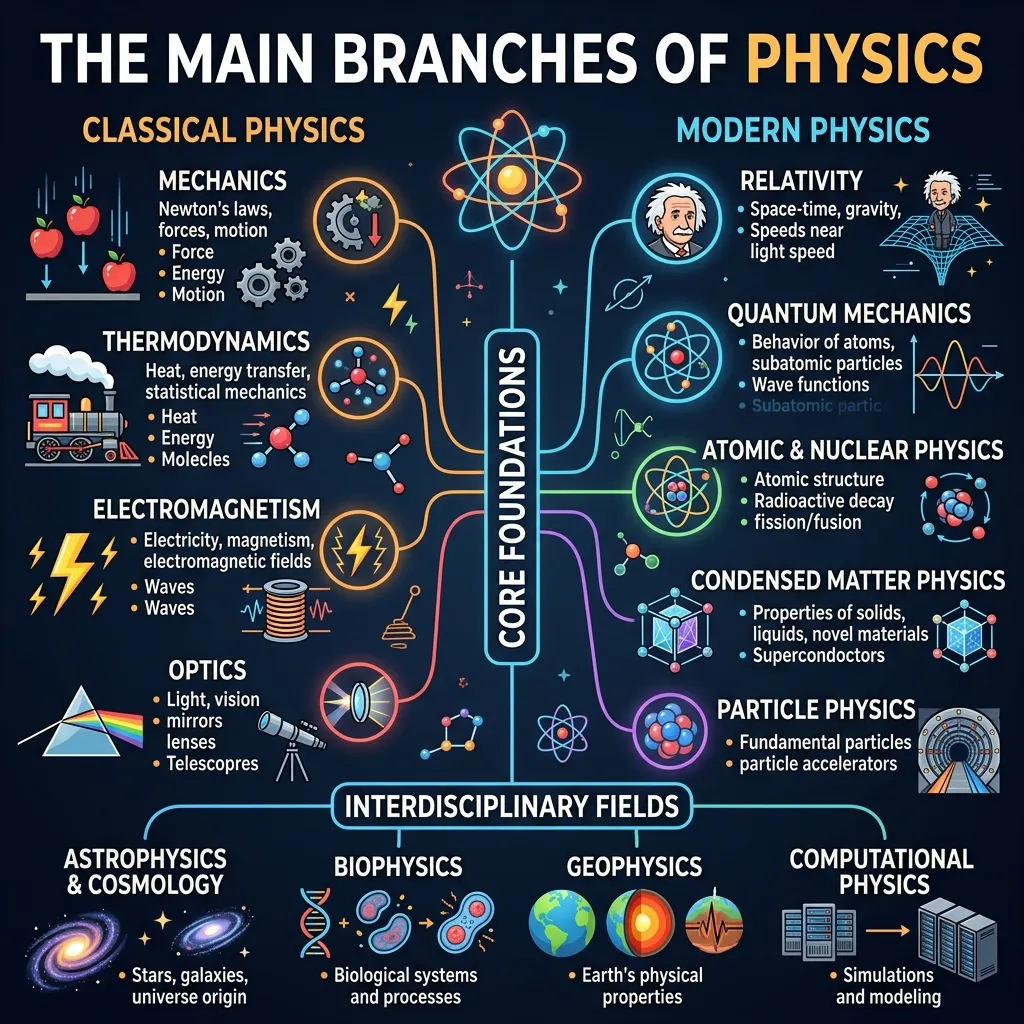
Physics is a very large field.
Scientists divide it into branches so each area can be studied in greater detail.
Classical Mechanics
Classical mechanics studies the motion of objects and the forces acting on them.
It includes:
- Position
- Distance
- Displacement
- Speed
- Velocity
- Acceleration
- Force
- Momentum
- Energy
- Gravity
The work of Galileo Galilei and Isaac Newton was central to the development of classical mechanics.
Newton’s laws of motion remain a key part of basic physics.
Thermodynamics
Thermodynamics studies heat, temperature, energy, and energy transfer.
It helps explain how heat moves and how energy changes inside physical systems.
It is important in engines, refrigerators, power plants, heating systems, and many natural processes.
Electromagnetism
Electromagnetism studies electric charges, electric fields, magnetic fields, and their interactions.
It explains much of what we know about:
- Electricity
- Magnetism
- Electric motors
- Generators
- Electromagnetic waves
- Radio
- Electronics
The work of scientists such as James Clerk Maxwell helped create the modern theory of electromagnetism.
Optics
Optics is the study of light.
It covers reflection, refraction, lenses, mirrors, diffraction, and interference.
Optics is used in cameras, telescopes, microscopes, glasses, fiber-optic communication, and many medical devices.
Relativity
Relativity is strongly associated with Albert Einstein.
Special relativity studies space, time, and motion at very high speeds.
General relativity provides a deeper description of gravity and its connection with spacetime.
Quantum Physics
Quantum physics studies matter and energy at very small scales.
It helps explain atoms, electrons, photons, and other microscopic systems.
Many modern technologies depend on quantum physics, including semiconductors, lasers, and other electronic devices.
Physical Quantities
Physics depends on measurement.
A physical quantity is something that can be measured and expressed with a number and a unit.
Examples include:
- Length
- Mass
- Time
- Temperature
- Speed
- Force
- Energy
- Pressure
Suppose you measure a table and find its length is 2 meters.
Here:
2 is the numerical value.
meter is the unit.
So a measurement can be thought of as:
Physical quantity = numerical value × unit
This idea is simple, but it is extremely important.
A number without a unit can be unclear.
For example, saying:
The distance is 20.
does not tell us If the distance is 20 meters, 20 kilometers, or 20 centimeters.
But:
The distance is 20 meters.
is clear.
Fundamental and Derived Quantities
Physical quantities are often divided into fundamental quantities and derived quantities.
Fundamental quantities are treated as basic quantities.
Derived quantities are created by combining fundamental quantities.
For example, length is a fundamental quantity.
Speed is derived because it depends on distance and time.
Speed = distance / time
If distance is measured in meters and time is measured in seconds, then:
Speed = meters / seconds
So the SI unit of speed is:
m/s
The same idea applies to many other physical quantities.
The SI System of Units
Scientists need a common measurement system.
The most widely used system is the International System of Units, usually called the SI system.
The SI system provides standard units for physical quantities.
The seven SI base quantities are:
| Physical quantity | SI base unit | Symbol |
| Length | meter | m |
| Mass | kilogram | kg |
| Time | second | s |
| Electric current | ampere | A |
| Thermodynamic temperature | kelvin | K |
| Amount of substance | mole | mol |
| Luminous intensity | candela | cd |
These seven base units form the foundation for many other units.
Common Derived SI Units
Many important physics quantities use derived units.
For example:
Speed
Unit = m/s
Acceleration
Unit = m/s²
Force
Unit = newton (N)
Energy
Unit = joule (J)
Power
Unit = watt (W)
Pressure
Unit = pascal (Pa)
These units are not random names.
They can be expressed using SI base units.
For example:
1 newton = 1 kg·m/s²
This comes from Newton’s second law:
Force = mass × acceleration
Since:
mass = kg
and:
acceleration = m/s²
we get:
Force = kg × m/s²
Therefore:
1 N = 1 kg·m/s²
Unit Conversion
You will often need to convert one unit into another.
For example:
1 kilometer = 1,000 meters
So:
3 kilometers = 3 × 1,000 meters
Therefore:
3 km = 3,000 m
Another common conversion is time.
1 minute = 60 seconds
Therefore:
5 minutes = 5 × 60
5 minutes = 300 seconds
Always keep track of units during calculations.
Units can help you find mistakes before you finish a problem.
Dimensions in Physics
Dimensions are another useful part of physics fundamentals.
A dimension tells us the basic physical nature of a quantity.
The most common basic dimensions are:
- Length = L
- Mass = M
- Time = T
For example, velocity is:
Velocity = displacement / time
Displacement has dimension L.
Time has dimension T.
Therefore:
Dimension of velocity = L/T
Or:
[v] = LT⁻¹
Acceleration is:
Acceleration = change in velocity / time
Velocity has dimension:
LT⁻¹
Divide by time:
[a] = LT⁻²
Force is:
Force = mass × acceleration
Therefore:
[F] = M × LT⁻²
So:
[F] = MLT⁻²
This is called the dimensional formula of force.
Why Dimensional Analysis Matters
Dimensional analysis can help you check equations.
Suppose someone gives you:
s = vt
where:
s = displacement
v = velocity
t = time
Check the dimensions.
Left side:
[s] = L
Right side:
[v][t] = (LT⁻¹)(T)
The T terms cancel:
LT⁻¹ × T = L
So both sides have dimension L.
The equation is dimensionally consistent.
Now imagine someone suggests:
s = v + t
Check the dimensions.
The left side has:
L
But the right side tries to add:
LT⁻¹ + T
These quantities have different dimensions.
You cannot add them.
So the equation is physically invalid.
This is one reason dimensions are useful.
Scalars and Vectors
Physics quantities can also be divided into scalars and vectors.
This difference is very important when studying motion and forces.
Scalar Quantities
A scalar has magnitude only.
It does not have a direction.
Examples include:
- Mass
- Time
- Temperature
- Distance
- Speed
- Energy
For example:
A car is moving at 60 km/h.
This gives the speed.
It does not tell us the direction.
Vector Quantities
A vector has both:
Magnitude + direction
Examples include:
- Displacement
- Velocity
- Acceleration
- Force
- Momentum
For example:
60 km/h east
gives both the size and direction of velocity.
This is why velocity is different from speed.
Speed tells us how fast something moves.
Velocity tells us how fast it moves and in which direction.
Distance and Displacement
Distance and displacement are basic concepts in mechanics.
Distance is the total length of the path traveled.
Displacement is the change in position from the starting point to the ending point, including direction.
Consider a simple example.
You walk 5 meters east.
Then you walk 5 meters west.
Your total distance is:
Distance = 5 + 5
Distance = 10 m
But you finish at your starting point.
So your displacement is:
Displacement = 0 m
This shows an important difference.
Distance can be greater than zero even when displacement is zero.
Speed
Speed tells us how quickly an object covers distance.
The basic formula is:
Speed = distance / time
Written with symbols:
v = d/t
where:
v = speed
d = distance
t = time
Deriving the Speed Formula
Suppose an object travels a distance d in a time t.
Average speed means the amount of distance traveled per unit of time.
Therefore:
Average speed = total distance / total time
So:
v = d/t
We can rearrange this equation.
Multiply both sides by t:
vt = d
Therefore:
d = vt
Now divide the original equation by v:
t = d/v
So the three useful forms are:
v = d/t
d = vt
t = d/v
These forms help solve many basic motion problems.
Example: Finding Speed
Suppose a cyclist travels 100 meters in 20 seconds.
Use:
v = d/t
Put in the values:
v = 100/20
Therefore:
v = 5 m/s
The cyclist’s average speed is 5 meters per second.
Average Speed
An object does not always move at the same speed.
It may speed up, slow down, or stop.
In such cases, we often use average speed.
The formula is:
Average speed = total distance / total time
Suppose a runner covers 200 meters in 40 seconds.
Average speed:
v = 200/40
v = 5 m/s
The runner may have changed speed during the run, but the average speed is still 5 m/s.
Velocity
Velocity is a vector quantity.
It tells us the rate at which displacement changes.
The basic formula is:
Velocity = displacement / time
So:
v = Δx/Δt
Here:
- Δx means change in position
- Δt means change in time
The direction matters.
For example:
10 m/s east
and
10 m/s west
have the same speed but different velocities.
Acceleration
Acceleration tells us how quickly velocity changes.
The basic formula is:
a = Δv/Δt
This means:
Acceleration = change in velocity / change in time
If an object’s velocity changes from 5 m/s to 15 m/s in 2 seconds:
Change in velocity:
Δv = 15 – 5
Δv = 10 m/s
Now:
a = 10/2
a = 5 m/s²
So the acceleration is:
5 m/s²
Acceleration does not always mean speeding up.
An object can also accelerate when it slows down or changes direction.
A Simple Way to Understand Acceleration
Imagine a car.
At first, it travels at:
10 m/s
After 5 seconds, it travels at:
20 m/s
Its velocity increased by:
20 – 10 = 10 m/s
The acceleration is:
a = 10/5
a = 2 m/s²
This means the velocity increases by 2 m/s every second, assuming the acceleration stays constant.
Scientific Notation
Physics often deals with very large and very small numbers.
Scientific notation makes these numbers easier to write.
For example:
300,000,000
can be written as:
3 × 10⁸
A very small number such as:
0.000001
can be written as:
1 × 10⁻⁶
The exponent tells you how many places the decimal point moves.
This is especially useful in physics because quantities can range from the size of galaxies to the size of atoms.
Significant Figures
Measurements have limited precision.
Significant figures help us show that precision.
For example:
5 m
and:
5.00 m
do not communicate the same amount of precision.
The first measurement has fewer significant figures.
The second measurement suggests that the value was measured more precisely.
When doing calculations, you should avoid reporting more precision than the original measurements support.
Measurement Uncertainty
No physical measurement is perfectly exact.
Every measuring instrument has some limit.
A ruler may allow you to measure to the nearest millimeter.
A digital timer may measure much more precisely.
This creates measurement uncertainty.
For example, if a ruler gives a length of:
10.2 cm
the actual length may be slightly above or below that value.
The uncertainty depends on the instrument and measurement method.
Understanding uncertainty is important because physics deals with real measurements, not perfect numbers.
Accuracy vs. Precision
These two terms are often confused.
Accuracy means how close a measurement is to the accepted value.
Precision means how close repeated measurements are to each other.
Imagine measuring the same object three times.
You get:
10.1 cm
10.1 cm
10.1 cm
These readings are very consistent, so they are precise.
But if the true value is 10.5 cm, they are not accurate.
A good experiment aims for both high accuracy and high precision.
Physics and Graphs
Graphs are powerful tools in physics.
They help us see relationships between physical quantities.
For example, a distance-time graph can show how an object moves.
If distance increases steadily with time, the object may be moving at a constant speed.
The slope of a distance-time graph gives speed.
This idea can be written as:
Slope = change in distance / change in time
Therefore:
Slope = speed
Similarly, the slope of a velocity-time graph gives acceleration.
So:
Slope = change in velocity / change in time
Therefore:
Slope = acceleration
Graphs allow us to understand motion without looking only at formulas.
Physics Is More Than Memorizing Formulas
One common mistake beginners make is trying to memorize every formula.
That is not the best way to learn physics.
First understand what the quantities mean.
For example:
F = ma
is not just three letters.
It tells us that the net force on an object is related to its mass and acceleration.
If the same mass experiences a larger net force, its acceleration becomes larger.
If the same force acts on a larger mass, the acceleration becomes smaller.
Understanding this relationship is more useful than simply memorizing the equation.
The Role of Experiments
Physics uses experiments to test ideas.
A scientist may notice a pattern and create a hypothesis.
The scientist then designs an experiment to test that idea.
A basic scientific investigation often follows this path:
Question → Hypothesis → Experiment → Measurement → Analysis → Conclusion
The result may support the original idea.
It may also show that the idea needs to be changed.
This is an important part of science.
Physics does not depend only on what someone thinks should happen. Physical ideas must be tested against evidence.
A Simple Physics Problem-Solving Method
When solving a physics problem, do not immediately search for a formula.
Start by understanding the problem.
Step 1: Read the question
Find out what is happening.
Step 2: List the known values
Write down the information given.
Step 3: Identify the unknown
Ask what the question wants you to find.
Step 4: Choose the correct relationship
Pick a formula that connects the known values to the unknown.
Step 5: Substitute the values
Put the numbers into the formula.
Step 6: Calculate
Perform the calculation carefully.
Step 7: Add the correct unit
A physics answer should normally include a unit.
Step 8: Check the result
Ask If the answer makes physical sense.
This simple process can prevent many common mistakes.
Common Beginner Mistakes in Physics
Learning physics becomes easier when you know what to avoid.
Mixing Units
Do not mix kilometers with meters or hours with seconds without converting them when needed.
Forgetting Direction
Velocity and force can have direction.
Do not treat vectors like ordinary numbers without considering direction.
Using the Wrong Formula
Do not choose a formula just because it contains a familiar number.
First understand what the formula describes.
Ignoring Units
Units are part of the answer.
If you calculate speed, the answer should have a speed unit such as m/s.
Memorizing Without Understanding
Try to understand the meaning behind each equation.
This will help you solve new problems instead of only repeating examples you have seen before.
Physics Fundamentals: What You Should Know So Far
At this stage, you should understand several important ideas.
Physics studies the physical world.
Physical quantities are measured using numbers and units.
The SI system gives scientists a standard set of units.
Dimensions help describe the physical nature of quantities and can help check equations.
Scalars have magnitude only, while vectors have magnitude and direction.
Distance measures the total path traveled, while displacement measures the change in position.
Speed tells us how quickly distance changes.
Velocity tells us how quickly displacement changes.
Acceleration tells us how quickly velocity changes.
These ideas form the foundation for the next major part of physics.
Motion, Force, and Newton’s Laws
We looked at distance, displacement, speed, velocity, acceleration, units, dimensions, and measurement.
Now we can ask a deeper question:
What causes an object to speed up, slow down, stop, or change direction?
The answer often involves force.
Force is one of the most important ideas in physics. It connects motion with its cause.
A force can push an object, pull it, speed it up, slow it down, or change its direction.
To understand force, we first need to understand motion more clearly.
What Is Motion?
An object is in motion when its position changes over time relative to a reference point.
For example, imagine you are sitting in a moving car.
Relative to the car, you are not moving.
But relative to a person standing beside the road, you are moving.
This shows an important idea:
Motion depends on the reference frame.
A reference frame gives us a way to describe an object’s position and motion.
Position
Position tells us where an object is compared with a chosen reference point.
We often use a coordinate system to describe position.
For motion along a straight line, we can use one axis.
For example:
- +x can represent east.
- −x can represent west.
If an object moves from x = 2 m to x = 8 m, its displacement is:
Δx = x₂ − x₁
Δx = 8 − 2
Δx = 6 m
The object moved 6 meters in the positive direction.
Uniform Motion
An object has uniform motion when it moves with constant velocity.
That means its velocity does not change.
If an object moves at 5 m/s in the same direction, then after each second it covers another 5 meters.
We can use:
v = Δx/Δt
Rearrange the equation:
Δx = vΔt
If the starting position is x₀, then:
x = x₀ + vt
This is the position equation for constant velocity.
Example
Suppose a cyclist starts at x₀ = 10 m and moves at 4 m/s for 5 seconds.
Use:
x = x₀ + vt
Put in the values:
x = 10 + (4 × 5)
x = 10 + 20
x = 30 m
So the cyclist’s final position is 30 meters from the chosen origin.
What Is Force?
A force is an interaction that can change the motion of an object.
A force can:
- Start motion
- Stop motion
- Increase speed
- Decrease speed
- Change direction
- Change an object’s shape
Force is a vector quantity.
That means it has both magnitude and direction.
The SI unit of force is the newton (N).
One newton is defined through Newton’s second law:
1 N = 1 kg·m/s²
Contact and Non-Contact Forces
Forces can act in different ways.
Some forces require physical contact.
Others can act without direct contact.
Contact Forces
A contact force occurs when objects interact physically.
Examples include:
- Friction
- Normal force
- Tension
- Air resistance
- Applied force
- Spring force
If you push a box with your hand, your hand applies a contact force to the box.
Non-Contact Forces
A non-contact force can act without objects touching.
Important examples include:
- Gravitational force
- Electric force
- Magnetic force
Earth’s gravity pulls objects toward its center even when there is no physical contact between the object and Earth.
Net Force
An object can have several forces acting on it at the same time.
We do not usually look at each force separately.
Instead, we find the net force.
The net force is the vector sum of all forces acting on an object.
In one dimension, suppose a box has:
20 N acting to the right
and
8 N acting to the left.
Take right as positive.
Net force:
F_net = 20 − 8
F_net = 12 N
So the net force is:
12 N to the right
The net force determines If the object’s velocity changes.
Balanced and Unbalanced Forces
Forces are balanced when the net force is zero.
Forces are unbalanced when the net force is not zero.
If:
F_net = 0
the object’s acceleration is:
a = 0
This does not always mean the object is stopped.
It can also mean the object is moving at constant velocity.
That idea is the foundation of Newton’s first law.
Newton’s First Law of Motion
Newton’s first law states that an object remains at rest or continues moving at constant velocity unless acted upon by a net external force.
This idea is often called the law of inertia.
In simple words:
Objects resist changes in their motion.
A stationary object tends to stay stationary.
A moving object tends to keep moving in a straight line at constant speed unless a net force changes its motion.
What Is Inertia?
Inertia is an object’s resistance to a change in its motion.
Mass is a measure of inertia.
A larger mass has greater inertia.
For example, it is easier to push an empty shopping cart than a fully loaded one.
The loaded cart has more mass, so it has greater resistance to changes in motion.
Why Do We Feel a Push When a Car Stops?
Imagine sitting in a moving car.
The car suddenly brakes.
Your body tends to keep moving forward.
The car slows down, but your body tries to maintain its previous motion.
This is an everyday example of inertia.
The seat belt provides a force that helps change your body’s motion with the car.
That is one reason seat belts are so important.
Newton’s Second Law
Newton’s second law connects force, mass, and acceleration.
It is commonly written as:
F_net = ma
where:
F_net = net force
m = mass
a = acceleration
This equation tells us something very important.
A larger net force produces greater acceleration when mass stays the same.
A larger mass produces less acceleration when the same force acts on it.
Derivation of Newton’s Second Law
A more general form begins with momentum.
Momentum is defined as:
p = mv
where:
p = momentum
m = mass
v = velocity
Newton’s second law can be expressed as:
F = Δp/Δt
If mass remains constant:
p = mv
Therefore:
Δp = mΔv
So:
F = mΔv/Δt
But:
Δv/Δt = a
Therefore:
F = ma
For a system where several forces act, we use the net force:
F_net = ma
This is the familiar form used in basic mechanics.
Example of Newton’s Second Law
Suppose a 10 kg box experiences a net force of 30 N.
Use:
F = ma
We want acceleration, so rearrange:
a = F/m
Now substitute:
a = 30/10
a = 3 m/s²
The box accelerates at:
3 m/s²
Rearranging F = ma
The same equation can answer different questions.
Starting with:
F = ma
To find acceleration:
a = F/m
To find mass:
m = F/a
To find force:
F = ma
These three forms are useful in basic physics problems.
Newton’s Third Law
Newton’s third law describes forces between interacting objects.
It states that when one object exerts a force on another object, the second object exerts an equal-magnitude force in the opposite direction on the first object.
In simple form:
For every action force, there is an equal and opposite reaction force.
The important point is that the two forces act on different objects.
Example: Pushing a Wall
Imagine pushing a wall.
You apply a force to the wall.
The wall applies a force back on you.
You do not see the wall move because the wall is connected to a large structure and other forces also act on it.
But the interaction still exists.
Example: Walking
Walking is another useful example.
Your foot pushes backward against the ground.
The ground pushes your foot forward.
That forward force helps move you ahead.
Example: Swimming
When you swim, your hands and feet push water backward.
The water pushes you forward.
This is Newton’s third law in action.
Common Mistake About Newton’s Third Law
A common mistake is to think that the action and reaction forces cancel each other.
They do not cancel because they act on different objects.
For example:
Person pushes wall → force on wall
Wall pushes person → force on person
Because the forces act on different objects, you cannot simply add them together as forces acting on one object.
Mass and Weight
Mass and weight are not the same thing.
This is one of the most important distinctions in basic physics.
What Is Mass?
Mass measures an object’s resistance to acceleration and is also related to the amount of matter in the object.
The SI unit of mass is the kilogram.
Mass does not normally change when an object moves from Earth to the Moon.
What Is Weight?
Weight is the gravitational force acting on an object.
Near Earth’s surface:
W = mg
where:
W = weight
m = mass
g = gravitational acceleration
On Earth, g is about:
9.8 m/s²
So a 10 kg object has a weight of approximately:
W = mg
W = 10 × 9.8
W = 98 N
The object’s mass is 10 kg.
Its weight is about 98 N.
Why Mass and Weight Change Differently
Suppose you take the same object from Earth to the Moon.
Its mass stays approximately the same.
But the Moon has weaker surface gravity.
So the object’s weight becomes smaller.
This is why astronauts can appear to weigh much less on the Moon even though their mass has not changed.
Gravity
Gravity is an attractive interaction between objects that have mass.
On Earth, gravity gives objects a downward acceleration near the surface.
For an object near Earth’s surface:
g ≈ 9.8 m/s²
If air resistance is ignored, objects near Earth’s surface fall with approximately the same gravitational acceleration regardless of their mass.
This does not mean a feather and a heavy ball always hit the ground at exactly the same time in everyday conditions.
Air resistance can affect the feather much more.
In a vacuum, where air resistance is absent, they fall together.
Newton’s Law of Universal Gravitation
Newton developed a general law describing gravitational attraction between masses.
The magnitude of the gravitational force is:
F = Gm₁m₂/r²
where:
F = gravitational force
G = gravitational constant
m₁ and m₂ = the two masses
r = distance between their centers
This equation shows two important relationships.
If either mass increases, the gravitational force increases.
If the distance increases, the gravitational force decreases.
Because distance is squared, gravity becomes much weaker as objects move farther apart.
Deriving the Inverse-Square Relationship
The equation is:
F = Gm₁m₂/r²
Suppose the distance changes from r to 2r.
The new force becomes:
F₂ = Gm₁m₂/(2r)²
Square the denominator:
F₂ = Gm₁m₂/(4r²)
Compare this with the original:
F₁ = Gm₁m₂/r²
Therefore:
F₂ = F₁/4
So doubling the distance reduces the gravitational force to one-fourth.
This is called an inverse-square relationship.
Free Fall
An object is in free fall when gravity is the main force acting on it.
Near Earth’s surface, ignoring air resistance:
a = g
The acceleration is directed downward.
If an object is dropped from rest, its initial velocity is:
v₀ = 0
For constant acceleration:
v = v₀ + at
Since v₀ = 0 and a = g:
v = gt
This tells us the object’s velocity after a given time.
For example, after 2 seconds:
v = 9.8 × 2
v = 19.6 m/s
The velocity is about 19.6 m/s downward.
Deriving the Free-Fall Distance Equation
For constant acceleration, displacement is:
Δy = v₀t + 1/2 at²
For an object dropped from rest:
v₀ = 0
So:
Δy = 1/2 gt²
Therefore:
Δy = 1/2 gt²
This equation tells us how far an object falls after a given time when air resistance is ignored.
For example, after 2 seconds:
Δy = 1/2 × 9.8 × 2²
Δy = 4.9 × 4
Δy = 19.6 m
So the object falls about 19.6 meters.
Normal Force
When an object rests on a surface, the surface usually pushes back on the object.
This force is called the normal force.
The normal force acts perpendicular to the surface.
For a book resting on a horizontal table, two important forces act on the book:
- Weight downward
- Normal force upward
If the book is not accelerating vertically, these forces balance.
So:
F_net = 0
Therefore:
N − W = 0
So:
N = W
And because:
W = mg
we get:
N = mg
This result applies to a simple object at rest on a level surface when no other vertical forces act.
Friction
Friction is a force that opposes relative motion or the tendency of surfaces to move relative to each other.
It occurs when surfaces interact.
There are two basic types that are often introduced in mechanics:
Static friction
and
Kinetic friction
Static Friction
Static friction acts when surfaces are not sliding relative to each other.
For example, a box can remain at rest on a floor even when you push it gently.
Static friction adjusts up to a maximum value.
A common model is:
f_s ≤ μ_sN
where:
f_s = static friction
μ_s = coefficient of static friction
N = normal force
The maximum static friction is:
f_s,max = μ_sN
Kinetic Friction
Kinetic friction acts when two surfaces slide relative to each other.
A simple model is:
f_k = μ_kN
where:
f_k = kinetic friction
μ_k = coefficient of kinetic friction
N = normal force
The coefficient depends on the surfaces involved.
Why Friction Is Useful
Friction is not always harmful.
Without enough friction, walking would be difficult.
Your shoes need friction with the ground.
Car tires need friction with the road.
Brakes also rely on friction to slow vehicles.
At the same time, unwanted friction can cause energy loss, heat, and wear in machines.
Engineers often try to control friction rather than simply eliminate it.
Tension Force
Tension is a pulling force transmitted through a stretched rope, cable, string, or similar object.
For an ideal light rope under suitable conditions, the tension can be treated as the same throughout the rope.
Imagine a mass hanging from a vertical rope.
Two main forces act on the mass:
- Tension upward
- Weight downward
If the mass is stationary:
F_net = 0
Therefore:
T − mg = 0
So:
T = mg
This simple result changes if the mass is accelerating or if other forces act on the system.
Air Resistance
Air resistance is a force that opposes the motion of an object through air.
It depends on factors such as:
- Speed
- Shape
- Surface area
- Properties of the air
A cyclist feels more air resistance as speed increases.
A parachute uses a large surface area to create strong air resistance and reduce the speed of a falling person.
Air resistance is why real-world falling objects often do not behave exactly like ideal free-fall models.
Free-Body Diagrams
A free-body diagram, or FBD, is a simple drawing that shows the forces acting on one object.
You do not need to draw the entire scene.
Focus on the object you are studying.
For example, imagine a box sitting on a horizontal table.
The free-body diagram would show:
- Weight downward
- Normal force upward
If someone pushes the box to the right, you may also show:
- Applied force to the right
- Friction to the left
Then you can use Newton’s second law:
F_net = ma
A free-body diagram helps prevent you from forgetting forces.
Equilibrium
An object is in mechanical equilibrium when its net force is zero.
So:
F_net = 0
From Newton’s second law:
F_net = ma
Therefore:
ma = 0
If the mass is not zero:
a = 0
An object in equilibrium can be:
- At rest
- Moving with constant velocity
This is an important point.
Zero net force does not always mean zero velocity.
It means zero acceleration.
Static and Dynamic Equilibrium
There are two common forms of equilibrium.
Static Equilibrium
The object is at rest.
Its velocity is zero.
Its acceleration is also zero.
For example, a book resting on a table can be in static equilibrium.
Dynamic Equilibrium
The object moves at constant velocity.
Its acceleration is zero.
For example, an object moving in a straight line at constant velocity has zero net force.
Force and Acceleration: The Big Picture
Newton’s second law gives us the central relationship:
F_net = ma
This tells us that force and acceleration are connected.
If:
F_net = 0
then:
a = 0
If the net force increases while mass stays constant, acceleration increases.
If mass increases while net force stays constant, acceleration decreases.
This simple relationship explains a huge range of motion.
A Simple Multi-Force Example
Imagine a 5 kg box.
A person pushes it with:
20 N to the right
Friction acts with:
5 N to the left
Take right as positive.
Net force:
F_net = 20 − 5
F_net = 15 N
Now use:
F_net = ma
15 = 5a
Divide both sides by 5:
a = 3 m/s²
So the box accelerates at:
3 m/s² to the right
Notice the important sequence:
Forces → Net force → Acceleration → Change in motion
This is the basic logic of Newtonian mechanics.
Key Formulas
Here are the main equations covered in this part.
Constant velocity
x = x₀ + vt
Average speed
v = d/t
Acceleration
a = Δv/Δt
Newton’s second law
F_net = ma
Weight
W = mg
Universal gravitation
F = Gm₁m₂/r²
Free-fall velocity
v = v₀ + gt
Free-fall displacement
Δy = v₀t + 1/2 gt²
For an object dropped from rest:
Δy = 1/2 gt²
Static friction
f_s ≤ μ_sN
Kinetic friction
f_k = μ_kN
Common Mistakes to Avoid
Mistake 1: Thinking mass and weight are the same
Mass is measured in kilograms.
Weight is a force measured in newtons.
Mistake 2: Thinking zero force means zero motion
Zero net force means zero acceleration.
An object can still move at constant velocity.
Mistake 3: Forgetting direction
Force, velocity, acceleration, and displacement are vectors.
Direction matters.
Mistake 4: Treating action and reaction as forces on one object
Newton’s third-law forces act on different objects.
Mistake 5: Ignoring friction
Real surfaces often produce friction.
If a problem says to ignore friction, then ignore it. Otherwise, check If friction should be included.
Mistake 6: Forgetting the net force
When several forces act on an object, add them as vectors to find the net force before using:
F_net = ma
Work, Energy, and Power
Now we can ask another important question:
How can we measure the effect of a force over a distance?
This leads us to the idea of work.
Work is closely connected to energy. When work is done on an object, energy can move into or out of that object.
Energy can also change from one form to another.
A moving car has kinetic energy. A raised object has gravitational potential energy. A stretched spring has elastic potential energy.
Power tells us how quickly energy is transferred or work is done.
These ideas are some of the most useful physics fundamentals because they apply to machines, vehicles, falling objects, sports, electricity, engines, and everyday activities.
What Is Work in Physics?
In everyday language, work can mean almost any difficult activity.
In physics, the word work has a more specific meaning.
Work is done when a force causes an object to move through a displacement.
For a constant force acting in the same direction as the displacement:
W = Fd
where:
- W = work
- F = force
- d = displacement
The SI unit of work is the joule (J).
One joule is equal to:
1 J = 1 N·m
Work Depends on Force and Displacement
Suppose you push a box with a force of 20 N.
The box moves 5 m in the same direction as your push.
Then:
W = Fd
W = 20 × 5
W = 100 J
So you do 100 joules of work on the box.
The example shows two important points.
A larger force can produce more work.
A larger displacement can also produce more work.
When Is Work Zero?
A force does not always do work.
For example, suppose you push against a wall, but the wall does not move.
You apply force.
But:
d = 0
Therefore:
W = Fd
W = F × 0
W = 0
So the mechanical work done on the wall is zero.
You may feel tired, but in the physics sense, the force you apply does not do mechanical work on the wall if there is no displacement.
Work When Force and Motion Have Different Directions
The simple equation:
W = Fd
works when force and displacement point in the same direction.
But what happens when they point in different directions?
We use:
W = Fd cosθ
where θ is the angle between the force and displacement.
This equation shows that only the part of the force acting along the direction of motion contributes to the work.
Understanding the Work Formula
The equation is:
W = Fd cosθ
Consider three simple cases.
Force in the Same Direction
If θ = 0°:
cos 0° = 1
Therefore:
W = Fd
The force does maximum positive work.
Force Perpendicular to Motion
If θ = 90°:
cos 90° = 0
Therefore:
W = 0
The force does no work in the direction of displacement.
Force Opposite to Motion
If θ = 180°:
cos 180° = −1
Therefore:
W = −Fd
The force does negative work.
Friction is a common example.
If a box moves to the right while friction acts to the left, friction does negative work.
Positive and Negative Work
Work can be positive, negative, or zero.
Positive Work
A force does positive work when it transfers energy into the object’s motion or acts partly in the direction of displacement.
For example, pushing a box forward can do positive work.
Negative Work
A force does negative work when it acts opposite to displacement.
Friction often does negative work.
Gravity can also do negative work when an object moves upward.
Zero Work
A force can do zero work if:
- There is no displacement.
- The force is perpendicular to the displacement.
For example, the force keeping an object moving in a circular path can be perpendicular to the instantaneous motion, so that force can do no work in the ideal case.
What Is Energy?
Energy is the capacity of a system to cause change or do work.
Energy appears in many forms.
Common forms include:
- Kinetic energy
- Gravitational potential energy
- Elastic potential energy
- Thermal energy
- Chemical energy
- Electrical energy
- Nuclear energy
- Radiant energy
Energy can move from one object to another.
It can also change from one form into another.
A key principle of physics is the conservation of energy.
The Law of Conservation of Energy
The law of conservation of energy states that energy cannot be created or destroyed in an isolated system.
It can only be transferred or transformed.
For example, consider a ball falling from a height.
At the top, the ball has a large amount of gravitational potential energy.
As it falls, that potential energy decreases.
At the same time, its kinetic energy increases.
If we ignore air resistance, the total mechanical energy remains constant.
The energy changes form.
Kinetic Energy
Kinetic energy is the energy an object has because of its motion.
The equation is:
K = 1/2 mv²
where:
K = kinetic energy
m = mass
v = speed
The SI unit is the joule.
Deriving the Kinetic Energy Formula
We can connect kinetic energy to work.
Suppose a constant net force F acts on an object of mass m.
The object moves through distance d.
Work is:
W = Fd
From Newton’s second law:
F = ma
Substitute this into the work equation:
W = mad
Now use the constant-acceleration relationship:
v² = v₀² + 2ad
Rearrange:
ad = (v² − v₀²)/2
Substitute into the work equation:
W = m(v² − v₀²)/2
So:
W = 1/2 mv² − 1/2 mv₀²
This means the net work changes the object’s kinetic energy.
Therefore:
W_net = ΔK
If the object starts from rest:
v₀ = 0
Then:
W = 1/2 mv²
So kinetic energy is:
K = 1/2 mv²
This relationship is called the work-energy theorem.
Why Does Speed Have Such a Large Effect?
Look at the kinetic energy formula:
K = 1/2 mv²
Speed is squared.
That means doubling speed does not simply double kinetic energy.
If speed changes from v to 2v:
Original:
K₁ = 1/2 mv²
New:
K₂ = 1/2 m(2v)²
K₂ = 1/2 m(4v²)
K₂ = 4K₁
So doubling speed makes the kinetic energy four times larger.
This is one reason high-speed moving objects can be much harder to stop.
Example: Kinetic Energy
A 4 kg object moves at 3 m/s.
Use:
K = 1/2 mv²
K = 1/2 × 4 × 3²
K = 2 × 9
K = 18 J
The object’s kinetic energy is:
18 J
Gravitational Potential Energy
An object can have energy because of its position in a gravitational field.
Near Earth’s surface, we call this gravitational potential energy.
The basic equation is:
U = mgh
where:
U = gravitational potential energy
m = mass
g = gravitational acceleration
h = height relative to a chosen reference level
The SI unit is the joule.
Deriving Gravitational Potential Energy
Suppose you lift an object with mass m through a vertical height h.
Near Earth’s surface, its weight is:
W = mg
If you lift the object slowly at constant speed, the upward force you apply is approximately equal to its weight:
F = mg
The work you do is:
W = Fd
The vertical displacement is h.
Therefore:
W = mgh
This work is stored as gravitational potential energy.
So:
U = mgh
The equation applies near Earth’s surface when g is approximately constant.
Example: Gravitational Potential Energy
A 2 kg object is raised 5 meters.
Take:
g = 9.8 m/s²
Use:
U = mgh
U = 2 × 9.8 × 5
U = 98 J
The object gains:
98 J
of gravitational potential energy.
Potential Energy Depends on Reference Level
An important detail is that potential energy depends on the reference level you choose.
For example, you can choose the floor as zero height.
You could also choose a table as zero height.
The actual useful quantity is often the change in potential energy.
The change is:
ΔU = mgΔh
So moving an object upward increases its gravitational potential energy.
Moving it downward decreases its gravitational potential energy.
Mechanical Energy
Mechanical energy is often described as the total of kinetic and potential energy.
For a simple system:
E_mech = K + U
If gravitational potential energy is the only potential energy involved:
E_mech = 1/2 mv² + mgh
If no non-conservative forces such as friction remove mechanical energy, then:
K₁ + U₁ = K₂ + U₂
This is a very useful equation.
Example: Falling Object and Energy
Imagine a ball at a height of 10 m.
Initially, suppose it is at rest.
Its initial kinetic energy is:
K₁ = 0
Its gravitational potential energy is:
U₁ = mgh
As the ball falls, its height decreases.
Its gravitational potential energy decreases.
Its speed increases.
So its kinetic energy increases.
Just before reaching the ground, if we ignore air resistance, most of the initial gravitational potential energy has become kinetic energy.
The total energy remains constant.
Deriving the Speed of a Falling Object Using Energy
Suppose an object falls from height h.
Initially:
K₁ = 0
U₁ = mgh
At the bottom, choose:
U₂ = 0
The object’s kinetic energy is:
K₂ = 1/2 mv²
By conservation of mechanical energy:
K₁ + U₁ = K₂ + U₂
Substitute:
0 + mgh = 1/2 mv² + 0
So:
mgh = 1/2 mv²
Cancel m:
gh = 1/2 v²
Multiply by 2:
2gh = v²
Take the square root:
v = √(2gh)
This gives the speed of an object falling from rest through height h when air resistance is ignored.
Example: Falling From 5 Meters
Suppose an object falls from 5 m.
Use:
v = √(2gh)
Take:
g = 9.8 m/s²
Then:
v = √(2 × 9.8 × 5)
v = √98
v ≈ 9.9 m/s
So the object reaches a speed of about:
9.9 m/s
just before reaching the bottom, assuming no air resistance.
Elastic Potential Energy
Energy can also be stored in stretched or compressed objects.
This is called elastic potential energy.
A spring is a common example.
For an ideal spring:
U_s = 1/2 kx²
where:
U_s = elastic potential energy
k = spring constant
x = extension or compression from the natural length
The spring constant tells us how stiff the spring is.
A larger k means a stiffer spring.
Hooke’s Law
For an ideal spring, Hooke’s law states:
F = −kx
The negative sign shows that the spring force acts opposite to the displacement from its equilibrium position.
If you stretch a spring to the right, the spring pulls back toward its original position.
The magnitude is:
F = kx
Deriving Spring Potential Energy
The spring force changes as the spring stretches.
So we cannot simply use:
W = Fd
with one constant force.
For an ideal spring, the force starts at zero and increases to kx.
The average force during the stretch is:
F_avg = (0 + kx)/2
So:
F_avg = 1/2 kx
Work is approximately:
W = F_avg × x
Therefore:
W = (1/2 kx)x
W = 1/2 kx²
This work becomes elastic potential energy.
Therefore:
U_s = 1/2 kx²
What Is Power?
Energy tells us how much work can be done.
Power tells us how quickly work is done or energy is transferred.
Average power is:
P = W/t
where:
P = power
W = work
t = time
The SI unit of power is the watt (W).
One watt means:
1 W = 1 J/s
So a device with a power rating of 100 W transfers energy at an average rate of 100 joules per second.
Deriving Power From Force and Velocity
Start with:
P = W/t
For a constant force in the direction of motion:
W = Fd
So:
P = Fd/t
But:
d/t = v
Therefore:
P = Fv
This relationship applies when force and velocity are in the same direction.
For a general angle:
P = Fv cosθ
Example: Power
Suppose a machine applies a force of 200 N while an object moves at 3 m/s in the same direction.
Use:
P = Fv
P = 200 × 3
P = 600 W
The power is:
600 W
Work-Energy Theorem
One of the most important connections in mechanics is:
Net work = change in kinetic energy
Written mathematically:
W_net = ΔK
or:
W_net = K₂ − K₁
This tells us that when the net force does positive work, kinetic energy increases.
When the net force does negative work, kinetic energy decreases.
Example of the Work-Energy Theorem
Suppose an object starts with:
K₁ = 20 J
A net force does:
W_net = 50 J
Then:
W_net = K₂ − K₁
50 = K₂ − 20
Therefore:
K₂ = 70 J
The final kinetic energy is:
70 J
Conservative and Non-Conservative Forces
Forces can also be grouped based on how they affect mechanical energy.
Conservative forces include ideal gravitational and spring forces.
For these forces, energy can be stored and recovered.
For example, an object can lose gravitational potential energy while gaining kinetic energy.
Non-conservative forces include friction and air resistance.
These forces can transfer mechanical energy into thermal energy and other forms.
This does not mean energy disappears.
The total energy is still conserved.
Instead, mechanical energy changes into other forms.
Energy Loss Does Not Mean Energy Is Destroyed
Suppose a sliding box eventually stops because of friction.
It may seem that its kinetic energy has disappeared.
But energy has not been destroyed.
Friction transfers some of the mechanical energy into thermal energy.
The box and nearby surfaces may become slightly warmer.
So:
Mechanical energy → Thermal energy
The total energy remains conserved.
This is a very important idea.
Efficiency
Real machines are not perfectly efficient.
Some of the input energy may become unwanted heat, sound, vibration, or other forms.
Efficiency tells us how much useful output we get compared with the input.
The formula is:
Efficiency = useful output energy / input energy × 100%
For example, suppose a machine receives 500 J of energy.
It produces 400 J of useful output.
Efficiency:
Efficiency = 400/500 × 100%
Efficiency = 80%
So the machine is:
80% efficient
Simple Machines and Mechanical Advantage
Machines can make tasks easier by changing the size or direction of a force.
Examples include:
- Levers
- Pulleys
- Inclined planes
- Wheels and axles
- Gears
A simple machine does not create energy.
Instead, it can allow you to apply a smaller force over a larger distance.
The ideal mechanical advantage can be described as:
IMA = output force / input force
In real machines, friction and other losses reduce performance.
Energy in Everyday Life
Energy changes form constantly.
Consider a car.
Chemical energy stored in fuel can become thermal energy during combustion.
That thermal energy can produce mechanical work.
The engine transfers energy to the vehicle.
The vehicle gains kinetic energy.
Some energy also becomes heat and sound.
A simple energy chain might look like:
Chemical energy → Thermal energy → Mechanical energy → Kinetic energy + Heat + Sound
The exact process depends on the system.
Energy in a Hydroelectric Dam
A hydroelectric system gives another useful example.
Water stored at a height has gravitational potential energy.
As water moves downward:
Gravitational potential energy → Kinetic energy
The moving water turns turbines.
Then:
Kinetic energy → Mechanical energy
The generator converts mechanical energy into electrical energy.
So the overall process is roughly:
Gravitational potential energy → Kinetic energy → Mechanical energy → Electrical energy
Energy changes form at each stage.
Energy in the Human Body
Your body also uses energy.
Food stores chemical energy.
Your body releases and transforms that energy through biological processes.
Some of it supports movement.
Some becomes heat.
When you lift an object, chemical energy in your body ultimately contributes to mechanical work and gravitational potential energy.
This is another example of energy transformation.
Work, Energy, and Power: The Difference
These three terms are closely related but mean different things.
Work
Work describes energy transfer caused by a force acting through displacement.
W = Fd cosθ
Energy
Energy describes the ability of a system to undergo change or do work.
Examples include kinetic and potential energy.
Power
Power describes how quickly work is done or energy is transferred.
P = W/t
A simple way to remember them is:
Work = energy transferred
Energy = capacity for change or work
Power = rate of energy transfer
Important Formulas
Here are the main equations from this section.
Work:
W = Fd cosθ
Kinetic energy:
K = 1/2 mv²
Gravitational potential energy:
U = mgh
Elastic potential energy:
U_s = 1/2 kx²
Mechanical energy:
E_mech = K + U
Conservation of mechanical energy:
K₁ + U₁ = K₂ + U₂
Work-energy theorem:
W_net = ΔK
Power:
P = W/t
Power from force and velocity:
P = Fv
Spring force:
F = −kx
Efficiency:
Efficiency = useful output / input × 100%
Common Mistakes to Avoid
Mistake 1: Thinking every force does work
A force only does work when it has a component along the displacement.
A force perpendicular to motion can do zero work.
Mistake 2: Confusing energy and power
Energy tells you how much.
Power tells you how quickly energy is transferred.
Mistake 3: Forgetting the square in kinetic energy
The formula is:
K = 1/2 mv²
Speed is squared.
Mistake 4: Thinking friction destroys energy
Friction does not destroy energy.
It often transfers mechanical energy into thermal energy.
Mistake 5: Using mgh everywhere
The equation:
U = mgh
is the simple gravitational potential energy formula near Earth’s surface where g is approximately constant.
It is not the universal formula for gravitational potential energy at every distance from a massive body.
Mistake 6: Assuming more power always means more total energy
Power describes the rate of energy transfer.
A high-power machine can transfer a large amount of energy quickly, but total energy also depends on how long it operates.
Momentum, Impulse, Collisions, and Circular Motion
In the last part, we learned how work and energy help us understand motion.
Now we will look at another powerful idea:
momentum.
Momentum helps us understand what happens when moving objects interact.
It explains why a heavy truck is harder to stop than a small bicycle moving at the same speed. It also helps us understand collisions, explosions, rockets, and many sports.
We will also study impulse, which explains how forces act over time.
After that, we will move into circular motion and rotation.
These topics are important because many objects do not simply move in a straight line.
A car turns around a corner. A satellite orbits Earth. A wheel spins. A fan rotates.
Physics gives us tools to understand all of these motions.
What Is Momentum?
Momentum is a measure of the motion of an object.
The linear momentum of an object is:
p = mv
where:
- p = momentum
- m = mass
- v = velocity
Momentum is a vector quantity.
That means momentum has both magnitude and direction.
The SI unit of momentum is:
kg·m/s
Because velocity has direction, momentum also has direction.
Understanding Momentum
Imagine two objects moving at the same speed.
One is a tennis ball.
The other is a truck.
The truck has much more mass.
Therefore, it has much greater momentum.
This means the truck requires a much larger change in momentum to stop.
Now imagine two objects with the same mass.
One moves slowly.
The other moves much faster. The faster object has greater momentum.
So momentum depends on both:
mass × velocity
Momentum and Newton’s Second Law
Newton’s second law can be written in terms of momentum.
The general form is:
F_net = Δp/Δt
This says that the net force is related to the rate of change of momentum.
If mass stays constant:
p = mv
Therefore:
Δp = mΔv
So:
F_net = mΔv/Δt
But:
Δv/Δt = a
Therefore:
F_net = ma
So the familiar form of Newton’s second law is a special case of the more general momentum relationship when mass remains constant.
What Is Impulse?
Impulse describes the effect of a force acting over a period of time.
For a constant force:
J = FΔt
where:
J = impulse
F = force
Δt = change in time
Impulse has the same units as momentum:
N·s
It can also be written as:
kg·m/s
The Impulse-Momentum Theorem
Start with Newton’s second law:
F = Δp/Δt
Multiply both sides by Δt:
FΔt = Δp
The left side is impulse.
Therefore:
J = Δp
So:
Impulse = change in momentum
This is called the impulse-momentum theorem.
It is one of the most useful relationships for understanding collisions.
Why Increasing Collision Time Can Reduce Force
Suppose a person’s momentum must change by a certain amount during a collision.
From:
FΔt = Δp
we can rearrange:
F = Δp/Δt
If the change in momentum stays the same, increasing the collision time reduces the average force.
This principle is used in many safety systems.
For example:
- Airbags
- Seat belts
- Crumple zones
- Helmets
- Protective padding
These systems can increase the time over which momentum changes.
That can reduce the average force acting on a person.
Example: Catching a Ball
Imagine catching a fast-moving ball.
If you stop the ball suddenly, its momentum changes over a very short time.
The force can be large.
If you move your hands backward while catching it, you increase the stopping time.
The momentum change is similar, but the average force can be smaller.
This is the same basic principle used in many protective devices.
Conservation of Momentum
One of the most important principles in mechanics is:
The total momentum of an isolated system remains constant.
This is the law of conservation of momentum.
If no net external impulse acts on a system:
p_initial = p_final
For two objects:
m₁v₁ + m₂v₂ = m₁v₁’ + m₂v₂’
Here:
v₁ and v₂ are the initial velocities.
v₁’ and v₂’ are the final velocities.
Why Is Momentum Conserved?
Consider two objects interacting.
Object 1 exerts a force on object 2.
By Newton’s third law, object 2 exerts an equal and opposite force on object 1.
So:
F₁₂ = −F₂₁
Over the same time interval:
F₁₂Δt = −F₂₁Δt
Using impulse:
Δp₂ = −Δp₁
Therefore:
Δp₁ + Δp₂ = 0
So:
Total change in momentum = 0
Therefore:
Total momentum before interaction = total momentum after interaction
This is the basic reason momentum is conserved in an isolated system.
Collisions
A collision happens when objects interact strongly over a relatively short time.
Collisions can occur between:
- Cars
- Balls
- Particles
- Molecules
- Billiard balls
- Sports equipment
Momentum is conserved in an isolated collision.
However, kinetic energy may or may not be conserved.
This gives us different types of collisions.
Elastic Collision
In an elastic collision, both momentum and kinetic energy are conserved.
So:
Momentum before = Momentum after
and:
Kinetic energy before = Kinetic energy after
Ideal elastic collisions are useful models.
They are closely approximated by some interactions, such as collisions between certain hard objects under suitable conditions.
Inelastic Collision
In an inelastic collision, momentum is conserved, but kinetic energy is not conserved as mechanical kinetic energy.
Some kinetic energy can become:
- Heat
- Sound
- Deformation
- Internal energy
Energy is still conserved overall.
It simply changes form.
Perfectly Inelastic Collision
A special type of inelastic collision occurs when two objects stick together after the collision.
This is called a perfectly inelastic collision.
Suppose object 1 has mass m₁ and velocity v₁.
Object 2 has mass m₂ and velocity v₂.
After the collision, they move together at velocity v.
Conservation of momentum gives:
m₁v₁ + m₂v₂ = (m₁ + m₂)v
Solve for v:
v = (m₁v₁ + m₂v₂)/(m₁ + m₂)
Example: Objects Sticking Together
Suppose:
m₁ = 2 kg
v₁ = 6 m/s
m₂ = 4 kg
v₂ = 0
They collide and stick together.
Use:
v = (m₁v₁ + m₂v₂)/(m₁ + m₂)
v = (2 × 6 + 4 × 0)/(2 + 4)
v = 12/6
v = 2 m/s
So the combined objects move at:
2 m/s
in the original direction of the moving object.
Momentum and Explosions
Momentum conservation also works for explosions.
Imagine an object initially at rest.
Its total momentum is:
0
The object suddenly breaks into two pieces.
One piece moves to the right.
The other moves to the left.
Their momenta must add to zero if external forces are negligible.
So:
p₁ + p₂ = 0
Therefore:
p₂ = −p₁
The pieces have equal and opposite momenta in this simple two-piece case.
Rocket Motion
Rocket propulsion is another example of momentum conservation.
A rocket pushes exhaust gases backward.
The gases gain backward momentum.
The rocket gains forward momentum.
The total momentum of the rocket and expelled gases remains conserved when external forces are neglected over the relevant time.
This is why a rocket can accelerate even in space.
A rocket does not need air to push against.
It pushes mass backward and gains forward momentum.
Center of Mass
The center of mass is a useful way to describe the average position of mass in a system.
For two objects along one dimension:
x_cm = (m₁x₁ + m₂x₂)/(m₁ + m₂)
This tells us where the center of mass lies.
For many objects:
x_cm = Σmᵢxᵢ / Σmᵢ
The center of mass is useful in:
- Collision problems
- Motion of systems
- Sports
- Engineering
- Astronomy
For symmetrical objects with uniform density, the center of mass often lies at the geometric center.
What Is Circular Motion?
An object has circular motion when it moves along a circular path.
Examples include:
- A car moving around a roundabout
- A satellite orbiting Earth
- A stone attached to a string
- The tip of a fan blade
- A wheel rotating
Circular motion can be confusing because an object may move at constant speed while still accelerating.
Why?
Because velocity includes direction.
When an object moves around a circle, its direction continuously changes.
Therefore, its velocity changes.
A change in velocity means acceleration.
Centripetal Acceleration
The acceleration directed toward the center of a circular path is called centripetal acceleration.
Its magnitude is:
a_c = v²/r
where:
a_c = centripetal acceleration
v = speed
r = radius
The direction is toward the center of the circle.
Deriving Centripetal Acceleration
Consider an object moving around a circle at constant speed.
Even though its speed stays the same, its velocity changes direction.
For a small change in direction:
Δv/v ≈ Δs/r
So:
Δv ≈ vΔs/r
Divide by time:
Δv/Δt ≈ v(Δs/Δt)/r
But:
Δv/Δt = a
and:
Δs/Δt = v
Therefore:
a = v × v/r
So:
a_c = v²/r
This is why circular motion requires acceleration even when speed is constant.
Centripetal Force
Newton’s second law tells us:
F = ma
For circular motion:
a = v²/r
Therefore:
F_c = mv²/r
This is called the centripetal force.
But centripetal force is not a new type of force.
It is the name for the net inward force required for circular motion.
That inward force can come from different physical forces.
For example:
- Gravity can provide centripetal force for an orbit.
- Friction can provide centripetal force for a turning car.
- Tension can provide centripetal force for an object moving on a string.
Example: Car Turning on a Road
A car turns around a curve.
The car needs an inward acceleration.
Therefore, it needs an inward net force.
On a normal road, friction between the tires and road can provide this force.
If the available friction is too small, the car may slide outward relative to the curve.
This is why road conditions matter when vehicles turn.
Circular Motion and Speed
From:
a_c = v²/r
we can see that speed has a strong effect.
If speed doubles:
a_c’ = (2v)²/r
a_c’ = 4v²/r
Therefore:
a_c’ = 4a_c
Doubling the speed makes the required centripetal acceleration four times larger if the radius stays the same.
This is one reason high-speed turns require careful control.
Angular Position
Rotation requires a different way to describe position.
Instead of measuring distance along a straight line, we often measure an angle.
Angular position is commonly represented by:
θ
The SI unit is the radian (rad).
One complete revolution is:
2π radians
or:
360°
Therefore:
180° = π radians
Angular Displacement
Angular displacement is the change in angular position.
It is:
Δθ = θ₂ − θ₁
If an object rotates from 30° to 90°:
Δθ = 90° − 30°
Δθ = 60°
In radians:
60° × π/180°
= π/3 rad
Angular Velocity
Angular velocity describes how quickly angular position changes.
The average angular velocity is:
ω = Δθ/Δt
where:
ω = angular velocity
Δθ = angular displacement
Δt = time interval
The SI unit is:
rad/s
Like ordinary velocity, angular velocity can have direction.
For rotation, we often describe the direction using clockwise or counterclockwise conventions.
Angular Acceleration
Angular acceleration tells us how quickly angular velocity changes.
It is:
α = Δω/Δt
where:
α = angular acceleration
ω = angular velocity
t = time
The SI unit is:
rad/s²
If a spinning wheel speeds up, it has angular acceleration.
If it slows down, it also has angular acceleration.
Connecting Linear and Angular Motion
There is a useful connection between motion around a circle and rotation.
For an object at radius r:
s = rθ
where:
s = arc length
r = radius
θ = angle in radians
This relationship is important.
If an object moves through one full revolution:
θ = 2π
Therefore:
s = r(2π)
So:
s = 2πr
This is the circumference of a circle.
Deriving Linear Speed From Angular Speed
Start with:
s = rθ
Divide both sides by time:
s/t = rθ/t
For instantaneous motion:
s/t becomes linear speed v.
θ/t becomes angular speed ω.
Therefore:
v = rω
This is one of the most useful relationships in rotational motion.
It tells us that points farther from the center move faster when the angular speed is the same.
Example: Rotating Wheel
Suppose a wheel has:
r = 0.5 m
and:
ω = 4 rad/s
Use:
v = rω
v = 0.5 × 4
v = 2 m/s
So a point on the edge of the wheel has a linear speed of:
2 m/s
Rotational Period
The period is the time required for one complete revolution.
It is represented by:
T
If an object completes one revolution in 2 seconds:
T = 2 s
Frequency is the number of complete cycles per second.
It is represented by:
f
The relationship is:
f = 1/T
Therefore:
T = 1/f
The SI unit of frequency is the hertz (Hz).
One hertz means one cycle per second.
Angular Speed and Frequency
One complete revolution is:
2π radians
If an object completes f revolutions per second, then its angular speed is:
ω = 2πf
Because:
ω = angle/time
and each revolution contributes 2π radians.
Since:
f = 1/T
we also get:
ω = 2π/T
Rotational Motion
Many real objects rotate.
Examples include:
- Wheels
- Gears
- Turbines
- Fans
- Motors
- Earth
- Planetary systems
Rotational motion has concepts that are similar to straight-line motion.
A useful comparison is:
| Linear motion | Rotational motion |
| Position x | Angular position θ |
| Velocity v | Angular velocity ω |
| Acceleration a | Angular acceleration α |
| Mass m | Moment of inertia I |
| Force F | Torque τ |
| Momentum p | Angular momentum L |
This comparison becomes very useful as you move into more advanced mechanics.
Torque
Torque describes the turning effect of a force.
A force can make an object rotate around an axis.
The magnitude of torque is:
τ = rF sinθ
where:
τ = torque
r = distance from the axis
F = force
θ = angle between the position vector and force
The SI unit of torque is:
N·m
Although this has the same base units as joules, torque and energy describe different physical quantities.
Why Distance From the Axis Matters
Imagine opening a door.
If you push close to the hinges, the door is harder to rotate.
If you push farther from the hinges, the door is easier to rotate.
The force may be the same.
But the distance from the axis is different.
Since:
τ = rF sinθ
a larger r can produce a larger torque.
This is why door handles are placed far from the hinges.
Maximum Torque
Torque is largest when the force is perpendicular to the lever arm.
Then:
θ = 90°
and:
sin 90° = 1
So:
τ_max = rF
If the force points directly toward the axis:
θ = 0°
and:
sin 0° = 0
Therefore:
τ = 0
A force directed toward the axis produces no turning effect around that axis.
Rotational Equilibrium
An object can rotate without changing its angular velocity when the net torque is zero.
So rotational equilibrium requires:
Στ = 0
For an object to be completely at rest in equilibrium, we usually need both:
ΣF = 0
and:
Στ = 0
This idea is important in structures such as bridges, beams, ladders, and other mechanical systems.
Angular Momentum
Angular momentum is the rotational counterpart of linear momentum.
For a rigid object rotating about a fixed axis:
L = Iω
where:
L = angular momentum
I = moment of inertia
ω = angular velocity
The moment of inertia depends on how mass is distributed around the axis.
Mass farther from the axis contributes more strongly to rotational inertia.
Conservation of Angular Momentum
If the net external torque on a system is zero, angular momentum is conserved.
So:
L_initial = L_final
For a rotating system:
I₁ω₁ = I₂ω₂
This explains why a spinning skater can rotate faster by pulling their arms closer to their body.
When the arms move inward, the moment of inertia decreases.
To conserve angular momentum, angular velocity increases.
Why a Figure Skater Spins Faster
Suppose a skater spins with arms extended.
Their mass is spread farther from the rotation axis.
This gives a larger moment of inertia.
When the skater pulls the arms inward, the mass moves closer to the axis.
The moment of inertia becomes smaller.
If external torque is negligible:
I₁ω₁ = I₂ω₂
If I decreases, ω must increase.
So the skater spins faster.
This is a real-world example of conservation of angular momentum.
Linear and Rotational Energy
A rotating object can also have kinetic energy.
For a rigid object rotating around a fixed axis:
K_rot = 1/2 Iω²
This has a similar form to linear kinetic energy:
K_linear = 1/2 mv²
The analogy is:
mass ↔ moment of inertia
velocity ↔ angular velocity
This connection helps make rotational physics easier to understand.
Rolling Motion
A rolling object can have both translational and rotational motion.
For a wheel rolling without slipping:
v = rω
The center of the wheel moves forward.
At the same time, the wheel rotates.
Therefore, its total kinetic energy can contain two parts:
K_total = K_translation + K_rotation
So:
K_total = 1/2 mv² + 1/2 Iω²
This equation is useful for studying rolling wheels, cylinders, spheres, and other objects.
Key Formulas
Here are the main relationships from this part.
Linear momentum
p = mv
Force and momentum
F_net = Δp/Δt
Impulse
J = FΔt
Impulse-momentum theorem
J = Δp
Conservation of momentum
p_initial = p_final
Perfectly inelastic collision
v = (m₁v₁ + m₂v₂)/(m₁ + m₂)
Centripetal acceleration
a_c = v²/r
Centripetal force
F_c = mv²/r
Arc length
s = rθ
Linear and angular speed
v = rω
Angular velocity
ω = Δθ/Δt
Angular acceleration
α = Δω/Δt
Frequency and period
f = 1/T
Angular speed and frequency
ω = 2πf
Torque
τ = rF sinθ
Angular momentum
L = Iω
Rotational kinetic energy
K_rot = 1/2 Iω²
Rolling kinetic energy
K_total = 1/2 mv² + 1/2 Iω²
Quick Review
Momentum tells us how much motion an object has.
Impulse tells us how a force acting over time changes momentum.
The impulse-momentum theorem is:
J = Δp
Momentum is conserved in an isolated system.
Collisions can be elastic or inelastic.
Circular motion requires an inward net force.
The required centripetal acceleration is:
a_c = v²/r
Rotational motion introduces angular displacement, angular velocity, angular acceleration, torque, and angular momentum.
For rotation:
v = rω
Torque is:
τ = rF sinθ
Angular momentum for a rigid object rotating about a fixed axis is:
L = Iω
And when external torque is negligible:
L_initial = L_final
These ideas connect straight-line motion, collisions, circular motion, and rotation into one larger picture of mechanics.
Fluids, Pressure, and Buoyancy
So far, we have studied motion, forces, energy, momentum, and rotation.
Now we turn our attention to something that surrounds us every day:
fluids.
A fluid is a substance that can flow.
Liquids and gases are both fluids.
Water flows through pipes.
Air moves around an airplane.
Blood flows through blood vessels.
Oil moves through engines and machines.
Even though liquids and gases behave differently in some ways, many basic physics principles apply to both.
In this part, we will learn about:
- Density
- Pressure
- Atmospheric pressure
- Pressure in liquids
- Pascal’s law
- Hydraulic systems
- Buoyant force
- Archimedes’ principle
- Floating and sinking
- Fluid flow
- Continuity
- Bernoulli’s principle
- Viscosity
- Surface tension
These concepts form the foundation of fluid mechanics.
What Is a Fluid?
A fluid is a substance that can flow and continuously deform when a shear force is applied.
Liquids and gases are fluids.
A solid generally maintains its shape under ordinary conditions.
A liquid has a definite volume but takes the shape of its container.
A gas does not have a fixed volume or shape. It expands to fill its container.
Density
One of the first properties we need to understand is density.
Density tells us how much mass is contained in a given volume.
The equation is:
ρ = m/V
where:
ρ = density
m = mass
V = volume
The SI unit of density is:
kg/m³
Density is a scalar quantity.
It has magnitude but no direction.
Understanding Density
Imagine two blocks with exactly the same volume.
One is made of aluminum.
The other is made of wood.
Their volumes can be identical, but their masses are different.
The aluminum block generally has greater density.
This means more mass is packed into the same volume.
A useful way to think about density is:
Density = mass per unit volume
Example: Finding Density
Suppose an object has:
Mass = 6 kg
Volume = 2 m³
Use:
ρ = m/V
ρ = 6/2
ρ = 3 kg/m³
So the density is:
3 kg/m³
Rearranging the Density Equation
Starting with:
ρ = m/V
To find mass:
m = ρV
To find volume:
V = m/ρ
These three forms are useful in physics problems.
Density and Floating
Density plays an important role in If an object floats or sinks in a fluid.
For a simple situation involving water:
- An average object density less than water can allow it to float.
- An object density greater than water tends to make it sink.
- An object with the same average density as water can remain suspended under suitable conditions.
But density alone does not tell the whole story.
The more fundamental explanation comes from buoyant force.
What Is Pressure?
Pressure describes how much force acts over a given area.
The basic equation is:
P = F/A
where:
P = pressure
F = force perpendicular to the surface
A = area
The SI unit of pressure is the pascal (Pa).
One pascal is:
1 Pa = 1 N/m²
Understanding Pressure
Imagine pressing your hand against a table.
If you spread your hand over a large area, the force is distributed over more area.
If the same force acts over a smaller area, the pressure becomes greater.
This is why a sharp object can create much more pressure than a blunt object when the applied force is similar.
Example: Pressure
Suppose a force of 100 N acts over an area of 2 m².
Use:
P = F/A
P = 100/2
P = 50 Pa
The pressure is:
50 Pa
Deriving Pressure From Force
Pressure is defined as force per unit area.
If:
P = F/A
then multiplying both sides by A gives:
F = PA
This form is useful when calculating the force produced by a known pressure acting over an area.
Atmospheric Pressure
Earth is surrounded by an atmosphere.
The air has mass.
Because of gravity, the atmosphere produces pressure on surfaces.
This is called atmospheric pressure.
Near sea level, standard atmospheric pressure is approximately:
101,325 Pa
or:
101.3 kPa
Atmospheric pressure changes with altitude and weather conditions.
As altitude increases, the amount of air above you generally decreases.
Therefore, atmospheric pressure usually decreases.
Why Don’t We Feel Atmospheric Pressure?
The atmosphere can exert a large pressure on our bodies.
So why aren’t we crushed?
The answer is that pressure also exists inside our bodies.
The internal pressure helps balance the external atmospheric pressure.
Pressure itself is not usually the problem.
A significant difference in pressure across a surface is what produces a net force.
Pressure in a Fluid
A fluid at rest produces pressure.
For a liquid, pressure generally increases with depth.
The deeper you go, the greater the pressure.
This happens because there is more fluid above you.
The basic equation for pressure due to a liquid column is:
P = ρgh
This represents the pressure increase caused by the fluid’s weight.
If atmospheric pressure is also present at the surface, the total pressure is:
P_total = P_atm + ρgh
Deriving the Fluid Pressure Equation
Imagine a vertical column of liquid.
Let:
- Area = A
- Height = h
- Density = ρ
The volume of the liquid column is:
V = Ah
Mass is:
m = ρV
Substitute:
m = ρAh
The weight of the liquid is:
W = mg
Therefore:
W = ρAhg
Pressure is:
P = F/A
The force from the liquid’s weight is W, so:
P = W/A
Substitute:
P = ρAhg/A
Cancel A:
P = ρgh
Therefore:
P = ρgh
This shows why pressure increases with depth.
What Does P = ρgh Tell Us?
The equation:
P = ρgh
shows that fluid pressure depends on:
- Density of the fluid
- Gravitational acceleration
- Depth
It does not directly depend on the shape of the container.
A narrow container and a wide container can produce the same pressure at the same depth if they contain the same fluid under the same gravitational conditions.
Example: Water Pressure
Suppose you are 3 m below the surface of water.
Take:
ρ = 1000 kg/m³
g = 9.8 m/s²
h = 3 m
Use:
P = ρgh
P = 1000 × 9.8 × 3
P = 29,400 Pa
So the water itself contributes approximately:
29.4 kPa
of pressure at that depth.
If atmospheric pressure is included, the total pressure is higher.
Gauge Pressure and Absolute Pressure
There are two useful ways to describe pressure.
Gauge pressure measures pressure relative to atmospheric pressure.
For a liquid at depth h:
P_gauge = ρgh
Absolute pressure includes atmospheric pressure:
P_absolute = P_atm + P_gauge
Therefore:
P_absolute = P_atm + ρgh
This distinction is important in many practical applications.
Pascal’s Law
Pascal’s law describes how pressure applied to an enclosed fluid is transmitted throughout the fluid.
In a confined fluid, an external pressure change is transmitted through the fluid.
This principle is used in hydraulic systems.
Examples include:
- Hydraulic brakes
- Hydraulic lifts
- Hydraulic presses
- Heavy machinery
Hydraulic Systems
A hydraulic system uses fluid pressure to transmit force.
Suppose a small piston has area A₁.
A force F₁ is applied.
The pressure is:
P = F₁/A₁
Because the pressure is transmitted through the enclosed fluid:
F₁/A₁ = F₂/A₂
Rearrange:
F₂ = F₁(A₂/A₁)
If A₂ is larger than A₁, the output force can be larger than the input force.
Example: Hydraulic Lift
Suppose:
F₁ = 100 N
A₁ = 0.01 m²
A₂ = 0.5 m²
Use:
F₂ = F₁(A₂/A₁)
F₂ = 100(0.5/0.01)
F₂ = 100 × 50
F₂ = 5000 N
So the larger piston can produce an output force of:
5000 N
under the idealized conditions of the model.
Does a Hydraulic Machine Create Energy?
No.
A hydraulic system can increase force, but the input piston usually has to move a greater distance than the output piston.
In an ideal system, energy is conserved.
Work input is approximately equal to work output:
F₁d₁ = F₂d₂
So a force advantage comes with a distance disadvantage.
This is an important principle of machines.
Buoyant Force
Have you ever wondered why a boat can float even though steel is much denser than water?
The answer involves buoyant force.
When an object is placed in a fluid, the fluid exerts an upward force on the object.
This upward force is called the buoyant force.
It occurs because fluid pressure increases with depth.
The bottom of a submerged object experiences greater pressure than the top.
That pressure difference creates a net upward force.
Archimedes’ Principle
Archimedes’ principle states that an object immersed in a fluid experiences an upward buoyant force equal to the weight of the fluid displaced by the object.
The equation is:
F_b = ρ_fluid g V_displaced
where:
F_b = buoyant force
ρ_fluid = density of the fluid
g = gravitational acceleration
V_displaced = volume of displaced fluid
Deriving Buoyant Force
Consider a simple rectangular object completely submerged in a fluid.
Let:
- Top depth = h₁
- Bottom depth = h₂
- Top area = A
- Bottom area = A
Pressure at the top:
P₁ = ρgh₁
Pressure at the bottom:
P₂ = ρgh₂
Because:
h₂ > h₁
we have:
P₂ > P₁
The downward force from the top pressure is:
F₁ = P₁A
The upward force from the bottom pressure is:
F₂ = P₂A
Net upward force:
F_b = F₂ − F₁
F_b = (P₂ − P₁)A
Substitute:
F_b = ρg(h₂ − h₁)A
The product:
(h₂ − h₁)A
is the object’s volume in this simple case.
Therefore:
F_b = ρgV
Since ρV is the mass of displaced fluid:
m_displaced = ρV
The weight of displaced fluid is:
W_displaced = m_displaced g
Therefore:
F_b = W_displaced
This gives Archimedes’ principle.
Example: Buoyant Force
Suppose an object displaces:
V = 0.02 m³
of water.
Take:
ρ = 1000 kg/m³
g = 9.8 m/s²
Use:
F_b = ρgV
F_b = 1000 × 9.8 × 0.02
F_b = 196 N
So the buoyant force is:
196 N upward
Floating Objects
An object floats when the upward buoyant force balances its weight.
So:
F_b = W
Since:
W = mg
we get:
F_b = mg
For a floating object:
ρ_fluid gV_displaced = mg
This means the object displaces enough fluid so that the displaced fluid weighs the same as the object.
Why Ships Made of Steel Can Float
Steel is denser than water.
So a solid block of steel tends to sink.
But a ship is not a solid block of steel.
A ship contains a large amount of air and has a carefully designed shape.
Its average density, considering both steel and enclosed air, can be less than the density of water.
The ship displaces enough water to create a buoyant force equal to its weight.
Therefore, it can float.
Sink, Float, or Stay Suspended?
The comparison between average object density and fluid density gives a useful first idea.
Object density greater than fluid density
The object tends to sink.
Object density less than fluid density
The object can float.
Object density equal to fluid density
The object can remain suspended when forces balance appropriately.
The buoyant-force explanation is more fundamental because it directly compares upward buoyancy with downward weight.
Apparent Weight in a Fluid
When an object is submerged, the fluid can provide an upward buoyant force.
So the object’s apparent weight becomes smaller.
If:
W = mg
and:
F_b = buoyant force
then the apparent weight is:
W_apparent = W − F_b
For example, if an object weighs 100 N in air and experiences a 30 N buoyant force:
W_apparent = 100 − 30
W_apparent = 70 N
So it appears to weigh:
70 N
in the fluid.
Fluid Flow
So far, we mostly discussed fluids at rest.
Now we consider moving fluids.
Fluid flow can be:
- Smooth
- Irregular
- Fast
- Slow
- Steady
- Unsteady
A simplified model of fluid flow often assumes the fluid is:
- Incompressible
- Non-viscous
- Steady
These assumptions make the mathematics easier.
Real fluids may not perfectly satisfy them.
Flow Rate
The volume flow rate tells us how much fluid passes through an area per unit time.
It is:
Q = ΔV/Δt
where:
Q = volume flow rate
ΔV = volume transferred
Δt = time
The SI unit is:
m³/s
Deriving the Flow Rate Equation
Suppose fluid moves through a pipe with:
- Cross-sectional area A
- Speed v
During time Δt, the fluid travels a distance:
d = vΔt
The volume passing through the pipe is approximately:
ΔV = Ad
Substitute:
ΔV = AvΔt
Divide by Δt:
Q = Av
Therefore:
Q = Av
This equation is useful for steady flow through a pipe.
Continuity Equation
For steady flow of an incompressible fluid, mass is conserved.
If a pipe becomes narrower, the fluid must move faster to maintain the same flow rate.
For two sections:
A₁v₁ = A₂v₂
This is the continuity equation for incompressible steady flow.
Deriving the Continuity Equation
The volume flow rate is:
Q = Av
If the fluid is incompressible and the flow is steady, the flow rate remains constant.
Therefore:
Q₁ = Q₂
So:
A₁v₁ = A₂v₂
This is the continuity equation.
Example: Narrowing Pipe
Suppose:
A₁ = 0.04 m²
v₁ = 2 m/s
The pipe narrows to:
A₂ = 0.01 m²
Use:
A₁v₁ = A₂v₂
0.04 × 2 = 0.01v₂
0.08 = 0.01v₂
v₂ = 8 m/s
So the fluid speed increases to:
8 m/s
when the pipe becomes narrower.
Bernoulli’s Principle
Bernoulli’s principle connects pressure, speed, and height in flowing fluids.
For an ideal, steady, incompressible fluid along a streamline:
P + 1/2ρv² + ρgh = constant
This is known as Bernoulli’s equation.
The three terms represent energy per unit volume:
P
Pressure energy per unit volume.
1/2ρv²
Kinetic energy per unit volume.
ρgh
Gravitational potential energy per unit volume.
Bernoulli’s Equation in Two Locations
Between two points in a flowing fluid:
P₁ + 1/2ρv₁² + ρgh₁ = P₂ + 1/2ρv₂² + ρgh₂
This equation tells us how pressure, speed, and height can trade off under the ideal assumptions.
Deriving Bernoulli’s Equation
Bernoulli’s equation can be derived from conservation of energy.
Imagine a fluid moving from point 1 to point 2.
Suppose the same mass of fluid moves between the two points.
The fluid has:
- Pressure-related work
- Kinetic energy
- Gravitational potential energy
The total mechanical energy remains constant for ideal steady flow.
So:
Pressure work + kinetic energy + potential energy
is constant.
For a fluid volume V:
Pressure work at the first point is:
W₁ = P₁V
Pressure work against the fluid at the second point is:
W₂ = P₂V
The change in kinetic energy is:
ΔK = 1/2 m(v₂² − v₁²)
The change in gravitational potential energy is:
ΔU = mg(h₂ − h₁)
Applying conservation of energy and rearranging gives:
P₁V + 1/2mv₁² + mgh₁ = P₂V + 1/2mv₂² + mgh₂
For fluid density:
m = ρV
Substitute:
P₁V + 1/2ρVv₁² + ρVgh₁
=
P₂V + 1/2ρVv₂² + ρVgh₂
Divide by V:
P₁ + 1/2ρv₁² + ρgh₁ = P₂ + 1/2ρv₂² + ρgh₂
This is Bernoulli’s equation.
Understanding Bernoulli’s Principle
Consider a horizontal pipe.
If the height stays the same:
h₁ = h₂
So the gravitational terms cancel.
We get:
P₁ + 1/2ρv₁² = P₂ + 1/2ρv₂²
If the fluid speed increases, pressure can decrease under these ideal conditions.
This is the basic idea behind the common statement:
Faster fluid flow can be associated with lower static pressure.
However, this relationship should be used within the assumptions of Bernoulli’s equation.
Example: Horizontal Pipe
Suppose a fluid moves through a horizontal pipe.
At point 1:
v₁ = 2 m/s
At point 2:
v₂ = 6 m/s
Assume:
ρ = 1000 kg/m³
If:
P₁ = 150,000 Pa
Use:
P₁ + 1/2ρv₁² = P₂ + 1/2ρv₂²
Rearrange:
P₂ = P₁ + 1/2ρ(v₁² − v₂²)
Substitute:
P₂ = 150000 + 1/2(1000)(4 − 36)
P₂ = 150000 + 500(−32)
P₂ = 150000 − 16000
P₂ = 134000 Pa
So under the ideal assumptions:
P₂ = 134 kPa
Torricelli’s Law
A useful result from Bernoulli’s equation is Torricelli’s law.
For fluid escaping from a hole in a container, under suitable ideal conditions:
v = √(2gh)
where:
v = speed of outflow
g = gravitational acceleration
h = height of the fluid surface above the hole
This resembles the speed equation for an object falling through height h.
The reason is that gravitational potential energy is converted into kinetic energy.
Viscosity
Real fluids have internal resistance to flow.
This property is called viscosity.
A fluid with high viscosity resists flow strongly.
Examples include:
- Honey
- Thick oils
- Syrups
A fluid with low viscosity flows more easily.
Examples include:
- Water
- Many light liquids
Viscosity is important in:
- Lubrication
- Blood flow
- Engine design
- Industrial pipes
- Chemical processing
Laminar Flow
Laminar flow is smooth and organized.
Fluid moves in relatively orderly layers.
This can occur when fluid moves slowly through a suitable pipe.
Laminar flow is easier to model mathematically.
Turbulent Flow
Turbulent flow is more irregular.
It can contain swirling motion and fluctuations.
Turbulence becomes more likely when flow speed increases or when the geometry and fluid conditions favor instability.
Real fluid systems often involve both laminar and turbulent behavior.
Surface Tension
Liquid surfaces can behave somewhat like stretched elastic membranes.
This effect is called surface tension.
It results from attractive forces between molecules.
Surface tension helps explain:
- Water droplets
- Small insects walking on water
- Bubbles
- Capillary effects
A liquid tends to minimize its surface area under suitable conditions.
Capillary Action
Capillary action describes the movement of a liquid in a narrow tube or porous material.
It depends on interactions between:
- Liquid molecules
- The surrounding material
Capillary action helps water move through plants.
It also plays a role in paper towels absorbing water.
Pascal’s Law, Archimedes’ Principle, and Bernoulli’s Principle
These three principles are worth remembering.
Pascal’s Law
Pressure changes applied to an enclosed fluid are transmitted through the fluid.
Main application: hydraulic systems
Archimedes’ Principle
An immersed object experiences an upward force equal to the weight of the fluid displaced.
Main application: floating and buoyancy
Bernoulli’s Principle
For ideal steady flow, pressure, kinetic, and gravitational energy terms remain related according to Bernoulli’s equation.
Main application: fluid flow
Important Fluid Equations
Density
ρ = m/V
Pressure
P = F/A
Pressure at depth
P = ρgh
Absolute pressure
P_absolute = P_atm + ρgh
Hydraulic systems
F₁/A₁ = F₂/A₂
Buoyant force
F_b = ρ_fluid gV_displaced
Volume flow rate
Q = Av
Continuity equation
A₁v₁ = A₂v₂
Bernoulli’s equation
P + 1/2ρv² + ρgh = constant
Two-point Bernoulli equation
P₁ + 1/2ρv₁² + ρgh₁ = P₂ + 1/2ρv₂² + ρgh₂
Torricelli’s law
v = √(2gh)
Common Mistakes to Avoid
Mistake 1: Confusing Pressure With Force
Pressure is force divided by area.
P = F/A
Force and pressure are not the same quantity.
Mistake 2: Forgetting Atmospheric Pressure
The equation:
P = ρgh
usually gives the pressure increase caused by the liquid column.
Absolute pressure may require:
P_absolute = P_atm + ρgh
Mistake 3: Thinking Deeper Water Has Greater Density
For an ordinary liquid under simple conditions, density may remain approximately constant.
Pressure increases with depth because:
P = ρgh
The changing quantity is depth, not necessarily density.
Mistake 4: Thinking Heavy Objects Always Sink
An object’s overall shape and displaced volume matter.
A large hollow steel ship can float.
Mistake 5: Thinking Buoyant Force Exists Only When an Object Floats
A submerged object also experiences buoyant force.
The force exists because of pressure differences within the fluid.
Mistake 6: Using Bernoulli’s Equation Without Checking Assumptions
The simple Bernoulli equation assumes idealized conditions such as steady, incompressible, low-loss flow along a streamline.
Real fluids can have viscosity, turbulence, and energy losses.
Mistake 7: Forgetting Area in Fluid Flow
The continuity equation is:
A₁v₁ = A₂v₂
If area decreases, speed increases for steady incompressible flow.
Heat, Temperature, and Thermodynamics
Everything around us contains thermal energy.
A cup of hot tea cools down.
Ice melts.
Water boils.
An engine becomes hot while running.
A refrigerator moves thermal energy away from the food inside.
These everyday events are explained by thermal physics and thermodynamics.
Thermal physics studies how matter behaves in relation to temperature, heat, and energy.
Thermodynamics gives us general laws that describe how energy moves and changes form.
In this part, we will build these ideas from the ground up.
We will cover:
- Temperature
- Heat
- Internal energy
- Thermal equilibrium
- Thermal expansion
- Specific heat
- Heat capacity
- Phase changes
- Latent heat
- Heat transfer
- Conduction
- Convection
- Radiation
- Gas laws
- Ideal gases
- The first law of thermodynamics
- Work done by gases
- The second law of thermodynamics
- Entropy
- Heat engines
- Refrigerators
What Is Temperature?
Temperature tells us about the thermal state of a system.
At the microscopic level, temperature is related to the average kinetic energy of particles in a substance.
Particles in matter are always moving.
In a gas, particles move freely in many directions.
In a liquid, particles move while remaining relatively close together.
In a solid, particles mainly vibrate around relatively fixed positions.
As temperature increases, the average microscopic kinetic energy generally increases.
Temperature Is Not the Same as Heat
This is one of the most important distinctions in thermal physics.
Temperature describes the thermal state of a system.
Heat is energy transferred between systems because of a temperature difference.
So an object does not simply “contain heat” in the same way it contains mass.
Heat refers to energy transfer.
For example, when you place a hot spoon in cool water, thermal energy moves from the hotter spoon toward the cooler water.
That transfer is heat.
Thermal Equilibrium
When two objects are placed in contact, thermal energy can flow between them.
If one is hotter than the other, energy tends to move from the hotter object to the cooler one.
Eventually, under suitable conditions, they can reach the same temperature.
They are then in thermal equilibrium.
At thermal equilibrium, there is no net heat transfer between the objects due to temperature difference.
Zeroth Law of Thermodynamics
The zeroth law of thermodynamics gives the foundation for temperature measurement.
It states:
If system A is in thermal equilibrium with system C, and system B is also in thermal equilibrium with system C, then A and B are in thermal equilibrium with each other.
This sounds simple, but it gives us a logical basis for the concept of temperature.
It is also why thermometers work.
If a thermometer reaches thermal equilibrium with an object, its temperature can be used to represent the object’s temperature.
Temperature Scales
Three temperature scales are commonly encountered.
Celsius
The Celsius scale uses:
0°C
for the freezing point of water under standard conditions.
And:
100°C
for the boiling point of water under standard conditions.
Kelvin
The Kelvin scale is the SI temperature scale.
The relationship is:
T(K) = T(°C) + 273.15
So:
0°C = 273.15 K
Fahrenheit
The Fahrenheit scale is commonly used in the United States.
The relationship between Celsius and Fahrenheit is:
T(°F) = (9/5)T(°C) + 32
Absolute Zero
The lowest possible temperature in the ideal thermodynamic sense is called absolute zero.
It is:
0 K
which corresponds to:
−273.15°C
At temperatures near absolute zero, thermal motion becomes extremely small.
However, quantum physics becomes essential when describing matter at very low temperatures.
Internal Energy
A system contains microscopic energy associated with its particles.
This total microscopic energy is called internal energy.
Internal energy can include:
- Translational kinetic energy
- Rotational kinetic energy
- Vibrational energy
- Intermolecular potential energy
- Chemical contributions
- Other microscopic forms
The exact microscopic description depends on the material.
Temperature is related to microscopic motion, but internal energy depends on the overall state and amount of matter as well.
Heat Transfer
Heat naturally transfers because of a temperature difference.
There are three major mechanisms:
- Conduction
- Convection
- Radiation
These mechanisms can occur separately or together.
Conduction
Conduction is thermal energy transfer through direct microscopic interactions.
It is especially important in solids.
For example, if one end of a metal rod is heated, the other end can become hot.
Energy is transferred through the material.
Metals are generally good thermal conductors.
Materials such as wood, plastic, and many foams are relatively poor thermal conductors.
Thermal Conductivity
A material’s ability to conduct heat is described by its thermal conductivity.
A simple one-dimensional steady conduction model is:
P = kAΔT/L
where:
P = rate of thermal energy transfer
k = thermal conductivity
A = cross-sectional area
ΔT = temperature difference
L = thickness or distance
A material with larger k conducts heat more effectively under the same conditions.
Deriving the Conduction Relationship
For steady heat conduction through a flat slab, the rate of energy transfer increases when:
- The area becomes larger.
- The temperature difference becomes larger.
- The material has higher thermal conductivity.
The rate decreases when:
- The thickness becomes larger.
This leads to the proportional relationship:
P ∝ kAΔT/L
Introducing the proportionality constant through the material property k gives:
P = kAΔT/L
The exact sign convention can depend on how the direction of heat flow is defined.
Heat flows naturally from higher temperature toward lower temperature.
Example: Heat Conduction
Suppose a wall has:
k = 0.5 W/(m·K)
A = 10 m²
ΔT = 20 K
L = 0.2 m
Use:
P = kAΔT/L
P = (0.5 × 10 × 20)/0.2
P = 500 W
So the idealized heat-transfer rate is:
500 W
Convection
Convection occurs when thermal energy is transported by the bulk movement of a fluid.
Fluids include liquids and gases.
When a fluid is heated, its density can change.
This can cause warmer fluid to move and cooler fluid to replace it.
This creates convection currents.
Natural Convection
Natural convection happens because of density differences produced by temperature differences.
For example, air near a heater becomes warmer.
Warm air tends to become less dense and rise.
Cooler air can move downward.
This creates a circulating pattern.
Forced Convection
In forced convection, an external device moves the fluid.
Examples include:
- Fans
- Pumps
- Blowers
A fan moving air across a warm surface increases convective heat transfer.
Radiation
Thermal radiation transfers energy through electromagnetic waves.
Unlike conduction and convection, radiation does not require matter between the source and receiver.
This is why energy from the Sun can reach Earth through space.
Thermal radiation is closely related to temperature.
All objects above absolute zero emit thermal radiation.
Blackbody Radiation
A blackbody is an idealized object that absorbs and emits electromagnetic radiation in an ideal way.
The power emitted per unit area is described by the Stefan-Boltzmann law:
P/A = σT⁴
where:
σ = Stefan-Boltzmann constant
T = absolute temperature in kelvin
For a surface with emissivity ε:
P = εσAT⁴
The fourth-power relationship is important.
If absolute temperature increases, emitted radiation can increase rapidly.
Why Kelvin Must Be Used
The Stefan-Boltzmann equation uses absolute temperature.
Therefore, temperature must be measured in kelvin.
Do not substitute Celsius directly into:
P = εσAT⁴
because the equation depends on absolute temperature.
Thermal Expansion
Many materials expand when heated.
Their particles generally vibrate more strongly, and the average spacing between them can increase.
The amount of expansion depends on the material and the temperature change.
For a simple linear expansion model:
ΔL = αL₀ΔT
where:
ΔL = change in length
α = coefficient of linear expansion
L₀ = original length
ΔT = temperature change
Deriving Linear Expansion
For many materials over a moderate temperature range, the change in length is approximately proportional to:
- Original length
- Temperature change
So:
ΔL ∝ L₀
and:
ΔL ∝ ΔT
Combining:
ΔL ∝ L₀ΔT
Introduce the proportionality constant α:
ΔL = αL₀ΔT
Therefore, the final length is:
L = L₀ + ΔL
or:
L = L₀(1 + αΔT)
Everyday Examples of Thermal Expansion
Thermal expansion is important in engineering.
Examples include:
- Bridges
- Railway tracks
- Pipelines
- Electrical wires
- Building materials
Engineers often provide expansion joints or other design features so structures can expand and contract safely.
Heat Capacity
Different materials require different amounts of energy to change temperature.
The heat capacity of an object is:
C = Q/ΔT
where:
C = heat capacity
Q = thermal energy transferred
ΔT = temperature change
The SI unit is:
J/K
A larger heat capacity means more energy is needed to produce the same temperature change.
Specific Heat Capacity
The specific heat capacity is the heat capacity per unit mass.
The equation is:
Q = mcΔT
where:
Q = thermal energy transferred
m = mass
c = specific heat capacity
ΔT = temperature change
The SI unit of specific heat capacity is:
J/(kg·K)
Deriving Q = mcΔT
By definition:
C = Q/ΔT
For an object of mass m, heat capacity can be written as:
C = mc
where c is the specific heat capacity.
Therefore:
mc = Q/ΔT
Multiply both sides by ΔT:
Q = mcΔT
This equation is useful when a substance changes temperature without undergoing a phase change.
Example: Heating Water
Suppose:
m = 2 kg
c = 4186 J/(kg·K)
The temperature increases by:
ΔT = 10 K
Use:
Q = mcΔT
Q = 2 × 4186 × 10
Q = 83,720 J
So approximately:
83.7 kJ
of thermal energy is required under these ideal conditions.
Why Water Heats Slowly
Water has a relatively high specific heat capacity.
This means a large amount of energy is needed to change its temperature by a given amount.
This property helps explain why large bodies of water can moderate temperature changes.
It is also important in cooling systems.
Phase Changes
Matter can change between different states.
The common states are:
- Solid
- Liquid
- Gas
Examples of phase changes include:
Melting: solid → liquid
Freezing: liquid → solid
Vaporization: liquid → gas
Condensation: gas → liquid
Sublimation: solid → gas
Deposition: gas → solid
Latent Heat
During a phase change, energy can be transferred without changing temperature.
This energy is associated with the phase transition.
The basic equation is:
Q = mL
where:
Q = energy transferred
m = mass
L = specific latent heat
There are different latent heats for different phase changes.
For example:
- Latent heat of fusion
- Latent heat of vaporization
Why Temperature Can Stay Constant During Melting
Suppose you heat ice at its melting point.
You continue adding energy.
The temperature can remain approximately constant while the ice melts.
Why?
The energy is being used to change the arrangement and interactions of the particles rather than simply increasing their average kinetic energy.
Once the phase change is complete, additional energy can raise the temperature of the liquid.
Heating Curve
A typical heating process can contain several stages.
For example:
- Solid warms.
- Solid melts.
- Liquid warms.
- Liquid boils.
- Gas warms.
During the phase-change regions, temperature can remain nearly constant while energy continues to enter the system.
Energy Required for Multiple Stages
Sometimes a problem involves both temperature changes and phase changes.
You may need to calculate several energy amounts separately.
For example:
Q_total = Q₁ + Q₂ + Q₃
A temperature-change stage uses:
Q = mcΔT
A phase-change stage uses:
Q = mL
You then add the energy contributions.
Gas Laws
Gases behave differently from liquids and solids.
Their particles are relatively far apart and move freely.
Several relationships describe idealized gas behavior.
The main variables are:
- Pressure P
- Volume V
- Temperature T
- Amount of gas n
For thermodynamics, temperature should usually be expressed in kelvin.
Boyle’s Law
At constant temperature and fixed amount of gas:
PV = constant
Therefore:
P₁V₁ = P₂V₂
If volume decreases, pressure increases, assuming the other conditions remain constant.
Deriving Boyle’s Law Conceptually
Imagine gas particles moving inside a container.
If the container becomes smaller, particles collide with the walls more frequently.
This can increase pressure.
For an ideal gas at constant temperature:
P ∝ 1/V
Therefore:
PV = constant
So:
P₁V₁ = P₂V₂
Charles’s Law
At constant pressure and fixed amount of gas:
V/T = constant
Therefore:
V₁/T₁ = V₂/T₂
Temperature must be measured in kelvin.
As absolute temperature increases, gas volume increases if pressure and amount remain constant.
Gay-Lussac’s Law
At constant volume and fixed amount of gas:
P/T = constant
Therefore:
P₁/T₁ = P₂/T₂
Again, temperature must be measured in kelvin.
Avogadro’s Law
At constant pressure and temperature:
V ∝ n
where n is the amount of gas.
Therefore:
V/n = constant
More gas particles require more volume under the same pressure and temperature conditions.
The Ideal Gas Law
These relationships can be combined into the ideal gas equation:
PV = nRT
where:
P = pressure
V = volume
n = amount of substance in moles
R = universal gas constant
T = absolute temperature
This equation is one of the most important relationships in thermal physics.
Deriving the Ideal Gas Law From Gas-Law Relationships
For a fixed amount of gas, the combined gas relationship is:
PV/T = constant
When the amount of gas can vary, the relationship becomes:
PV/T ∝ n
Therefore:
PV ∝ nT
Introduce the universal constant R:
PV = nRT
This gives the ideal gas law.
Microscopic View of an Ideal Gas
The ideal gas model makes several simplifying assumptions.
The particles are treated as:
- Very small compared with the container.
- In constant random motion.
- Separated by relatively large distances.
- Subject to negligible intermolecular forces except during collisions.
- Undergoing approximately elastic collisions.
This model works well for many gases under ordinary conditions, though real gases can deviate from ideal behavior.
Internal Energy of an Ideal Monatomic Gas
For an ideal monatomic gas, internal energy depends only on temperature.
For n moles:
U = 3/2 nRT
for a monatomic ideal gas.
This result comes from the microscopic kinetic-energy description of the gas.
It shows that increasing temperature increases internal energy.
The First Law of Thermodynamics
The first law is essentially the law of conservation of energy applied to thermodynamic systems.
A common convention is:
ΔU = Q − W
where:
ΔU = change in internal energy
Q = heat added to the system
W = work done by the system
This convention defines W as work done by the system.
Different textbooks may use a different sign convention, so always check the convention being used.
Understanding the First Law
The first law says that energy entering a system as heat can:
- Increase internal energy.
- Leave as work done by the system.
- Or do both.
For example, heating a gas inside a cylinder can increase its internal energy.
The gas may also expand and push a piston.
So some energy goes into doing mechanical work.
Deriving the First Law Conceptually
Energy conservation requires:
Energy entering − energy leaving = change in stored energy
If Q is heat entering the system and W is work done by the system:
ΔU = Q − W
This is the first law of thermodynamics.
Work Done by an Expanding Gas
Suppose a gas pushes a piston.
The gas exerts force:
F = PA
where:
P = pressure
A = piston area
If the piston moves a small distance Δx:
W = FΔx
Substitute:
W = PAΔx
But:
AΔx = ΔV
Therefore:
W = PΔV
for constant pressure.
So for a constant-pressure expansion:
W = P(V₂ − V₁)
Example: Gas Expansion
Suppose a gas expands at constant pressure:
P = 100,000 Pa
V₁ = 0.02 m³
V₂ = 0.05 m³
Use:
W = P(V₂ − V₁)
W = 100000(0.05 − 0.02)
W = 100000 × 0.03
W = 3000 J
So the gas does:
3000 J
of work.
Work on a Pressure-Volume Diagram
A pressure-volume diagram, often called a P-V diagram, is useful for thermodynamics.
Pressure is shown on the vertical axis.
Volume is shown on the horizontal axis.
For a constant-pressure process, the work done is the area under the line.
For a general process:
W = ∫P dV
This means the work is related to the area under the process curve on a P-V diagram.
Thermodynamic Processes
Several idealized processes are commonly studied.
Isothermal Process
Temperature remains constant.
For an ideal gas:
PV = constant
Isobaric Process
Pressure remains constant.
P = constant
Isochoric Process
Volume remains constant.
V = constant
Because volume does not change:
W = 0
Therefore, from the first law:
ΔU = Q
under the stated sign convention.
Adiabatic Process
No heat enters or leaves the system:
Q = 0
Therefore:
ΔU = −W
Again, this uses the convention where W is work done by the system.
The Second Law of Thermodynamics
The first law tells us that energy is conserved.
But it does not tell us which processes happen naturally.
The second law of thermodynamics gives us that direction.
Heat naturally flows from a hotter object to a colder object without external intervention.
It does not naturally flow from a colder object to a hotter object while leaving everything else unchanged.
The second law also introduces the concept of entropy.
Entropy
Entropy is a measure related to the number of microscopic ways a system can be arranged and to the direction of thermodynamic processes.
For a reversible transfer of heat:
dS = δQ_rev/T
where:
S = entropy
Q_rev = reversible heat transfer
T = absolute temperature
For a finite reversible process:
ΔS = ∫δQ_rev/T
The SI unit of entropy is:
J/K
Understanding Entropy
Entropy is often introduced as a measure of “disorder,” but that description can be too simple.
A better view is that entropy is connected to the number of microscopic configurations available to a system.
For an isolated system undergoing a spontaneous process:
ΔS_total ≥ 0
For a reversible process:
ΔS_total = 0
For an irreversible process:
ΔS_total > 0
This is a mathematical expression of the second law.
Why Heat Engines Cannot Be 100% Efficient
A heat engine takes energy from a high-temperature source.
It converts part of that energy into useful work.
The remaining energy must be rejected to a lower-temperature environment.
A simplified energy balance is:
Q_H = W + Q_C
where:
Q_H = heat absorbed from the hot reservoir
W = work output
Q_C = heat rejected to the cold reservoir
Therefore:
W = Q_H − Q_C
Because some heat must be rejected in a cyclic heat engine, no ordinary heat engine can convert all input heat into work.
Thermal Efficiency
The efficiency of a heat engine is:
η = W/Q_H
Since:
W = Q_H − Q_C
we get:
η = (Q_H − Q_C)/Q_H
Therefore:
η = 1 − Q_C/Q_H
Efficiency is usually expressed as a percentage:
Efficiency = η × 100%
Carnot Engine
The Carnot engine is an idealized heat engine.
It provides the maximum possible efficiency for a heat engine operating between two temperatures.
Its efficiency is:
η_C = 1 − T_C/T_H
where:
T_H = hot-reservoir temperature
T_C = cold-reservoir temperature
Both temperatures must be in kelvin.
Why Carnot Efficiency Depends on Temperature
The Carnot result shows that maximum efficiency depends only on the temperatures of the hot and cold reservoirs.
A greater temperature difference can allow a higher maximum theoretical efficiency.
However, real engines are less efficient than the ideal Carnot limit because of irreversibility and practical losses.
Refrigerators
A refrigerator works in the opposite direction from a heat engine.
It uses external work to move heat from a colder region to a warmer environment.
This does not violate the second law.
The refrigerator requires energy input.
A simplified energy relationship is:
Q_H = Q_C + W
where:
Q_C = heat removed from the cold region
W = work input
Q_H = heat released to the surroundings
Coefficient of Performance
For a refrigerator:
COP = Q_C/W
A larger coefficient of performance means more heat is moved from the cold region for each unit of work input.
Air conditioners and heat pumps use closely related principles.
Heat Pumps
A heat pump transfers thermal energy from a colder region to a warmer region.
In heating mode, the useful effect is often the heat delivered to the warm space.
A heat pump can have a coefficient of performance defined as:
COP_HP = Q_H/W
Because heat pumps move heat rather than simply create it, their energy performance can be greater than 100% when described using this coefficient.
That does not mean they violate conservation of energy.
They use external work to transfer additional thermal energy.
Thermal Energy and Everyday Life
Thermodynamics appears almost everywhere.
Cooking
A stove transfers energy to food.
Heat moves through the pan by conduction.
Fluids inside the food can transport energy by convection.
The hot surface can also emit radiation.
Refrigeration
A refrigerator uses work to move heat from the inside to the surroundings.
Car Engines
Fuel releases chemical energy.
The engine converts part of that energy into mechanical work.
Some energy leaves as waste heat and other forms.
Air Conditioning
An air conditioner removes thermal energy from indoor air and releases it outdoors.
Insulation
Insulation reduces unwanted heat transfer.
Materials with low thermal conductivity can slow conduction.
Air pockets can also reduce convection and conduction.
Important Thermal Equations
Temperature conversion
T(K) = T(°C) + 273.15
Density
ρ = m/V
Heat capacity
C = Q/ΔT
Specific heat
Q = mcΔT
Latent heat
Q = mL
Thermal expansion
ΔL = αL₀ΔT
Heat conduction
P = kAΔT/L
Stefan-Boltzmann law
P = εσAT⁴
Boyle’s law
P₁V₁ = P₂V₂
Charles’s law
V₁/T₁ = V₂/T₂
Pressure-temperature law
P₁/T₁ = P₂/T₂
Ideal gas law
PV = nRT
First law of thermodynamics
ΔU = Q − W
Constant-pressure gas work
W = PΔV
General gas work
W = ∫P dV
Entropy
dS = δQ_rev/T
Heat-engine efficiency
η = W/Q_H
Carnot efficiency
η_C = 1 − T_C/T_H
Refrigerator coefficient of performance
COP = Q_C/W
Waves, Oscillations, and Sound
Many things in nature repeat.
A swing moves back and forth.
A guitar string vibrates.
A speaker cone moves in and out.
Water waves travel across a surface.
Sound travels through air.
These are all connected by the physics of oscillations and waves.
An oscillation is a repeated motion around an equilibrium position.
A wave is a disturbance that transfers energy and information from one place to another.
Waves are everywhere in physics.
They appear in:
- Sound
- Light
- Radio signals
- Earthquakes
- Water waves
- Vibrating strings
- Mechanical systems
- Quantum physics
In this part, we will build the basic ideas step by step.
What Is an Oscillation?
An oscillation is repeated motion around an equilibrium position.
For example, imagine a mass attached to a spring.
Pull the mass away from its equilibrium position and release it.
The spring pulls it back.
The mass passes through equilibrium.
It then moves to the other side.
The spring pulls it back again.
This repeated motion is an oscillation.
Equilibrium Position
The equilibrium position is the position where the net force on the object is zero.
For a simple horizontal spring system, the equilibrium position is where the spring is neither stretched nor compressed relative to its natural balance point.
When the object moves away from equilibrium, a restoring force can pull it back.
Restoring Force
A restoring force acts toward the equilibrium position.
For an ideal spring:
F = −kx
The negative sign means the force acts opposite to displacement.
If x is positive, the force is negative.
If x is negative, the force is positive.
This is the basic idea behind simple harmonic motion.
Simple Harmonic Motion
Simple harmonic motion (SHM) occurs when the restoring force is directly proportional to displacement and points toward equilibrium.
The defining relationship is:
F = −kx
Using Newton’s second law:
F = ma
we get:
ma = −kx
Therefore:
a = −(k/m)x
This tells us that acceleration is proportional to displacement but points in the opposite direction.
That is the key condition for simple harmonic motion.
Deriving the SHM Equation
Start with:
F = −kx
Newton’s second law gives:
F = ma
Therefore:
ma = −kx
Divide by m:
a = −(k/m)x
Since acceleration is the second derivative of position:
a = d²x/dt²
we get:
d²x/dt² = −(k/m)x
or:
d²x/dt² + (k/m)x = 0
This is the differential equation for an ideal mass-spring oscillator.
Its solution is sinusoidal:
x(t) = A cos(ωt + φ)
where:
A = amplitude
ω = angular frequency
φ = phase constant
The angular frequency is:
ω = √(k/m)
Period of a Spring-Mass System
The period is the time required for one complete oscillation.
Since:
ω = 2π/T
we have:
2π/T = √(k/m)
Rearrange:
T = 2π√(m/k)
Therefore:
T = 2π√(m/k)
This tells us that a heavier mass oscillates more slowly, while a stiffer spring oscillates more quickly.
Frequency
Frequency tells us how many complete oscillations occur each second.
It is:
f = 1/T
The SI unit is the hertz (Hz).
One hertz means:
1 cycle per second
Since:
ω = 2π/T
and:
f = 1/T
we get:
ω = 2πf
This relationship is used throughout wave physics.
Amplitude
The amplitude is the maximum displacement from equilibrium.
It is represented by:
A
If an oscillator moves 0.2 m from equilibrium at its maximum displacement:
A = 0.2 m
Amplitude describes the size of the oscillation.
For an ideal spring oscillator, changing amplitude does not change the period, provided the spring remains within the ideal linear regime.
Position in Simple Harmonic Motion
A common equation is:
x(t) = A cos(ωt + φ)
This equation tells us the position of the oscillator at any time.
The phase constant φ depends on the starting conditions.
If:
φ = 0
then:
x(t) = A cos(ωt)
At t = 0:
x = A
So the object begins at maximum positive displacement.
Velocity in SHM
Start with:
x(t) = A cos(ωt + φ)
Differentiate with respect to time:
v(t) = −Aω sin(ωt + φ)
Therefore:
v = −Aω sin(ωt + φ)
The maximum speed occurs when:
|sin(ωt + φ)| = 1
So:
v_max = Aω
This means the maximum speed increases when either amplitude or angular frequency increases.
Acceleration in SHM
Start with:
v(t) = −Aω sin(ωt + φ)
Differentiate again:
a(t) = −Aω² cos(ωt + φ)
But:
x(t) = A cos(ωt + φ)
Therefore:
a = −ω²x
This is the defining acceleration relationship for simple harmonic motion.
Energy in Simple Harmonic Motion
A spring oscillator has both kinetic and potential energy.
The spring potential energy is:
U = 1/2 kx²
The kinetic energy is:
K = 1/2 mv²
Total mechanical energy is:
E = K + U
For an ideal oscillator, total energy remains constant.
At maximum displacement:
x = A
The speed is zero.
So all the mechanical energy is spring potential energy:
E = 1/2 kA²
Therefore:
E = 1/2 kA²
At equilibrium:
x = 0
The spring potential energy is zero.
The speed is maximum.
So the energy is entirely kinetic:
E = 1/2 mv_max²
Because:
v_max = Aω
and:
ω² = k/m
we get:
E = 1/2 m(Aω)²
E = 1/2 mA²ω²
Substitute:
ω² = k/m
E = 1/2 mA²(k/m)
Therefore:
E = 1/2 kA²
The energy is the same at every point in the ideal motion.
The Simple Pendulum
A pendulum is another important oscillator.
For a simple pendulum, a mass hangs from a string of length L.
For small angles, its motion is approximately simple harmonic.
The period is:
T = 2π√(L/g)
where:
L = pendulum length
g = gravitational acceleration
Deriving the Pendulum Period
For a pendulum displaced by a small angle θ, the restoring force along the arc is approximately:
F_t ≈ −mgθ
For small angles:
sinθ ≈ θ
The arc displacement is:
s = Lθ
Therefore:
θ = s/L
Substitute:
F_t ≈ −mg(s/L)
So:
F_t ≈ −(mg/L)s
Compare this with the SHM form:
F = −ks
The effective spring-like constant is:
k_eff = mg/L
Using:
ω = √(k_eff/m)
we get:
ω = √[(mg/L)/m]
ω = √(g/L)
Since:
ω = 2π/T
then:
2π/T = √(g/L)
Therefore:
T = 2π√(L/g)
This approximation works for small oscillation angles.
What Is a Wave?
A wave is a traveling disturbance that transfers energy and information from one location to another.
The particles of the medium do not necessarily travel with the wave over long distances.
For example, in a simple water wave, the water can move up and down while the wave pattern travels horizontally.
Mechanical and Electromagnetic Waves
Waves can be divided into broad categories.
Mechanical waves require a physical medium.
Examples include:
- Sound
- Water waves
- Waves on a string
- Seismic waves
Electromagnetic waves can travel through empty space.
Examples include:
- Radio waves
- Microwaves
- Infrared
- Visible light
- Ultraviolet
- X-rays
- Gamma rays
We will explore electromagnetic waves in a later section.
Transverse Waves
In a transverse wave, the disturbance is perpendicular to the direction the wave travels.
A wave on a stretched string is a common example.
If the wave travels horizontally, the string may move vertically.
So:
Particle motion ⟂ wave propagation
Longitudinal Waves
In a longitudinal wave, the disturbance is parallel to the direction of wave travel.
Sound in air is a common example.
Air molecules move back and forth along the direction the sound travels.
Longitudinal sound waves contain:
- Compressions
- Rarefactions
Wavelength
The wavelength is the distance between corresponding points on consecutive cycles.
It is represented by:
λ
For a transverse wave, this could be the distance from one crest to the next.
For a longitudinal wave, it could be the distance from one compression to the next.
The SI unit is the meter.
Frequency of a Wave
Frequency tells us how many cycles pass a point each second.
It is:
f = number of cycles/time
The unit is hertz.
A higher frequency means more cycles pass a point each second.
Period of a Wave
The period is the time required for one complete cycle.
T = 1/f
So:
f = 1/T
Frequency and period are inversely related.
Wave Speed
Wave speed is related to frequency and wavelength.
The fundamental relationship is:
v = fλ
This is one of the most important wave equations.
Deriving v = fλ
In one complete period T, one wavelength λ passes a fixed point.
So:
v = distance/time
Therefore:
v = λ/T
Since:
f = 1/T
we get:
v = fλ
This relationship applies broadly to periodic waves.
Example: Wave Speed
Suppose a wave has:
f = 5 Hz
λ = 2 m
Use:
v = fλ
v = 5 × 2
v = 10 m/s
The wave speed is:
10 m/s
Frequency Does Not Always Determine Wave Speed
A common misunderstanding is that changing frequency always changes wave speed.
For a wave traveling through a particular medium under fixed conditions, the wave speed is often determined mainly by the properties of the medium.
If the frequency changes, the wavelength adjusts according to:
v = fλ
So if v stays constant and f increases, λ decreases.
Wave Number
The wave number is commonly represented by:
k = 2π/λ
It describes the spatial frequency of a wave.
This quantity is especially useful in mathematical descriptions of waves.
Angular Frequency
Angular frequency is:
ω = 2πf
Since:
f = 1/T
we can also write:
ω = 2π/T
Angular frequency is measured in radians per second.
A Mathematical Wave
A simple traveling wave can be written as:
y(x,t) = A cos(kx − ωt + φ)
where:
A = amplitude
k = wave number
ω = angular frequency
φ = phase constant
The sign before ωt determines the direction of propagation.
For example:
kx − ωt
describes a wave traveling in the positive x-direction under the usual convention.
Deriving the Wave Equation Relationship
For a sinusoidal wave:
y = A cos(kx − ωt)
A point of constant phase satisfies:
kx − ωt = constant
Therefore:
kx = ωt + constant
For changes along the wave:
kΔx = ωΔt
So:
Δx/Δt = ω/k
The wave speed is therefore:
v = ω/k
Now substitute:
ω = 2πf
and:
k = 2π/λ
Therefore:
v = (2πf)/(2π/λ)
So:
v = fλ
This gives the same fundamental wave-speed relationship.
Principle of Superposition
When two or more waves overlap, their disturbances combine.
This is called the principle of superposition.
If:
y₁
is one wave and:
y₂
is another wave, the total disturbance is:
y_total = y₁ + y₂
This simple idea leads to interference.
Constructive Interference
When waves arrive in phase, their amplitudes can add.
For example:
A + A = 2A
This is called constructive interference.
The resulting wave can have a larger amplitude.
Destructive Interference
When waves arrive out of phase, their disturbances can partially or completely cancel.
For equal amplitudes:
A + (−A) = 0
This is called destructive interference.
The waves can cancel at certain locations.
Phase Difference
Two waves can have different phases.
The phase difference is related to the path difference.
For two waves with the same wavelength:
Δφ = 2πΔx/λ
where:
Δφ = phase difference
Δx = path difference
λ = wavelength
If:
Δx = λ
then:
Δφ = 2π
The waves are back in phase.
Standing Waves
A standing wave can form when two waves with the same frequency and amplitude travel in opposite directions and interfere.
The result appears to remain stationary.
Standing waves contain:
- Nodes
- Antinodes
A node is a point where the displacement is always zero.
An antinode is a point where the displacement reaches maximum amplitude.
Standing Waves on a String
Consider a string fixed at both ends.
The ends must be nodes.
For the simplest standing-wave pattern:
L = λ/2
Therefore:
λ = 2L
Using:
v = fλ
we get:
v = f(2L)
So:
f₁ = v/(2L)
This is the fundamental frequency.
Higher Harmonics
For a string fixed at both ends:
L = nλ_n/2
where:
n = 1, 2, 3, …
Therefore:
λ_n = 2L/n
Using:
v = f_nλ_n
we get:
f_n = v/λ_n
Substitute:
f_n = v/(2L/n)
Therefore:
f_n = nv/(2L)
So the allowed frequencies are:
f_n = n f₁
These are called harmonics.
Resonance
Resonance occurs when a system is driven near one of its natural frequencies.
The amplitude can become much larger under suitable conditions.
Examples include:
- Musical instruments
- Bridges
- Buildings
- Mechanical systems
- Electrical circuits
Real systems have damping, so resonance does not usually produce infinite amplitude.
Natural Frequency
A system can have one or more frequencies at which it naturally tends to oscillate.
For a simple spring-mass system:
f = 1/(2π)√(k/m)
For a simple pendulum at small amplitude:
f = 1/(2π)√(g/L)
The natural frequency depends on the system’s physical properties.
Damping
Real oscillations often lose energy.
This effect is called damping.
Sources of damping include:
- Friction
- Air resistance
- Internal material losses
- Fluid resistance
As energy is removed, the amplitude decreases.
A damped oscillator may continue oscillating while gradually losing amplitude.
What Is Sound?
Sound is a mechanical wave produced by vibrations.
In air, ordinary sound travels as a longitudinal pressure wave.
A vibrating object pushes nearby air molecules.
Those molecules push neighboring molecules.
This creates regions of compression and rarefaction that travel through the medium.
Sound Requires a Medium
Ordinary mechanical sound cannot travel through a vacuum.
It needs matter through which the disturbance can propagate.
Sound can travel through:
- Gases
- Liquids
- Solids
Its speed depends on the properties of the medium.
Speed of Sound
At room temperature, sound travels through air at roughly:
343 m/s
The exact speed depends on temperature, composition, humidity, and other conditions.
Sound generally travels faster through liquids and solids than through air because their mechanical properties support faster propagation.
Frequency and Pitch
The frequency of a sound wave is related to its perceived pitch.
Higher frequency generally means higher pitch.
Lower frequency generally means lower pitch.
Human hearing is commonly described as roughly:
20 Hz to 20,000 Hz
for healthy young listeners, though the actual range varies between individuals and changes with age.
Amplitude and Loudness
The amplitude of a sound wave is related to the strength of the disturbance.
Greater wave amplitude generally corresponds to greater sound intensity.
Human perception of loudness is more complicated than amplitude alone because the ear responds differently to different frequencies.
Sound Intensity
Sound intensity is the average power transferred per unit area.
The basic definition is:
I = P/A
where:
I = intensity
P = power
A = area
The SI unit is:
W/m²
For an ideal point source radiating uniformly in all directions:
I = P/(4πr²)
Deriving the Inverse-Square Relationship
Imagine sound spreading uniformly outward from a point source.
At distance r, the energy spreads over the surface area of a sphere.
The surface area is:
A = 4πr²
Intensity is:
I = P/A
Therefore:
I = P/(4πr²)
So:
I ∝ 1/r²
This means that as distance increases, intensity decreases according to the inverse square of distance under the ideal point-source model.
Example: Changing Distance
Suppose you move twice as far from an ideal point source.
The distance changes from:
r
to:
2r
The intensity becomes:
I₂ = P/[4π(2r)²]
I₂ = P/(16πr²)
Compared with:
I₁ = P/(4πr²)
we get:
I₂ = I₁/4
So doubling the distance reduces ideal intensity to one-quarter.
Decibel Scale
Sound levels are often described using decibels (dB).
A common sound-intensity level is:
β = 10 log₁₀(I/I₀)
where:
β = sound level in decibels
I = measured intensity
I₀ = reference intensity
The reference intensity is commonly:
I₀ = 10⁻¹² W/m²
for sound in air under standard reference conditions.
The decibel scale is logarithmic.
A 10-fold increase in intensity corresponds to a 10 dB increase.
The Doppler Effect
The Doppler effect is the change in observed frequency caused by relative motion between a source and an observer.
A familiar example is an ambulance siren.
As the ambulance approaches, the pitch sounds higher.
As it moves away, the pitch sounds lower.
The source’s actual frequency has not necessarily changed.
The observed frequency changes because the source and observer are moving relative to one another.
Doppler Effect for a Moving Source
For a stationary observer and a source moving toward the observer:
f’ = fv/(v − v_s)
where:
f’ = observed frequency
f = source frequency
v = wave speed in the medium
v_s = source speed toward the observer
For a source moving away:
f’ = fv/(v + v_s)
The signs depend on the direction convention.
Understanding the Doppler Effect
When a source moves toward an observer, each new wave crest is emitted from a position closer to the observer than the previous crest.
The wavefronts become closer together.
So the observed wavelength decreases.
Since:
v = fλ
and wave speed in the medium remains approximately fixed:
a smaller wavelength means a larger observed frequency.
When the source moves away, the wavefronts spread farther apart.
The observed wavelength increases.
Therefore, the observed frequency decreases.
Doppler Effect in Everyday Life
The Doppler effect is used in many technologies.
Examples include:
- Radar
- Medical ultrasound
- Astronomy
- Weather measurement
- Traffic speed measurement
Astronomers can use Doppler shifts to study the motion of stars and galaxies.
Wave Reflection
When a wave reaches a boundary, it can reflect.
For a simple reflection:
Angle of incidence = angle of reflection
This relationship is especially familiar for light but also applies to many wave systems under suitable conditions.
Sound reflection produces echoes.
Echoes
An echo occurs when sound reflects from a surface and returns to the listener.
If the speed of sound is v and the sound travels to a wall and back over time t, the total path is:
d_total = vt
The one-way distance is half of this:
d = vt/2
This principle can be used to estimate distances.
Refraction of Waves
Refraction occurs when a wave changes direction because its speed changes as it enters a different medium or region.
The frequency generally remains determined by the source at the boundary.
The wavelength changes because:
v = fλ
If wave speed changes while frequency remains constant, wavelength must change.
Diffraction
Diffraction is the spreading or bending of waves around obstacles and through openings.
Diffraction becomes especially noticeable when the opening or obstacle size is comparable to the wavelength.
Longer-wavelength waves generally diffract more strongly around a given obstacle.
Polarization
Polarization is a property of transverse waves.
It describes the direction of oscillation.
Light can be polarized because electromagnetic waves are transverse.
Ordinary longitudinal sound waves in air cannot be polarized in the same way.
Waves in Everyday Technology
Wave physics is used in many technologies.
Music
Musical instruments create vibrations that produce sound waves.
Telecommunications
Radio waves carry information through electromagnetic signals.
Medical Imaging
Ultrasound uses high-frequency sound waves to create images of internal structures.
Earthquake Detection
Seismic waves help scientists study Earth’s interior.
Radar
Radar systems use electromagnetic waves to detect objects and measure motion.
Important Wave Equations
Frequency
f = 1/T
Angular frequency
ω = 2πf
Wave speed
v = fλ
Wave number
k = 2π/λ
Traveling wave
y(x,t) = A cos(kx − ωt + φ)
Wave speed in angular form
v = ω/k
Spring oscillator angular frequency
ω = √(k/m)
Spring oscillator period
T = 2π√(m/k)
Maximum SHM speed
v_max = Aω
SHM acceleration
a = −ω²x
SHM energy
E = 1/2 kA²
Simple pendulum period
T = 2π√(L/g)
Standing-wave fundamental frequency
f₁ = v/(2L)
String harmonics
f_n = nv/(2L)
Sound intensity
I = P/A
Point-source intensity
I = P/(4πr²)
Sound level
β = 10 log₁₀(I/I₀)
FAQs:
1. What are physics fundamentals?
Physics fundamentals are the basic ideas used to understand how the natural world works. They include concepts such as motion, force, energy, matter, gravity, electricity, waves, and heat.
2. Why are physics fundamentals important?
Physics fundamentals help us explain everyday events and understand how machines, technology, nature, and the universe work. They also provide the foundation for advanced science and engineering.
3. What are the main topics in basic physics?
The main topics include motion, forces, Newton’s laws, energy, momentum, gravity, waves, sound, light, electricity, magnetism, and thermodynamics.
4. What is force in physics?
Force is a push or pull that can change an object’s motion. Force is measured in newtons (N) and can cause an object to speed up, slow down, stop, or change direction.
5. What is energy in physics?
Energy is the ability to do work or cause change. Common forms include kinetic energy, potential energy, thermal energy, chemical energy, electrical energy, and light energy.
6. What is the difference between mass and weight?
Mass is the amount of matter in an object, while weight is the force of gravity acting on that mass. Mass is measured in kilograms, while weight is measured in newtons.
7. How can I learn physics fundamentals easily?
Start with basic concepts and simple examples. Learn important formulas, understand what each variable means, solve practice problems, and connect physics ideas to everyday situations.
Conclusion:
Physics fundamentals give us the basic tools needed to understand the world around us. From the motion of a moving car to the force of gravity, the flow of electricity, and the behavior of light, physics helps explain why things happen.
Learning concepts such as force, motion, energy, mass, waves, and momentum creates a strong foundation for more advanced topics.
You do not need to memorize every formula to become good at physics. Instead, focus on understanding the ideas behind each formula and how they apply to real situations. Practice is also important because solving problems helps turn theory into useful knowledge.
If you are a student, science enthusiast, or preparing for an exam, mastering Physics Fundamentals can make complex topics easier to understand and build a strong foundation for future learning in science, engineering, and technology.

I’m Jessica Morgan, a writer who loves covering lifestyle, entertainment, sports, trends, and everyday topics in a simple and engaging way. At PrayersVibe.com, I focus on creating helpful, easy-to-read content that informs and connects with readers. I enjoy researching new ideas and turning them into clear, useful stories that readers can enjoy.