Have you ever watched a movie or show and thought, “Wait, that was never said before”? Then a new episode reveals a fact that changes how you understand an older part of the story. That change may be a retcon.
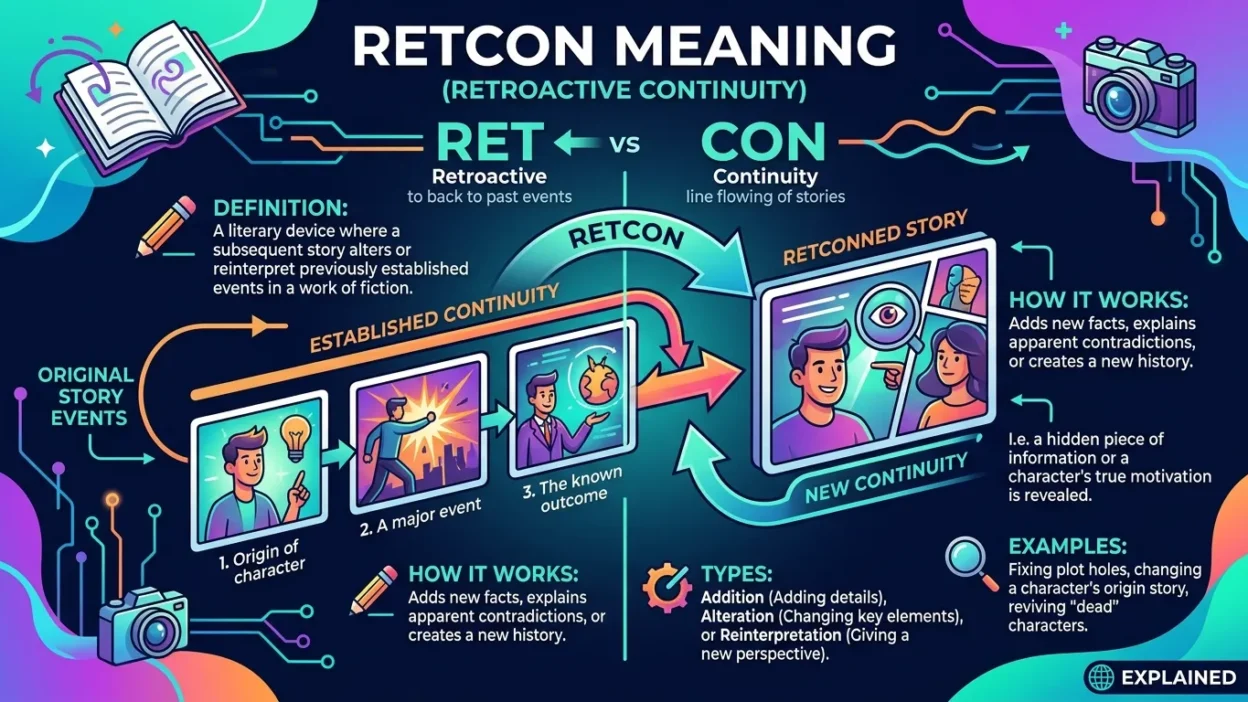
The retcon meaning is a change made to an established story that alters, explains, or gives new meaning to something that happened earlier. The word comes from “retroactive continuity.” Cambridge Dictionary defines a retcon as new information that changes or gives a different understanding of what came before in a movie, TV series, or similar story. It also uses retcon as a verb.
Retcons appear often in movies, television, comics, books, and video games. Writers may use them to fix a story problem, add a new idea, explain an old mystery, or take a character in a new direction.
This guide explains the term in plain English. You will learn what a retcon is, how it works, the main types, common examples, and how to tell a retcon from a normal plot twist.
Quick Answer
Retcon means changing or adding to an earlier part of a fictional story so that the past has a new meaning.
For example, imagine a show says that a hero was an only child. Three seasons later, the writers reveal that the hero has an older sister who was hidden from everyone.
That new fact changes what viewers thought they knew about the hero’s past. The new information is a retcon.
Retcon is short for retroactive continuity. It can work as both a noun and a verb. You can say, “That reveal is a retcon,” or, “The writers retconned his origin.”
Definition & Meaning of Retcon
The simplest retcon definition is:
A later change or addition that changes how an earlier part of a story should be understood.
The key idea is looking backward.
A writer creates a new story detail today, but that detail affects the story’s past. The original scene may still exist, but the audience now understands it in a different way.
A retcon does not always erase an old event. Sometimes it adds information that fits around what already happened.
For example:
- A character was thought to be dead.
- A later story says the character survived.
- The old death scene now has a different meaning.
That is a retcon.
The term is mainly used for ongoing fictional stories. Dictionary.com describes it as a later revision of an established story in areas such as film, television, video games, and comics. It also records the word as a shortening of “retroactive continuity” and dates its first recorded use to the early 1980s.
What Does Retcon Mean in Simple English?
If someone asks, “What does retcon mean?”, you can explain it this way:
A retcon is when a writer changes or adds to the past of a story after that past has already been shown.
Think of it like editing a family photo album.
You already know the story behind every photo. Later, someone tells you a new fact about one person in an old picture. The picture has not changed, but your understanding of it has.
A story retcon works in a similar way.
It can:
- Add a new fact about the past
- Change an old fact
- Remove an old story detail
- Explain an earlier mystery
- Change a character’s history
- Alter the meaning of an earlier event
- Sometimes remove an event from the story’s current continuity
The size of the change can vary. A retcon can affect one small detail or reshape a major part of a fictional universe.
What Is Retroactive Continuity?
Retroactive continuity is the full phrase behind the word retcon.
“Retroactive” refers to something that affects the past. In ordinary English, something done retroactively has an effect from an earlier time.
“Continuity” refers to the way events, characters, and facts remain connected across a story.
Put the two ideas together and you get:
Retroactive continuity = changing the story’s established past while trying to keep the larger story coherent.
This explains why retcons matter so much in long-running fiction.
A writer may inherit a story that has been running for years. New writers may want a different direction. They may also find an old detail that no longer fits.
A retcon gives them a way to change the past without starting the entire story again.
How Does a Retcon Work?
A retcon usually follows a simple pattern.
1. The story establishes a fact
The audience learns something about a character, event, place, or relationship.
For example:
“Alex moved away when he was ten.”
2. The story continues
More episodes or chapters appear. Everyone accepts the original fact.
3. A new story adds information
Years later, the writer says:
“Alex did not leave voluntarily. His family moved him to protect him.”
4. The old information gets a new meaning
The audience now understands Alex’s childhood in a different way.
That is the basic structure of a retcon.
Sometimes the new information creates a better story. Other times, fans may feel that the writer changed the past simply to solve a problem.
Common Types of Retcons
Not every retcon works in the same way. Here are some common forms.
Adding Hidden Information
This type adds a fact that was never known before.
A character may suddenly have a secret parent, sibling, mentor, or past connection.
The old story does not always become false. The audience simply learns more.
Changing a Character’s Origin
A writer may change where a character came from or explain their powers in a new way.
For example, a character may first seem to have gained powers through an experiment. A later story could reveal that the experiment only activated an ability the character already had.
The new explanation changes the character’s history.
Reversing an Earlier Event
This is a stronger form of retcon.
A character who appeared to die may later return. The writers then explain why the death was not permanent.
The earlier event still appeared real to the audience, but the current story gives it a different status.
Removing a Story Detail
A new story may ignore or cancel an old fact.
This can happen when a franchise changes direction.
Fans often notice this type because it can create clear conflicts with older material.
Reframing an Earlier Event
Sometimes nothing major changes.
Instead, the audience learns something that makes an old scene look different.
For example, a character may seem cruel in an early episode. Later, viewers learn that the character was secretly trying to protect someone.
The event remains, but its meaning changes.
Retcon vs Plot Twist
People often confuse a retcon with a plot twist.
They are not always the same.
A plot twist is a surprising development in a story. It can happen without changing the established past.
A retcon specifically affects how an earlier part of the story is understood.
Imagine a detective story.
The detective discovers that the suspect is actually the victim’s brother. That may be a plot twist.
But if the writer later reveals that the victim and suspect had secretly met years earlier, and that new fact changes the meaning of earlier scenes, that can be a retcon.
A story can contain both a twist and a retcon.
Retcon vs Rewrite
A rewrite and a retcon also have different meanings.
A rewrite usually means changing the story itself, such as producing a new version of a scene, chapter, script, or entire work.
A retcon usually happens later in an ongoing story. It changes or adds information that affects an established continuity.
Here is an easy way to remember it:
Rewrite: “Let’s change the old story.”
Retcon: “Let’s add or change something now that affects what the old story means.”
The line can become less clear when a franchise completely changes its continuity. In those cases, people may use terms such as reboot, remake, or retcon depending on the exact change.
Retcon vs Reboot
A reboot usually starts a fictional continuity again with major changes.
A retcon does not always start over.
Suppose a superhero series has ten seasons. In season eleven, the writers change the hero’s childhood. That is likely a retcon.
Now suppose the studio creates a new version where the hero’s story begins from scratch with a new history. That is more likely a reboot.
A reboot can contain retcons, but the two terms do not mean the same thing.
Retcon vs Sequel
A retcon looks backward and changes or adds to established information.
A sequel can introduce a retcon, but simply continuing the story does not make something a retcon.
For example, if a sequel says a character now works as a doctor, that is not automatically a retcon.
But if the sequel reveals that the character had secretly trained as a doctor before the original movie, and that changes how viewers understand earlier scenes, that may be a retcon.
Why Do Writers Use Retcons?
Retcons can serve useful story purposes.
To Fix Continuity Problems
Long stories can collect mistakes.
A character may have an incorrect age. A timeline may stop making sense. A writer may have forgotten an old detail.
A retcon can help repair the problem.
To Create New Story Ideas
A new writer may see an old character in a fresh way.
A small change to the character’s history can open the door to new plots.
To Add Mystery
A secret from the past can make an old story feel new.
The audience may revisit earlier scenes and notice details that now seem important.
To Support Character Growth
A new backstory can give a character more depth.
The writer may reveal why the character behaves in a certain way or why an old decision mattered.
To Handle Long-Running Franchises
Large fictional worlds often involve many writers, directors, editors, and creators.
Keeping every detail consistent can become difficult.
Retcons give creators some flexibility while allowing a story to continue.
Can a Retcon Be Good or Bad?
There is no rule that says every retcon is good or bad.
Its success depends on how well it fits the story.
A strong retcon usually does more than change something for shock value. It should add useful information, solve a real story issue, or create a better understanding of the characters.
A weak retcon may feel forced.
For example, if a writer changes a character’s past only because an old detail blocks a new plot, viewers may notice the problem.
The best test is simple:
Does the new information make the story stronger, or does it only create an excuse for the new plot?
Fans may also disagree. One viewer may see a clever correction. Another may see an unwanted change to a story they already loved.
Retcon Examples in Everyday Storytelling
You do not need a huge superhero universe to understand a retcon.
Consider this simple fictional example:
In episode one, Maya says she has never left her hometown.
In episode six, the writers reveal that Maya spent two years living in another city under a different name.
That new information changes what viewers believed about Maya’s past.
Another example:
A fantasy story says a magic sword belonged to one king.
Later, the writer reveals that the king found the sword after stealing it from an older civilization.
The sword’s history now has a new meaning.
A third example:
A game shows a character losing their memory after an accident.
In a later installment, the story reveals that the character had already lost their memory before the accident.
That new fact changes how players understand earlier events.
These examples show the basic idea without relying on any one franchise.
Comparison: Retcon vs Other Story Changes
| Story term | What happens? | Does it change the past? |
| Retcon | New information changes or adds to established history | Usually yes |
| Plot twist | A surprising event or reveal changes the story | Not always |
| Rewrite | An older version of the story is changed | Often |
| Reboot | A new continuity starts with major changes | Often |
| Sequel | The story continues after an earlier story | Usually no |
| Prequel | A story explores events that happened earlier | No, unless it adds a retcon |
The key question is not whether the audience feels surprised. The key question is whether the new information changes the established history or its meaning.
How to Tell If Something Is a Retcon
When you are unsure, ask five questions.
Was the old information already established?
If nobody knew the old fact before, there may be no retcon.
Did the new story add or change information about the past?
If yes, you may have a retcon.
Does the new information affect earlier events?
This is one of the strongest signs.
Does the change affect continuity?
If it changes what counts as true in the story, it is more likely to be a retcon.
Could the story have introduced the fact earlier?
If the information appears later and changes your view of earlier material, that is a common retcon pattern.
Common Mistakes About Retcon Meaning
One common mistake is thinking that every surprise reveal is a retcon.
That is not true.
A surprise can simply be a normal plot development.
Another mistake is thinking every retcon completely erases the past. Some do, but many simply add information or change the way an old event is understood.
People also use retcon in casual fan discussions. Because of that, different people may use the word slightly differently.
When you want to be precise, focus on the core idea: later story information affects established earlier continuity.
Quick Reference Checklist
| Question | Quick answer |
| What does retcon mean? | A later story change that affects the established past |
| What does retcon stand for? | Retroactive continuity |
| Is retcon a noun? | Yes |
| Is retcon a verb? | Yes |
| Where is it used? | Movies, TV, comics, books, games, and other ongoing fiction |
| Does every plot twist count? | No |
| Does every sequel contain a retcon? | No |
| Can a retcon add information without erasing anything? | Yes |
| Can a retcon change a character’s history? | Yes |
| Can a retcon be small? | Yes |
| Can a retcon affect an entire fictional universe? | Yes |
How to Use “Retcon” in a Sentence
Once you understand the retcon meaning, the word is easy to use.
Here are some natural examples:
- “The new episode retconned the character’s childhood.”
- “That reveal feels like a retcon.”
- “The writers used a retcon to explain the timeline.”
- “Fans noticed several retcons in the later seasons.”
- “I think the retcon made the character’s story better.”
- “The sequel introduced a major retcon.”
- “That detail was later retconned.”
As a verb, you will often see forms such as retconned and retconning. Dictionary.com and Cambridge both recognize retcon as a verb as well as a noun.
Is Retcon a Negative Word?
Not necessarily.
The word itself is neutral. It describes a type of story change.
However, fans often use it when they dislike a change.
For example, someone might say, “The writers ruined the old story with that retcon.”
Another person might say, “That retcon fixed a major problem.”
So the word does not tell you whether the change was good or bad. The speaker’s context does.
Why Retcons Matter to Fans
Retcons can affect more than one scene.
In a long-running story, fans may spend years learning a character’s history. A later change can alter how they view that character.
A good retcon can reward careful viewers. They may return to older episodes and notice new meaning.
A poor retcon can create frustration. Fans may feel that the creators ignored earlier material.
This is why discussions about continuity can become intense in large fictional communities.
The more history a story has, the more important continuity becomes.
FAQs:
1. What does retcon mean in simple terms?
Retcon means changing or adding information to a story after the earlier part has already been established. The new information changes the past or gives an earlier event a different meaning. The term is short for “retroactive continuity.”
2. What does retcon stand for?
Retcon stands for retroactive continuity. It describes a later story change that affects established continuity or changes how earlier events should be understood.
3. Is retcon a word or an abbreviation?
Retcon is a shortened form of “retroactive continuity.” Dictionaries now list retcon as both a noun and a verb.
4. What is an example of a retcon?
A simple example is a show that says a character has no siblings and later reveals that the character secretly has a sister. The new fact changes the established history of that character, so it can be called a retcon.
5. Is a plot twist the same as a retcon?
No. A plot twist is a surprising development. A retcon specifically changes or adds to established past information. A single story can contain both a plot twist and a retcon.
6. Can a retcon erase something from a story?
Yes. Some retcons change or remove an earlier event from the current version of a story’s continuity. But not every retcon erases anything. Some simply add new information or change the meaning of an old event.
7. Why do writers use retcons?
Writers may use retcons to fix continuity problems, add new story ideas, explain mysteries, develop characters, or change the direction of a long-running fictional universe. The result can work well or poorly depending on how naturally it fits the existing story.
Conclusion:
The retcon meaning is simple once you break it down. A retcon is a later change or addition that affects an established part of a fictional story. The term comes from retroactive continuity, and it can work as both a noun and a verb.
Retcons can add hidden facts, change character origins, reverse earlier events, or give old scenes a new meaning. They are common in long-running movies, TV shows, comics, books, and games.
The easiest way to spot one is to ask: Did new information change how I understand something that the story had already established? If yes, you are probably looking at a retcon.
Keep that simple test in mind, and you will be able to understand and use the term with confidence.

I’m Michael Carter, a writer passionate about education, general information, language, and the meaning behind words and phrases. At PrayersVibe.com, I create clear and useful content that helps readers understand topics without complicated language. I enjoy researching different subjects and sharing accurate information in a simple, reader-friendly way.