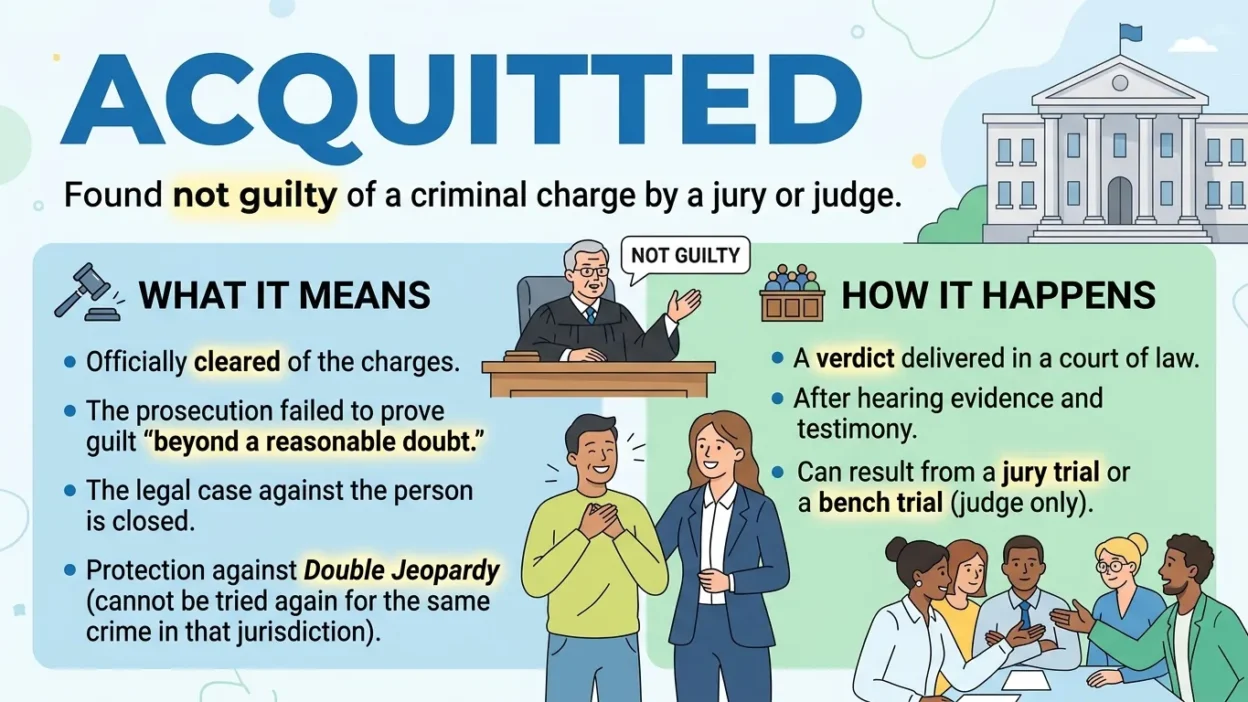
If you saw the word “acquitted” in a news story, court report, movie, or legal document, you may wonder what it really means. The acquitted meaning is simple: a court has officially decided that a person is not guilty of a particular crime.
For example, if a person faces a theft charge and the court acquits them, the court has found them not guilty of that charge.
But there is an important point many people miss. Being acquitted does not always mean a court has declared that the person did not do anything wrong in every sense. It means the legal case did not result in a guilty finding for the offense charged.
In this guide, you will learn what acquitted means, how to use it, what acquitted of charges means, how it differs from convicted and innocent, and what the related word acquittal means.
Quick Answer: What Does Acquitted Mean?
Acquitted means officially found not guilty by a court of law.
If someone is acquitted of a crime, the court has decided that the person is not guilty of that particular offense. Cambridge defines acquit as the official decision in court that someone is not guilty of a particular crime.
Example:
The jury acquitted the defendant of murder.
This means the jury found the defendant not guilty of murder.
The opposite legal outcome is generally a conviction, where a defendant is found guilty.
Acquitted Meaning and Definition
The word acquitted is the past tense and past participle of the verb acquit.
In legal English, to acquit someone means to officially decide that the person is not guilty of a particular criminal offense.
So, when you read:
“She was acquitted of the charges.”
It means:
“The court found her not guilty of those charges.”
The word often appears in passive sentences because the court or jury makes the decision.
Common patterns include:
- He was acquitted of murder.
- She was acquitted of fraud.
- The defendant was acquitted of all charges.
- The jury acquitted him of the crime.
- They were acquitted after the trial.
The noun form is acquittal. An acquittal is the court’s decision that the defendant is not guilty.
What Does Acquitted of Charges Mean?
“Acquitted of charges” means that a person was found not guilty of the criminal charges brought against them.
For example:
John was acquitted of robbery.
This tells us that John faced a robbery charge, but the legal process ended with a not-guilty finding.
A person can also be acquitted of some charges while being convicted of others.
For example:
The jury acquitted Maria of theft but convicted her of fraud.
Here, Maria received two different outcomes. The court did not find her guilty of theft, but it did find her guilty of fraud.
Cambridge gives the same basic legal pattern: a person can be acquitted of one offense while being convicted of another.
This is why it is useful to look at the exact charge when reading a court report.
What Does Acquitted Mean in Court?
In court, acquitted means the defendant received a not-guilty verdict or finding for the offense at issue.
In the U.S. criminal system, the prosecution generally must prove the required elements of the crime beyond a reasonable doubt to obtain a conviction. If reasonable doubt remains after the evidence is considered, the jury must acquit the defendant.
This does not mean the court must prove that the defendant is completely innocent in every possible sense.
The legal question is narrower:
Did the prosecution prove the charged offense to the required legal standard?
If the answer is no, the defendant may be acquitted.
That distinction helps explain why acquitted and innocent are related but not always interchangeable.
Acquitted vs. Convicted
The easiest way to understand acquitted is to compare it with convicted.
A person is acquitted when the legal process ends with a not-guilty finding for the charge.
A person is convicted when the court or jury finds them guilty of a criminal offense.
Here is a simple comparison:
| Term | Meaning | Simple Example |
| Acquitted | Found not guilty of a particular charge | “He was acquitted of theft.” |
| Convicted | Found guilty of a criminal offense | “He was convicted of theft.” |
| Charged | Formally accused of an offense | “He was charged with theft.” |
| Acquittal | The legal result of being found not guilty | “The trial ended in an acquittal.” |
A charge is not the same as a conviction. Someone may be charged with a crime and later be acquitted.
That is an important point when reading news reports or discussing a person’s legal history.
Acquitted vs. Innocent: Are They the Same?
Not exactly.
In everyday English, people may use acquitted and innocent as if they mean the same thing. In legal language, however, the ideas can be different.
Innocent generally means a person did not commit the wrongdoing or is not guilty of it.
Acquitted describes the result of a legal proceeding: the person was officially found not guilty of the particular charge.
An acquittal can happen because the prosecution did not prove the case beyond the required standard. Cornell’s Legal Information Institute explains an acquittal as a finding that the proof was insufficient to overcome the applicable reasonable doubt standard.
So you should not automatically rewrite:
“The defendant was acquitted.”
as:
“The defendant definitely did not commit the crime.”
The first sentence reports a legal outcome. The second makes a broader factual claim.
That difference matters.
Acquittal Meaning
Acquittal is the noun form connected to acquitted.
An acquittal is a court’s decision that a person is not guilty of the offense charged. Cambridge describes it as the decision of a court that someone is not guilty.
Think of the relationship this way:
- Acquit = the action or legal decision.
- Acquitted = the person received that not-guilty decision.
- Acquittal = the name of the legal outcome.
Example
Verb:
The jury acquitted the defendant.
Past participle/adjective-like use:
The defendant was acquitted.
Noun:
The defendant received an acquittal.
All three forms relate to the same basic legal idea.
Simple Examples of Acquitted
Seeing the word in real sentences can make its meaning much easier to understand.
Example 1
The man was acquitted of burglary.
Meaning: The court found him not guilty of burglary.
Example 2
She was acquitted after a long trial.
Meaning: The trial ended with a not-guilty finding for her.
Example 3
The jury acquitted him of the murder charge.
Meaning: The jury found him not guilty of murder.
Example 4
He was acquitted of fraud but convicted of tax evasion.
Meaning: He was found not guilty of fraud but guilty of another offense.
Example 5
The defendant was acquitted because the prosecution did not prove the case beyond a reasonable doubt.
Meaning: The required level of proof for a conviction was not met.
These examples show why the word acquitted usually needs some legal context.
How to Use Acquitted in a Sentence
The most common structure is:
subject + was/were + acquitted + of + charge
Examples:
- He was acquitted of theft.
- She was acquitted of murder.
- They were acquitted of fraud.
- The defendant was acquitted of all charges.
You can also use acquit as an active verb:
The jury acquitted the defendant.
Another useful form is:
The court acquitted her of the charge.
When writing about a real case, be precise about the charge. Saying someone was “acquitted” without explaining what happened can leave readers with an incomplete picture.
Common Mistakes With the Word Acquitted
People often make small mistakes when using legal words. The biggest mistake is treating acquitted as a complete synonym for innocent.
Another common mistake is confusing an acquittal with a dismissal.
A dismissal and an acquittal can both end a case without a conviction, but they are not the same legal event. The exact effect can depend on the legal system and the reason for the dismissal.
Another mistake is assuming that an acquittal means every accusation against a person has disappeared. An acquittal applies to the particular offense that was resolved.
Use the exact language found in the court record when accuracy matters.
| Common Mistake | Better Understanding |
| “Acquitted” always means proven innocent | It means found not guilty of the particular charge |
| Acquitted means convicted | They are opposite outcomes |
| Acquittal means the person was never charged | An acquittal usually follows a legal proceeding involving a charge |
| Acquitted means cleared of every possible wrongdoing | The finding concerns the specific offense at issue |
| Charge and conviction mean the same thing | A charge is an accusation; a conviction is a guilty finding |
| Acquittal and dismissal are identical | They are different legal outcomes and can have different effects |
Why Does a Court Acquit Someone?
A court or jury may acquit a defendant when the prosecution does not establish the required elements of the charged offense to the applicable legal standard.
In a U.S. criminal trial, the prosecution carries the burden of proving guilt beyond a reasonable doubt. If reasonable doubt remains, the defendant must be acquitted rather than convicted.
The evidence may be weak, conflicting, incomplete, or insufficient to prove one or more required elements of the crime.
For example, imagine a person is charged with theft. The prosecution may need to prove several facts. If the evidence does not establish a required part of the offense beyond a reasonable doubt, the legal result may be an acquittal.
This is one reason you should not assume that an acquittal tells the whole story about what happened outside the courtroom.
Does Being Acquitted Mean You Can Never Be Tried Again?
This question has an important legal answer: the effect of an acquittal depends on the jurisdiction and the legal circumstances.
In the United States, the Double Jeopardy Clause generally protects against a second prosecution for the same offense after an acquittal. Cornell’s Legal Information Institute notes that the Double Jeopardy Clause bars government appeal and retrial after an acquittal, subject to the rules and exceptions that apply in particular legal situations.
Other countries may use different rules.
So, if you are dealing with a real case, do not rely on the general meaning of the word alone. The law of the relevant country, state, or court matters.
Acquitted Meaning in Everyday English
Outside legal writing, people sometimes use acquitted in a more general way to suggest that someone has been cleared of blame.
For example:
After the investigation, she felt acquitted of any wrongdoing.
However, this use can sound formal or legal.
The most common and clear use remains the legal one:
The defendant was acquitted of the charges.
There is also a less common meaning of acquit yourself. In formal English, this phrase can mean to perform or behave in a particular way, especially in a difficult situation. Cambridge lists this as a separate meaning of acquit.
For example:
He acquitted himself well during the interview.
Here, acquitted does not mean “found not guilty.” It means he performed or behaved well.
This second meaning can confuse English learners, so context matters.
Acquitted Meaning: Quick Reference
Use this quick guide when you need to understand the word fast.
| Question | Quick Answer |
| What does acquitted mean? | Officially found not guilty of a particular charge |
| What is the verb? | Acquit |
| What is the noun? | Acquittal |
| What is the opposite legal result? | Convicted |
| Common phrase | Acquitted of the charges |
| Does it always mean innocent? | No; it describes a legal finding |
| Who can acquit a defendant? | A court or jury, depending on the legal system and proceeding |
| What does acquitted of murder mean? | Found not guilty of the murder charge |
How to Understand “Acquitted” in News Stories
News reports often use words like charged, tried, acquitted, and convicted in the same story.
Here is a simple way to follow the sequence:
Charged → Trial → Verdict → Acquitted or Convicted
A person may first face a criminal charge. The case may then go to trial. After the relevant legal process, the result can include an acquittal or conviction, depending on the case and legal system.
When reading a news story, ask three questions:
- What was the person charged with?
- What was the final finding?
- Was the person acquitted of all charges or only some?
These questions can prevent many misunderstandings.
Is Acquitted a Positive or Negative Word?
The word itself is neutral and legal.
For the defendant, an acquittal is generally a favorable legal outcome because it means there was no guilty finding for that charge.
But the word does not tell you everything about the case. It does not automatically describe why the court reached that result or what happened with other charges.
For example:
She was acquitted of one charge but convicted of another.
So, always read the surrounding sentence.
What Is the Difference Between Acquitted and Cleared?
Acquitted has a specific legal meaning. It normally refers to a court’s not-guilty finding on a criminal charge.
Cleared can have a broader meaning.
For example, a police investigation might say that a person was “cleared as a suspect.” That does not necessarily mean a court acquitted the person because there may never have been a trial.
This distinction is useful when reading crime reports.
If a court officially finds someone not guilty, acquitted is the more precise legal term.
A Simple Way to Remember Acquitted Meaning
Use this memory trick:
Acquitted = Not guilty after a legal proceeding.
Then remember:
Acquittal = the not-guilty result.
And:
Convicted = found guilty.
These three words cover much of the basic vocabulary you will see in criminal court reports.
FAQs:
1. What is the simple meaning of acquitted?
Acquitted means officially found not guilty of a particular crime or charge by a court or jury. It is a legal term used to describe the outcome of a criminal case.
2. Does acquitted mean innocent?
Not necessarily. Acquitted means the person was found not guilty of the specific charge. It does not always amount to a broad factual declaration that the person could not have committed any wrongdoing.
3. What does acquitted of all charges mean?
It means the person was found not guilty of all the charges covered by that legal proceeding. No guilty finding was entered for those charges.
4. What is the difference between acquitted and convicted?
Acquitted means found not guilty of a particular charge. Convicted means found guilty of a criminal offense. They describe opposite types of case outcomes.
5. What is the noun form of acquitted?
The related noun is acquittal. An acquittal is the legal decision or outcome in which a defendant is found not guilty.
6. Can someone be acquitted of one charge and convicted of another?
Yes. A case can involve multiple charges with different outcomes. A person may be acquitted of one offense while being convicted of another, as the charges are considered separately.
7. What does “acquit yourself” mean?
“Acquit yourself” is a different, formal use of the verb. It can mean to perform or behave in a certain way, often in a difficult situation. For example, “She acquitted herself well” means she performed well.
Conclusion:
The acquitted meaning is straightforward: a person has been officially found not guilty of a particular criminal charge. The word comes from the verb acquit, while acquittal names the legal outcome.
Remember that acquitted does not always mean the same thing as proven innocent. It describes a legal result based on the evidence and the applicable standard of proof.
When you see the word in a news story, check what charge the person faced and whether they were acquitted of all or only some charges. That small step will help you understand the story with much greater accuracy.

I’m Michael Carter, a writer passionate about education, general information, language, and the meaning behind words and phrases. At PrayersVibe.com, I create clear and useful content that helps readers understand topics without complicated language. I enjoy researching different subjects and sharing accurate information in a simple, reader-friendly way.