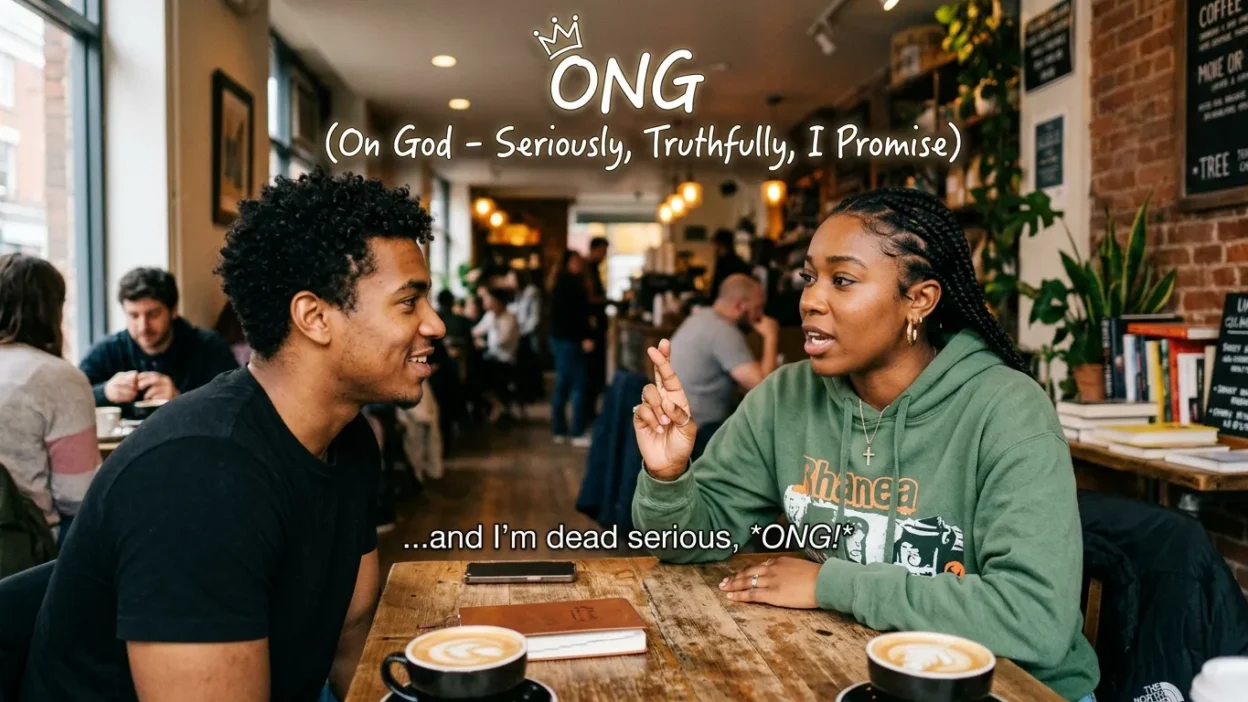
Have you ever opened a text, TikTok comment, or group chat and seen someone write “ong”? At first, it may look like a typo for “OMG.” But ONG has a different meaning.
In texting and internet slang, ONG usually means “On God.” People use it to show that they are telling the truth, speaking seriously, or strongly agreeing with something. It can feel similar to “I swear,” “for real,” or “I’m serious.”
You may see ONG meaning in text searches because slang can be hard to understand without context. A short reply such as “ONG!” can mean “Exactly!” while “ONG, I didn’t do it” can mean “I swear I didn’t do it.”
This guide explains the ONG full form, what it means in texting, how people use it, where you may see it, how to reply, and how it differs from similar slang.
Quick Answer
ONG means “On God.” In texting, people use it to stress that something is true, serious, or strongly believed. It can also show strong agreement.
For example:
“That was the best pizza ever, ong.”
This means:
“That was the best pizza ever, I swear.”
If someone replies “ONG” after you say something they agree with, it can mean “For real,” “Exactly,” or “I agree.”
Definition & Meaning
The most common ONG meaning is “On God.”
The phrase works as an emphasis marker. A person adds it to a statement when they want to make the statement sound more sincere, serious, or certain.
For example:
“ONG, I saw him at the store.”
The person is saying:
“I swear I saw him at the store.”
But ONG does not always describe a literal promise. In casual online speech, it can also show agreement.
Example:
Person 1: “That game was so fun.”
Person 2: “ONG!”
Here, Person 2 means something like:
“For real!”
or
“Exactly!”
Dictionary.com defines ONG as an abbreviation for “on God” and notes that the expression can communicate honesty, strong belief, or strong emotion.
What Does ONG Mean in Text?
The ONG meaning in text is usually “On God.”
People use it in informal digital conversations when they want to add weight to what they are saying.
You might see:
- “ONG, I’m telling the truth.”
- “That movie was amazing ong.”
- “ONG, you have to try this.”
- “That was shocking, ONG.”
- “ONG!” as a reply to someone.
The exact meaning depends on the sentence.
When ONG comes after a statement, it often strengthens that statement.
When someone sends only “ONG,” it often means they agree with the previous message.
This makes context very important. The same three letters can express sincerity, excitement, agreement, or strong emotion.
What Is the ONG Full Form?
The common slang full form of ONG is “On God.”
It is a shortened form used mainly in informal online communication. People type it because it is quick and easy to understand among people who know the slang.
You may see it written as:
- ONG
- ong
- On God
- on god
The capitalization usually does not change the meaning.
“ONG” can look more forceful because of the capital letters, while “ong” often looks more relaxed.
The abbreviation became associated with online slang and social media use, with sources documenting its use as a shortened form of “on God.”
Where Did ONG Come From?
The phrase “on God” is older than the abbreviation itself. It works as a way to strongly affirm that something is true or that the speaker stands behind what they said.
The exact origin of the slang phrase is difficult to assign to one person or one date. Sources trace its online use back years before its recent popularity on social media.
The abbreviation ONG became a convenient way to type the phrase quickly.
This is common with internet slang. Longer expressions often become shorter because people want fast, easy communication.
What Does ONG Mean in Chat?
In a chat, ONG can mean “I swear,” “for real,” or “I agree,” depending on how someone uses it.
Consider these examples.
Example 1:
“ONG, I didn’t take your phone.”
Meaning:
“I swear I didn’t take your phone.”
Example 2:
“Bro, that restaurant is so good.”
“ONG.”
Meaning:
“I agree. It really is.”
Example 3:
“ONG, that was the funniest thing I’ve seen today.”
Meaning:
“I swear, that was really funny.”
This is why you should not translate ONG with only one phrase every time. The basic meaning stays connected to “On God,” but its natural English meaning changes with the context.
How Is ONG Used in Texting?
People use ONG in several simple ways.
To Show You Are Telling the Truth
This is one of the clearest uses.
“ONG, I never said that.”
The writer wants the other person to believe them.
It works much like:
- “I swear.”
- “I’m telling the truth.”
- “Seriously.”
- “I promise.”
To Show Strong Agreement
Someone can send ONG as a short reply.
Friend: “That was the best concert ever.”
You: “ONG.”
Here, you are strongly agreeing.
To Add Emphasis
ONG can also make an opinion sound stronger.
“This burger is so good ONG.”
The writer is not simply saying the burger is good. They are adding strong emphasis.
To Show Strong Emotion
People may use ONG when they feel excited, annoyed, surprised, or strongly convinced.
The phrase does not create the emotion by itself. The rest of the message and the situation tell you what emotion the writer has.
ONG Meaning on TikTok, Snapchat, and Instagram
You can see ONG slang across casual social media conversations, comments, and messages.
It appears in places such as:
- TikTok
- Snapchat
- Discord
- Group chats
- Gaming chats
- Text messages
- Online comments
Social media slang changes quickly, so not every user will use ONG in exactly the same way.
Current slang references still describe ONG as a common abbreviation for “On God,” especially for expressing truth, seriousness, or agreement.
The important point is that ONG is informal. It fits casual conversations much better than formal writing.
ONG vs. OMG: What Is the Difference?
This is one of the most common points of confusion.
ONG means “On God.”
OMG means “Oh my God.”
They can look similar because both are three-letter internet abbreviations, but they serve different purposes.
OMG usually expresses surprise, shock, excitement, or another strong reaction.
ONG usually emphasizes truth, seriousness, certainty, or agreement.
For example:
“OMG! You won the game!”
This expresses surprise or excitement.
“ONG, you played really well.”
This emphasizes the speaker’s strong belief in the statement.
If someone types ONG, do not automatically assume they meant OMG. Current slang references specifically distinguish the two abbreviations.
ONG vs. I Swear vs. No Cap vs. FR
ONG belongs to a larger group of slang expressions that people use to show sincerity or agreement.
| Expression | Common meaning | Typical use | Tone |
| ONG | On God | Strong truth or agreement | Very casual |
| I swear | I am telling the truth | To stress honesty | Casual |
| No cap | No lie | To say something is true | Casual slang |
| FR | For real | Agreement or sincerity | Casual |
| Seriously | I truly mean this | Strong emphasis | Casual to neutral |
| I promise | I give my word | Commitment or reassurance | Casual to serious |
These expressions can overlap, but they are not always interchangeable.
For example, “no cap” focuses on the idea that the speaker is not lying or exaggerating. ONG has the stronger “on God” wording and can also work as a one-word agreement.
What Does ONG Mean When Someone Says It Alone?
If someone sends only:
“ONG”
they are often agreeing with what you just said.
For example:
You: “That exam was way harder than I expected.”
Friend: “ONG.”
Your friend likely means:
“For real.”
or
“Exactly.”
This use is similar to nodding strongly in agreement.
However, context still matters. If the conversation has no statement to agree with, you may need to read the messages before and after it to understand the intent.
How to Reply to ONG
Your response depends on what the person means.
If they use ONG to agree with you, you can simply continue the conversation.
For example:
Them: “ONG, that movie was terrible.”
You: “Right? I almost left halfway through.”
If they use ONG to emphasize a claim, you can respond naturally:
Them: “ONG, I didn’t touch your charger.”
You: “Okay, I believe you.”
And also reply with similar casual phrases such as:
- “For real.”
- “Exactly.”
- “Facts.”
- “I know, right?”
- “Same.”
- “No cap.”
- “True.”
You do not need to use slang just because someone else does. A normal response is completely fine.
When Should You Use ONG?
Use ONG when you are having an informal conversation with someone who understands internet slang.
It can work well in:
- Text messages
- Friendly group chats
- Social media comments
- Gaming conversations
- Casual DMs
- Memes
- Informal online discussions
For example:
“ONG, that was hilarious.”
That sounds natural in a casual chat.
But slang is not always the best choice. Avoid ONG in situations where you need a formal or professional tone.
A work email, school report, job application, legal document, or formal business message should normally use clear standard English instead.
Common Mistakes When Using ONG
Understanding the slang is only half the job. Using it naturally matters too.
Mistake 1: Thinking ONG Means OMG
This is probably the easiest mistake to make.
ONG and OMG have different meanings.
Remember:
ONG = On God
OMG = Oh my God
Mistake 2: Using It in Every Sentence
ONG is an emphasis word. If you add it to every message, it can lose its effect and make your writing sound forced.
Use it when it fits the moment.
Mistake 3: Assuming It Always Means “I Swear”
That is not always true.
If someone replies with only “ONG,” they may simply be agreeing with you.
Mistake 4: Using It in Formal Writing
ONG is casual slang. It may look unprofessional in formal communication.
Mistake 5: Ignoring Context
A single slang term can carry different shades of meaning. Look at the full message before deciding what the sender means.
| Common mistake | Better approach |
| Reading ONG as OMG | Remember that ONG means “On God” |
| Assuming it always means “I swear” | Check whether it is being used as agreement |
| Using ONG in formal emails | Use clear standard English |
| Adding ONG to every message | Use it only when emphasis fits |
| Ignoring the conversation around it | Read the full context |
| Assuming every person knows slang | Consider who you are talking to |
Is ONG Rude or Offensive?
ONG is not normally a rude word. It is informal slang.
Still, the phrase comes from language that invokes God, so some people may not feel comfortable using it. Religious beliefs and personal preferences can affect how someone views expressions such as “On God.”
That means you should consider your audience.
Among friends, ONG may sound completely normal.
In a formal setting or with someone who prefers more careful language, phrases such as “I’m serious,” “I mean it,” or “I’m telling the truth” may be better.
The key is not just knowing the definition. Good communication also means knowing your audience.
Is ONG a Gen Z Slang Word?
ONG is strongly associated with modern internet slang and younger online users, including Gen Z communities.
However, it is not limited to one age group.
People often pick up slang from social media, friends, gaming communities, memes, and other online spaces. That means you should not assume that only teenagers use or understand it.
Historical references also show that “on God” existed before the current social-media slang cycle, while the shortened form ONG became more visible online later. Know Your Meme records the abbreviation and its growth in online use during the 2010s and early 2020s.
Does ONG Always Mean “On God”?
In modern texting and social media slang, “On God” is the main meaning of ONG.
However, abbreviations can have different meanings in other fields or contexts. If you see ONG outside a casual conversation, do not assume the slang definition automatically applies.
For example, a business document, technical text, organization name, or specialized subject may use the same letters for something completely different.
Context remains the safest way to interpret an abbreviation.
For everyday texting, though, ONG usually means “On God.”
Quick Reference: ONG Meaning and Usage
| Question | Quick answer |
| What does ONG mean? | On God |
| ONG meaning in text? | Usually “On God” |
| ONG full form? | On God |
| What does ONG mean in chat? | I swear, for real, or I agree |
| Is ONG slang? | Yes |
| Is ONG formal? | No |
| ONG vs OMG? | ONG = On God; OMG = Oh my God |
| Can ONG show agreement? | Yes |
| Can ONG emphasize truth? | Yes |
| Where is ONG common? | Texts, chats, comments, and social media |
How to Know What ONG Means in a Message
When you see ONG, use these three simple steps.
Step 1: Read the whole message.
Do not judge the meaning from the three letters alone.
Step 2: Look at its position.
If it comes after a claim, it may strengthen that claim.
Example:
“That food was amazing, ong.”
If it appears alone after someone else’s statement, it may show agreement.
“ONG!”
Step 3: Think about the relationship.
A close friend may use ONG casually or jokingly. Someone you barely know may use it in a more direct way.
This simple approach can help you understand most uses without overthinking the slang.
Examples of ONG in Realistic Conversations
Here are some natural examples.
Example 1: Truth
A: “Did you really see Sarah there?”
B: “ONG, I did.”
Meaning: “I swear I did.”
Example 2: Agreement
A: “That was the best episode.”
B: “ONG!”
Meaning: “Exactly!”
Example 3: Strong opinion
A: “This pizza is amazing, ong.”
Meaning: “This pizza is seriously amazing.”
Example 4: Frustration
A: “ONG, I have studied for six hours and still don’t understand this.”
Meaning: “I’m seriously frustrated after studying this much.”
Example 5: Excitement
A: “ONG, we actually won!”
Meaning: “I can’t believe it we really won!”
These examples show why context matters. ONG can strengthen different emotions without changing its basic meaning.
FAQs:
1. What does ONG mean in text?
ONG usually means “On God.” People use it to emphasize that they are telling the truth, being serious, or strongly agreeing with something. Depending on the sentence, it can feel like “I swear,” “for real,” or “exactly.”
2. What does ONG mean on TikTok?
On TikTok, ONG generally means “On God.” Users may add it to a statement to emphasize that they strongly believe what they are saying. It can also appear alone as a way to agree with another person’s comment.
3. Is ONG the same as OMG?
No. ONG means “On God,” while OMG means “Oh my God.” ONG usually relates to truth, seriousness, or agreement. OMG more often expresses surprise, excitement, shock, or another strong reaction.
4. What does ONG mean from a girl or boy?
The meaning does not normally change based on whether the sender is a girl or boy. In most casual texting, ONG means “On God.” The exact feeling depends on the conversation.
5. Is ONG a bad word?
No. ONG is generally considered casual slang rather than a profanity. However, it uses religious language, so some people may prefer not to use it. In formal settings, standard phrases such as “I’m serious” or “I’m telling the truth” are safer.
6. How do you respond to ONG?
If someone uses ONG to agree with you, you can respond with “Exactly,” “Facts,” “For real,” or simply continue the conversation. If they use it to emphasize a claim, you can acknowledge what they said or ask a follow-up question.
7. Does ONG always mean “I swear”?
Not always. ONG can mean “I swear” when someone uses it to emphasize a claim. But when someone sends ONG alone as a response, it can simply mean “I agree,” “For real,” or “Exactly.” Context tells you which meaning fits best.
Conclusion:
The main ONG meaning is simple: ONG stands for “On God.” In texting and online slang, people use it to show that they are serious, tell the truth, strongly believe something, or agree with another person.
You may see ONG meaning in text on TikTok, Snapchat, Instagram, Discord, group chats, and other casual spaces. It can mean “I swear,” “for real,” or “exactly,” depending on the context.
The easiest way to remember it is:
ONG = On God = strong sincerity or agreement.
Do not confuse it with OMG, and avoid using ONG in formal writing. If you understand the message around it, you can usually work out the intended meaning quickly.

I’m Jessica Morgan, a writer who loves covering lifestyle, entertainment, sports, trends, and everyday topics in a simple and engaging way. At PrayersVibe.com, I focus on creating helpful, easy-to-read content that informs and connects with readers. I enjoy researching new ideas and turning them into clear, useful stories that readers can enjoy.