Have you ever seen de facto in a news story, legal document, business article, or formal email and wondered what it really means? The phrase may look difficult, but the idea is simple.
The de facto meaning is “in fact,” “in reality,” or “actually.” It describes something that exists or works in practice, even if it has not been formally approved, legally recognized, or officially named that way. Cambridge defines it as something that exists in fact, even when it may not be intended, legal, or accepted.
For example, a person may have no official title but still make all the important decisions. That person can be called the de facto leader.
In this guide, you will learn the plain-English definition, the de facto meaning in law, common examples, de facto vs. de jure, useful synonyms, and the right way to use the phrase.
Quick Answer
De facto means “in reality” or “in practice.”
It describes something that is true or operates in real life, even when it is not officially recognized or legally established.
Example:
“Maria became the de facto manager after the company owner left.”
This means Maria was not necessarily given the official manager title, but she performed the manager’s role in practice.
Merriam-Webster also defines de facto as “in reality” and uses it for situations where something has an actual effect without formal recognition.
Definition & Meaning of De Facto
The phrase de facto comes from Medieval Latin and literally means “from the fact.” In modern English, it usually means existing in fact or reality. Merriam-Webster records its first known English use as an adverb in 1601.
The easiest way to understand it is to think:
De facto = what happens in real life.
It does not always mean something is official, legal, planned, or written into a rule.
For example:
“James is the de facto leader of the team.”
James may not have the official title of leader. Yet, everyone follows his decisions, so he acts as the leader in practice.
The phrase can work as an adjective or adverb. You will often see it before a noun, such as de facto leader, de facto standard, or de facto government. It can also describe an action or condition that exists in practice.
What Does De Facto Mean in Simple Words?
In simple words, de facto means “the way things really are.”
Imagine a group of five friends. Nobody chooses a leader. However, one friend plans every trip, makes the final calls, and organizes everyone.
That friend is the de facto leader.
The important point is that the role comes from actual behavior, not necessarily from an official appointment.
You can remember it this way:
Official title = what something is called.
De facto status = what something actually does or is.
This simple difference helps you understand the phrase in business, law, politics, relationships, and everyday English.
De Facto Examples in Everyday English
You do not need a legal or political situation to use de facto. The phrase can describe many ordinary situations.
1. De Facto Leader
“Sarah became the de facto leader of the project.”
Sarah may not hold the formal leadership title. Still, she makes the main decisions and guides the team.
2. De Facto Standard
“One software became the de facto standard for the industry.”
This means many people use it as the normal or accepted choice, even though no official body necessarily declared it the standard.
Cambridge gives a similar business use for something that becomes a de facto standard through actual use rather than formal approval.
3. De Facto Control
“After the founder became ill, his daughter took de facto control of the company.”
She may not have received the formal legal title, but she actually controlled the main decisions.
4. De Facto Language
A language can become a de facto common language because people widely use it in daily life, business, education, or communication.
The key idea remains the same: real-world use creates the status.
5. De Facto Rule
A workplace may have a rule that nobody wrote down.
For example, employees may always ask one senior worker for approval before making major decisions. That person may have a de facto authority, even without a formal rule giving them that power.
De Facto Meaning in Law
The de facto meaning in law is closely tied to something that exists or operates in reality, even if it does not have full formal or legal recognition.
Legal writing often uses de facto to separate actual circumstances from official legal status.
For example, a person may exercise authority as though they hold a legal position. A court or legal writer may describe that person as a de facto official when the person acts in that role without having the usual formal status.
Merriam-Webster’s legal definition includes the idea of exercising power as if legally constituted or authorized. It gives examples such as a de facto government or de facto judge.
However, the exact legal effect of the term depends on the law and jurisdiction involved. De facto does not automatically mean legally valid.
That distinction matters.
If you see the phrase in a contract, court decision, government document, or legal advice, you should read the surrounding text carefully rather than assuming that “de facto” gives something legal approval.
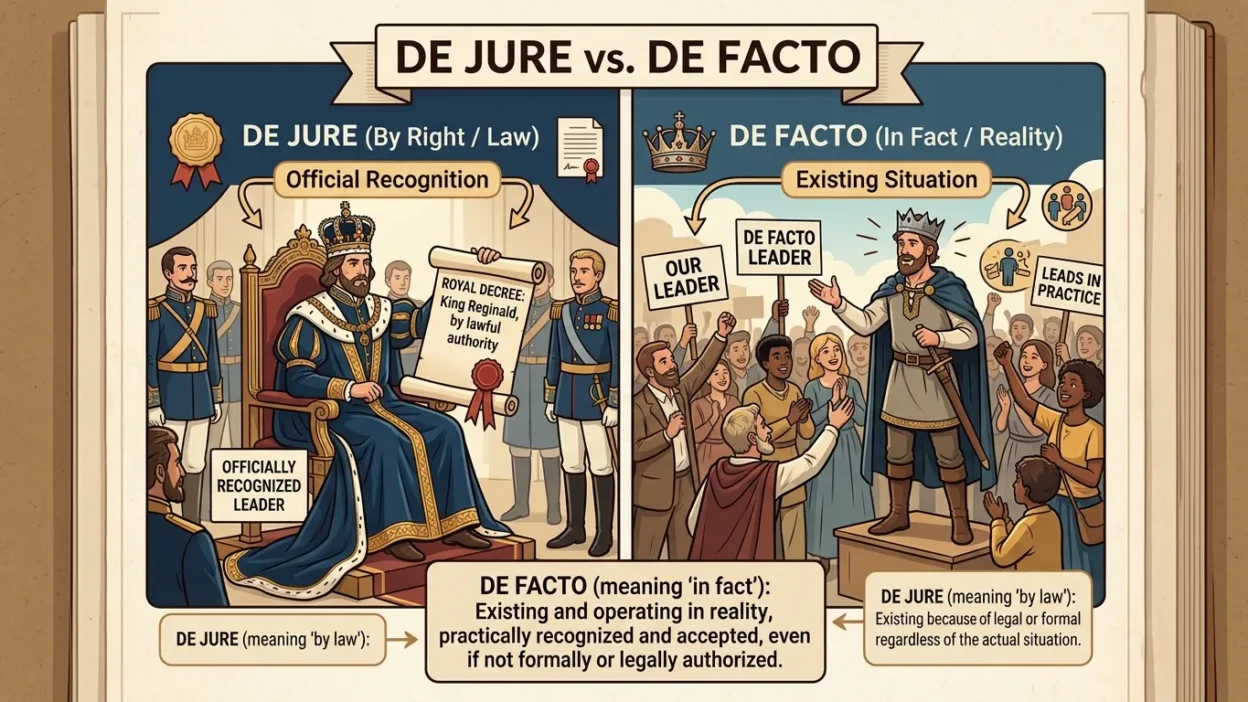
De Facto vs. De Jure
One of the most common questions is the difference between de facto and de jure.
They point in different directions:
- De facto = what exists or happens in reality.
- De jure = what exists according to law or formal rules.
Think of de facto as “in practice” and de jure as “by law.”
| Situation | De Facto | De Jure |
| Leadership | A person actually makes the decisions | A person officially holds the title |
| Authority | Someone exercises power in practice | Someone has legal authority |
| Standard | People widely use something | An official body formally recognizes it |
| Government | A group controls the area in practice | A government has formal legal status |
| Rules | People follow an unwritten practice | A written rule officially requires it |
A situation can sometimes be both de facto and de jure.
For example, a company manager may officially hold the manager title and also perform all management duties. In that case, the person’s role can be formal and practical at the same time.
The important difference is whether you are describing actual practice or formal status.
De Facto vs. De Jure: Easy Example
Suppose a company names Alex as its president.
Alex has the official title and legal authority. That is de jure.
Now imagine Alex leaves for several months. During that time, another executive, Maya, makes all major decisions and directs the company.
Maya may become the de facto leader because she performs the leadership role in practice.
So:
Alex = de jure leader.
Maya = de facto leader.
This example shows why the two terms matter. They can describe two different kinds of authority in the same situation.
De Facto Government
You may also encounter the phrase de facto government in political or international discussions.
A de facto government refers to a governing authority that exercises actual control, even when questions exist about its formal legal status or recognition.
Merriam-Webster specifically includes de facto government in its legal definition and describes the phrase in terms of exercising power as if legally constituted.
This is an area where context matters a lot.
A government can control territory or public institutions in practice without receiving the same level of formal recognition that another government receives. Calling something “de facto” does not, by itself, settle questions about sovereignty, legitimacy, or international recognition.
De Facto Relationship Meaning
In some English-speaking contexts, especially Australian English, de facto can also describe a person who lives with a partner as a husband or wife without being legally married.
Cambridge lists this as a noun use in Australian English.
For example:
“She attended the event with her de facto.”
Here, the phrase refers to an unmarried partner.
This use differs from the broader meaning of de facto, so context is important.
If you see de facto relationship, the phrase may refer to an unmarried couple whose relationship has a recognized status under a particular legal system. The exact rights and requirements can vary by location.
De Facto Synonyms
If you want simpler wording, several words can replace de facto in the right context.
Common de facto synonyms include:
- Actual
- Real
- In fact
- In reality
- In practice
- Practically
- Existing
- Effective
- Factual
- Established
The best synonym depends on the sentence.
For example:
De facto leader → actual leader or person who really leads
De facto rule → unwritten rule or rule in practice
De facto standard → widely accepted standard
De facto control → actual control
Merriam-Webster lists words such as actual, real, factual, genuine, effective, and concrete among related synonyms.
How to Use De Facto Correctly
The phrase is most useful when you want to point out a difference between formal status and actual reality.
Use it when:
- Something exists in practice.
- Its official status differs from its real role.
- People treat something as a standard without a formal declaration.
- Someone exercises authority without necessarily holding the official title.
- A situation is true in reality but not formally recognized.
Correct examples
- “She became the de facto team leader.”
- “The software is now the de facto industry standard.”
- “He had de facto control of the business.”
- “The policy created a de facto ban.”
- “The city became the de facto center of the region.”
Notice how each sentence describes something that is actually happening, rather than simply something written in an official document.
Common Mistakes When Using De Facto
People often make one of a few simple mistakes with this phrase.
| Mistake | Correct Approach |
| Treating de facto as meaning “legal” | Understand it as “in reality” or “in practice” |
| Assuming it always means official | It can describe something without formal recognition |
| Using it for every normal situation | Use it when actual practice matters |
| Confusing it with de jure | De facto focuses on reality; de jure focuses on law |
| Assuming de facto means permanent | The status can change with circumstances |
| Treating de facto as automatic legal approval | Check the relevant law and context |
The biggest mistake is thinking de facto = legally recognized.
That is not the core meaning.
In fact, the contrast with formal or legal recognition is often the reason writers use the term in the first place. Cambridge describes it as existing in fact even when it may not be legally recognized or officially approved.
De Facto in Business and Work
You will often see de facto in business writing.
Imagine a company has a formal manager. However, everyone goes to another employee for answers because that employee has the most knowledge and makes the practical decisions.
That employee may be the de facto leader of the team.
The phrase can also describe technology.
Suppose several competing products exist, but one product becomes the option that most companies use. People may call it the de facto standard even if no law or official organization requires everyone to use it.
This is useful language because it separates popularity or practical use from formal designation.
De Facto in Politics and News
News writers often use de facto when they need to describe real power or real conditions.
You might read about a:
- De facto leader
- De facto ruler
- De facto government
- De facto authority
- De facto border
- De facto policy
- De facto state
- De facto capital
In these cases, the writer usually wants to show that the situation exists on the ground or in practice, while its formal status may be different or disputed.
That does not mean the writer is automatically making a legal judgment. The exact meaning depends on the facts and context.
How to Remember the De Facto Meaning
Here is a simple memory trick:
De facto = fact.
Both words point you toward what is actually happening.
When you see de facto, ask:
“Is this true in real life, even if it is not officially stated?”
If the answer is yes, de facto may fit.
For example:
Official title: “Tom is not the manager.”
Real situation: “Tom runs the department.”
You could say:
“Tom is the de facto manager.”
That means Tom acts as the manager in practice.
Quick Reference: De Facto at a Glance
| Question | Quick Answer |
| What does de facto mean? | In fact, in reality, or in practice |
| What language is it from? | Medieval Latin |
| Is de facto formal English? | Yes, it is common in formal writing |
| What is the opposite term? | De jure, meaning by law or formally |
| What is a de facto leader? | Someone who leads in practice |
| What is a de facto standard? | A standard widely used in practice |
| Does de facto always mean legal? | No |
| Can it describe relationships? | Yes, in some regional and legal contexts |
| Main idea to remember | What is true in practice |
Why De Facto Matters
Learning de facto meaning helps you understand more than one difficult Latin phrase.
It teaches you to notice the difference between official status and real-world practice.
That difference appears everywhere.
A person can have a title but lack real influence. Another person can have no title but make every important decision. A product can lack official designation but become the standard that everyone uses.
In each case, de facto helps describe what is actually happening.
This is why you may see the term in law, business, politics, technology, relationships, and formal writing.
FAQs:
1. What is the simple meaning of de facto?
De facto means “in fact,” “in reality,” or “in practice.” It describes something that exists or happens in real life, even when it may not have formal or legal recognition.
2. What does de facto mean in law?
In law, de facto can describe a person, authority, condition, or situation that exists or operates in reality. It can contrast with formal legal status. The exact legal meaning depends on the jurisdiction and context.
3. What is the difference between de facto and de jure?
De facto means something exists or happens in practice. De jure means something exists according to law or formal authority. A person, government, or rule can have a de facto status that differs from its de jure status.
4. What is an example of a de facto leader?
A de facto leader is someone who leads in practice, even if another person has the official title. For example, an employee may make most team decisions without being formally named the team manager.
5. Is de facto the same as “official”?
No. De facto usually focuses on actual reality rather than official status. Something can be de facto without being formally approved or legally established.
6. What are common de facto synonyms?
Depending on the sentence, you can use actual, real, in fact, in reality, in practice, effective, or established. The best choice depends on what you want to express.
7. How do you use de facto in a sentence?
You can use it before a noun or to describe something that exists in practice. For example: “She became the de facto leader of the group.” This means she became the person who actually led the group.
Conclusion:
The de facto meaning is simple: something that exists or happens in reality or in practice. It often describes a situation that differs from its official, legal, or formal status.
Remember the main contrast: de facto means “in practice,” while de jure means “by law.”
You can use de facto for leaders, standards, governments, authority, policies, and other real-world situations. Just avoid assuming that de facto automatically means legal or officially recognized.
Once you connect de facto with the idea of what actually happens, the phrase becomes much easier to understand and use correctly.