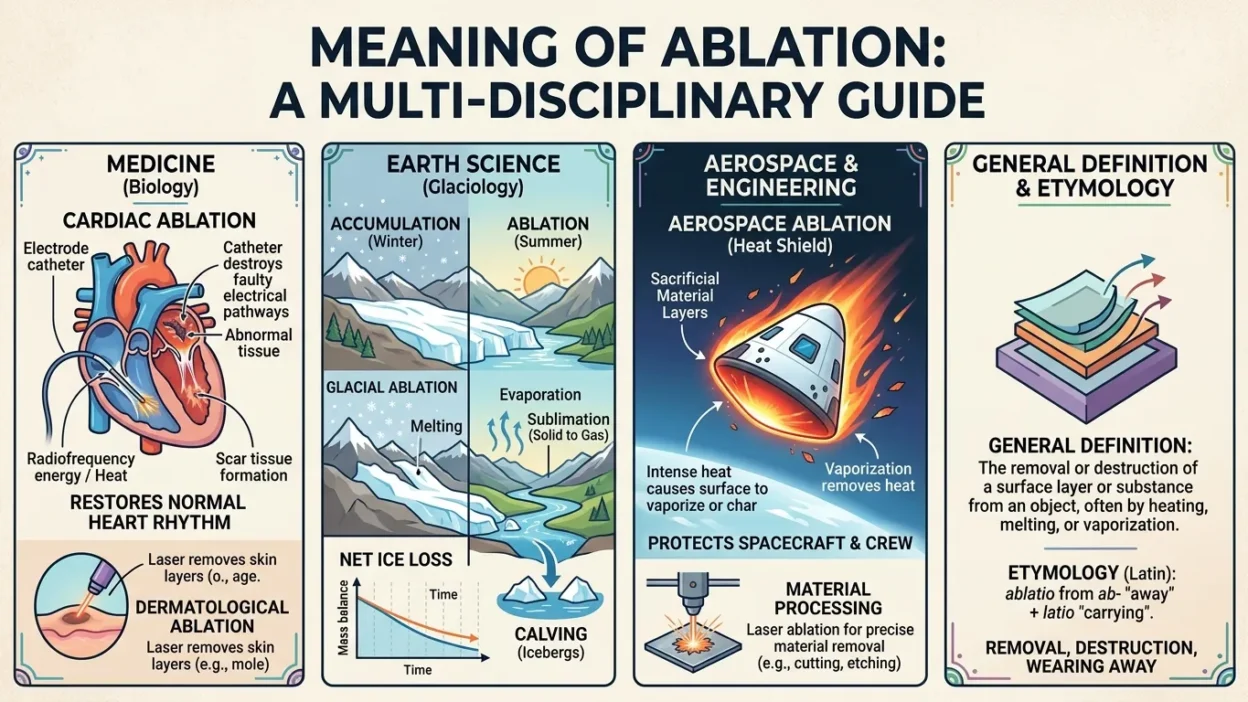
If you searched for ablation meaning, you may have seen the word in a heart, cancer, thyroid, or pain-treatment context. It can sound complex, but the basic idea is simple.
Ablation means destroying or removing unwanted or abnormal tissue so it can no longer cause a problem. Doctors can do this in several ways, including heat, extreme cold, lasers, chemicals, or other forms of energy.
The exact meaning depends on where the ablation happens. For example, cardiac ablation treats abnormal heart rhythms, while radiofrequency ablation may treat certain tumors or pain conditions.
In this guide, you will learn what ablation means, how it works, the main types, why doctors use it, what recovery may involve, and what questions you should ask your doctor.
Quick Answer
Ablation means using a controlled treatment to destroy, remove, or disable abnormal tissue.
Doctors use ablation for many health problems. The method may use heat, cold, electrical energy, lasers, or other techniques. The goal is to treat the problem while limiting damage to nearby healthy tissue.
The word does not describe just one procedure. “Ablation” is a broad medical term. The meaning changes based on the body part and condition being treated.
Ablation Definition & Meaning
In medical language, ablation refers to the destruction or removal of tissue.
Doctors often target tissue that is causing an unwanted problem. They then use a controlled source of energy or another method to damage that tissue.
For example, abnormal heart cells can send faulty electrical signals. During cardiac ablation, a doctor creates small areas of scar tissue that interrupt those signals.
In cancer treatment, ablation can destroy tumor cells. A doctor may guide a probe into or near a tumor and use heat or cold to kill the targeted cells.
So, in plain English:
Ablation = controlled destruction or removal of unwanted tissue.
It does not always mean that a doctor cuts the tissue out. Some forms of ablation destroy tissue in place.
What Does Ablation Mean in Medical Terms?
The medical meaning of ablation is broader than one specific treatment.
Doctors can use different forms of energy or techniques depending on the condition. Common methods include:
- Radiofrequency ablation: Uses electrical energy to create heat.
- Cryoablation: Uses extreme cold to freeze and destroy tissue.
- Laser ablation: Uses laser energy.
- Microwave ablation: Uses microwave energy to produce heat.
- Chemical ablation: Uses a chemical substance to destroy targeted tissue.
Not every type is suitable for every condition. Your doctor chooses the method based on the location, size, type, and purpose of the treatment.
What Is Cardiac Ablation?
When people search for ablation meaning, they often mean heart ablation.
Cardiac ablation is a treatment for abnormal heart rhythms, also called arrhythmias. A heart specialist guides a thin catheter through a blood vessel to the heart.
The doctor identifies the area that produces abnormal electrical signals. The catheter then delivers energy, such as radiofrequency heat or extreme cold, to create small scars.
These scars can block the faulty electrical signals that cause an abnormal rhythm.
Cardiac ablation may be used for conditions such as atrial fibrillation and some forms of supraventricular tachycardia.
The exact procedure depends on the type of rhythm problem and the patient’s health.
What Is Ablation for Cancer?
Doctors can also use ablation to treat some tumors.
In radiofrequency ablation, a doctor guides a needle-like device toward the target tissue. Electrical energy then creates heat that destroys cells around the device.
Another approach is cryoablation. It uses very cold temperatures to freeze and destroy diseased tissue.
Ablation may offer an alternative to some forms of major surgery in selected patients. However, it is not the right treatment for every tumor.
The choice depends on factors such as the type, size, location, and stage of the disease.
How Does an Ablation Procedure Work?
The steps depend on the type of ablation, but the basic process often follows a similar pattern.
1. Preparation
Your healthcare team reviews your medical history, medicines, and test results.
You may need to stop eating or drinking for a set period before some procedures. Your doctor will give you specific instructions.
2. Anesthesia or sedation
Some procedures use local anesthesia to numb an area. Others may require sedation or general anesthesia.
The choice depends on the procedure and your medical needs.
3. Reaching the target
The doctor may use a catheter, needle, probe, or another device.
Imaging can help guide the device to the correct location. Depending on the procedure, doctors may use ultrasound, CT, MRI, X-ray imaging, or other methods.
4. Treating the tissue
The doctor applies the selected energy or treatment to the target tissue.
The goal is to destroy the unwanted tissue while limiting harm to nearby healthy structures.
5. Recovery and monitoring
After the procedure, your care team checks your vital signs and watches for complications.
Some ablations are outpatient procedures, while more complex procedures may require a hospital stay.
Types of Ablation Explained
There are many forms of ablation. The most important difference is what the procedure treats and how it destroys the target tissue.
| Type | How it works | Common use |
| Radiofrequency ablation | Uses electrical energy to create heat | Heart rhythms, some tumors, certain pain conditions |
| Cryoablation | Uses extreme cold | Heart rhythms and some tumors |
| Laser ablation | Uses laser energy | Selected medical conditions |
| Microwave ablation | Uses microwave energy to create heat | Some tumors |
| Chemical ablation | Uses chemicals to damage tissue | Selected medical conditions |
This table gives a broad overview. A particular procedure may have additional uses or limitations.
Ablation vs. Surgery: What Is the Difference?
Ablation and surgery can both treat abnormal tissue, but they do not always work in the same way.
Traditional surgery may involve removing tissue through a larger incision. Ablation often destroys the target tissue through a smaller opening, catheter, needle, or probe.
Because of this, some ablation procedures are considered minimally invasive. They may involve smaller incisions, less bleeding, shorter hospital stays, and faster recovery than some major operations.
However, less invasive does not mean risk-free.
Some patients still need surgery, medication, or another treatment. Your doctor must decide which option fits your condition.
Benefits and Limits of Ablation
Ablation can provide important benefits, but it also has limits.
| Potential benefits | Important limitations |
| May avoid some major surgery | Not suitable for every condition |
| Often uses small openings or punctures | Results depend on the condition treated |
| May allow faster recovery than major surgery | Some problems may return |
| Can target abnormal tissue | Nearby tissue can sometimes be injured |
| Some procedures allow same-day discharge | Some procedures require hospital monitoring |
The right choice depends on your diagnosis, overall health, and the specific type of ablation being considered.
Is Ablation Safe?
Ablation is used widely, but every medical procedure carries some risk.
Possible complications vary greatly by procedure. General risks can include bleeding, infection, blood vessel injury, damage to nearby organs or nerves, blood clots, or other complications. Serious problems can occur in some procedures, although they may be uncommon.
For this reason, do not judge the safety of an ablation procedure only by its name.
Heart ablation, tumor ablation, and other forms of ablation have different risks.
Your doctor should explain the specific risks that apply to you.
Ablation Recovery: What Should You Expect?
Recovery depends on the type of ablation.
Some people return home the same day. Others need to stay in the hospital for observation.
You may have soreness, bruising, tiredness, or mild pain around the treatment area. Recovery can range from several days to several weeks, depending on the procedure.
Your doctor may also give you temporary limits on exercise, lifting, driving, or work.
Follow those instructions rather than comparing your recovery with another person’s experience.
When Should You Contact Your Doctor?
Follow your care team’s instructions. Seek medical advice promptly if you develop warning signs such as:
- Heavy bleeding
- Severe or worsening pain
- Fever
- Signs of infection
- Unusual swelling or discharge
- Severe nausea or vomiting
- Other symptoms your doctor told you to watch for
The exact warning signs depend on the procedure.
Common Mistakes People Make About Ablation
A common mistake is thinking that “ablation” always means heart treatment.
It does not.
Another mistake is assuming that ablation completely removes every disease. In some cases, ablation treats the source of a problem. In others, it reduces symptoms or destroys a specific area of abnormal tissue.
People also sometimes assume that minimally invasive means completely risk-free. That is not correct.
Quick Reference Checklist
| Before an ablation | What to remember |
| Know the diagnosis | Ask exactly what condition the procedure will treat |
| Know the target | Ask which tissue will be treated |
| Understand the method | Ask whether the procedure uses heat, cold, or another method |
| Review medicines | Tell your doctor about prescription drugs and supplements |
| Ask about anesthesia | Find out what type you will receive |
| Ask about recovery | Learn when you can drive, work, exercise, and lift |
| Know the warning signs | Ask when you should call the medical team |
| Discuss alternatives | Ask whether medication, surgery, monitoring, or another treatment is possible |
This checklist can help you have a more useful conversation with your healthcare provider.
What Questions Should You Ask Before Ablation?
Before agreeing to a procedure, consider asking:
What exactly are you treating?
This helps you understand the purpose of the procedure.
Why do you recommend ablation for me?
There may be several treatment options. Your doctor can explain why ablation may fit your situation.
What type of ablation will you use?
Ask whether the procedure uses heat, cold, electrical energy, a laser, or another method.
What are the main risks?
Ask about both common side effects and serious complications.
How long will recovery take?
Your expected recovery can depend on the body part treated and the type of procedure.
What happens if ablation does not work?
Knowing the next step can reduce uncertainty and help you make an informed decision.
Ablation Meaning in Simple Words
If you need the shortest explanation, remember this:
Ablation means destroying or disabling unwanted tissue in a controlled way to treat a medical problem.
Doctors use different ablation techniques for different conditions.
For example, cardiac ablation can interrupt abnormal electrical signals in the heart. Tumor ablation can destroy selected tumor tissue.
The word itself does not tell you the whole story. You need to know what is being treated, where it is located, and which ablation method the doctor plans to use.
FAQs:
1. What does ablation mean in simple terms?
Ablation means destroying or disabling unwanted or abnormal tissue. Doctors use different methods, including heat, extreme cold, lasers, and other forms of energy. The exact meaning depends on the condition being treated.
2. Is ablation the same as surgery?
No. Ablation and surgery are different treatments. Many ablation procedures are minimally invasive and use a catheter, needle, probe, or small opening instead of a large surgical incision. However, some ablation procedures can also take place during surgery.
3. What is cardiac ablation?
Cardiac ablation is a treatment for abnormal heart rhythms. A doctor guides a catheter to the heart and uses controlled energy to create small scars that can block faulty electrical signals.
4. Does ablation hurt?
Pain and discomfort vary by procedure. Doctors may use local anesthesia, sedation, or general anesthesia to help control discomfort. You may have soreness or pain after some procedures, but your care team will give you instructions for managing it.
5. How long does it take to recover from ablation?
There is no single recovery time for every ablation. Some people recover within days, while others need several weeks. The type and location of the procedure have a major effect on recovery.
6. Can ablation cure a medical condition?
Sometimes ablation can correct or control the source of a medical problem. In other cases, it may reduce symptoms or destroy a specific area of abnormal tissue. Whether it can provide a lasting cure depends on the condition and the individual patient.
7. What are the risks of ablation?
Risks depend on the specific procedure. They can include bleeding, infection, blood vessel injury, damage to nearby tissue, blood clots, and other complications. Ask your doctor about the risks that apply to your exact treatment.
Conclusion:
Understanding ablation meaning is easier when you remember one simple idea: ablation uses a controlled treatment to destroy or disable unwanted tissue. Doctors use it for several conditions, including abnormal heart rhythms and some tumors.
The method can involve heat, cold, lasers, or other forms of energy. Some procedures are minimally invasive and may offer a shorter recovery than major surgery. Still, ablation is not right for everyone, and each type has its own risks and benefits.
If your doctor has recommended ablation, ask what tissue will be treated, why the procedure is needed, what alternatives exist, and what recovery will look like. Those answers will help you make a better-informed decision.

I am Scottking, the heart and voice behind PrayersVibe.com, where faith meets real-life emotions.
I am here to share powerful prayers, spiritual comfort, and words that heal the soul.
I am walking this journey of faith with you one prayer, one hope, one blessing at a time.