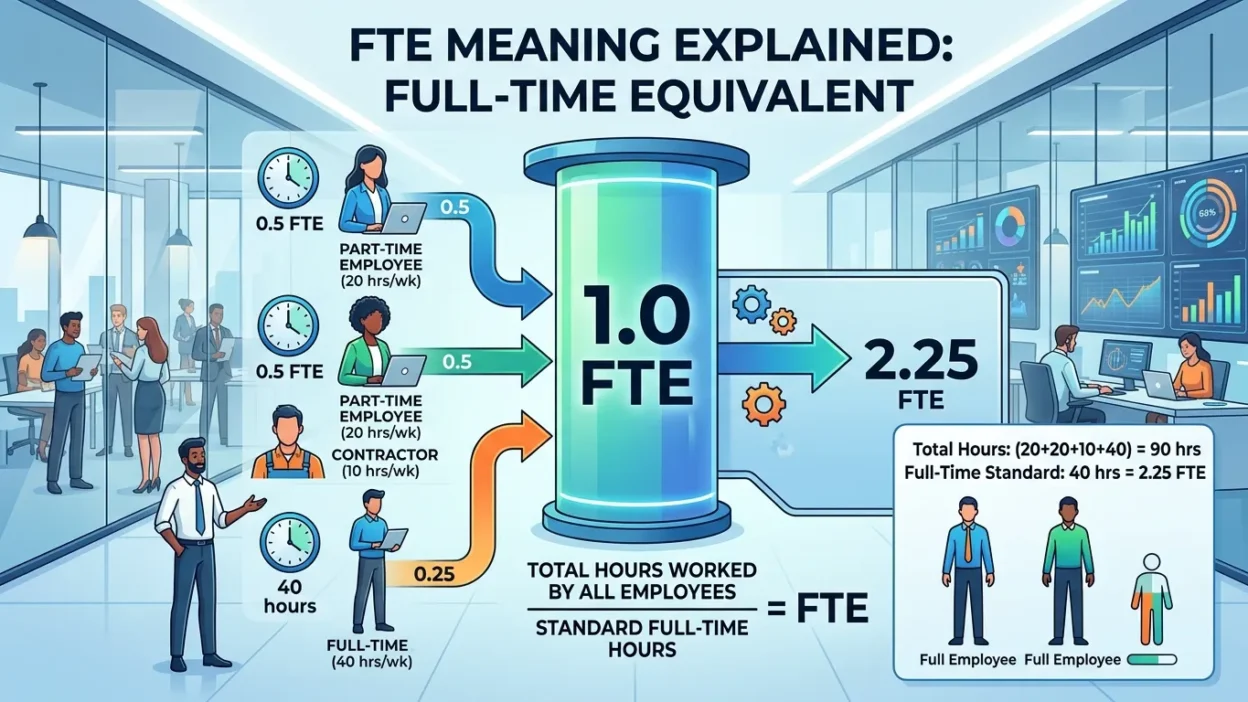
If you saw FTE on a job post, work schedule, payroll report, or company document, you may wonder what it means. The most common FTE meaning is Full-Time Equivalent. It is a way to measure work hours as a share of one full-time worker.
For example, if a company treats 40 hours per week as full-time, a person who works 40 hours has an FTE of 1.0. Someone who works 20 hours has an FTE of 0.5.
FTE does not always mean the number of people in a company. Instead, it measures the amount of full-time work those people represent. This makes it useful for hiring, budgets, staffing, payroll planning, and project work.
In this guide, you will learn the simple meaning of FTE, how to calculate it, what numbers such as 0.5 and 0.75 FTE mean, and how FTE differs from headcount.
Quick Answer
FTE means “Full-Time Equivalent.” It is a measurement that shows how much work equals one full-time worker.
If full-time work at a company is 40 hours per week:
- 1.0 FTE = 40 hours
- 0.75 FTE = 30 hours
- 0.5 FTE = 20 hours
- 0.25 FTE = 10 hours
The exact hours can vary because employers and organizations may define full-time work differently.
Definition & Meaning
The FTE meaning is Full-Time Equivalent.
Think of FTE as a measuring unit for work. It turns different work schedules into one common number.
Suppose one worker works 40 hours each week. That worker represents 1.0 FTE under a 40-hour standard.
Now suppose two workers each work 20 hours. Together, they also provide 40 hours of work. Their combined workload equals 1.0 FTE, even though the company has two people.
This is why FTE and employee count are not the same thing.
The IRS also uses the term in specific legal and tax contexts. Its rules can use different hour thresholds and calculation methods, so a general workplace FTE calculation should not be confused with an FTE figure used for a specific tax rule.
What Does FTE Mean in a Job?
When you see FTE in a job listing, it usually describes the position as a full-time equivalent role.
For example, a job may be listed as:
“1.0 FTE Marketing Specialist”
This normally means the role is planned as a full-time position under that employer’s work schedule.
You may also see:
“0.5 FTE Assistant”
This means the role represents half of the employer’s full-time workload.
However, FTE does not automatically tell you every detail about the job. It may not tell you the exact schedule, benefits, salary, overtime rules, or employment status.
Always read the job description and ask the employer if those details are unclear.
What Does 1.0 FTE Mean?
1.0 FTE means one full-time equivalent.
The important point is that the actual number of hours depends on the organization’s definition of full-time work.
For a 40-hour workweek:
1.0 FTE = 40 hours per week
For a 35-hour workweek:
1.0 FTE = 35 hours per week
So you should not assume that every company uses 40 hours when calculating FTE.
Indeed notes that many organizations use 40 hours, but the full-time standard can depend on company policy and location.
What Does 0.5 FTE Mean?
0.5 FTE means half of a full-time workload.
If full-time work equals 40 hours per week:
0.5 × 40 = 20 hours
So 0.5 FTE would equal 20 hours per week under that standard.
It does not necessarily mean the employee is paid exactly half in every situation. Pay, benefits, leave, and other terms depend on the employer’s policies and applicable rules.
What Does 0.75 FTE Mean?
A 0.75 FTE represents 75% of a full-time workload.
Using a 40-hour workweek:
0.75 × 40 = 30 hours
So 30 hours per week equals 0.75 FTE when 40 hours is the full-time standard.
This can help employers compare workers who have different schedules.
What Does 0.25 FTE Mean?
A 0.25 FTE represents one-quarter of a full-time workload.
With a 40-hour workweek:
0.25 × 40 = 10 hours
So 10 hours per week would equal 0.25 FTE under that example.
FTE can also help when several people share the work of one full-time position.
For example, four people who each work 10 hours could collectively provide 1.0 FTE.
How to Calculate FTE
The basic calculation is simple:
FTE = Total work hours ÷ Full-time work hours
For a weekly calculation, first identify the normal full-time weekly hours.
Example
Imagine a company uses 40 hours as its full-time week.
Three employees work:
- Employee A: 40 hours
- Employee B: 20 hours
- Employee C: 20 hours
Total hours:
40 + 20 + 20 = 80 hours
Now divide by 40:
80 ÷ 40 = 2.0 FTE
The company has three employees, but their combined work equals 2.0 FTE.
This shows why FTE gives a different view from simple headcount.
For annual planning, organizations can use annual hours instead. For example, 40 hours per week multiplied by 52 weeks gives 2,080 hours. Some formal calculations use different rules, so use the method required for the specific purpose. The IRS, for example, has specific FTE rules for tax purposes.
FTE vs. Headcount
FTE and headcount answer two different questions.
Headcount asks: “How many people do we have?”
FTE asks: “How much full-time work do those people represent?”
Imagine a company has five workers:
- Two work 40 hours.
- Three work 20 hours.
The headcount is 5.
But if 40 hours equals full-time:
- Two full-time workers = 2.0 FTE
- Three half-time workers = 1.5 FTE
Total:
3.5 FTE
So the company has five people but 3.5 FTE.
This difference can matter when managers plan staffing, budgets, workloads, and projects.
FTE vs. Full-Time Employee
These terms sound similar, but they are not always interchangeable.
A full-time employee is a person.
An FTE is a measurement.
One full-time employee may equal 1.0 FTE. But several part-time workers can also combine to equal 1.0 FTE.
For example, two people working 20 hours each can equal one FTE in a workplace where 40 hours represents full-time work.
There is another important point: legal definitions can vary by purpose. For example, the IRS uses a specific definition of full-time employee for the Affordable Care Act, including a 30-hour-per-week or 130-hour-per-month standard for that particular rule.
So do not use a general FTE calculation as a substitute for a legal or tax rule.
FTE Salary: Does FTE Affect Pay?
FTE can help describe the size of a role, but it does not by itself determine someone’s exact salary.
Suppose a full-time role has a salary of $60,000 and an employee works 0.5 FTE.
A simple proportional calculation might suggest $30,000. But this is only an example of how FTE can be used for planning. Actual pay depends on the employment agreement, pay structure, location, benefits, and company policy.
The same caution applies to benefits.
An employer may have different rules for health insurance, paid time off, retirement plans, or other benefits. Therefore, 0.5 FTE does not automatically mean every part of the employment package is exactly half of full-time terms.
Why Do Companies Use FTE?
FTE gives businesses a common way to measure labor.
A company may use it to:
- Plan staffing needs
- Estimate labor costs
- Compare workloads
- Build budgets
- Plan projects
- Track workforce capacity
- Compare full-time and part-time work
- Decide whether more staff may be needed
For example, imagine a project needs 400 hours of work and must finish within two weeks.
If one FTE provides 40 hours per week, one FTE provides about 80 hours over two weeks.
The project would need the equivalent of about five FTEs to provide 400 hours during that period, assuming all those hours are available for the project.
Real projects can be more complex because workers have meetings, leave, other duties, and different schedules. So FTE is a planning tool, not a guarantee that a project will finish on time.
Common FTE Mistakes to Avoid
FTE looks simple, but people often use it incorrectly.
Mistake 1: Treating FTE as headcount
Five employees do not always equal five FTE.
Part-time workers can make total FTE lower than headcount.
Mistake 2: Assuming every company uses 40 hours
Many organizations use 40 hours as a standard, but not all do.
Check the employer’s definition before doing the calculation.
Mistake 3: Assuming FTE tells you salary
FTE describes workload or employment capacity. It does not, by itself, establish a worker’s exact salary.
Mistake 4: Using a general formula for a legal rule
Some government programs use their own FTE definitions and formulas.
For example, the IRS has special rules for determining FTEs for specific tax purposes.
Mistake 5: Thinking 0.5 FTE means half of everything
A 0.5 FTE workload does not automatically mean half the benefits, leave, or other employment terms.
Read the employer’s policy.
FTE Comparison: Common Numbers
| FTE | Share of Full-Time Work | Hours at 40 Hours/Week |
| 1.0 FTE | 100% | 40 hours |
| 0.75 FTE | 75% | 30 hours |
| 0.5 FTE | 50% | 20 hours |
| 0.25 FTE | 25% | 10 hours |
| 0.1 FTE | 10% | 4 hours |
These figures use a 40-hour workweek only as an easy example. Your employer may use another full-time standard.
FTE Quick Reference Checklist
| Question | What to Check |
| What does FTE mean? | Full-Time Equivalent |
| What does 1.0 FTE mean? | One full-time workload |
| What does 0.5 FTE mean? | Half of the full-time workload |
| How do I calculate FTE? | Total hours ÷ full-time hours |
| Is FTE the same as headcount? | No |
| Does FTE always mean 40 hours? | No |
| Does FTE set salary? | No |
| Can part-time workers make 1.0 FTE? | Yes |
| Are legal FTE rules always the same? | No; purpose-specific rules may apply |
FTE Meaning in Different Work Situations
You may see FTE in several places.
Job Listings
A job post may use FTE to show whether a position is full-time or a fraction of a full-time role.
Human Resources
HR teams can use FTE to compare different work schedules and plan staffing.
Project Management
Project managers can use FTE to estimate how much workforce capacity a project needs.
Budget Planning
Finance teams can use FTE to connect staffing levels with labor costs.
Government and Tax Reporting
Government agencies may use FTE as a formal workforce measure. The exact calculation can depend on the program or law. The IRS, for example, defines FTE in several specific contexts.
Is FTE the Same as WTE?
You may also come across WTE, which stands for Whole-Time Equivalent.
In many workplace contexts, WTE and FTE describe a similar idea: comparing work with a standard full-time workload.
The term used can depend on the country, organization, or industry. Indeed notes that WTE is another term used for the same type of measurement.
How to Read FTE on a Job Offer
If you see an FTE number on a job offer, do not stop at the number.
Check these details:
- Ask what the employer defines as full-time.
- Confirm the expected weekly hours.
- Check whether the role is permanent or temporary.
- Ask about salary or hourly pay.
- Review benefit eligibility.
- Check the expected schedule.
- Ask about overtime rules if relevant.
This gives you a much clearer picture of what the position actually involves.
FAQs:
1. What does FTE stand for?
FTE stands for Full-Time Equivalent. It measures work capacity against a full-time standard. For example, if 40 hours is full-time, 20 hours represents 0.5 FTE.
2. What does 1.0 FTE mean?
1.0 FTE means one full-time equivalent. The number of hours depends on the organization’s full-time work standard. If the standard is 40 hours per week, 1.0 FTE equals 40 weekly hours.
3. What does 0.5 FTE mean?
0.5 FTE means half of the full-time workload. Under a 40-hour weekly standard, that equals 20 hours per week.
4. Is FTE the same as full-time?
Not exactly. A full-time employee is a person who meets the employer’s full-time standard. FTE is a measurement of work capacity. Multiple part-time workers can combine to create 1.0 FTE.
5. Is FTE the same as headcount?
No. Headcount counts people. FTE measures their combined work against a full-time standard. A company can have five employees but fewer than five FTEs.
6. How do I calculate FTE?
Divide total work hours by the number of hours that count as full-time for the same period. For example, 80 hours divided by 40 full-time hours equals 2.0 FTE.
7. Does FTE determine salary?
No. FTE can help describe the size of a role, but salary depends on the employer’s pay structure, contract, location, and other factors. Do not assume an FTE number alone tells you what you will earn.
Conclusion:
The simplest FTE meaning is Full-Time Equivalent. It is a useful way to measure work by comparing total hours with a full-time workload.
Remember the key difference: headcount tells you how many people you have, while FTE tells you how much full-time work those people represent. A 1.0 FTE can come from one full-time worker or several part-time workers.
If you see FTE on a job post, payroll document, or business report, check the full-time hour standard first. For legal, tax, or benefits questions, also check the specific rules that apply. That small step can prevent a lot of confusion.

I am Scottking, the heart and voice behind PrayersVibe.com, where faith meets real-life emotions.
I am here to share powerful prayers, spiritual comfort, and words that heal the soul.
I am walking this journey of faith with you one prayer, one hope, one blessing at a time.