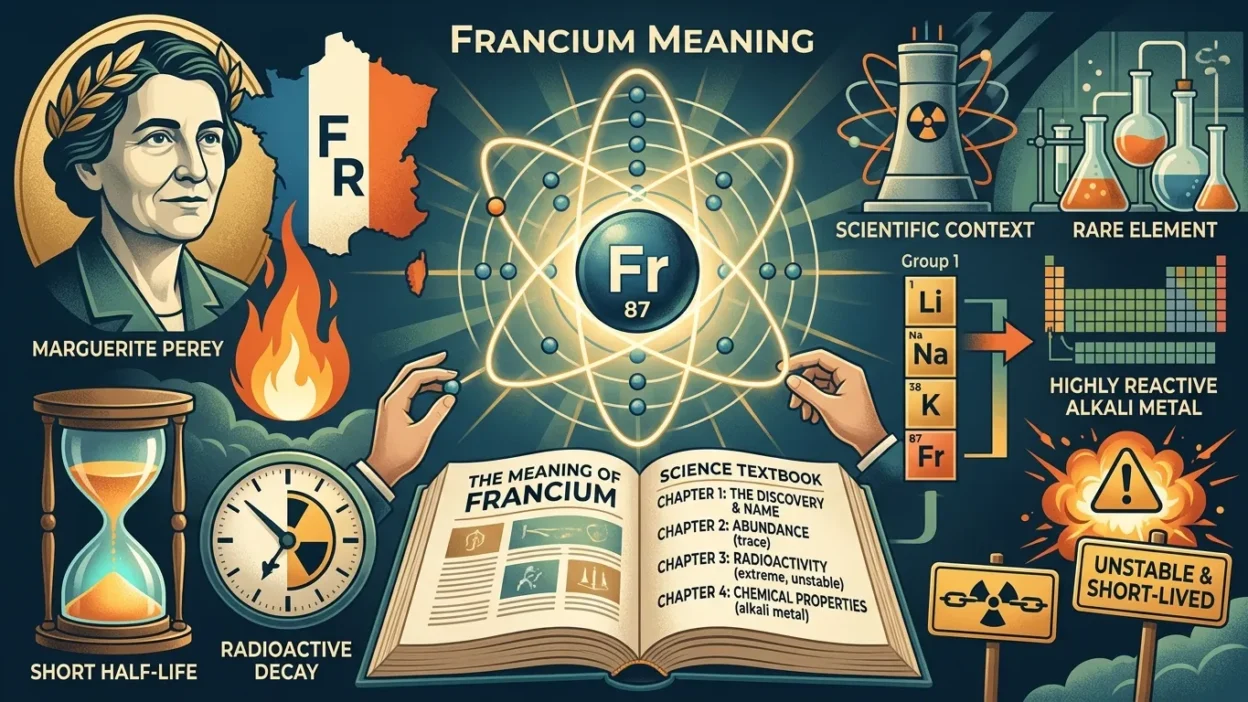
What does francium meaning really refer to? In simple terms, francium is the name of a rare, highly radioactive chemical element. It has the symbol Fr and atomic number 87. It belongs to the alkali metal group, the same family as lithium, sodium, potassium, rubidium, and cesium.
Francium stands out because it is extremely unstable. Its most important natural isotope, francium-223, has a half-life of about 22 minutes. That means scientists cannot collect or store a normal sample of francium for long.
In this guide, you will learn the francium element meaning, its francium symbol, francium atomic number, properties, history, half-life, natural occurrence, and possible uses.
You will also see why francium is so rare and why many claims about it being the “most reactive metal” need a little care.
Quick Answer: What Is the Francium Meaning?
The word francium refers to a chemical element with the symbol Fr and atomic number 87. It is a radioactive alkali metal named after France, the country of its discoverer, Marguerite Perey.
Francium occurs naturally only in tiny amounts because its isotopes decay very quickly. Its best-known isotope, francium-223, has a half-life of about 22 minutes.
So, if you see “francium” in a chemistry lesson, it means element 87 on the periodic table.
Francium Definition and Meaning
Francium is a chemical element found in Group 1 of the periodic table. Group 1 contains the alkali metals.
Its position tells us a lot about its chemistry. Francium has one electron in its outer shell, shown by its electron configuration [Rn] 7s¹. It commonly forms a +1 oxidation state by losing that outer electron.
The name also has a simple story.
The element was named francium after France. Marguerite Perey discovered it in 1939 while working at the Curie Institute in Paris. She studied radioactive material from actinium and found evidence of a new element.
Before its discovery, scientists had predicted that an element should exist below cesium in Group 1. Several earlier claims of finding it turned out to be wrong. Perey’s work finally provided convincing evidence for element 87.
Francium Symbol and Atomic Number
The francium symbol is Fr.
Its atomic number is 87. Atomic number means the number of protons in the nucleus of an atom. Therefore, every neutral francium atom has 87 protons and 87 electrons.
The element has a relative atomic mass listed as about [223] because its isotopes are radioactive and it has no stable isotope. Francium-223 is the key naturally occurring isotope.
Here is a quick reference:
| Property | Francium |
| Name | Francium |
| Symbol | Fr |
| Atomic number | 87 |
| Group | 1 |
| Period | 7 |
| Block | s-block |
| Family | Alkali metals |
| Common oxidation state | +1 |
| Electron configuration | [Rn] 7s¹ |
| Key natural isotope | Francium-223 |
| Francium-223 half-life | About 22 minutes |
| Discovered | 1939 |
| Named after | France |
Where Is Francium on the Periodic Table?
Francium sits at the bottom of Group 1 in the periodic table.
Above it, you will find cesium, followed by other alkali metals such as rubidium, potassium, sodium, and lithium.
This location is important because elements in the same group often share similar chemical behavior. They have one outer electron and tend to lose it during chemical reactions.
Francium is also in Period 7, which means its electrons occupy seven main energy levels.
Its position helps scientists predict some of its chemical behavior even though they cannot easily study a large physical sample.
Francium Properties Explained Simply
The francium properties make it one of the most unusual elements on the periodic table.
Francium is a metal and is intensely radioactive. The Royal Society of Chemistry lists it as a solid at 20°C, while other reference data give melting and boiling values that differ slightly.
Scientists know much of its chemistry through radioactive and theoretical studies because no weighable quantity of francium has been isolated.
Francium has a strong tendency to form a +1 ion. This matches the general behavior of Group 1 metals.
Its chemistry is most similar to cesium, its closest stable-group neighbor above it.
One common mistake is to assume that francium must automatically be the most reactive metal because it sits below cesium.
The trend becomes more complicated for very heavy atoms. Relativistic effects change how the electrons behave, so francium does not simply follow the basic Group 1 trend in every measurable property. The Royal Society of Chemistry notes that cesium actually has a lower first ionization energy than francium.
Why Is Francium So Rare?
Francium is rare because it disappears almost as soon as it forms.
Its longest-lived naturally occurring isotope, francium-223, has a half-life of about 22 minutes. After one half-life, half of a sample has decayed. After another half-life, half of what remains decays again.
Francium can form naturally during radioactive decay.
For example, actinium-227 can decay into francium-223 through alpha decay. Francium-223 then undergoes further radioactive decay.
This creates a simple problem: even when nature makes francium, the element quickly changes into other atoms.
The result is an extremely small amount of francium in Earth’s crust at any given time. Los Alamos National Laboratory states that there is probably less than an ounce of francium in the entire Earth’s crust at one time.
Francium Half-Life and Radioactivity
The francium half-life is one of the most important facts about this element.
Francium-223 has a half-life of about 22 minutes. It can decay by beta emission or alpha decay pathways as part of its radioactive behavior.
A half-life does not mean that every atom disappears after 22 minutes.
Instead, it describes the time needed for half of a radioactive sample to decay.
For example, if you somehow had 100 atoms of francium-223, about 50 would remain after one half-life. After another half-life, about 25 would remain.
The actual sample would keep shrinking as radioactive decay continues.
This short half-life explains why francium is so difficult to study and why it has no common household, industrial, or commercial role.
How Was Francium Discovered?
Marguerite Perey discovered francium in 1939 at the Curie Institute in Paris.
Her work involved studying actinium and carefully separating radioactive products. She noticed radiation that could not be explained by the known elements in her sample.
Perey correctly connected this activity to the missing element with atomic number 87.
She first referred to the substance as actinium-K. Later, she suggested the name francium, honoring France. The name was accepted.
The discovery was important because it completed a long-standing gap in the alkali-metal section of the periodic table.
It also showed how radioactive decay can help scientists find elements that exist only for a very short time.
Does Francium Occur Naturally?
Yes. Francium occurs naturally, but only in extremely tiny quantities.
It forms as part of radioactive decay chains. One important route comes from actinium-227, which can produce francium-223 through alpha decay.
Francium can therefore be found in association with uranium-bearing minerals, but it does not build up in large amounts.
There is an important difference between “naturally occurring” and “easy to find.”
Francium is naturally formed, but its short half-life keeps its amount very low. Researchers cannot simply mine a rock and collect a useful supply of francium.
Can Scientists Make Francium?
Yes. Scientists can produce francium artificially.
The Royal Society of Chemistry notes that francium can be produced by neutron bombardment of radium. It can also be made by bombarding thorium with protons.
However, making francium does not solve the main problem.
The atoms still decay quickly.
Because the element is highly radioactive and extremely short-lived, researchers work with very small quantities and specialized methods. Los Alamos notes that no weighable quantity of francium has been prepared or isolated.
This is why you will not find a bottle of pure francium in a normal chemistry lab.
What Are the Uses of Francium?
This is one of the most useful points to understand about francium.
Francium has no practical commercial uses. Its short half-life makes it unsuitable for ordinary products and industrial applications. The Royal Society of Chemistry specifically lists no uses for francium.
Its main value comes from scientific research.
Scientists study francium to learn more about atomic structure, radioactive decay, and the behavior of very heavy atoms.
So, when someone asks, “What is francium used for?” the safest answer is:
Francium is mainly useful as a subject of scientific research rather than as a practical material.
Francium: Common Mistakes vs Correct Facts
| Common mistake | Correct fact |
| Francium is stable. | Francium has no stable isotope. |
| You can store a large sample of francium. | Its short half-life makes this impractical. |
| Francium is common in nature. | It occurs naturally only in extremely tiny amounts. |
| Francium has many commercial uses. | It has no practical commercial uses. |
| Its symbol is F. | Its symbol is Fr. |
| Its atomic number is 88. | Its atomic number is 87. |
| Francium was discovered in the 1800s. | It was discovered in 1939. |
| Francium is named after a person. | It is named after France. |
| Francium’s chemistry is completely unknown. | Scientists know important chemical properties through radiochemical and related studies. |
| Francium must be the most reactive metal in every sense. | Heavy-atom effects make this more complex than a simple periodic trend. |
Is Francium Dangerous?
Francium is dangerous because it is highly radioactive.
Its radioactivity, rather than ordinary chemical toxicity, is the main concern. The Royal Society of Chemistry describes francium as toxic due to its radioactivity.
Still, the danger should not be confused with everyday exposure.
Francium is so rare and short-lived that ordinary people do not encounter a macroscopic sample of the element.
In professional research, scientists use controlled facilities and radiation-safety procedures when working with radioactive materials.
The practical lesson is simple: francium is not a material for home experiments or casual handling.
Francium Compared With Cesium
Francium and cesium are both Group 1 alkali metals, so they share several chemical features.
Both have one outer electron and commonly form +1 ions. However, cesium is much easier to obtain and study because it has stable isotopic material, while francium is intensely radioactive and short-lived.
Their comparison also explains why chemistry can be more complex than simply reading the periodic table from top to bottom.
Cesium has a lower first ionization energy than francium, according to the Royal Society of Chemistry. This is linked to relativistic effects that become important in very heavy atoms.
Why Is Francium Important in Chemistry?
Francium is important even though it has few practical uses.
First, it helps scientists test ideas about the periodic table.
Second, its extreme radioactivity provides a useful case for studying nuclear decay.
Third, francium gives scientists a way to explore how very heavy atoms behave. Its electron structure also helps researchers examine where simple periodic trends begin to break down.
This makes francium a good example of a scientific idea that has value even without a commercial product.
Not every element needs to be used in a phone, medicine, building, or machine to be important.
How to Remember the Francium Meaning
If you need a simple way to remember the answer, focus on five facts:
Francium = France + Fr + 87 + alkali metal + extreme radioactivity.
The name connects it to France.
The symbol Fr identifies it on the periodic table.
The number 87 identifies its atomic number.
Its Group 1 position makes it an alkali metal.
Its short half-life explains why it is so rare and difficult to study.
Francium Quick Reference Checklist
| What to remember | Quick answer |
| Meaning | A chemical element |
| Symbol | Fr |
| Atomic number | 87 |
| Group | 1, alkali metals |
| Period | 7 |
| Key isotope | Francium-223 |
| Half-life | About 22 minutes |
| Discovery | 1939 |
| Discoverer | Marguerite Perey |
| Name origin | France |
| Natural occurrence | Radioactive decay |
| Main value | Scientific research |
| Commercial uses | None |
FAQs:
1. What does francium mean in simple words?
Francium means the chemical element with atomic number 87. It is a radioactive alkali metal with the symbol Fr. Its name comes from France, and it was discovered by Marguerite Perey in 1939.
2. Why is francium called francium?
Francium was named after France. Marguerite Perey, who discovered the element, chose the name to honor her country.
3. What is the symbol for francium?
The chemical symbol for francium is Fr. Its atomic number is 87.
4. Is francium the rarest element?
Francium is one of the rarest naturally occurring elements because it forms in tiny amounts and decays very quickly. Its longest-lived naturally occurring isotope, francium-223, has a half-life of about 22 minutes.
5. Is francium radioactive?
Yes. All known francium isotopes are radioactive. Francium-223, the key naturally occurring isotope, has a half-life of about 22 minutes.
6. What is francium used for?
Francium has no practical commercial uses. Scientists mainly study it in research because its short half-life and intense radioactivity make it unsuitable for ordinary applications.
7. Is francium found naturally on Earth?
Yes. Francium forms naturally during radioactive decay, including the decay of actinium-227. However, only tiny amounts exist at any given time because francium decays rapidly.
Conclusion:
The francium meaning is simple once you know the key facts: francium is the radioactive chemical element with the symbol Fr and atomic number 87. It belongs to the alkali metals and was discovered by Marguerite Perey in 1939. Its name honors France.
Its biggest feature is its extreme instability. Francium-223 lasts only about 22 minutes on average before half of a sample decays. That explains why francium occurs naturally in only tiny amounts and has no common commercial use.
If you are studying the periodic table, remember Fr = francium = 87. That one link makes the element much easier to recall.

I’m Jessica Morgan, a writer who loves covering lifestyle, entertainment, sports, trends, and everyday topics in a simple and engaging way. At PrayersVibe.com, I focus on creating helpful, easy-to-read content that informs and connects with readers. I enjoy researching new ideas and turning them into clear, useful stories that readers can enjoy.