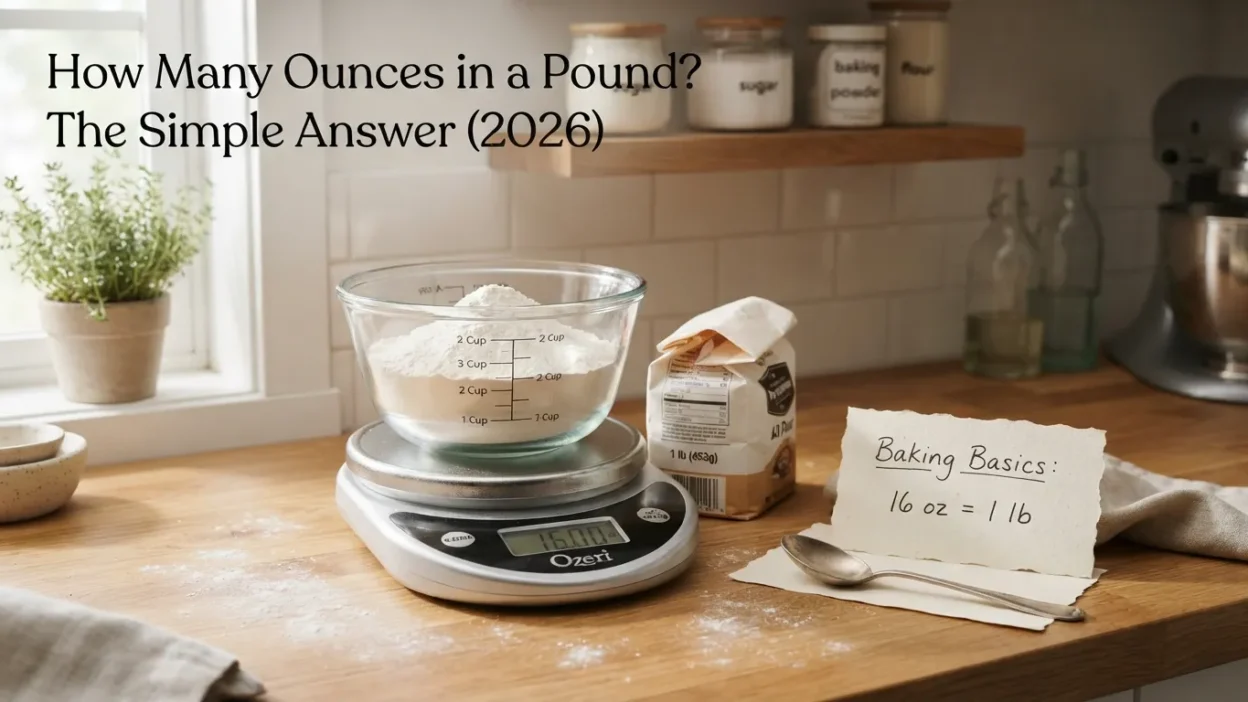
Quick, be honest. You’re standing in your kitchen, recipe in one hand, phone in the other, and you just need one number. There are 16 ounces in 1 pound. That’s it. That’s the whole formula.
Maybe you’re double-checking a recipe. Maybe you’re weighing a package before a trip to the post office. Or maybe you’re just trying to settle a quick debate with someone at the grocery store. Whatever brought you here, you’re in the right place, and the answer is simpler than you think.
But stick around, because knowing the number isn’t the same as knowing how to use it with confidence.
In the next few minutes, you’ll learn how to convert ounces to pounds in your head, why bakers and jewelers use different kinds of “ounces,” and how to avoid the one mistake that trips up almost everyone.
Quick Answer
One pound equals 16 ounces. This is true for weight measurements used every day in the United States groceries, body weight, shipping labels, and recipes.
Here’s the formula you need:
Pounds × 16 = Ounces
So if you have 2 pounds of flour, you have 32 ounces. If you have half a pound of turkey, you have 8 ounces. Simple math, every time.
And the reverse works just as easily:
Ounces ÷ 16 = Pounds
If a package weighs 48 ounces, divide by 16. You get 3 pounds.
That’s the core of it. Everything else in this guide just helps you apply that formula with confidence, in real life, without a calculator.
Understanding Pounds and Ounces: The Basics
Before we go further, let’s build a little context. Understanding why these units work the way they do makes the math stick better.
What Is a Pound?
A pound is a unit of weight in the US customary system. You’ll see it written as “lb” or “lbs,” which comes from the Latin word libra.
Americans use pounds for almost everything. Body weight. Grocery items. Shipping boxes. Gym equipment. It’s the everyday unit of weight in the U.S., much like the kilogram is used in most other countries.
One pound equals:
- 16 ounces
- 0.453592 kilograms
- 453.592 grams
What Is an Ounce?
An ounce is a smaller unit of weight. It’s part of the same system as the pound, just scaled down. Think of it like inches to feet smaller pieces that build up to a bigger whole.
One ounce equals:
- 1/16 of a pound
- 28.35 grams
- 0.0625 pounds
Ounces show up on nutrition labels, in recipes, and on the little scale at your local deli counter. If you’ve ever ordered “6 ounces of turkey breast,” you already know this unit better than you think.
History: Why 16 Ounces Make a Pound
Ever wonder why 16 and not a rounder number like 10? The answer goes back centuries.
The number 16 divides evenly by 2, 4, and 8. That made it far easier for merchants without calculators to split goods into halves, quarters, and eighths by eye. A pound of butter could be cut into two 8-ounce blocks, or four 4-ounce sticks, without any complicated math.
This system, called avoirdupois weight, came from medieval trade practices in England and eventually became the standard in the United States. It’s stuck around because, honestly, it still works.
The Simple Formula: How to Convert Pounds to Ounces
Let’s make this foolproof. Here’s every version of the formula you’ll ever need.
To convert pounds to ounces: Multiply the number of pounds by 16.
Example: 5 pounds × 16 = 80 ounces
To convert ounces to pounds: Divide the number of ounces by 16.
Example: 32 ounces ÷ 16 = 2 pounds
To convert pounds and ounces together: Multiply the pounds by 16, then add the extra ounces.
Example: 3 pounds 4 ounces = (3 × 16) + 4 = 52 ounces
That third one is the formula most people forget. It’s also the one you’ll use most in real life, especially with baby weights, packages, and recipes that mix units.
Ounces to Pounds Conversion Chart (Quick Reference Table)
Bookmark this. It’ll save you a dozen mental math sessions down the road.
| Pounds | Ounces |
| 0.25 lb | 4 oz |
| 0.5 lb | 8 oz |
| 0.75 lb | 12 oz |
| 1 lb | 16 oz |
| 2 lb | 32 oz |
| 3 lb | 48 oz |
| 4 lb | 64 oz |
| 5 lb | 80 oz |
| 10 lb | 160 oz |
| 25 lb | 400 oz |
| 50 lb | 800 oz |
| 100 lb | 1,600 oz |
Notice the pattern. Every whole pound adds another 16 to the ounce count. Once that clicks, you won’t need the chart anymore.
Weight Ounces vs. Fluid Ounces: Don’t Get Confused
This is where most conversion mix-ups happen, so let’s fix it right now.
A weight ounce measures how heavy something is. It’s what we’ve been talking about this whole article. Sixteen of them make a pound.
A fluid ounce measures volume, or how much space a liquid takes up. It’s what you see on a water bottle or a carton of milk.
Here’s the catch: these two units are not interchangeable, even though they share a name. A fluid ounce of water happens to weigh close to one weight ounce, but a fluid ounce of honey weighs more, and a fluid ounce of oil weighs less.
So if a recipe says “8 fl oz of milk,” that’s a volume measurement, not a weight one. But if it says “8 oz of cheese,” that’s weight. Reading the label carefully saves you from a kitchen disaster.
Real-Life Examples: Where You’ll Use This Conversion
Let’s ground this in situations you’ll actually run into.
Cooking and Baking
Recipes often list ingredients in ounces, especially for meat, cheese, pasta, and chocolate. If your recipe calls for a pound of ground beef and you only have an 8-ounce package, you know instantly you need to double it.
Baking is even more exact. A pound cake, true to its name, historically used a pound each of butter, sugar, eggs, and flour. That’s 16 ounces of each ingredient, measured precisely.
Grocery Shopping
Ever notice how meat, cheese, and produce are priced “per pound” but sold in smaller packages? A package labeled 12 oz is 3/4 of a pound. Knowing the math helps you compare prices and portion sizes without guessing.
This trick also helps with unit pricing. If a 12-ounce bag of coffee costs $9 and a 1-pound bag costs $11, you can quickly see which one gives you more for your money.
Grocery stores rarely make this obvious on the shelf tag, so doing the mental math yourself pays off.
Deli counters are another everyday example. When you ask for “half a pound of turkey,” the person behind the counter is aiming for 8 ounces on the scale. If you want a smaller portion, asking for “6 ounces” instead of “a little less than half a pound” gets you a more accurate cut every time.
Shipping and Postage
Postal services like USPS calculate shipping costs by weight, and rates change at pound thresholds. A package at 15.9 ounces costs less to ship than one that tips over into a full pound. That’s real money saved by understanding this conversion.
This matters even more for small business owners and online sellers. If you’re shipping handmade candles, jewelry, or books, trimming your packaging by even an ounce or two can drop your item into a cheaper shipping tier.
Many sellers weigh their packages in ounces first, then convert to pounds only when they cross that 16-ounce line, since carriers often price by the pound once you’re over a certain threshold.
Even everyday mail matters here. A single stamp usually covers letters up to 1 ounce, and each additional ounce adds a small fee. Knowing that 16 ounces make a pound helps you estimate costs before you even step up to the counter.
Fitness and Nutrition
Protein intake, meal prepping, and portion control all lean on ounces and pounds. A “4 oz chicken breast” is a common serving size. If your meal plan calls for 1 pound of chicken across four meals, you now know that’s exactly 4 ounces per serving.
Body weight tracking uses the same logic. If your goal is to lose a pound a week, and you weigh yourself daily, small ounce changes on the scale can feel discouraging. Remembering that a pound is made of 16 ounces helps you see that a 4-ounce fluctuation is nothing to worry about. It’s a quarter of a pound, easily explained by water weight or timing.
Meal prep containers often list capacity in ounces too. A container that holds 16 ounces of food holds exactly one pound of most solid ingredients, which makes portioning out a week’s worth of meals much easier to plan.
Gold, Silver, and Troy Ounces
Here’s a twist that surprises a lot of people. Precious metals like gold and silver aren’t weighed in regular ounces. They use troy ounces, an older system.
A troy ounce equals about 31.1 grams, slightly heavier than the standard (avoirdupois) ounce at 28.35 grams. And a troy pound has only 12 troy ounces, not 16.
So if you’re ever pricing gold jewelry, remember: it’s a different scale entirely. This is why a “troy ounce of gold” and a “regular ounce of sugar” are not directly comparable, even though they share the same unit name. Jewelers, coin collectors, and precious metal investors all use troy weight, while everyone else, including bakers, butchers, and shippers, uses standard avoirdupois ounces.
If you’ve ever seen gold prices quoted “per ounce” in the news, that number is always based on the troy ounce, not the one you’d use to weigh a bag of flour.
Common Mistakes People Make With Ounces and Pounds
Let’s cover the slip-ups so you can skip them.
Mixing up fluid ounces and weight ounces. As covered above, these measure completely different things. Always check If a recipe or label means volume or weight.
Forgetting the 16-ounce rule. Some people guess 10 or 12 ounces per pound, confusing it with the metric system or troy weights. It’s always 16 for standard weight.
Rounding too early. If you’re converting for shipping costs or a recipe that needs precision, round at the very end of your calculation, not in the middle.
Ignoring troy ounces for metals. Applying the 16-ounce rule to gold or silver will throw your math off. Remember, that world uses 12 troy ounces per troy pound.
Confusing dry and liquid measuring cups. A dry measuring cup and a liquid measuring cup hold the same volume, but they’re shaped differently for accuracy.
This isn’t the same issue as fluid versus weight ounces, but it trips up new bakers just as often, so it’s worth keeping in mind while you’re in the kitchen.
Trusting a kitchen scale that isn’t zeroed out. If you’re weighing ingredients in ounces, always “tare” your scale first, meaning you reset it to zero with the empty bowl or container on top. Skipping this step throws off your whole recipe, since you’ll be weighing the container along with the food.
Quick Mental Math Tricks
Want to convert without pulling out a calculator? Try these shortcuts.
Halving trick: 8 ounces is always half a pound. Once you know that, you can build out from there. 4 ounces is a quarter pound, and 12 ounces is three-quarters.
Doubling trick: To go from pounds to ounces fast, double the pound number three times. Two pounds doubled three times: 2 → 4 → 8 → 16, then multiply by 2 again for the final ounce count… or just remember it’s pounds times 16.
Round numbers first: If you’re converting something like 47 ounces, round to 48 (which is 3 pounds exactly), then adjust down slightly. This gets you a fast, close estimate.
Use your fingers as a guide: Some people count in groups of four. Four fingers up means 4 ounces, a second hand means 8, and so on. It sounds simple, but it works surprisingly well when you’re standing at a grocery scale without your phone handy.
Memorize the “friendly” numbers: Certain ounce amounts convert to clean, round pound values: 8, 16, 24, 32, and 40 ounces become 0.5, 1, 1.5, 2, and 2.5 pounds. Once these five numbers are locked in your memory, almost every real-world conversion becomes a quick estimate away from one of them.
Why Doesn’t the US Use the Metric System?
You might be wondering why America still uses pounds and ounces when most of the world measures weight in grams and kilograms.
The short answer is habit and cost. The US customary system was already deeply built into American industry, education, and daily life by the time the metric system spread globally in the 1900s. Switching every road sign, recipe book, scale, and shipping label would have taken massive time and money.
So today, the United States lives with both systems side by side. Science, medicine, and international trade often use metric units.
Everyday life, from cooking to grocery shopping, sticks with pounds and ounces. That’s exactly why a solid grip on this conversion matters so much for anyone living or shopping in the US.
A Handy Conversion Table for Common Foods
Sometimes it helps to see this conversion applied to things you’d actually buy. Here’s a quick-glance table for common grocery items sold by weight.
| Item | Common Package Size | In Ounces |
| Ground beef | 1 lb | 16 oz |
| Bacon | 12 oz | 12 oz |
| Butter (1 stick) | 1/4 lb | 4 oz |
| Deli turkey | 0.5 lb | 8 oz |
| Bag of coffee | 1 lb | 16 oz |
| Cream cheese | 8 oz | 8 oz |
| Chicken breast | 1.5 lb | 24 oz |
Tables like this make grocery math almost automatic once you’ve seen them a few times. You start recognizing packages by weight without even checking the label.
Other Handy Weight Conversions to Know
While we’re at it, here are a few related conversions worth remembering:
- 1 ton = 2,000 pounds = 32,000 ounces
- 1 kilogram ≈ 2.2 pounds ≈ 35.27 ounces
- 1 stone (UK unit) = 14 pounds = 224 ounces
- 1 gram ≈ 0.035 ounces
These come in handy if you’re reading a European recipe, comparing shipping weights, or just satisfying your own curiosity.
How to Estimate Weight Without a Scale
Not every kitchen has a scale handy. Here are a few practical ways to estimate ounces and pounds using items you probably already own.
Compare to common objects. A standard deck of cards weighs about 3 ounces. A large apple weighs close to 8 ounces, or half a pound. A loaf of bread comes in around 1 pound. Keeping a mental list of these everyday comparisons helps you eyeball weight in a pinch.
Use your measuring cups. One cup of water weighs about 8 ounces. This trick works well for liquids, but remember it won’t hold true for denser ingredients like flour or sugar, since those pack differently into the same cup.
Check the packaging math. Most grocery items list both the ounce and pound weight right on the label. Training your eye to notice both numbers, side by side, builds your intuition over time, so you’ll eventually be able to guess weight just by picking something up.
Ask your phone for help. If you’re really stuck, a quick search or a conversion app does the math instantly. But the goal of this guide is to get you comfortable enough that you rarely need to.
FAQs:
Q1. How many ounces are in a pound of meat?
A pound of meat, If it’s beef, chicken, or pork, always equals 16 ounces. This applies to raw weight before cooking, since cooking can reduce the final weight through moisture loss.
Q2. Is 16 oz the same as 1 lb?
Yes. Sixteen ounces and one pound are exactly the same weight, just expressed differently. You’ll see both used on food packaging, often side by side.
Q3. How many ounces are in half a pound?
Half a pound equals 8 ounces. This is one of the most useful numbers to memorize, since it comes up constantly in cooking and shopping.
Q4. Why do gold and silver use different ounces?
Precious metals use troy ounces, a separate measurement system where 12 troy ounces make a troy pound. A troy ounce is also slightly heavier than a standard ounce.
Q5. How do I convert pounds and ounces to just ounces?
Multiply the pound number by 16, then add any extra ounces. For example, 2 pounds 6 ounces becomes (2 × 16) + 6, which equals 38 ounces total.
Q6. Are fluid ounces and weight ounces the same?
No. Fluid ounces measure volume, like liquid in a bottle. Weight ounces measure how heavy something is. They share a name but measure different things.
Q7. How many ounces are in a quarter pound?
A quarter pound equals 4 ounces. This is the classic “quarter pounder” measurement you’ve likely seen on fast food menus.
Final Thoughts:
At the end of the day, the answer is simple: 16 ounces make one pound, every single time.
If you’re weighing chicken for dinner, mailing a package, or just settling a kitchen debate, that one number covers you.
Keep the chart handy, remember the halving trick, and watch out for fluid ounces sneaking into your recipes. Once this conversion clicks, you’ll never second-guess it again. You’ve got this.

I’m Jessica Morgan, a writer who loves covering lifestyle, entertainment, sports, trends, and everyday topics in a simple and engaging way. At PrayersVibe.com, I focus on creating helpful, easy-to-read content that informs and connects with readers. I enjoy researching new ideas and turning them into clear, useful stories that readers can enjoy.