Have you ever received a text that says “IMY” and wondered what the person really means? You are not alone. This short text slang can look simple, but the feeling behind it can change based on who sends it.
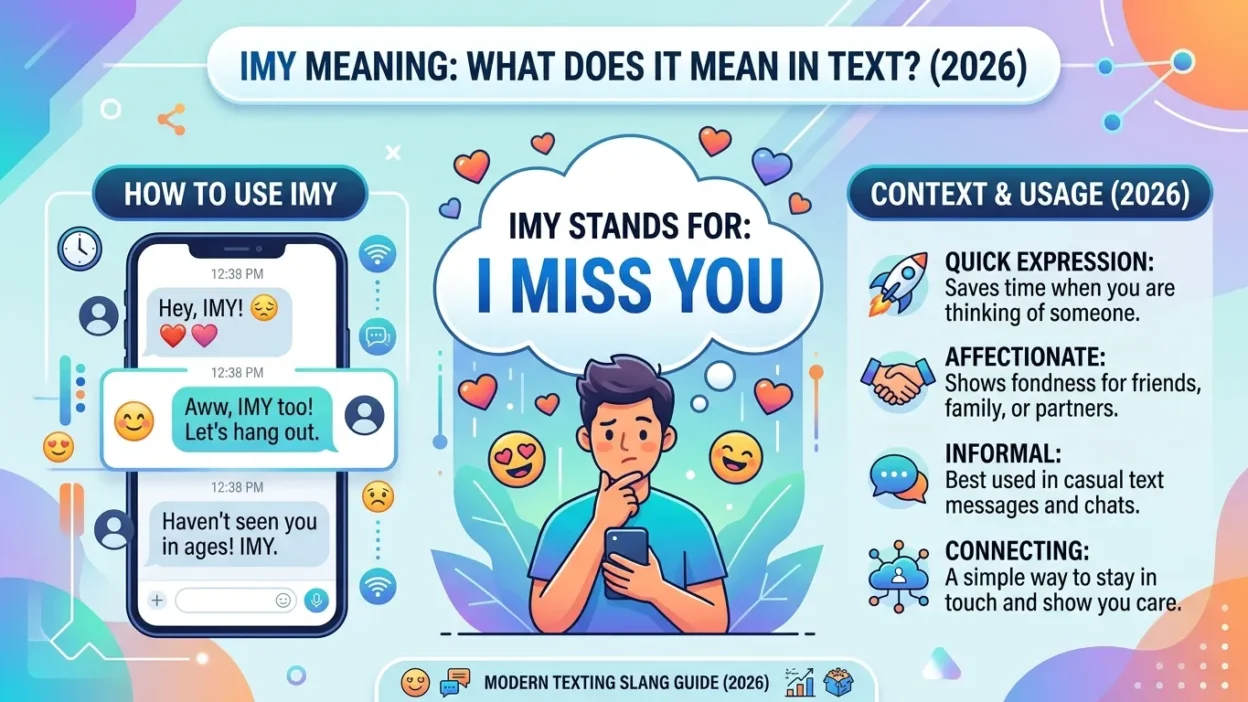
The most common imy meaning is “I miss you.” People use it in texts, chats, DMs, and social media to say that they miss someone or wish they were around.
It can sound friendly, sweet, emotional, or romantic. The relationship and the rest of the conversation help you understand the tone.
In this guide, you will learn what IMY means, how people use it, what it can mean from a girl or guy, how it differs from similar slang, and how to reply without making things awkward.
Quick Answer
IMY means “I miss you” in texting and online chats.
It is an informal abbreviation made from the first letters of I, Miss, and You. Someone may send IMY when they miss spending time with you, miss talking to you, or simply want you to know that you are on their mind.
For example:
“Hey, it’s been a while. IMY.”
This usually means:
“Hey, it’s been a while. I miss you.”
The message does not always mean romantic love. A friend, family member, partner, or someone you care about can use it. Context matters most.
Definition & Meaning
The basic imy meaning in text is “I miss you.”
It is a short form that lets people express a feeling without typing the full sentence. Like many texting abbreviations, it works best in casual conversations.
IMY can express:
- Missing someone
- Wanting to see someone
- Missing a conversation
- Feeling close to someone
- Thinking about someone
- Showing affection
- Feeling nostalgic
- Flirting in some situations
The exact feeling can range from simple friendship to strong romantic interest.
For example, a friend might write:
“We need to hang out soon. IMY!”
A partner might write:
“Wish you were here. IMY ❤️”
Both messages use the same abbreviation, but the emotional meaning may feel very different.
What Does IMY Mean in Text?
When someone types IMY, they usually mean “I miss you.”
The phrase can refer to physical distance, emotional distance, or simply time spent apart. Someone may miss seeing you in person. They may also miss your talks, jokes, company, or support.
For example:
Person A: “I haven’t seen you since summer.”
Person B: “I know. IMY.”
Here, IMY clearly means that Person B misses Person A.
The abbreviation is informal, so you will usually see it in personal communication rather than formal writing.
IMY Meaning Slang: How People Use It
The imy meaning slang version is simple, but people use it in several ways.
1. To Say You Miss Someone
This is the most direct use.
“IMY. When are you coming back?”
The person wants to say that they miss you and want to see you again.
2. To Show Friendship
IMY does not automatically mean romance.
Close friends can use it after spending time apart.
“College isn’t the same without you. IMY!”
This shows friendship and affection.
3. To Show Romantic Feelings
A romantic partner may use IMY to express affection.
“Goodnight. IMY already.”
In a romantic conversation, the message can feel more intimate.
4. To Express Nostalgia
Someone may use IMY when remembering an old time.
“Remember our old road trips? IMY guys!”
Here, the person may miss the group and the memories they shared.
5. As a Playful Message
Friends may also use IMY as a joke when someone has been gone for only a short time.
“You left five minutes ago. IMY 😂”
The message is not meant to show deep sadness. The humor comes from exaggerating the feeling.
IMY Meaning From a Girl
If a girl sends you IMY, the most direct meaning is still “I miss you.”
But that does not automatically mean she has romantic feelings for you.
Look at the relationship and the conversation around it.
If she is your friend, she may simply miss talking to you or spending time with you. If you are dating, IMY may show affection and emotional closeness.
For example:
“I really wish you were here. IMY ❤️”
This sounds more affectionate than:
“IMY lol, we need to hang out.”
The first message has a warmer and more intimate tone. The second may simply show friendly affection.
IMY Meaning From a Guy
When a guy sends IMY, it usually means “I miss you.”
Again, the abbreviation alone does not prove romantic interest.
A male friend may send:
“Bro, IMY. When are we gaming again?”
That is clearly friendly.
A romantic partner may send:
“Can’t sleep. IMY.”
That can sound more emotional or romantic.
If you are trying to understand what a guy means, look at the whole conversation rather than only the three letters.
Is IMY Romantic?
Sometimes, but not always.
IMY can be romantic when it comes from a boyfriend, girlfriend, crush, or someone who is showing romantic interest.
But friends and family members can use it too.
The safest way to judge the tone is to look at:
- Who sent the message
- Your relationship with them
- What you were discussing
- Whether they use affectionate emojis
- How often they contact you
- What they say before and after IMY
Do not assume that IMY means “I love you.” It only directly says that the person misses you.
How to Tell If IMY Is Friendly or Romantic
Context is the biggest clue.
| Situation | Likely Meaning | Tone |
| Close friend after a long time apart | I miss you | Friendly |
| Partner during a busy day | I miss you | Romantic |
| Crush during a late-night chat | I miss you | Possibly romantic |
| Family member after a trip | I miss you | Loving |
| Friend after leaving a few minutes ago | I miss you | Playful |
| Ex after a long period apart | I miss you | Could be emotional or romantic |
This table shows why you should not judge IMY by the letters alone.
A short message can have different emotional weight depending on the people involved.
How to Reply to IMY
Your reply should match how you feel.
If you miss the person too, keep it simple:
“IMY too!”
If you want a warmer reply:
“I miss you too. Hope we can see each other soon.”
For a friend, you could say:
“Aww, I miss you too! We need to catch up.”
For a romantic partner:
“I miss you too ❤️ I wish you were here.”
If you do not feel the same way, you do not have to pretend.
You can give a kind but neutral answer: “It’s nice hearing from you. Hope you’re doing well!”
The best reply is honest and fits the relationship.
IMY vs. ILY: What Is the Difference?
IMY means “I miss you.”
ILY means “I love you.”
IMY focuses on absence. ILY focuses on love.
For example:
“IMY” = I wish you were here.
“ILY” = I love you.
Someone can send both:
“ILY and IMY ❤️”
That means:
“I love you and I miss you.”
This difference is useful because IMY does not automatically declare romantic love.
IMY vs. IMYT
You may also see IMYT, which means “I miss you too.”
For example:
Person A: “IMY.”
Person B: “IMYT.”
The second person is saying that they also miss the first person.
However, people often simply write:
“IMY too!”
This is clearer for most readers.
Common Examples of IMY in Text
Here are some natural examples of how people might use IMY.
Example 1 : Friends
“We haven’t talked in forever. IMY!”
Meaning: “I miss you and want to catch up.”
Example 2 : Dating
“Last night was so fun. IMY already.”
Meaning: “I enjoyed being with you and already miss you.”
Example 3 : Family
“Hope your trip is going well. IMY!”
Meaning: “I miss having you here.”
Example 4 : Long-distance relationship
“Counting the days until I see you. IMY ❤️”
Meaning: “I miss you and want to be with you.”
Example 5 : Funny use
“You left five minutes ago. IMY 😂”
Meaning: “I am jokingly saying that I miss you already.”
Where Do People Use IMY?
IMY works best in casual digital communication.
You may see it in:
- Text messages
- Private chats
- Social media DMs
- Instagram conversations
- Snapchat messages
- WhatsApp chats
- Casual online conversations
The abbreviation is not limited to one social platform. Its main purpose stays the same: expressing that someone is missed. Current online usage guides also describe it as common in personal chats and social media.
Is IMY Formal or Informal?
IMY is informal.
It works well when texting friends, family, partners, or people you know well.
It is not a good choice for formal emails, job applications, business letters, or professional reports.
For example, avoid:
“Dear Manager, IMY.”
Instead, use complete and professional language when the situation requires it.
The same rule applies to many texting abbreviations. Short forms save time, but they can look too casual in professional communication.
Common Mistakes When Using IMY
People sometimes misunderstand IMY because they focus only on the abbreviation.
Here are some common mistakes to avoid:
| Mistake | Better Approach |
| Assuming IMY is always romantic | Check the relationship and context |
| Treating IMY as “I love you” | Remember that it means “I miss you” |
| Using IMY in a formal email | Write the full phrase instead |
| Overthinking three letters | Read the surrounding messages |
| Assuming the sender wants a relationship | Look at their overall behavior |
| Sending IMY to someone you barely know | Consider whether the message fits your relationship |
The biggest mistake is reading too much into the abbreviation.
Words matter, but context matters too.
Quick Reference: IMY Meaning
| Question | Quick Answer |
| IMY full form | I Miss You |
| IMY meaning in text | I miss you |
| IMY meaning slang | A casual way to say I miss you |
| Is IMY romantic? | Sometimes |
| Can friends say IMY? | Yes |
| Can family use IMY? | Yes |
| Is IMY formal? | No |
| Common reply | IMY too! |
| Similar phrase | I miss you too |
| Opposite idea | I am glad you are here |
Use this quick reference when you need a fast answer.
When Should You Use IMY?
Use IMY when you already have a comfortable relationship with the person.
It works especially well when:
- You have not seen someone for a while.
- You miss talking to a friend.
- You are away from your partner.
- You are remembering a good time.
- You want to send a short affectionate message.
- You want a casual way to reconnect.
If you are unsure whether the message will sound too personal, write the full phrase instead.
For example:
“I miss talking to you.”
This can feel more natural and clear than using slang.
Does IMY Have Other Meanings?
In normal texting, “I miss you” is by far the meaning to use first.
Some websites list unusual or joking expansions for short acronyms, but these are not the standard meaning of IMY in everyday personal texting. Current texting references consistently identify “I miss you” as the primary interpretation.
So if someone sends you:
“IMY”
the safest interpretation is:
“I miss you.”
Only look for another meaning if the surrounding conversation clearly points somewhere else.
How to Respond When You Do Not Know What They Mean
Sometimes the relationship is unclear.
Maybe an old friend suddenly messages:
“IMY.”
You do not need to guess their feelings.
You can answer:
“Aww, what made you think of me?”
This keeps the conversation open without making assumptions.
You can also say:
“I miss you too. How have you been?”
If you do not want to return the same feeling, stay polite:
“It’s good to hear from you!”
This gives you room to continue the conversation without sending a stronger emotional signal than you intend.
Why Short Text Slang Can Feel So Emotional
IMY is only three letters, but it represents a full emotional sentence.
That is part of what makes texting slang useful. A short message can communicate a feeling without a long explanation.
Still, text has limits. You cannot hear the sender’s voice or see their facial expression. A message like “IMY” can therefore feel more serious or more romantic than the sender intended.
That is why the surrounding conversation matters. Look at the complete message, not just the abbreviation.
FAQs:
1. What does IMY mean in texting?
IMY usually means “I miss you.” It is an informal abbreviation used in text messages, chats, and social media. The tone may be friendly, emotional, playful, or romantic depending on the relationship.
2. What does IMY mean from a girl?
If a girl sends IMY, she most likely means “I miss you.” It can be friendly or romantic. The meaning depends on your relationship, the conversation, and other signs of affection.
3. What does IMY mean from a guy?
IMY from a guy usually means “I miss you.” It does not automatically mean he has romantic feelings. A friend, brother, partner, or another close person can use the same abbreviation.
4. Is IMY a romantic text?
It can be romantic, but it is not always romantic. Partners and people who are flirting may use IMY to show affection. Friends and family can also use it in a completely non-romantic way.
5. How do you reply to IMY?
If you feel the same, you can reply “IMY too!” or “I miss you too.” For a friend, keep it friendly. For a partner, you can make the reply warmer. If you do not share the feeling, give a polite and neutral response.
6. What is the difference between IMY and ILY?
IMY means “I miss you,” while ILY means “I love you.” IMY talks about missing someone’s presence. ILY expresses love. The two phrases can appear together, but they have different meanings.
7. Is IMY appropriate for formal communication?
No. IMY is casual texting slang. Use it with friends, family, partners, or other people with whom you have an informal relationship. In work emails and other formal writing, use complete sentences instead.
Conclusion:
The simple imy meaning is “I miss you.” It is a casual texting abbreviation that people use to express affection, friendship, nostalgia, or romantic feelings.
The important thing to remember is that IMY does not have one emotional tone. A friend can use it casually, while a partner may use it romantically. The relationship, timing, emojis, and surrounding messages can help you understand the real feeling.
If someone sends you IMY, do not overthink the three letters. Start with the most common meaning, look at the context, and reply in a way that matches how you truly feel. That is the easiest way to understand and use texting slang naturally.

I’m Michael Carter, a writer passionate about education, general information, language, and the meaning behind words and phrases. At PrayersVibe.com, I create clear and useful content that helps readers understand topics without complicated language. I enjoy researching different subjects and sharing accurate information in a simple, reader-friendly way.