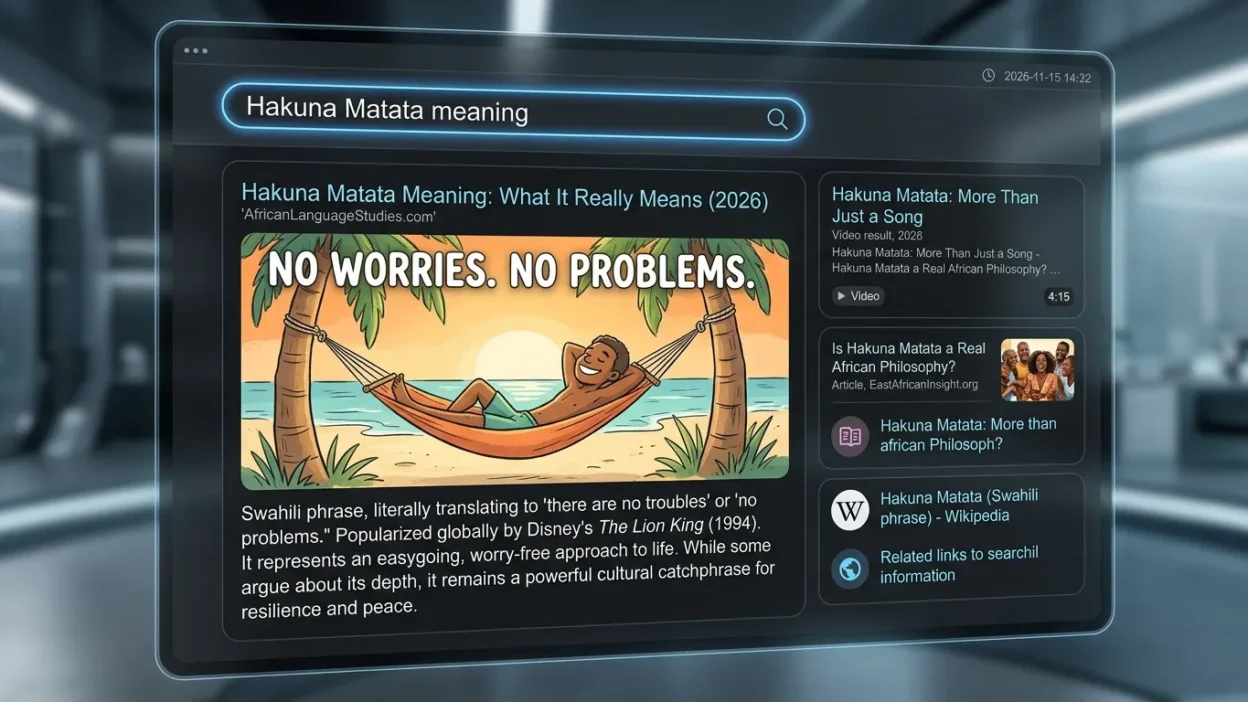
You may know “Hakuna Matata” from The Lion King, but the phrase did not begin with Disney. It comes from Swahili, a major language spoken across East Africa. In simple English, the hakuna matata meaning is close to “no worries,” “no problem,” or “there is no trouble.”
The phrase became famous around the world because of Disney’s The Lion King. The movie gave it a fun and memorable message: do not let worry control your life.
But there is more to understand. The words have a real meaning in Swahili, and the phrase can sound different depending on the situation.
In this guide, you will learn the hakuna matata definition, its Swahili roots, its English meaning, how people use it, what it means in The Lion King, and what it does not mean. You will also see simple examples so you can understand the phrase with ease.
Quick Answer
Hakuna Matata means “no worries,” “no problem,” or “there is no trouble.” It is a Swahili phrase. The word hakuna can express the idea of “there is no,” while matata refers to troubles or problems.
A Swahili dictionary from the Institute of Kiswahili Research at the University of Dar es Salaam lists matata as “trouble” or “disturbance.”
In everyday English, the closest natural meaning is “no worries.” English dictionaries also use “no worries” to reassure someone or respond in a friendly way to thanks.
Definition & Meaning
The simplest hakuna matata meaning in English is:
“No worries.”
You can also understand it as:
- No problem.
- There is no trouble.
- Do not worry.
- Everything is okay.
- There is nothing to worry about.
The exact English wording can change with the context.
The two main parts help explain the phrase. Hakuna is used in Swahili to express absence, such as “there is no” or “there are no.” The MobiTUKI Swahili dictionary gives examples such as hakuna chakula, meaning “there is no food.”
Matata means trouble, disturbance, or a difficult situation.
So, taken together, the phrase gives the idea that there are no troubles.
That is why “no worries” works so well as an English translation.
What Does Hakuna Matata Mean in Swahili?
The phrase is part of Swahili, also called Kiswahili. Cambridge describes Swahili as a language spoken by many people in East Africa and often used as a second language between people with different first languages.
The literal structure is useful to understand:
- Hakuna : there is no / there are no
- Matata : troubles or problems
The phrase therefore points to the absence of trouble.
One important point is that a direct word-for-word translation does not always sound natural in English. Languages build meaning in different ways.
For normal English conversation, “no worries” is usually the best simple match. “No problem” can also fit many situations.
What Does Hakuna Matata Mean in English?
In English, hakuna matata usually carries a relaxed and positive idea.
Someone may use it to say:
“Don’t worry about it.”
For example, imagine that a friend says:
“I am sorry I forgot to bring your book.”
You might reply:
“It’s okay. Hakuna matata.”
Here, the phrase means “No worries” or “It’s not a problem.”
This matches the way English speakers use the phrase today. Cambridge defines “no worries” as a friendly expression used to tell someone not to be concerned and as a response to thanks.
So, the hakuna matata meaning is not only about having no problems. It can also express a calm attitude toward small problems.
What Does Hakuna Matata Mean in The Lion King?
The Lion King made Hakuna Matata famous around the world.
In the movie, Timon and Pumbaa teach Simba a carefree way of looking at life. The phrase becomes a central part of their message.
The movie uses the phrase in a playful way. It suggests that Simba should stop being trapped by his past and enjoy the present.
This is why many people connect hakuna matata with:
- A carefree life
- Positive thinking
- Letting go of worry
- Enjoying the present
- Friendship
- A relaxed attitude
However, it is important to separate the movie’s message from the phrase’s actual language meaning.
Hakuna Matata is a real Swahili phrase. Disney did not create the words. The movie helped make them globally popular.
Is Hakuna Matata a Real Phrase?
Yes. Hakuna matata is a real Swahili phrase.
This matters because many people first hear it through The Lion King and assume it was invented for the movie.
The Swahili dictionary evidence supports the words behind the phrase. The dictionary lists hakuna in meanings connected with “there is no” and lists matata as trouble or disturbance.
So, when you search for the hakuna matata phrase, you are looking at a genuine Swahili expression that later became a major part of global popular culture.
Is Hakuna Matata a Greeting?
Not exactly.
This is one of the most common mistakes.
Hakuna matata is not simply the Swahili equivalent of “hello.” Its meaning relates to the absence of trouble or worry.
You might hear it in a friendly conversation, but that does not make it a standard greeting.
For example:
Correct idea:
“Thanks for helping me.”
“Hakuna matata.”
Here, the phrase can carry the friendly idea of “no problem.”
Less accurate idea:
“Hello, Hakuna Matata!”
That treats the phrase like a normal greeting, which is not what the words mean.
How Is Hakuna Matata Used?
The phrase can be used in a relaxed setting when someone wants to show that a problem is not serious.
Here are some simple examples.
Example 1:
“I am sorry I called you late.”
“Hakuna matata.”
Meaning: No worries.
Example 2:
“Can you help me tomorrow?”
“Hakuna matata.”
Meaning: Sure, no problem.
Example 3:
“Sorry about the small mistake.”
“Hakuna matata.”
Meaning: Don’t worry about it.
For English speakers, the phrase often works best in informal or playful settings.
If you are speaking with a Swahili speaker, however, remember that language use depends on the person, place, and context. A phrase that became famous through a movie may not carry exactly the same cultural feel for every speaker.
Hakuna Matata vs. No Worries
These two expressions are close in meaning, but they belong to different languages and cultures.
| Phrase | Language | Basic Meaning | Common Feel |
| Hakuna Matata | Swahili | No trouble / no worries | Relaxed and positive |
| No worries | English | Do not worry / no problem | Friendly and casual |
| No problem | English | It is okay / I can do it | Helpful and casual |
| It’s okay | English | The situation is fine | Reassuring |
| Don’t worry | English | Do not feel concerned | Reassuring |
The important difference is that hakuna matata has a Swahili origin, while “no worries” and “no problem” are English expressions.
What Does Hakuna Matata Symbolize?
Although the literal hakuna matata meaning relates to having no trouble, popular culture has given the phrase a wider symbolic meaning.
Today, people often use it to represent a carefree outlook.
It can symbolize the choice to:
- Stop overthinking small problems.
- Enjoy the present moment.
- Stay calm during stressful times.
- Avoid unnecessary worry.
- Focus on what you can control.
- Keep a positive attitude.
This does not mean that serious problems do not matter.
That distinction is important.
A healthy interpretation is not “ignore every problem.” Instead, it can mean do not allow worry to control you when a problem does not need your full attention.
Hakuna Matata Meaning in Daily Life
You can think of the phrase as a reminder to keep small problems in their proper place.
Suppose you make a small mistake at work. You may feel embarrassed for a moment. But if you can fix it, learn from it, and move forward, there is little value in worrying about it all day.
That is where the popular idea behind “hakuna matata” can help.
It encourages a simple question:
“Is this problem worth all the worry I am giving it?”
If the answer is no, take a breath and move forward.
If the problem is serious, deal with it. Ask for help when needed. Make a plan. Take action.
A carefree mindset should not become an excuse to avoid responsibility.
Common Mistakes About Hakuna Matata
People often misunderstand the phrase because they learn it from pop culture instead of its language roots.
Here are the main mistakes to avoid.
| Common Mistake | Better Understanding |
| It means “hello.” | It relates to having no trouble or worry. |
| Disney invented the phrase. | The words come from Swahili. |
| It means you should ignore every problem. | It suggests a relaxed attitude toward worry. |
| It is only a movie phrase. | It is a real Swahili expression. |
| It always means exactly “no worries.” | The best English wording can change with context. |
| It is a formal English expression. | In English, it is mainly used as a playful or informal borrowed phrase. |
Knowing these differences helps you use the phrase with more respect and accuracy.
Why Did Hakuna Matata Become So Famous?
The phrase gained huge global attention through The Lion King.
The movie placed the expression at the heart of a memorable song and story moment. That helped people who had never studied Swahili learn and repeat the words.
The phrase also has qualities that make it easy to remember.
It is short.
It has a clear rhythm.
And its message feels positive.
People around the world can understand the basic idea of not letting worry take over.
That combination helped turn a Swahili expression into a phrase recognized far beyond East Africa.
Is Hakuna Matata a Positive Phrase?
Yes, it is generally used in a positive or reassuring way.
It can help someone feel that a small mistake is not a big deal.
For example:
“I broke your pen. I’m sorry.”
“Hakuna matata.”
The speaker is not saying the pen never mattered. The message is that the mistake does not need to create anger or stress.
In this sense, the phrase can express patience, calmness, and friendliness.
Still, context matters. Saying “hakuna matata” to someone facing a serious loss or major crisis could sound dismissive.
The words may be light and friendly, but not every situation needs a carefree response.
Can You Use Hakuna Matata in a Sentence?
Yes, especially in informal English.
Here are a few examples:
- “Thanks for helping me with my homework.” : “Hakuna matata!”
- “Sorry I am a few minutes late.” : “Hakuna matata.”
- “I made a small mistake, but hakuna matata. I can fix it.”
- “We missed the first bus. Hakuna matata; another one will come.”
- “Hakuna matata! Let’s enjoy the trip.”
These examples show how English speakers often use the phrase as a playful way to say “no worries.”
Hakuna Matata and the Idea of Living in the Present
One reason the phrase remains popular is its connection with a simple life lesson: do not spend all your energy worrying about things you cannot change.
You cannot change yesterday.
You cannot control every event tomorrow.
But you can choose how you respond today.
That idea does not come directly from the literal dictionary definition. Rather, it is a popular cultural interpretation of the phrase, strongly shaped by The Lion King.
Keeping that difference clear makes the explanation more trustworthy.
The language meaning and the pop-culture message overlap, but they are not exactly the same thing.
How to Use Hakuna Matata Respectfully
If you want to use the phrase, learn what it means first.
Do not treat it as a meaningless catchphrase. It comes from a real language spoken by millions of people.
Use it in light and friendly situations when the meaning fits.
Also, avoid assuming that every Swahili speaker uses the phrase in the same way you have seen in movies or social media.
A little cultural awareness goes a long way.
If you use hakuna matata meaning “no worries” in an English conversation, most people will understand the popular reference.
If you are using Swahili with native speakers, it is better to learn the wider language and its normal expressions rather than relying only on famous phrases.
Quick Reference: Hakuna Matata
| Question | Quick Answer |
| What does hakuna matata mean? | No worries, no trouble, or no problem. |
| What language is hakuna matata? | Swahili. |
| What does hakuna mean? | It expresses the idea of there being no or not having something. |
| What does matata mean? | Trouble, disturbance, or problems. |
| Is it from The Lion King? | The phrase existed before the movie and became globally famous through it. |
| Is it a greeting? | No. Its meaning relates to trouble or worry, not hello. |
| Can I use it in English? | Yes, usually in a casual or playful setting. |
FAQs:
What is the exact hakuna matata meaning?
The basic meaning is “no worries,” “no trouble,” or “there is no problem.” The phrase comes from Swahili. Hakuna expresses absence, while matata refers to trouble or disturbance.
What language does hakuna matata come from?
Hakuna matata comes from Swahili, also known as Kiswahili. Swahili is widely spoken in East Africa and is often used as a common language among people with different first languages.
Does hakuna matata really mean no worries?
Yes. “No worries” is a useful natural English translation. The English phrase itself can reassure someone or show that something is not a problem.
Did Disney create the phrase hakuna matata?
No. The phrase has Swahili roots and existed before The Lion King. Disney helped make it famous around the world by using it in the 1994 animated movie.
Is hakuna matata a religious phrase?
No. Hakuna matata is not a religious phrase. It is a Swahili expression about the absence of trouble or worry. People may use it in many settings, but the words themselves do not represent a specific religion.
Can I use hakuna matata as a greeting?
Not as a normal greeting. The phrase does not mean “hello.” It is better understood as an expression similar to “no worries” or “no problem.”
What does hakuna matata symbolize today?
In modern popular culture, it often symbolizes a carefree and calm attitude toward life. People use it to suggest that they should not let small problems or worry control them. This broader life message is strongly linked to The Lion King.
Conclusion:
The hakuna matata meaning is simple: “no worries,” “no trouble,” or “no problem.” The phrase comes from Swahili, with hakuna expressing absence and matata referring to trouble or disturbance.
Its worldwide fame came from The Lion King, which gave the phrase a strong connection with a carefree way of life.
Still, the phrase does not mean that every problem should be ignored. A better lesson is to stay calm, handle real problems, and avoid giving small worries more power than they deserve.
If you use “hakuna matata,” remember its real language roots and use it in the right context. That makes the phrase more meaningful, not just memorable.

I am Scottking, the heart and voice behind PrayersVibe.com, where faith meets real-life emotions.
I am here to share powerful prayers, spiritual comfort, and words that heal the soul.
I am walking this journey of faith with you one prayer, one hope, one blessing at a time.