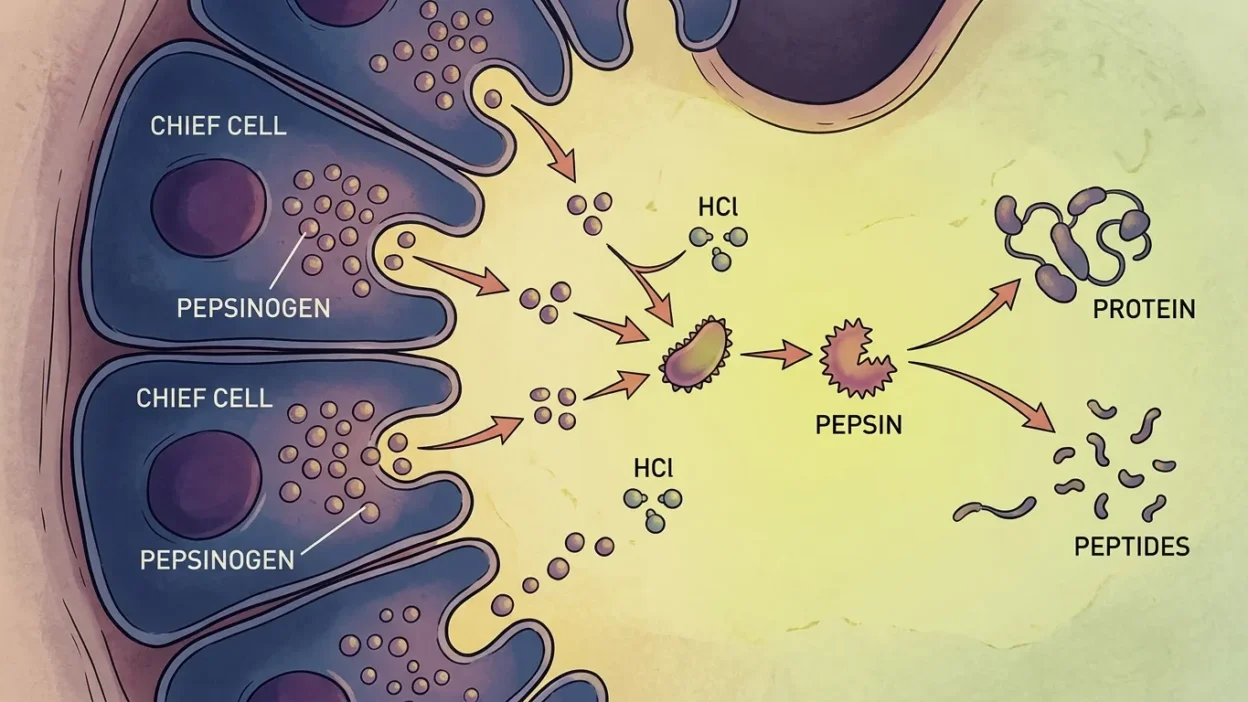
If you saw pepsinogen on a blood test and wondered what it means, you are not alone. The word sounds complex, but the basic idea is simple: pepsinogen is an inactive form of pepsin, a stomach enzyme that helps digest protein. Your stomach makes pepsinogen before it becomes active pepsin.
The term can also appear when doctors check gastric health, especially when they look at pepsinogen I, pepsinogen II, or the pepsinogen I/II ratio. These markers can give clues about changes in the stomach lining.
In this guide, you will learn what pepsinogen means, how it works, what the pepsinogen test checks, what low or high levels may suggest, and why doctors do not use one result alone to diagnose a disease.
Quick Answer: What Does Pepsinogen Mean?
Pepsinogen is the inactive precursor of pepsin, a digestive enzyme made in the stomach. When stomach acid creates the right conditions, pepsinogen changes into pepsin, which helps break down proteins from food.
A blood test can measure pepsinogen I and pepsinogen II. Doctors may use these results to learn about the condition of the stomach lining, including possible gastric atrophy.
A low pepsinogen I level or a low pepsinogen I/II ratio can be linked with atrophic changes in the stomach, but the result needs to be interpreted with other findings.
Pepsinogen Definition and Meaning
Pepsinogen is a zymogen, which means it is an inactive form of an enzyme.
Your stomach produces it so that protein digestion can start when conditions are right. If pepsin were active as soon as stomach cells made it, it could potentially damage the cells that produce it.
Instead, the stomach releases pepsinogen. Stomach acid then helps convert it into active pepsin.
Pepsin breaks large protein molecules into smaller pieces. This makes it easier for the digestive system to continue breaking proteins down and absorb their building blocks.
So, in very simple terms:
Pepsinogen → stomach acid → pepsin → protein digestion
That is the basic meaning behind the term.
What Is the Difference Between Pepsinogen and Pepsin?
The two terms are closely related, but they do not mean the same thing.
Pepsinogen is inactive.
Pepsin is the active digestive enzyme.
The stomach releases pepsinogen first. Acid in the stomach helps turn it into pepsin. Pepsin then takes part in protein digestion.
Think of pepsinogen as an enzyme that is still “switched off.” Pepsin is the active version.
This system helps the stomach control when protein digestion begins.
What Are Pepsinogen I and Pepsinogen II?
When people talk about pepsinogen levels, they often mean two forms: pepsinogen I (PGI) and pepsinogen II (PGII).
Both come from cells in the stomach, but they have different patterns of production.
Pepsinogen I mainly comes from glands in the body and fundus of the stomach. Pepsinogen II has a wider source and can also come from areas such as the pyloric glands and Brunner’s glands in the upper small intestine.
This difference matters because the two measurements can provide information about the condition of different parts of the stomach.
Doctors may therefore look at both numbers rather than focusing on one number alone.
What Is a Pepsinogen Test?
A pepsinogen test is usually a blood test that measures pepsinogen I and pepsinogen II.
Doctors may use these markers as part of an assessment of the stomach lining. In particular, serum pepsinogens can help identify patterns linked with gastric atrophy, where stomach glands become reduced or damaged.
The test is not the same as a direct examination of the stomach.
An endoscopy can allow a doctor to look at the stomach lining and take biopsies when needed. Histology from biopsy remains important when doctors need to confirm atrophic gastritis.
That is why you should not treat a pepsinogen result as a diagnosis by itself.
What Does Pepsinogen I Tell You?
Pepsinogen I mainly reflects the function of glands in the stomach’s corpus, or main body.
When significant atrophic changes affect this area, pepsinogen I can fall because specialized stomach cells are lost.
A low PGI level, especially when combined with a low PGI/II ratio, can therefore point toward gastric atrophy in the stomach body.
However, there is no single number that works perfectly for every person, laboratory, or population.
Test methods and cutoff values can differ. A result must be read using the reference range and method used by the laboratory.
What Does Pepsinogen II Tell You?
Pepsinogen II comes from a wider area of the upper digestive tract than pepsinogen I.
Changes in PGII can occur with inflammation of the gastric lining. Some research and clinical guidance use PGI and PGII together because their relationship can provide more information than either number alone.
For this reason, you may see three results on a report:
- Pepsinogen I
- Pepsinogen II
- Pepsinogen I/II ratio
The combination can help doctors assess patterns in gastric function.
What Is the Pepsinogen I/II Ratio?
The pepsinogen I/II ratio is calculated by dividing the PGI level by the PGII level.
For example, if PGI is 60 and PGII is 20, the ratio is 3.
A lower ratio can be associated with atrophic changes in the stomach, particularly when pepsinogen I is also low. Some commonly studied criteria use PGI below 70 ng/mL together with a PGI/II ratio below 3, but these are not universal diagnostic rules.
This is an important point: do not diagnose yourself from a cutoff found online.
Your doctor should consider the laboratory method, your symptoms, medical history, age, risk factors, and other test results.
What Can Low Pepsinogen Levels Mean?
Low pepsinogen levels can have different meanings depending on which type is low and what the other results show.
A particularly low pepsinogen I or a low PGI/PGII ratio may suggest loss of functioning glands in the stomach body. This pattern can occur with advanced gastric atrophy.
Gastric atrophy can develop in connection with long-term inflammation. Helicobacter pylori (H. pylori) infection and autoimmune processes are important causes of atrophic gastritis.
But a low result does not automatically mean cancer.
Pepsinogen testing can help identify people who may need further assessment, but it is not a stand-alone cancer diagnosis. Research has also found that commercial pepsinogen tests are imperfect for diagnosing gastric atrophy.
What Can High Pepsinogen Levels Mean?
High pepsinogen levels can occur with inflammation of the stomach lining.
Research and clinical guidance note that gastric mucosal inflammation can raise both PGI and PGII, often with a greater rise in PGII.
The meaning of a high result depends on the full clinical picture.
A high value alone does not tell you exactly what condition you have. Your doctor may consider other tests, such as testing for H. pylori, depending on your symptoms and history.
Pepsinogen and Gastric Atrophy
One of the most important clinical uses of pepsinogen testing is its relationship with gastric atrophy.
Gastric atrophy means the stomach loses some of its normal glandular tissue. Long-term inflammation can play a role in this process.
Serum pepsinogens can reflect both functional and structural changes in the stomach lining. Low PGI and a low PGI/II ratio can be markers of more extensive atrophy, especially in the stomach corpus.
Still, blood markers are not a replacement for every other form of evaluation.
The American Gastroenterological Association notes that a diagnosis of atrophic gastritis should be confirmed through histopathology when appropriate.
Pepsinogen and H. Pylori
H. pylori is a type of bacteria that can infect the stomach and cause long-term inflammation.
Over time, chronic H. pylori-related inflammation may contribute to atrophic gastritis in some people.
Pepsinogen results may therefore be considered alongside H. pylori testing.
This combination can give doctors more information than looking at pepsinogen alone. European guidance has noted the usefulness of H. pylori testing in people with low pepsinogen results.
If your report shows an unusual pepsinogen result, ask your clinician whether H. pylori testing is appropriate for you.
Pepsinogen and Stomach Cancer: What Is the Connection?
This is where many people become worried.
Some patterns of low pepsinogen, especially low PGI and a low PGI/II ratio, can indicate extensive gastric atrophy. Gastric atrophy is an important condition because some forms can be part of the pathway that increases the risk of gastric cancer.
But this does not mean that a low pepsinogen result means you have stomach cancer.
Pepsinogen testing is a marker. It does not directly identify cancer cells.
Research has found that pepsinogen testing alone does not provide enough information for complete gastric cancer risk assessment.
If your doctor sees a concerning pattern, they may recommend other tests or an endoscopic evaluation based on your overall risk.
Pepsinogen Test: Mistakes vs Correct Approach
| Common mistake | Better approach |
| Assuming low pepsinogen means cancer | Understand that low results can suggest gastric atrophy but do not diagnose cancer |
| Using one online cutoff for everyone | Check the reference range and testing method on your own report |
| Looking only at PGI | Consider PGI, PGII, and the ratio together |
| Ignoring H. pylori | Ask whether H. pylori testing is useful in your situation |
| Treating a blood test as a final diagnosis | Follow up with your doctor when the result is abnormal |
| Comparing your result with a friend’s | Interpret your result using your own lab’s range and medical history |
What Happens If Your Pepsinogen Result Is Abnormal?
First, do not panic.
An abnormal result is a reason to understand the result, not a reason to assume the worst.
Start by checking which value is abnormal. Is it PGI, PGII, or the ratio? Then check the laboratory’s reference range.
Next, ask your healthcare provider what the pattern means in your case.
Depending on your history, your doctor may consider tests for H. pylori, other blood tests, endoscopy, or biopsy. The right next step depends on the suspected cause and your individual risk.
Do not start supplements or medicines just because you found a low or high value online.
Quick Pepsinogen Reference Checklist
| What to check | Why it matters |
| Pepsinogen I | Mainly reflects glands in the stomach body and fundus |
| Pepsinogen II | Comes from a wider area of the stomach and upper digestive tract |
| PGI/PGII ratio | Helps show the relationship between the two markers |
| Lab reference range | Cutoffs can vary by method and population |
| H. pylori status | Infection can affect the stomach lining and pepsinogen pattern |
| Symptoms and history | A lab result needs clinical context |
| Endoscopy or biopsy, when advised | Can directly assess the stomach lining and confirm atrophy |
Does a Pepsinogen Test Require Fasting?
The preparation depends on the specific test and laboratory.
Some gastric biomarker panels use fasting blood samples, while preparation rules can vary by the test being ordered.
Do not assume that every pepsinogen test has the same preparation instructions.
The safest step is to follow the instructions given by your laboratory or healthcare provider. If you were not given instructions, ask before having the test.
Is Pepsinogen Testing Used Everywhere?
No.
The use of serum pepsinogen testing varies by country and healthcare system.
For example, the American Gastroenterological Association notes that pepsinogen testing is not available for routine clinical use in the United States.
Some countries and research settings have used pepsinogen testing more widely, especially for assessing gastric atrophy and gastric cancer risk.
This difference explains why you may find different advice online.
FAQs:
1. What is the simple meaning of pepsinogen?
Pepsinogen is an inactive form of pepsin, a stomach enzyme that helps digest protein. Stomach acid helps convert pepsinogen into active pepsin.
2. What does a pepsinogen blood test check?
It measures pepsinogen I and II in the blood. Doctors may use the results to assess patterns linked with the condition of the stomach lining, including gastric atrophy.
3. Is low pepsinogen dangerous?
A low result can be important because low PGI or a low PGI/II ratio may suggest gastric atrophy. However, the result alone does not tell you how serious the condition is or prove that you have cancer.
4. Does low pepsinogen mean stomach cancer?
No. Low pepsinogen can be associated with gastric atrophy, which can be linked to increased gastric cancer risk in some settings. But pepsinogen testing alone cannot diagnose stomach cancer.
5. What is a normal pepsinogen level?
There is no single universal “normal” number that applies to every laboratory and person. Testing methods and reference ranges can differ, so use the range printed on your laboratory report.
6. Why are pepsinogen I and II tested together?
They come from different areas of the stomach and upper digestive tract. Looking at both, along with their ratio, can provide more useful information about gastric function than looking at only one value.
7. What should I do if my pepsinogen result is abnormal?
Review the result with your healthcare provider. Ask which value is abnormal, whether H. pylori testing is needed, and whether further evaluation such as endoscopy is appropriate.
Conclusion:
The simplest pepsinogen meaning is an inactive form of the stomach enzyme pepsin. Your stomach makes pepsinogen, and stomach acid helps turn it into pepsin so protein digestion can begin.
Pepsinogen I, pepsinogen II, and the PGI/II ratio can also provide clues about the health of the stomach lining.
Low values may point toward gastric atrophy, while inflammation can affect pepsinogen levels in other ways. But no single result should be treated as a diagnosis.
If you have a real test result, discuss the exact numbers with your healthcare provider. Looking at the complete pattern is much safer than judging one number alone.

I am Jane Austen, a soul that believes faith speaks best through quiet words and honest prayers.
I share reflections that blend timeless wisdom, gentle hope, and heartfelt devotion.
On PrayersVibe.com, my words are written to comfort hearts, strengthen faith, and remind you that you are never alone.