If someone suddenly stops talking, barely moves, holds an unusual position, or seems unable to respond, it can be frightening.
This is where understanding catatonia meaning becomes important. Catatonia is not simply being quiet, stubborn, or tired. It is a serious syndrome, or group of symptoms, that can affect movement, speech, behavior, and responses to the world around a person.
Catatonia can happen with mental health conditions, but it can also occur with neurological or other medical problems. It may look like a person has completely “shut down,” but some people with catatonia have the opposite pattern and become very restless or agitated.
This guide explains the meaning of catatonia in simple language. You will learn the common signs, possible causes, different forms, how doctors diagnose it, available treatments, and when it becomes an emergency.
Quick Answer
Catatonia means a state in which a person has major changes in movement, speech, behavior, and response to their surroundings.
A person may become very still and quiet, repeat words or movements, hold unusual positions, or become extremely agitated. Catatonia can occur with psychiatric, neurological, or medical conditions and needs professional medical assessment.
It is important to know that catatonia is not the same as schizophrenia. It can occur alongside schizophrenia, bipolar disorder, depression, and several medical or neurological conditions.
Definition & Meaning
The medical catatonia meaning refers to a syndrome that changes how a person moves, communicates, behaves, and responds to the environment.
The word does not describe one single behavior. A person may show several different signs at the same time. For example, they may stop speaking, resist movement, copy another person’s actions, or hold their body in a fixed position.
Catatonia can also involve excessive movement. This surprises many people because popular descriptions often focus only on being motionless.
Doctors therefore look at a group of symptoms rather than one isolated behavior.
What Does Catatonia Look Like?
Catatonia can appear in different ways. One person may sit still and not respond. Another may pace, shout, or act in a highly unusual way without an obvious reason.
Common signs can include:
- Very little or no movement
- Little or no speech
- Holding a body position for a long time
- Resistance when someone tries to move the person
- Repeating another person’s words
- Copying another person’s movements
- Repeating unusual movements
- Facial grimacing
- Unusual or excessive agitation
- Reduced response to the environment
These signs do not always occur together. A trained healthcare professional must assess the overall pattern.
Catatonia Meaning in Simple Terms
In simple terms, catatonia can make the brain and body seem disconnected from normal movement and communication.
Imagine someone who is awake but does not answer questions, move normally, or react to people nearby. They may remain in one position for a long time.
Another person may show the opposite pattern. They may move constantly, become agitated, or behave in a way that seems difficult to control.
Both patterns can fall under catatonia. This is why the condition can be easy to misunderstand.
Main Types of Catatonia
Healthcare professionals commonly describe three broad patterns.
Withdrawn or Hypokinetic Catatonia
This form involves very little activity. A person may remain still, speak very little, show limited facial expression, and respond slowly or not at all.
They may also have trouble eating or drinking. Severe cases can lead to physical complications because the person cannot care for basic needs.
Excited or Hyperkinetic Catatonia
This form looks very different. The person may become extremely restless, agitated, or physically active without a clear reason.
The behavior can seem unpredictable. In severe cases, the person may act in ways that place themselves or others at risk.
Mixed Catatonia
Mixed catatonia includes features of both patterns.
A person may move very little at one point and later become highly agitated. These changes can make the condition harder for family members to understand.
Common Catatonia Symptoms
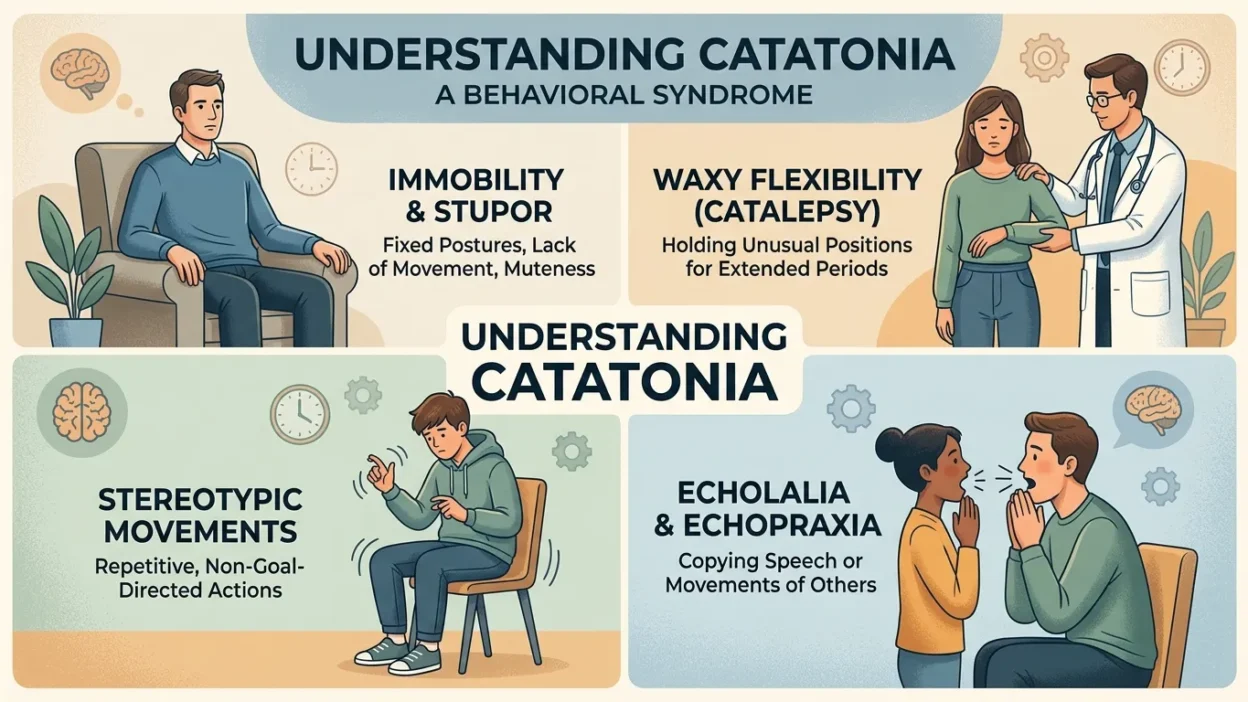
Doctors use specific clinical signs when assessing catatonia. The DSM-5 includes symptoms such as catalepsy, waxy flexibility, mutism, stupor, agitation, negativism, posturing, mannerisms, stereotyped movements, grimacing, echolalia, and echopraxia.
Here are some of these terms in plain English:
- Mutism: The person does not speak.
- Stupor: The person shows very little movement or response.
- Posturing: The person holds an unusual position.
- Catalepsy: The body remains in a position after another person places it there.
- Waxy flexibility: The limbs may slowly stay in a position after someone moves them.
- Echolalia: The person repeats words or sounds spoken by another person.
- Echopraxia: The person copies another person’s movements.
- Negativism: The person resists instructions or attempts to move them.
- Grimacing: The person holds an unusual facial expression.
Not every quiet or unresponsive person has catatonia. Other medical conditions can cause similar symptoms, which is one reason professional assessment matters.
What Causes Catatonia?
There is no single cause that explains every case.
Catatonia can occur with several psychiatric conditions, including:
- Bipolar disorder
- Schizophrenia
- Schizoaffective disorder
- Major depressive disorder
It can also occur with neurological and medical conditions. Examples include autoimmune diseases, encephalitis, epilepsy, stroke, dementia, Parkinson’s disease, electrolyte problems, and some medication or drug-related conditions.
This is an important point: catatonia does not automatically mean that a person has schizophrenia.
The National Institute of Mental Health also notes that catatonia can occur in severe cases of schizophrenia, but it is only one possible clinical feature and does not define the entire illness.
Catatonia vs. Schizophrenia
People often connect catatonia with schizophrenia because the two can occur together. But they are not the same condition.
| Mistake vs. Correct Understanding | What to Know |
| “Catatonia means schizophrenia.” | Catatonia can occur with schizophrenia, but it also occurs with other psychiatric and medical conditions. |
| “Catatonia only means being still.” | It can also involve severe agitation and excessive movement. |
| “A quiet person must have catatonia.” | Many conditions can cause reduced speech or movement. |
| “It will always go away on its own.” | Catatonia can cause serious complications and needs medical assessment. |
| “It cannot be treated.” | Catatonia is often treatable, especially when recognized early. |
The older term “catatonic schizophrenia” is also no longer used as a separate diagnosis in modern diagnostic systems. Catatonia is instead considered as a feature that may occur with schizophrenia or other conditions.
How Is Catatonia Diagnosed?
There is no simple blood test that says, “This person has catatonia.”
A healthcare professional usually starts by observing behavior and performing a physical and neurological examination. They may use a structured tool, such as the Bush-Francis Catatonia Rating Scale, to assess symptoms.
Doctors also need to find out why the catatonia is happening.
Depending on the situation, testing may include:
- Blood tests
- Urine tests
- Brain imaging such as CT or MRI
- EEG to check brain activity
- Cerebrospinal fluid testing in selected cases
- Review of medications and substance use
- Assessment of psychiatric and medical history
The goal is not only to identify catatonia but also to rule out other conditions that can produce similar symptoms.
Catatonia Treatment
Treatment depends on the person’s symptoms and the condition causing them.
Benzodiazepines
Benzodiazepines are commonly used as a first-line treatment for catatonia. Lorazepam is one medication doctors may use.
These medicines require professional supervision. The correct medicine, dose, route, and monitoring depend on the person’s health and circumstances.
Electroconvulsive Therapy
Electroconvulsive therapy (ECT) is another important treatment.
ECT uses a controlled electrical stimulus to produce a brief seizure while the person receives anesthesia. It can be especially important when catatonia is severe or does not improve enough with medication.
ECT may also be used in certain severe mood disorders, including situations involving catatonia.
Treating the Underlying Cause
Doctors also need to treat the condition linked to the catatonia.
For example, if an underlying medical or neurological problem is responsible, treating that problem may help resolve the catatonic symptoms.
Can Catatonia Be Dangerous?
Yes. Severe catatonia can become a medical emergency.
A person who does not move or eat may develop problems such as dehydration, poor nutrition, pneumonia, blood clots, or other complications related to prolonged immobility.
There is also a severe form called malignant catatonia. It can involve high fever, fast heart rate, sweating, unstable blood pressure, and other signs of serious body-system disturbance. It requires urgent medical treatment.
When Should You Seek Emergency Help?
Seek urgent medical care if someone:
- Suddenly becomes very unresponsive
- Stops eating or drinking
- Becomes severely agitated or unsafe
- Develops a high fever
- Has major changes in heart rate or blood pressure
- Shows signs of severe dehydration
- May hurt themselves or someone else
- Becomes difficult to wake or physically manage
Do not try to diagnose catatonia at home. A sudden change in movement or responsiveness can have many causes, including medical emergencies.
What Should You Do If You Suspect Catatonia?
If you notice possible catatonia in someone you know, focus on safety rather than trying to force normal behavior.
Quick Reference Checklist
| What to Do | Why It Matters |
| Seek medical assessment quickly | Catatonia can have serious causes and complications. |
| Stay calm | A calm setting may reduce additional distress. |
| Watch eating and drinking | Reduced intake can cause dehydration and poor nutrition. |
| Note unusual movements or speech | Details can help clinicians understand the episode. |
| Share medication information | Medicines can be relevant to the medical assessment. |
| Report fever or major physical changes | These can signal a more serious form. |
| Do not self-medicate | Treatment needs professional assessment and monitoring. |
| Follow the treatment plan | Ongoing care may address both catatonia and its underlying cause. |
If the person is in immediate danger, contact your local emergency service or go to the nearest emergency department.
Is Catatonia the Same as Being in a Coma?
No.
A coma involves a profound state of unconsciousness. Catatonia can involve a person who appears awake but has very limited movement, speech, or response.
However, severe unresponsiveness can have many causes. You should not assume that someone is experiencing catatonia simply because they do not respond normally.
A healthcare team can assess consciousness, movement, neurological function, medications, and other possible causes.
Can Catatonia Go Away?
Yes, catatonia can improve with appropriate treatment.
The recovery time varies from person to person. It depends on the cause, severity, duration, underlying health conditions, and response to treatment.
Some people respond quickly to treatment, while others need longer care or repeated treatment. Cleveland Clinic notes that benzodiazepines can work quickly in some cases, while others may need several days of treatment or ECT.
The key lesson is simple: early recognition matters.
Can Catatonia Happen More Than Once?
Yes. Some people can experience repeated episodes.
The risk of another episode depends on the underlying condition and the person’s medical history. This is why treating the condition linked to catatonia is an important part of long-term care.
If someone has experienced catatonia before, their healthcare team should know about the previous episode when planning future care.
Catatonia Meaning and Mental Health
Understanding the term can also reduce harmful assumptions.
A person with catatonia may look as if they are refusing to communicate. But the behavior may reflect a serious medical or psychiatric syndrome rather than a simple choice.
Family members may feel confused or frustrated when a loved one does not respond. A better approach is to treat the change as a health concern and seek professional help.
Catatonia can occur with mood disorders, psychotic disorders, and medical or neurological illnesses. It should therefore be viewed as a clinical condition that deserves proper assessment rather than a personality trait.
FAQs:
1. What does catatonia mean in simple words?
Catatonia is a syndrome that can greatly change a person’s movement, speech, behavior, and response to the environment. A person may become very still and quiet, or they may become highly agitated and active. It can occur with mental health, neurological, or medical conditions.
2. Is catatonia a mental illness?
Catatonia is better understood as a syndrome, not simply one mental illness. It can occur alongside psychiatric conditions such as bipolar disorder, schizophrenia, and major depression, but it can also occur with medical and neurological conditions.
3. What are the first signs of catatonia?
Possible signs include becoming unusually quiet, stopping normal movement, holding a fixed position, showing little response to people, resisting movement, repeating words or movements, or becoming unusually agitated. A single sign does not confirm catatonia.
4. Can a person with catatonia hear you?
A person with catatonia may have very limited responses to the environment, but this does not mean you can determine their awareness from appearance alone. Avoid assuming what they can or cannot hear. Medical professionals should assess the person’s condition.
5. Is catatonia dangerous?
It can be. Severe catatonia may lead to dehydration, malnutrition, pneumonia, blood clots, and other complications. Malignant catatonia can become life-threatening and requires urgent treatment.
6. How is catatonia treated?
Doctors commonly use benzodiazepines, with lorazepam often used, and may use ECT when symptoms are severe or do not respond adequately to medication. Treatment also focuses on the underlying medical or psychiatric condition.
7. Does catatonia mean someone has schizophrenia?
No. Catatonia can occur with schizophrenia, but it can also occur with bipolar disorder, depression, neurological conditions, autoimmune diseases, infections, and other medical problems.
Conclusion:
The clearest catatonia meaning is a serious syndrome that can affect movement, speech, behavior, and a person’s response to the world around them.
It may look like extreme stillness, but it can also involve severe agitation. Catatonia can occur with psychiatric, neurological, and medical conditions, so it should never be assumed to mean schizophrenia.
If someone suddenly becomes very still, unresponsive, unable to eat or drink, or severely agitated, seek medical help quickly. Catatonia is often treatable, and early professional care can help reduce serious complications.

I am Ernest Angelou, the heart and voice behind prayersvibe.com.
I am someone who believes that prayers are not just words, but a deep conversation between the soul and God.
I am here to share faith-filled prayers that bring peace, hope, and divine comfort into everyday life.