
Chinese can look difficult when you first see characters like 你好, 谢谢, or 再见. But translating Chinese to English does not have to feel confusing.
You can translate a single Chinese word, a full sentence, a message, a document, or even a Chinese website.
The key is knowing what type of Chinese text you have and which translation method works best.
In this guide, you will learn how to translate Chinese to English in simple steps. We will also cover Chinese characters, Pinyin, word order, common phrases, translation tools, and mistakes to avoid.
What Does Chinese to English Mean?
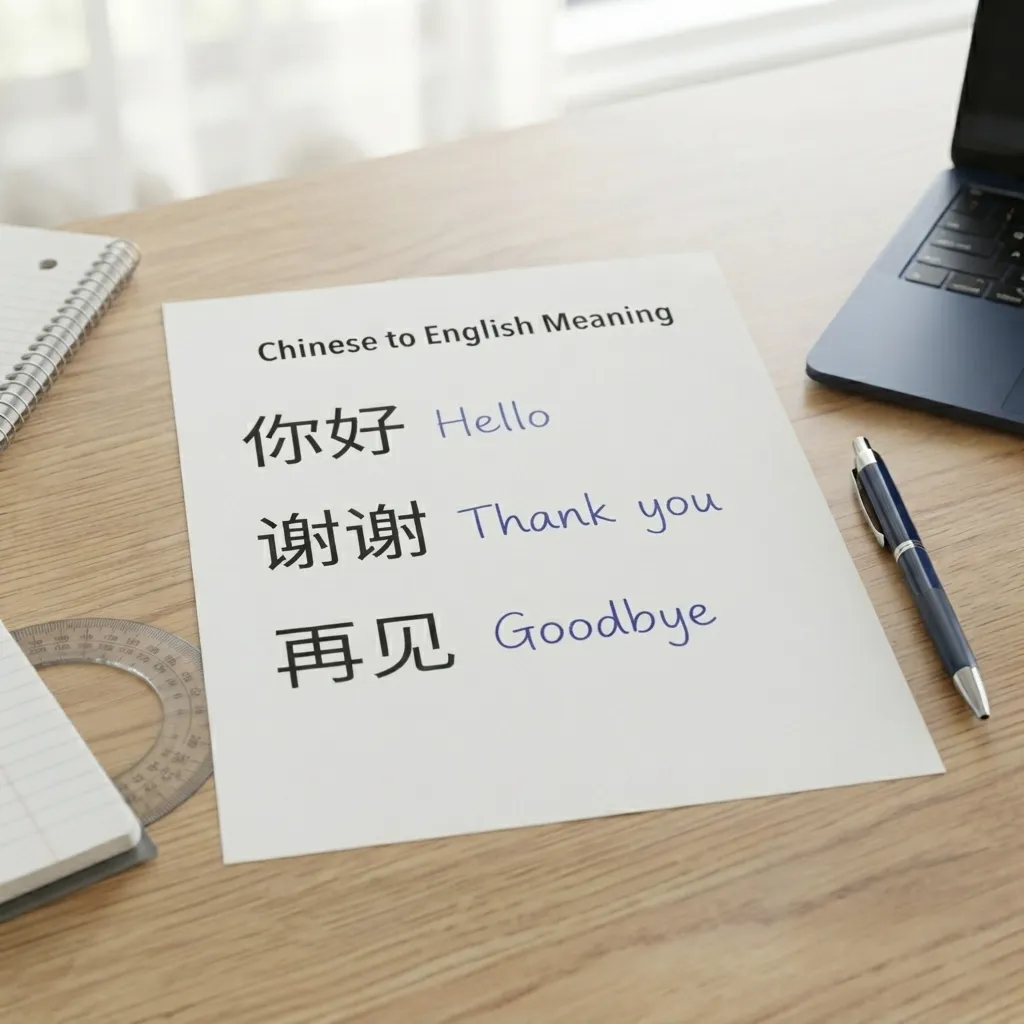
Chinese to English means changing written or spoken Chinese into English while keeping the original meaning as accurately as possible.
For example:
| Chinese | English |
| 你好 | Hello |
| 谢谢 | Thank you |
| 再见 | Goodbye |
| 早上好 | Good morning |
| 我爱你 | I love you |
| 多少钱? | How much is it? |
Chinese can refer to several varieties, but Mandarin Chinese is the most common form used for modern translation.
Chinese writing mainly uses characters called Hanzi (汉字). Unlike English, Chinese does not normally use spaces between individual words.
That difference can make Chinese-to-English translation interesting for beginners.
How to Translate Chinese to English
There are several easy ways to translate Chinese into English.
1. Translate Chinese Text With an Online Translator
The fastest method is to enter Chinese text into an online translation service.
You can paste a Chinese word, sentence, paragraph, or longer passage and select English as the target language.
This works well when you need a quick idea of what something means.
However, automatic translation is not always perfect. Chinese words can have different meanings depending on the sentence.
2. Translate Chinese From a Picture
Sometimes you do not have Chinese text that you can copy.
You may see Chinese on:
- A menu
- A sign
- A product label
- A book
- A screenshot
- A document
- A package
- A website
In this situation, image-based translation can help.
Many modern translation apps can recognize Chinese characters from a photograph and provide an English translation.
Always check the result carefully, especially when the text is important.
3. Type Chinese Using Pinyin
Pinyin is a system used to represent Mandarin Chinese pronunciation with the Latin alphabet.
For example:
你好 → nǐ hǎo → hello
Pinyin can help you understand how a Chinese word sounds, but it is not the same thing as an English translation.
Here is another example:
谢谢 → xièxie → thank you
Learning a little Pinyin makes Chinese translation much easier because you can connect Chinese characters with their pronunciation.
4. Ask a Human Translator
For important content, a professional human translator can provide better context and natural English.
Human translation is especially useful for:
- Legal documents
- Business contracts
- Medical information
- Academic papers
- Official documents
- Marketing content
- Technical manuals
A machine may translate the individual words correctly but miss the intended meaning.
Chinese Characters and Their English Meanings
Chinese characters are called Hanzi.
A single character can sometimes represent a word or part of a word. Other Chinese words contain two or more characters.
For example:
学生 (xuéshēng) means student.
Here, 学 and 生 work together to form the word.
Some common Chinese words include:
| Chinese | Pinyin | English |
| 人 | rén | person |
| 水 | shuǐ | water |
| 天 | tiān | sky/day |
| 家 | jiā | home/family |
| 学生 | xuéshēng | student |
| 老师 | lǎoshī | teacher |
| 朋友 | péngyou | friend |
| 中国 | Zhōngguó | China |
| 英语 | Yīngyǔ | English |
| 中文 | Zhōngwén | Chinese |
The context is important because a Chinese character may have more than one meaning.
Common Chinese to English Translations
If you are learning basic Chinese, these everyday expressions are useful.
Greetings
你好 (nǐ hǎo) Hello
早上好 (zǎoshang hǎo) Good morning
晚上好 (wǎnshang hǎo) Good evening
再见 (zàijiàn) Goodbye
Polite Expressions
谢谢 (xièxie) Thank you
不客气 (bú kèqi) You’re welcome
对不起 (duìbuqǐ) Sorry
没关系 (méi guānxi) It’s okay / No problem
请 (qǐng) Please
Useful Questions
你好吗? (nǐ hǎo ma?) How are you?
你叫什么名字? (nǐ jiào shénme míngzi?) What is your name?
多少钱? (duōshao qián?) How much is it?
厕所在哪里? (cèsuǒ zài nǎlǐ?) Where is the bathroom?
你会说英语吗? (nǐ huì shuō Yīngyǔ ma?) Can you speak English?
Chinese to English Sentence Examples
Understanding complete sentences is often more useful than translating individual words.
Example 1
我喜欢中国。
Pinyin: Wǒ xǐhuan Zhōngguó.
English: I like China.
Example 2
我正在学习英语。
Pinyin: Wǒ zhèngzài xuéxí Yīngyǔ.
English: I am learning English.
Example 3
今天很热。
Pinyin: Jīntiān hěn rè.
English: It is very hot today.
Example 4
我不知道。
Pinyin: Wǒ bù zhīdào.
English: I don’t know.
Example 5
明天见。
Pinyin: Míngtiān jiàn.
English: See you tomorrow.
These examples show why translating an entire sentence is often better than translating each character separately.
Chinese Word Order vs. English Word Order
One reason Chinese-to-English translation can feel difficult is that Chinese and English organize sentences differently.
A basic Chinese sentence often follows a pattern similar to:
Subject + Verb + Object
For example:
我喜欢茶。
Literally:
I + like + tea
Natural English:
I like tea.
The basic structure is familiar, but Chinese also uses time and location expressions differently.
For example:
我今天去学校。
This means:
I am going to school today.
The Chinese sentence places 今天 (today) before the verb phrase.
Understanding sentence structure helps you translate meaning instead of simply replacing words.
Why Chinese Translation Can Be Difficult
Chinese and English are very different languages.
Here are some common challenges.
Chinese Has Characters Instead of an Alphabet
English uses 26 basic letters. Chinese uses thousands of characters.
You do not need to know every character to start translating, but recognizing common characters helps.
One Word Can Have Several Meanings
A Chinese word may mean different things depending on the context.
For example, 意思 (yìsi) can relate to meaning, interest, or intention depending on how it is used.
This is why context matters.
Chinese Does Not Usually Mark Plurals Like English
English often changes nouns to show plural forms.
For example:
book → books
Chinese often uses context or additional words instead.
Chinese Has Tones
Mandarin Chinese uses tones to distinguish words.
The same basic sound can have different meanings when spoken with different tones.
This is one reason Pinyin tone marks are useful.
Simplified Chinese vs. Traditional Chinese
There are two major writing systems you may encounter:
- Simplified Chinese
- Traditional Chinese
Simplified Chinese is widely used in mainland China and Singapore.
Traditional Chinese is commonly used in places such as Taiwan and Hong Kong.
Some characters look different between the two systems.
For example:
Simplified: 学
Traditional: 學
Both relate to the idea of learning.
A good translation tool should be able to recognize the writing system you are using.
Chinese to English With Pinyin
Pinyin does not directly translate Chinese. Instead, it shows how Mandarin words are pronounced.
For example:
中国
Pinyin:
Zhōngguó
English:
China
Another example:
朋友
Pinyin:
péngyou
English:
friend
A useful learning method is to study all three together:
Chinese → Pinyin → English
This helps you recognize characters while also learning pronunciation and meaning.
How to Get More Accurate Chinese to English Translations
A quick translation is useful, but accuracy matters when the text is important.
Follow these tips.
Translate the Full Sentence
Do not translate every character separately.
Chinese words often work together, so translating characters one by one can create strange English.
Keep the Context
A word can change meaning depending on the situation.
Include the surrounding sentence whenever possible.
Check Names and Places
Names, company names, cities, and product names may not translate literally.
They may have established English forms.
Check the Final English
After translation, read the English naturally.
If the sentence sounds strange, compare it with the original Chinese and check the context again.
Be Careful With Idioms
Chinese has many idioms called 成语 (chéngyǔ).
Their literal translation may not communicate the intended meaning.
For example, translating an idiom word by word can produce an English sentence that makes little sense.
The translator should focus on the idea behind the expression.
Chinese to English for Travel
Chinese translation is especially useful when traveling.
You may need to understand:
- Restaurant menus
- Train stations
- Airport signs
- Hotel information
- Street signs
- Shopping labels
- Directions
- Transportation information
Useful travel phrases include:
多少钱? How much is it?
在哪里? Where is it?
我不明白。 I don’t understand.
请说慢一点。 Please speak more slowly.
我会一点中文。 I speak a little Chinese.
Learning a few basic phrases before traveling can make everyday situations much easier.
Chinese to English for Business
Business translation requires more care than casual translation.
A short Chinese message may contain a polite expression that sounds too direct if translated word for word.
Business translation may involve:
- Emails
- Contracts
- Product descriptions
- Company websites
- Presentations
- Reports
- Customer messages
- Business proposals
For important business documents, review the final translation with someone who understands both languages and the business context.
Common Chinese to English Translation Mistakes
Mistake 1: Translating Every Character Separately
This can create unnatural English.
Better: Understand the complete phrase first.
Mistake 2: Ignoring Context
A word may have multiple meanings.
Better: Look at the sentence around it.
Mistake 3: Confusing Pinyin With Translation
Pinyin tells you pronunciation.
It does not automatically tell you the English meaning.
Mistake 4: Translating Idioms Literally
Chinese idioms often have cultural meanings.
Better: Find the equivalent idea in English.
Mistake 5: Trusting Machine Translation Blindly
Automatic translation is useful, but it can make mistakes.
Always review important translations.
Best Method for Different Needs
| Your Need | Best Approach |
| One Chinese word | Dictionary or translator |
| Short sentence | Translation tool |
| Chinese image | Image translation |
| Learning pronunciation | Pinyin |
| Casual message | Machine translation + review |
| Business content | Human review |
| Legal document | Professional translator |
| Medical information | Professional translation |
| Chinese idiom | Context-based translation |
| Large document | Translation software + human review |
Is Chinese to English Translation Accurate?
It can be very accurate, especially for simple sentences and common phrases.
However, no translation method is perfect.
Accuracy depends on:
- The quality of the original Chinese
- Sentence complexity
- Context
- Idioms
- Technical vocabulary
- Cultural references
- The translation system
For everyday communication, automatic translation is often enough.
For sensitive or professional content, human review is a safer choice.
How to Learn Chinese Through English Translation
Chinese-to-English translation can also become a useful learning tool.
Instead of only checking the English meaning, study the Chinese sentence.
Look at:
- The Chinese characters
- The Pinyin
- The English meaning
- The sentence structure
- New vocabulary
For example:
我喜欢喝咖啡。
Wǒ xǐhuan hē kāfēi.
I like drinking coffee.
You can learn:
- 我 = I
- 喜欢 = like
- 喝 = drink
- 咖啡 = coffee
This method helps you build vocabulary naturally.
Quick Reference
Here are some useful translations to remember:
| Chinese | Pinyin | English |
| 是 | shì | be / is |
| 不 | bù | not / no |
| 好 | hǎo | good |
| 大 | dà | big |
| 小 | xiǎo | small |
| 多 | duō | many / much |
| 少 | shǎo | few / little |
| 吃 | chī | eat |
| 喝 | hē | drink |
| 看 | kàn | look / watch / read |
| 说 | shuō | speak / say |
| 学 | xué | learn |
| 工作 | gōngzuò | work |
| 学校 | xuéxiào | school |
| 家 | jiā | home / family |
| 朋友 | péngyou | friend |
FAQs:
Q1. What is Chinese to English translation?
Chinese-to-English translation is the process of changing Chinese words, sentences, or longer text into English while preserving the original meaning.
Q2. Can I translate Chinese from a picture?
Yes. Image translation tools can recognize Chinese characters from photos, screenshots, signs, menus, and documents and provide an English translation.
Q3. What is Pinyin in Chinese translation?
Pinyin is a Romanization system used to show the pronunciation of Mandarin Chinese. It helps learners read and pronounce Chinese words.
Q4. Is Chinese difficult to translate into English?
It can be challenging because Chinese and English have different writing systems, grammar patterns, word order, and cultural expressions. Simple phrases are usually much easier to translate.
Q5. Can I translate Chinese without knowing Chinese?
Yes. Online translation tools can help you understand Chinese text even if you cannot read Chinese characters. For important information, however, you should verify the result.
Q6. Is Simplified Chinese the same as Traditional Chinese?
No. They are two writing systems used for Chinese. Simplified Chinese uses simplified character forms, while Traditional Chinese retains traditional forms. The meaning is often the same, but the written characters can look different.
Q7. What is the best way to get an accurate Chinese to English translation?
For simple text, a reliable translation tool can work well. For legal, medical, business, academic, or other important content, professional human review is the better option.
Final Thoughts
Chinese to English translation becomes much easier when you look beyond individual characters.
Start with the complete sentence. Check the context. Use Pinyin when pronunciation matters, and remember that Simplified and Traditional Chinese can look different.
For everyday words and simple messages, translation tools can save time. For important documents, idioms, and professional content, human review can help preserve the exact meaning.
The more Chinese phrases you translate, the easier it becomes to recognize common characters, sentence patterns, and expressions. What first looks like a wall of unfamiliar symbols can gradually become a language you can understand.