Geometry can look hard when you see a page full of symbols, lines, and shapes. But here is the good news: most geometry problems use a small set of basic formulas.
Once you know what each formula means and when to use it, geometry becomes much easier. If you are studying for a test, doing homework, or simply want to refresh your math skills, this guide will help.
In this complete guide, you will learn the most useful geometry formulas for 2D and 3D shapes.
We will cover area, perimeter, circumference, volume, surface area, angles, triangles, circles, and more.
What Are Geometry Formulas?
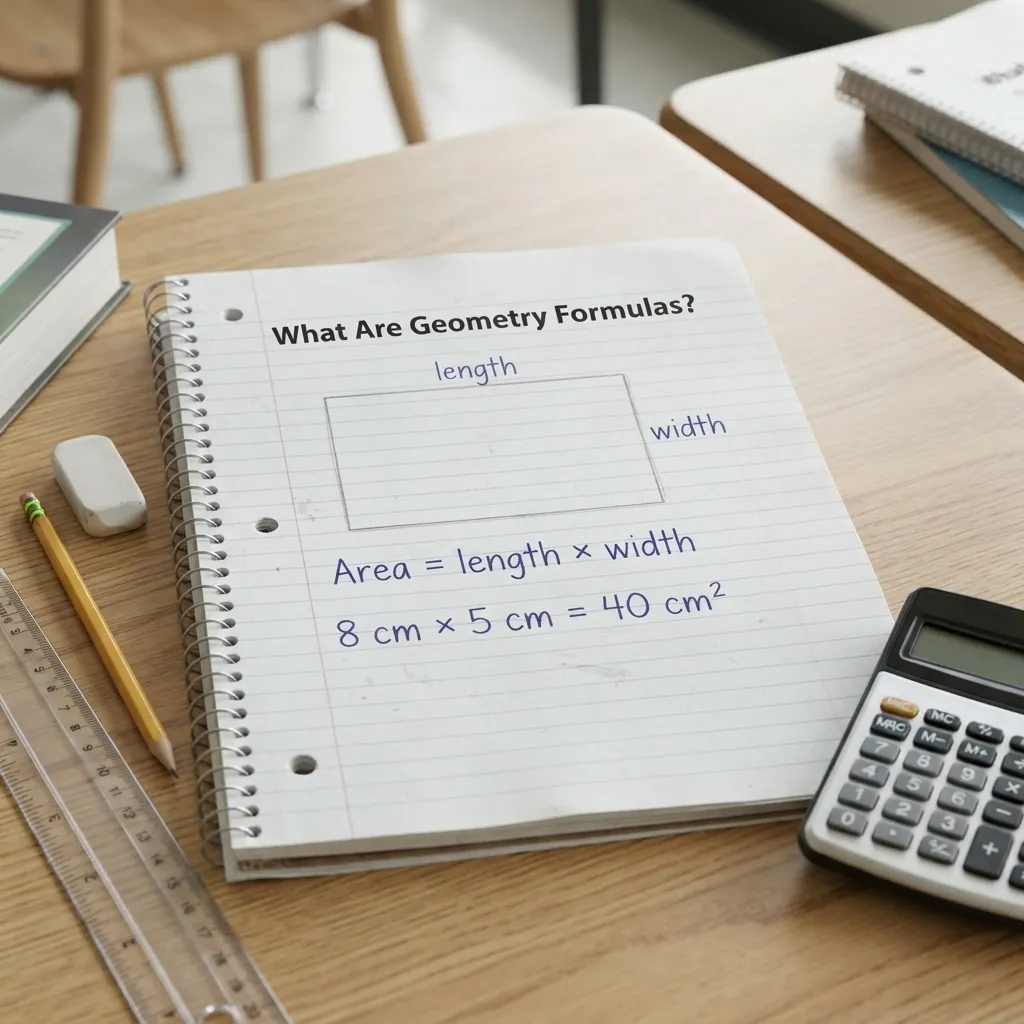
Geometry formulas are mathematical rules used to find measurements such as area, perimeter, length, angles, volume, and surface area of geometric shapes.
For example, the area of a rectangle is:
Area = length × width
If a rectangle is 8 cm long and 5 cm wide:
Area = 8 × 5 = 40 cm²
The key is not just memorizing formulas. You should also understand what the formula finds and which measurements you need.
Basic Geometry Formulas You Should Know
Here are some of the most common formulas at a glance:
| Shape or Measurement | Formula |
| Rectangle Area | A = l × w |
| Rectangle Perimeter | P = 2(l + w) |
| Square Area | A = s² |
| Square Perimeter | P = 4s |
| Triangle Area | A = ½bh |
| Triangle Perimeter | P = a + b + c |
| Circle Area | A = πr² |
| Circle Circumference | C = 2πr |
| Parallelogram Area | A = bh |
| Trapezoid Area | A = ½(a + b)h |
| Cube Volume | V = s³ |
| Rectangular Prism Volume | V = lwh |
| Cylinder Volume | V = πr²h |
| Sphere Volume | V = ⁴⁄₃πr³ |
These formulas cover many of the geometry questions you will meet in school and everyday math.
2D Geometry Formulas
Two-dimensional, or 2D, shapes have length and width but no depth.
Common 2D shapes include squares, rectangles, triangles, circles, parallelograms, rhombuses, and trapezoids.
Rectangle Formulas
A rectangle has four sides. Opposite sides have the same length.
Area of a Rectangle
A = l × w
Where:
- A = area
- l = length
- w = width
Perimeter of a Rectangle
P = 2(l + w)
Example
Suppose a rectangle has a length of 10 m and a width of 4 m.
Area:
A = 10 × 4 = 40 m²
Perimeter:
P = 2(10 + 4) = 28 m
Square Formulas
A square has four equal sides.
Area of a Square
A = s²
Perimeter of a Square
P = 4s
Where s represents the side length.
Example
If each side is 6 cm:
Area = 6² = 36 cm²
Perimeter = 4 × 6 = 24 cm
A square is simply a special type of rectangle where all four sides are equal.
Triangle Formulas
Triangles have three sides and three angles.
Area of a Triangle
A = ½bh
Where:
- b = base
- h = perpendicular height
Perimeter of a Triangle
P = a + b + c
Add all three sides to find the perimeter.
Example
A triangle has a base of 12 cm and a height of 5 cm.
A = ½ × 12 × 5
A = 30 cm²
Remember that the height must be perpendicular to the base.
Equilateral Triangle Formula
An equilateral triangle has three equal sides.
If each side is s, its perimeter is:
P = 3s
Its area is:
A = (√3/4)s²
Example
If each side is 8 cm:
P = 3 × 8 = 24 cm
The area can be found using:
A = (√3/4)(8²)
Parallelogram Formulas
A parallelogram has two pairs of parallel sides.
Area
A = bh
Where:
- b = base
- h = perpendicular height
Perimeter
P = 2(a + b)
Example
If the base is 9 cm and the height is 4 cm:
A = 9 × 4 = 36 cm²
Do not use the slanted side as the height. The height must be the perpendicular distance between the parallel sides.
Rhombus Formulas
A rhombus has four equal sides.
Perimeter
P = 4s
Area Using Diagonals
A = ½d₁d₂
Where d₁ and d₂ are the two diagonals.
Example
If the diagonals are 10 cm and 6 cm:
A = ½ × 10 × 6
A = 30 cm²
Trapezoid Formulas
A trapezoid has at least one pair of parallel sides.
Area
A = ½(a + b)h
Here, a and b are the parallel sides, while h is the height.
Example
If the parallel sides are 8 cm and 12 cm and the height is 5 cm:
A = ½(8 + 12)(5)
A = 50 cm²
Circle Geometry Formulas
Circles are one of the most important topics in geometry.
A circle has a center, radius, diameter, circumference, and area.
Radius and Diameter
The radius (r) is the distance from the center of a circle to its edge.
The diameter (d) passes through the center from one side to the other.
The relationship is:
d = 2r
or
r = d/2
Circle Area Formula
A = πr²
Here, π (pi) is approximately 3.14159.
Example
If the radius is 5 cm:
A = π × 5²
A = 25π
Approximately:
A ≈ 78.54 cm²
Circle Circumference Formula
The circumference is the distance around a circle.
You can use:
C = 2πr
or:
C = πd
Example
If the radius is 7 cm:
C = 2π(7)
C = 14π
Approximately:
C ≈ 43.98 cm
Angle Formulas
Angles are another major part of geometry.
The size of an angle is usually measured in degrees (°).
Common Angle Types
- Acute angle: less than 90°
- Right angle: exactly 90°
- Obtuse angle: greater than 90° but less than 180°
- Straight angle: exactly 180°
- Reflex angle: greater than 180° but less than 360°
Triangle Angle Sum Formula
The interior angles of every triangle add up to:
180°
For example, if two angles are 50° and 60°:
Third angle = 180° − 50° − 60°
Third angle = 70°
Quadrilateral Angle Sum Formula
The interior angles of a quadrilateral add up to:
360°
For a polygon with n sides, the sum of its interior angles is:
(n − 2) × 180°
This formula works for triangles, quadrilaterals, pentagons, hexagons, and other polygons.
Pythagorean Theorem
The Pythagorean theorem is one of the most famous geometry formulas.
It works with right triangles.
a² + b² = c²
Here, c is the hypotenuse, which is always opposite the right angle.
Example
Suppose:
a = 3
b = 4
Then:
3² + 4² = c²
9 + 16 = c²
25 = c²
So:
c = 5
This gives the famous 3-4-5 right triangle.
3D Geometry Formulas
Three-dimensional, or 3D, shapes have length, width, and height.
Common 3D shapes include cubes, rectangular prisms, cylinders, cones, pyramids, and spheres.
Cube Formulas
A cube has six square faces, and every edge has the same length.
Volume
V = s³
Surface Area
SA = 6s²
Example
If the side is 4 cm:
V = 4³ = 64 cm³
SA = 6(4²) = 96 cm²
Rectangular Prism Formulas
A rectangular prism looks like a box.
Volume
V = lwh
Surface Area
SA = 2(lw + lh + wh)
Example
If:
- l = 8 cm
- w = 3 cm
- h = 2 cm
Then:
V = 8 × 3 × 2 = 48 cm³
Cylinder Formulas
A cylinder has two circular bases and one curved surface.
Volume
V = πr²h
Surface Area
SA = 2πr² + 2πrh
Where:
- r = radius
- h = height
Example
If the radius is 3 cm and the height is 10 cm:
V = π(3²)(10)
V = 90π cm³
Cone Formulas
A cone has a circular base and a pointed top.
Volume
V = ⅓πr²h
Surface Area
The total surface area is:
SA = πr² + πrl
Here, l is the slant height.
Example
If a cone has radius 4 cm and height 6 cm:
V = ⅓π(4²)(6)
V = 32π cm³
Sphere Formulas
A sphere is perfectly round in three dimensions.
Examples include a ball or globe.
Volume
V = ⁴⁄₃πr³
Surface Area
SA = 4πr²
Example
If the radius is 3 cm:
V = ⁴⁄₃π(3³)
V = 36π cm³
The surface area is:
SA = 4π(3²)
SA = 36π cm²
Pyramid Formulas
A pyramid has a polygonal base and triangular faces that meet at one point.
Volume
V = ⅓Bh
Here, B represents the area of the base.
Example
If the base area is 40 cm² and the height is 9 cm:
V = ⅓ × 40 × 9
V = 120 cm³
The same basic volume idea applies to many types of pyramids.
Geometry Formulas for Polygons
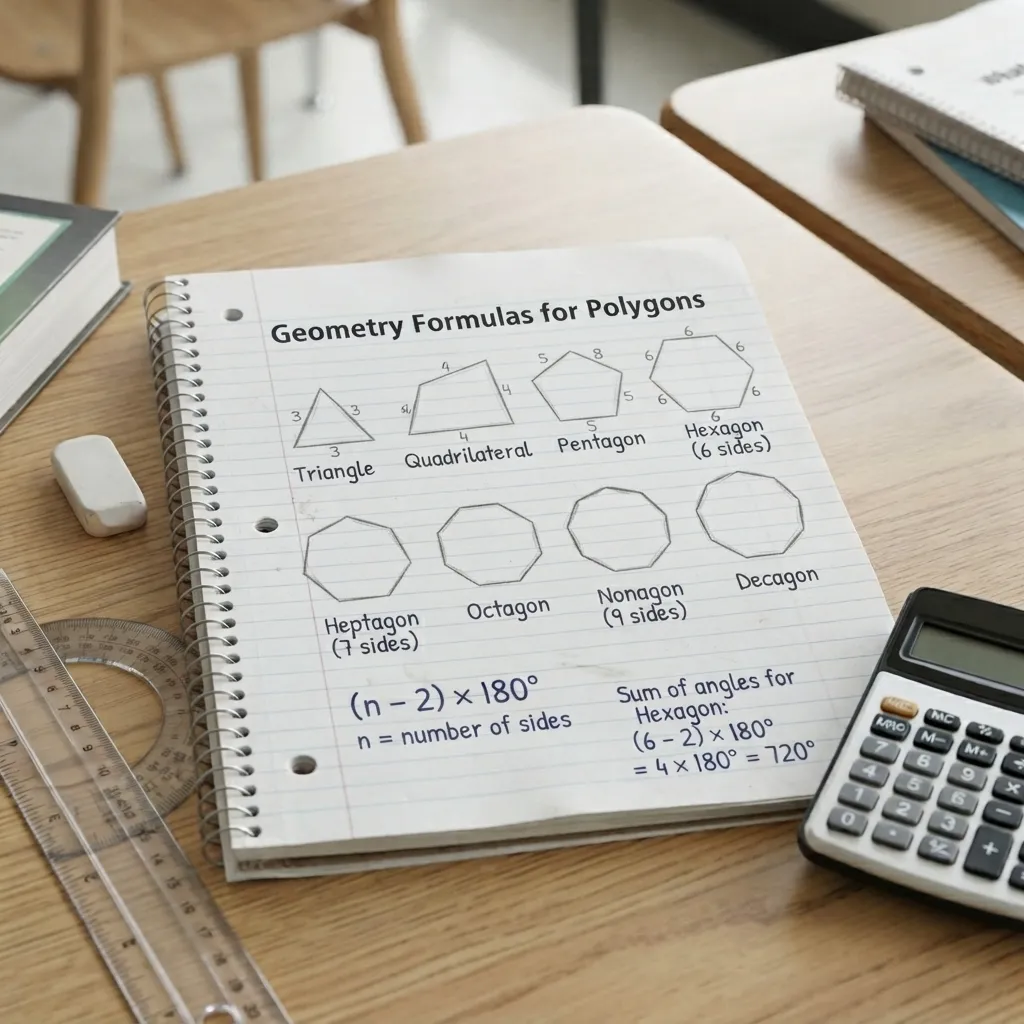
Polygons are closed shapes made from straight line segments.
Common polygons include:
- Triangle
- Quadrilateral
- Pentagon
- Hexagon
- Heptagon
- Octagon
- Nonagon
- Decagon
Interior Angle Sum
For a polygon with n sides:
Sum = (n − 2) × 180°
Regular Polygon
For a regular polygon, every side and angle is equal.
Each interior angle is:
[(n − 2) × 180°] / n
Example: Regular Hexagon
A hexagon has 6 sides.
[(6 − 2) × 180°] / 6
= 720° / 6
= 120°
So, each interior angle of a regular hexagon is 120°.
Coordinate Geometry Formulas
Coordinate geometry connects algebra with geometry.
Points are written as (x, y) on a coordinate plane.
Distance Formula
For two points:
(x₁, y₁) and (x₂, y₂)
the distance is:
d = √[(x₂ − x₁)² + (y₂ − y₁)²]
This formula comes from the Pythagorean theorem.
Midpoint Formula
The midpoint between two points is:
M = ((x₁ + x₂)/2, (y₁ + y₂)/2)
Example
For points:
(2, 4) and (6, 8)
The midpoint is:
((2 + 6)/2, (4 + 8)/2)
= (4, 6)
Slope Formula
The slope of a line is:
m = (y₂ − y₁)/(x₂ − x₁)
Slope tells you how steep a line is.
A positive slope rises from left to right. A negative slope falls from left to right.
How to Choose the Right Geometry Formula
Knowing many formulas is useful, but knowing which formula to use is even more important.
Use this simple process:
1. Identify the Shape
Look at the diagram first.
Is it a rectangle, triangle, circle, cylinder, or another shape?
2. Identify What You Need
Ask what the question wants.
Does it ask for:
- Area?
- Perimeter?
- Circumference?
- Volume?
- Surface area?
- Missing side?
- Missing angle?
3. Write the Formula
Write the formula before putting in the numbers.
This reduces mistakes.
4. Substitute the Values
Replace each variable with the measurement given in the problem.
5. Check Your Units
Area uses square units, such as cm².
Volume uses cubic units, such as cm³.
Length and perimeter use normal units, such as cm or m.
Area vs. Perimeter vs. Volume
These terms can be confusing at first.
Area tells you how much flat space is inside a 2D shape.
Perimeter tells you the distance around a 2D shape.
Circumference is the distance around a circle.
Volume tells you how much space is inside a 3D object.
Surface area tells you the total area covering the outside of a 3D object.
A simple way to remember them is:
Perimeter = around
Area = inside a flat shape
Volume = space inside a 3D shape
Surface area = outside of a 3D shape
Common Geometry Mistakes to Avoid
Even simple formulas can lead to wrong answers if you use them incorrectly.
Using Diameter Instead of Radius
The circle area formula needs the radius:
A = πr²
If you are given the diameter, divide it by 2 first.
Forgetting Square or Cubic Units
Area should be written in units such as m².
Volume should be written in units such as m³.
Using the Wrong Height
For triangle and parallelogram area, the height must be perpendicular to the base.
Mixing Up Area and Perimeter
A fence around a garden is usually a perimeter problem.
The amount of grass covering the garden is an area problem.
Rounding Too Early
If a problem involves π or square roots, keep extra decimal places until the final answer when possible.
Quick Geometry Formula Cheat Sheet
For fast revision, remember these key formulas:
Rectangle
Area = lw
Perimeter = 2(l + w)
Square
Area = s²
Perimeter = 4s
Triangle
Area = ½bh
Perimeter = a + b + c
Circle
Area = πr²
Circumference = 2πr
Parallelogram
Area = bh
Trapezoid
Area = ½(a + b)h
Cube
Volume = s³
Surface Area = 6s²
Rectangular Prism
Volume = lwh
Cylinder
Volume = πr²h
Cone
Volume = ⅓πr²h
Sphere
Volume = ⁴⁄₃πr³
Surface Area = 4πr²
Right Triangle
a² + b² = c²
FAQs:
Q1. What are the most important geometry formulas?
The most important formulas include those for area, perimeter, circumference, volume, surface area, and angles. Start with rectangle, square, triangle, circle, cube, cylinder, and sphere formulas.
Q2. What is the formula for area?
The area formula depends on the shape. For example, a rectangle uses A = lw, a triangle uses A = ½bh, and a circle uses A = πr².
Q3. What is the formula for perimeter?
Perimeter is found by adding the lengths of all outside sides. For a rectangle, the formula is P = 2(l + w).
Q4. What is the formula for the area of a circle?
The area of a circle is:
A = πr²
Here, r is the radius.
Q5. What is the Pythagorean theorem?
The Pythagorean theorem is a² + b² = c². It is used to find a missing side of a right triangle.
Q6. What is the formula for volume?
The volume formula depends on the 3D shape. For example, a rectangular prism uses V = lwh, while a cylinder uses V = πr²h.
Q7. How can I memorize geometry formulas?
Do not try to memorize everything at once. Group formulas by shape, understand what each variable means, and practice using the formulas in simple problems. Repeated practice makes them easier to remember.
Final Thoughts:
Geometry formulas may seem like a lot at first, but they become much easier when you organize them by shape and purpose.
Start with the basics: area, perimeter, circumference, volume, and surface area. Then move on to triangles, circles, polygons, coordinate geometry, and 3D shapes.
The biggest tip is simple: do not memorize a formula without understanding what it finds.
Once you can identify the shape and understand what the question is asking, choosing the right geometry formula becomes much easier. With a little practice, those symbols on the page will start to make sense.

I am Jane Austen, a soul that believes faith speaks best through quiet words and honest prayers.
I share reflections that blend timeless wisdom, gentle hope, and heartfelt devotion.
On PrayersVibe.com, my words are written to comfort hearts, strengthen faith, and remind you that you are never alone.