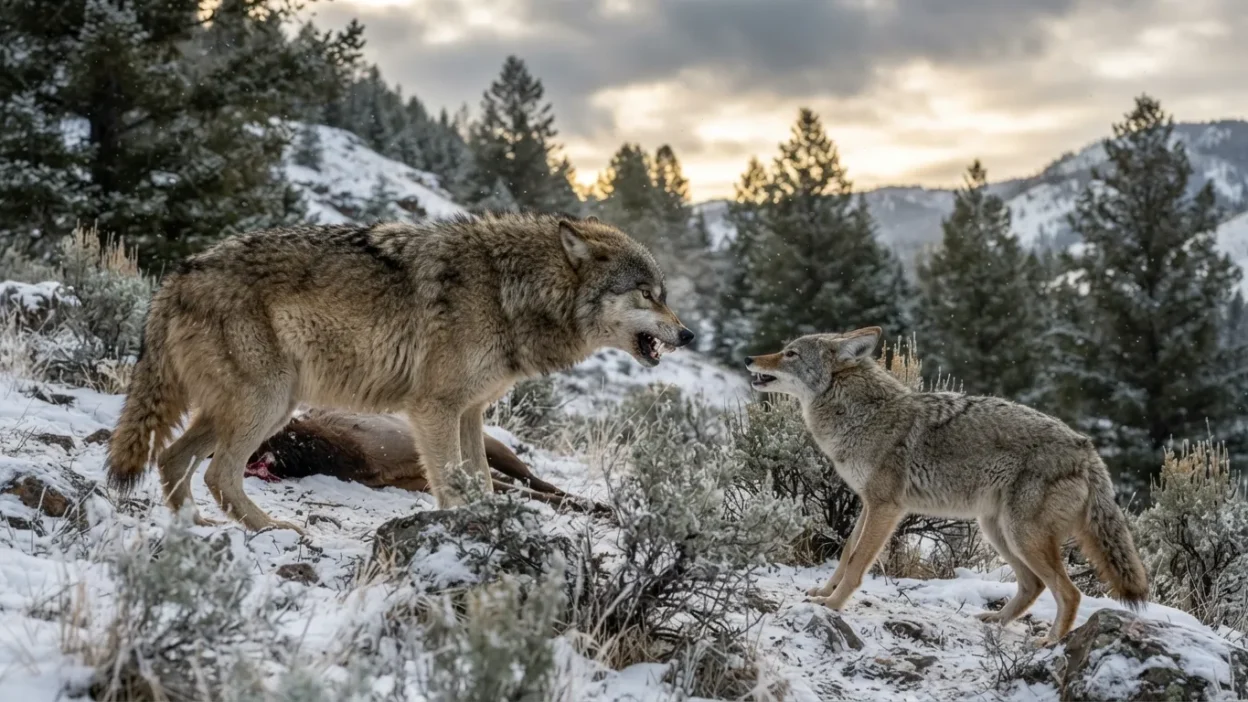
A coyote vs wolf comparison shows a clear difference in size, build, behavior, and habitat. Coyotes are smaller and slimmer, with large pointed ears, narrow muzzles, and smaller paws.
Gray wolves are much larger and heavier, with broad muzzles, large paws, and smaller ears relative to their heads.
Coyotes also adapt especially well to human-altered areas, while wolves are strongly associated with wild habitats and pack living.
Key Takeaways
- Wolves are much larger and heavier than coyotes.
- Coyotes have narrow muzzles and relatively large, pointed ears.
- Wolves have broader heads, larger paws, and a heavier body.
- Coyotes often travel alone or in pairs, while wolves commonly live in family-based packs.
- Both animals are native North American canids and can sometimes be difficult to identify from a distance.
Coyote vs Wolf: Quick Comparison
Coyotes and gray wolves belong to the same genus, Canis, but they are different species. The coyote is Canis latrans, while the gray wolf is Canis lupus.
| Feature | Coyote | Gray Wolf |
| Scientific name | Canis latrans | Canis lupus |
| General build | Slim and lightly built | Large and powerful |
| Typical weight | About 20–50 pounds | Commonly 60–130 pounds, with regional variation |
| Shoulder height | About 16–23 inches | About 26–34 inches |
| Ears | Large and pointed | Smaller relative to head |
| Muzzle | Narrow and pointed | Broad and blocky |
| Paws | Smaller and narrower | Large and robust |
| Social behavior | Often alone, in pairs, or family groups | Usually lives in packs |
| Habitat | Highly adaptable | Primarily associated with larger wild landscapes |
Exact measurements vary by individual, sex, age, and geographic population, so size should be used with other identification clues.
Size and Physical Appearance
Size is usually the easiest way to separate a coyote from a wolf.
Coyote Size and Build
Coyotes have a slim, lightweight appearance. Depending on the population and individual, adults may weigh roughly 20 to 50 pounds. Their legs look relatively long for their narrow body, and their overall shape can resemble a small, athletic dog.
A coyote’s head is also relatively small. Its ears appear large compared with its head, and its muzzle is long and narrow.
Wolf Size and Build
Gray wolves are substantially larger. Sources from the National Park Service list adult wolves at roughly 26–34 inches at the shoulder and about 70–115 pounds, although wolf size varies by population and individual.
The wolf’s body looks heavier and more powerful. Its head is broad, its muzzle is thicker, and its paws are much larger than those of a coyote.
Animal Diversity Web notes that gray wolves can be 50–100% larger than coyotes and have broader snouts and larger feet.
How to Tell a Coyote From a Wolf
If you see one in the wild, do not rely on one feature alone. Look at the animal’s overall shape.
Ears and Muzzle
Coyotes have large, pointed ears that stand out from their heads. Their muzzles are narrow and taper toward the nose.
Wolves have smaller ears relative to their large heads. Their muzzles are wider and more block-shaped. These differences can remain useful even when the animal’s exact size is hard to judge.
Paws and Tracks
Tracks can provide another helpful clue.
Coyote tracks are relatively narrow and small. Wolf tracks are considerably larger and broader. The International Wolf Center gives approximate track dimensions of 2.5 by 1.5 inches for coyotes and 4.5 by 3.5 inches for gray wolves.
Still, track size can vary, so it is better to compare several tracks rather than one isolated print.
Tail and Movement
Coyotes have long, bushy tails that often hang downward when they move. Wolves have proportionally different tails and usually show a more powerful, deliberate stride.
A coyote may appear light-footed and somewhat bouncy as it moves. A wolf tends to look heavier and smoother in its stride.
Coat Color
Coyote coats commonly contain mixtures of gray, brown, tan, and reddish tones. Wolves have a wider range of coat colors, including gray, brown, black, white, and combinations of these colors.
Color alone is not a reliable way to identify either animal. A wolf does not have to be gray, and a coyote does not always look exactly the same.
Behavior and Social Structure
One of the biggest behavioral differences involves social life.
Wolves are highly social animals that commonly live in family-based packs. Pack members can cooperate when raising young, defending territory, and hunting larger prey. Yellowstone National Park reports an average wolf pack size of 11.8 individuals in its population, although pack sizes vary.
Coyotes can also form family groups and sometimes travel in larger groups. However, they are more frequently seen alone or in pairs than wolves.
This means seeing a single animal does not automatically prove it is a coyote. It is simply one clue to consider.
Habitat and Range
Coyotes are famous for their adaptability. They can live in forests, grasslands, deserts, agricultural areas, suburbs, and urban environments. Their ability to use human-altered landscapes has helped them maintain a broad range across North and Central America.
Wolves generally require larger areas with enough space, prey, and suitable habitat to support their social groups. Their distribution is more restricted than that of coyotes in many parts of North America.
The two species can occur in the same broad regions, but their local presence depends on habitat, prey, human activity, and conservation history.
Diet and Hunting
Both animals are predators and can eat a variety of foods.
Coyotes have a particularly flexible diet. They may eat rabbits, rodents, fish, frogs, insects, snakes, fruit, grass, and other available foods. They can also prey on larger animals when circumstances allow.
Wolves can also consume different types of prey, but their larger bodies allow them to pursue and handle larger prey than coyotes generally can. Yellowstone National Park notes that wolves consume a wide variety of prey, both large and small, and that pack hunting can help them take larger animals.
Their hunting strategies reflect their different body sizes and social structures.
How Their Howls Differ
Both coyotes and wolves vocalize, so hearing a howl does not automatically identify the animal.
Coyote vocalizations are often higher-pitched and may include yips, barks, and changes in tone. Wolf howls are generally lower and longer, often sounding more continuous.
Several coyotes calling together can also create the impression that there are more animals present than there actually are.
Can Coyotes and Wolves Live in the Same Area?
Yes. Coyotes and wolves can occur in overlapping regions.
However, their relationship can be competitive. Wolves may affect coyote numbers and behavior in areas where both species are present.
Yellowstone provides an example of how changes in wolf populations have been associated with changes in coyote abundance and ecological relationships.
This is one reason the presence of wolves can influence the behavior and distribution of other predators.
Which Animal Is More Likely to Be Seen Near People?
Coyotes are much more commonly associated with suburban and urban environments.
Their ability to use many habitats and eat a wide variety of foods has helped them live close to human communities. California’s wildlife agency notes that coyotes are often found in urban and suburban environments and are highly adaptable.
That does not mean every large canine seen near a neighborhood is a coyote. Dogs, coyotes, and occasionally other wild canids can be confused, especially at night or from a distance.
If you see a wild coyote or wolf, observe it from a safe distance and do not approach or feed it. The National Park Service advises treating coyotes as wild animals and maintaining a healthy distance.
FAQs:
Is a wolf bigger than a coyote?
Yes. Gray wolves are substantially larger than coyotes. Adult wolves commonly weigh many times more than coyotes and have larger heads, paws, and overall body frames. Exact size varies by individual and population.
Can a coyote look like a wolf?
Yes, especially from far away. Both have similar canine body shapes and overlapping coat colors. A coyote can be mistaken for a small wolf when lighting is poor or there is no object nearby to show its size. Look at the ears, muzzle, paws, tail, and overall build together.
Are coyotes and wolves related?
Yes. Both are members of the canine family and the genus Canis. Coyotes are Canis latrans, while gray wolves are Canis lupus. They are closely related but are distinct species.
How can you tell a coyote from a wolf?
Start with size. A wolf should look much larger and heavier. Then check the head: coyotes have pointed ears and a narrow muzzle, while wolves have smaller ears relative to the head and a broader muzzle. Large paws and a heavy build are additional wolf clues.
Do coyotes and wolves compete?
They can. Because both are predators, they may use some of the same areas and food resources. Wolves can influence coyote populations and behavior where the species overlap. The exact relationship depends on local conditions, prey, habitat, and other ecological factors.
Conclusion:
The main difference in a coyote vs wolf comparison is size, but identification involves much more than weight alone.
Coyotes are smaller, slimmer, and more adaptable to human-dominated landscapes. Wolves are much larger, heavier, and strongly social, often living in family-based packs.
If you spot a wild canid, look at its entire shape. Large paws, a broad muzzle, a heavy head, and a powerful body point toward a wolf.
Large pointed ears, a narrow muzzle, smaller paws, and a slimmer frame point toward a coyote. When the animal is far away, however, identification can remain difficult, so give wildlife plenty of space.