You’ve just finished a heartfelt thank-you note, and you write, “I truly appreciated your kind complement.” It looks fine, it sounds fine, and spellcheck doesn’t blink. But one letter has quietly changed your meaning.
The complement vs. compliment mix-up is one of the most common slip-ups in English, and it’s easy to see why. The two words sound identical, look almost the same, and even share a Latin root. Yet they mean very different things: one describes something that completes or enhances, the other is a kind word of praise.
In this guide, you’ll learn exactly what each word means, how to use them in a sentence, and how to handle their tricky adjective forms, complementary and complimentary. You’ll also get simple memory tricks so you never mix them up again.
The Quick Answer
Short on time? Here’s the difference in ten seconds.
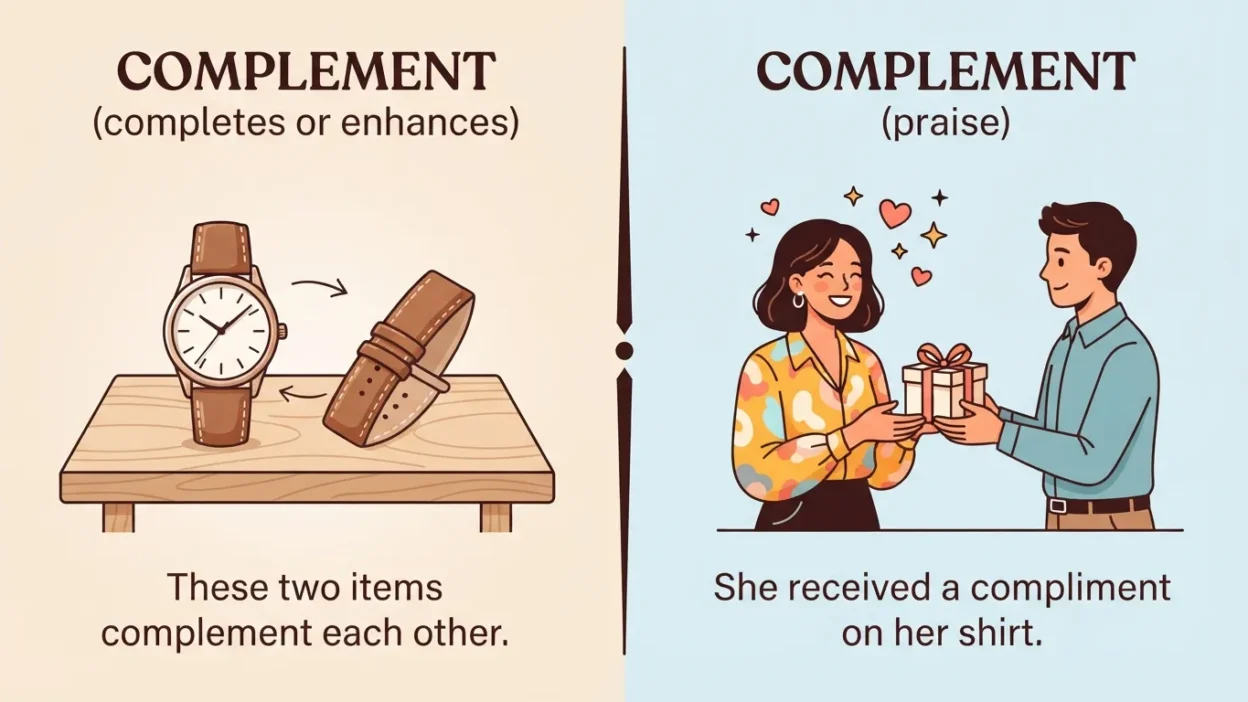
Complement (with an e) means something that completes, enhances, or pairs well with something else.
Compliment (with an i) means a polite expression of praise or admiration.
Here they are in action:
- The scarf complements her coat. (It goes well with it.)
- He complimented her scarf. (He praised it.)
| Complement | Compliment | |
| Meaning | Completes or enhances | Praise or admiration |
| Spelling clue | e as in “complete” | i as in “I like it” |
| As a noun | “Basil is a perfect complement to tomatoes.” | “That was a generous compliment.” |
| As a verb | “The wine complements the meal.” | “She complimented my presentation.” |
Notice that both words work as nouns and verbs, so grammar alone won’t tell you which to use. Meaning is what decides it.
Ask yourself one question: am I talking about completing something, or praising someone? If something is being completed, balanced, or improved, it’s complement.
If you remember nothing else, remember this: complements complete, compliments are for people. It’s not a perfect rule, since you can compliment a meal or a design, but it works as a quick gut check.
Complement: Meaning and Usage
What it means
As a noun, a complement is something that completes, balances, or improves something else. Think of it as the missing piece that makes the picture whole. It can also mean the full number needed to make a group complete, as in a ship’s “full complement” of crew. As a verb, to complement means to complete or enhance.
Everyday examples
- Food: The sharp lemon complements the rich fish.
- Design: Blue accents complement the orange sofa.
- Teams: Their skills complement each other perfectly.
In each case, the complement makes the whole better or more complete. Nobody is being praised.
Where else you’ll see it
- Math: Complementary angles add up to 90°, and the complement of a set is everything not in that set.
- Grammar: A subject complement completes the meaning of a linking verb, as in “She is a doctor.”
- Color theory: Complementary colors sit opposite each other on the color wheel, like blue and orange.
- Biology: The complement system is a group of proteins that supports the immune response.
- Economics: Complementary goods, like printers and ink, are used together.
Quick test
Swap in the word “complete.” If the sentence still makes sense, complement is your word. “The wine completes the meal” works. “The wine praises the meal” doesn’t.
Compliment: Meaning and Usage
What it means
As a noun, a compliment is a polite expression of praise, admiration, or respect. As a verb, to compliment means to offer that praise. Unlike complement, this word is all about how people (or their work, taste, and choices) are seen and appreciated.
Everyday examples
- Noun: She gave me a lovely compliment about my speech.
- Verb: He complimented the chef on the sauce.
- Reaction: Take it as a compliment.
Whenever someone is saying something nice, compliment is the word.
Common expressions and idioms
- Fishing for compliments: Trying to get others to praise you.
- Return the compliment: Praise someone back after they’ve praised you.
- Pay someone a compliment: A polite way of saying you praised them.
- Backhanded compliment: Praise with an insult hidden inside, like “You’re much smarter than you look.”
- Compliments of the chef: A free extra offered with the restaurant’s good wishes.
- With compliments: A courteous phrase used when sending something, often written on a note.
Compliment or flattery?
A compliment is usually sincere. Flattery is excessive or insincere praise, often given to win a favor. If the praise feels calculated, it’s probably flattery.
Quick test
Swap in the word “praise.” If the sentence still makes sense, compliment is your word. “He praised her scarf” works. “The scarf praises her coat” doesn’t.
Where the Confusion Comes From
If you’ve ever mixed up these two words, you’re in good company. Several things work against you.
1. They sound identical
Complement and compliment are homophones, so both are pronounced “KOM-pluh-ment.” Since you can’t hear the difference, you have to remember it in writing.
2. They look almost the same
Only one vowel separates them, and that single letter is easy to miss when you’re typing quickly or reading your own draft.
3. They share a root
Both words trace back to the Latin complere, meaning “to fill up” or “to complete.” Compliment reached English through Italian, French, and Spanish, where it referred to the “completing” of politeness and ceremony, the courteous gestures people were expected to make. Over time, the spellings drifted apart, and so did the meanings. Their shared ancestry helps explain why they feel so alike.
4. Spellcheck won’t save you
Both are real words, so autocorrect sees nothing wrong with “the wine compliments the meal.” A spellchecker checks spelling, not meaning.
5. Both are nouns and verbs
You can’t rely on grammar to tell them apart. Both work in either role, so the meaning of the sentence is the only reliable guide.
6. The adjectives add a second layer
Complementary and complimentary repeat the same confusion, with a bonus twist: complimentary can mean “free.”
The good news is that once you know the trick, the difference sticks. The next section gives you simple memory tools to keep them straight.
Memory Tricks
Once you know the meanings, a few simple hooks will lock them in.
1. The “E” trick
Complement and complete both start with “comple-,” and both have an e. If something is completing or enhancing something else, use the e spelling.
2. The “I” trick
Compliment has an i, and so does the phrase “I like it.” Praise is personal, so think “I like your shirt” and reach for the i spelling.
3. The substitution test
Swap in a simpler word and see what fits:
- Try “complete” or “go well with.” If the sentence still works, use complement.
- Try “praise.” If the sentence still works, use compliment.
“The sauce [completes] the pasta” works, so complements. “She [praised] my cooking” works, so compliments.
4. The rhyme
Complements complete. Compliments are sweet.
It’s short enough to stick in your head, and you can use it under deadline pressure.
5. The adjective shortcut
The same tricks work for the adjectives:
- Complementary → “completing.” Think complementary colors.
- Complimentary → “praising” or “free.” Think “compliments of the house.”
6. The sticky-note version
If you write often, keep this on your desk:
| Ask yourself | Then use |
| Does it complete or enhance? | E: complement |
| Is it praise? | I: compliment |
Pick whichever trick feels most natural and use it consistently. Within a week or two, the right spelling will start to feel automatic.
The Adjective Trap: Complementary vs. Complimentary
The confusion doesn’t stop at the nouns and verbs. The adjective forms are just as easy to mix up, and they cause even more mistakes in real life.
Complementary
Complementary describes things that work together to complete or enhance each other.
- Complementary colors, like blue and orange
- Complementary skills on a team
- Complementary medicine, meaning treatments used alongside conventional care
Complimentary
Complimentary has two common meanings:
- Expressing praise: “She made several complimentary remarks about the design.”
- Free of charge: “The hotel offers complimentary breakfast.”
The “free” meaning comes from the idea of a courtesy. Something given “with compliments” is a gift from the giver, not a sale.
Side by side
| Complementary | Complimentary | |
| Core idea | Completing, matching | Praising, or free |
| Example | The two therapies are complementary. | The Wi-Fi is complimentary. |
The most common mistake
Signs and menus often say “complementary breakfast” or “complementary drinks.” Unless the breakfast is meant to match something, the word they want is complimentary.
Quick test
Ask: “Is it free, or is it praise?” If yes, use complimentary. Ask: “Does it complete or match something?” If yes, use complementary.
A useful memory hook
Complimentary starts with “I” in the middle, and you like free stuff: “I like free.”
Related Word Pairs That Cause Trouble
Once you’ve mastered complement and compliment, a few nearby word pairs are worth knowing. They tend to trip up the same writers for similar reasons.
Complement vs. supplement
These two sound alike in meaning, but they aren’t the same.
- A complement completes something. Without it, the whole feels missing something.
- A supplement adds something extra to a whole that’s already complete.
“A side salad complements the pasta” suggests the meal is better balanced. “A vitamin supplement adds to your diet” suggests you’re topping up something that already exists.
Complementary vs. supplementary angles
This one shows up in math class and catches many people out.
- Complementary angles add up to 90°.
- Supplementary angles add up to 180°.
A handy trick: C comes before S in the alphabet, and 90 comes before 180.
Compliment vs. flattery
Both involve praise, but the intent differs.
- A compliment is usually sincere and given freely.
- Flattery is excessive or insincere, often used to win favor.
Compliment vs. commend
Commend is more formal and often used for achievements: “The manager commended the team for meeting the deadline.” Compliment is lighter and more personal.
Other confusing pairs to explore
If this topic interests you, these are also worth reading up on:
- Affect vs. effect
- Principal vs. principle
- Stationary vs. stationery
- Discreet vs. discrete
Each of these follows the same pattern: similar sound, different meaning, and a simple trick that makes the difference stick.
next and 250 word count
Common Mistakes: Before and After
Seeing the errors in context is one of the fastest ways to learn. Here are the mistakes that come up most often, with the reasoning behind each fix.
1. Using “compliment” when something is being completed
❌ The sauce compliments the pasta.
✅ The sauce complements the pasta.
Why: The sauce isn’t praising the pasta. It’s completing the dish.
2. Using “complement” when someone is being praised
❌ He gave her a nice complement on her dress.
✅ He gave her a nice compliment on her dress.
Why: Kind words about someone’s dress are praise.
3. Using “complementary” for free items
❌ Enjoy a complementary drink on us.
✅ Enjoy a complimentary drink on us.
Why: Free means complimentary. This is probably the most common real-world error, and it appears on menus and hotel signs everywhere.
4. Using “complimentary” for things that match
❌ Their personalities are complimentary.
✅ Their personalities are complementary.
Why: The sentence means their personalities balance each other, not that they’re free or full of praise.
5. Mixing them up in a thank-you note
❌ Thank you for the kind complement.
✅ Thank you for the kind compliment.
Why: A kind remark is always a compliment.
6. Wrong verb form in a business setting
❌ Our services compliment each other.
✅ Our services complement each other.
Why: The services work together. Nobody is flattering anyone.
Quick Quiz: Test Yourself
Think you’ve got it? Fill in each blank with complement, compliment, complementary, or complimentary (adjust the ending if needed). Answers are below.
- The red tie really ______ your navy suit.
- She blushed when he paid her a ______.
- The hotel offers ______ airport transfers.
- Their skills are ______, so they work well as a team.
- My boss ______ me on the presentation.
- A squeeze of lime ______ the spicy flavors.
- Thanks for the ______! That made my day.
- Orange and blue are ______ colors.
Answer Key
- complements: The tie completes and enhances the suit.
- compliment: He offered praise.
- complimentary: The transfers are free.
- complementary: Their skills balance each other.
- complimented: The boss praised her.
- complements: The lime balances the spice.
- compliment: Kind words are praise.
- complementary: The colors sit opposite each other on the color wheel.
Cheat Sheet: Save This for Later
Bookmark this section or screenshot it. It’s everything you need in one place.
| Word | Meaning | Memory trick | Example |
| Complement | Completes or enhances | E as in “complete” | The scarf complements her coat. |
| Compliment | Praise or admiration | I as in “I like it” | He complimented her scarf. |
| Complementary | Completing, matching | Think “complete” | Blue and orange are complementary colors. |
| Complimentary | Praising, or free | Think “praise” or “free” | The breakfast is complimentary. |
The two-second tests
- Swap in “complete” → use complement or complementary.
- Swap in “praise” → use compliment or complimentary.
- Is it free? → use complimentary.
The rhyme
Complements complete. Compliments are sweet.
Related pairs at a glance
| Pair | Quick difference |
| Complement vs. supplement | Completes vs. adds extra |
| Complementary vs. supplementary angles | 90° vs. 180° |
| Compliment vs. flattery | Sincere vs. excessive or insincere |
FAQs:
Is “complement” ever used to mean praise?
No. Praise is always spelled compliment. Complement is only for things that complete, balance, or enhance something else.
Is it “complementary” or “complimentary” breakfast?
If the breakfast is free, it’s complimentary. Complementary would mean the breakfast matches or completes something else, which is rarely what a hotel means.
Can a person be a complement?
Yes. In the sense of balancing or completing someone, it works: “She’s the perfect complement to his cautious style.” That has nothing to do with praise, so the e spelling is correct.
Do British and American English spell these differently?
No. The spellings and meanings are the same in both. The only regional difference is that “compliments slip” (a note sent with a delivery) is more common in British usage.
Are both words nouns and verbs?
Yes. You can pay a compliment (noun) or compliment someone (verb). Likewise, something can be a complement (noun) or complement something else (verb). That’s why meaning, not grammar, decides the spelling.
What does “compliments of the chef” mean?
It means a free extra from the kitchen, offered with the restaurant’s good wishes. It uses compliments because it’s a courtesy, not something that completes the meal.
What’s the fastest way to check my spelling?
Swap in “complete” or “praise.” Whichever makes sense tells you which word to use.
Conclusion:
The difference between complement and compliment comes down to one question: are you completing something, or praising someone?
Whenever you’re unsure, use the two-second test: swap in “complete” or “praise.” Whichever fits tells you the right spelling, and it works for all four words.
Since spellcheck won’t catch this mistake, make it a habit to double-check these words before you hit send or publish, especially in thank-you notes, menus, business emails, and signage.
A small slip in a message meant to be warm or professional can undercut the effect you were going for.

I’m Michael Carter, a writer passionate about education, general information, language, and the meaning behind words and phrases. At PrayersVibe.com, I create clear and useful content that helps readers understand topics without complicated language. I enjoy researching different subjects and sharing accurate information in a simple, reader-friendly way.