Consider two sentences: “Cars that are parked illegally will be towed” and “Cars, which are parked illegally, will be towed.” They look almost identical, yet the first targets only the offenders, while the second claims every car is parked illegally and all of them will be towed. One tiny word swap and two commas change the whole meaning.
That is the heart of the which vs that dilemma. Both words connect a clause to a noun, so they seem interchangeable, and even confident writers pause mid-sentence to wonder which one belongs. The good news is that the difference comes down to one simple question, and once you know it, you can settle the choice in seconds.
In this guide, you’ll learn the core rule, a quick test you can run on any sentence, the exceptions worth knowing, and the common mistakes to avoid. You’ll finish with a cheat sheet and a short quiz to lock it all in.
What Is a Relative Clause?
Before choosing between “which” and “that,” it helps to know what job they’re doing. Both words introduce a relative clause: a group of words, with its own subject and verb, that gives more information about a noun.
Look at this sentence: “The laptop that I bought last week already needs repairs.” The clause “that I bought last week” describes the noun laptop. Relative clauses are usually introduced by relative pronouns: who, whom, whose, which, and that.
Here’s where the confusion comes in. Not every relative clause plays the same role. Grammarians split them into two types, and this split is the key to the entire which vs that debate.
Restrictive (defining) clauses
A restrictive clause is essential. It tells you which specific noun the writer means, and without it the sentence would lose its meaning or become too vague.
Students who study daily perform better.
Remove the clause and the sentence claims that all students perform better, which is a different claim entirely.
Nonrestrictive (nondefining) clauses
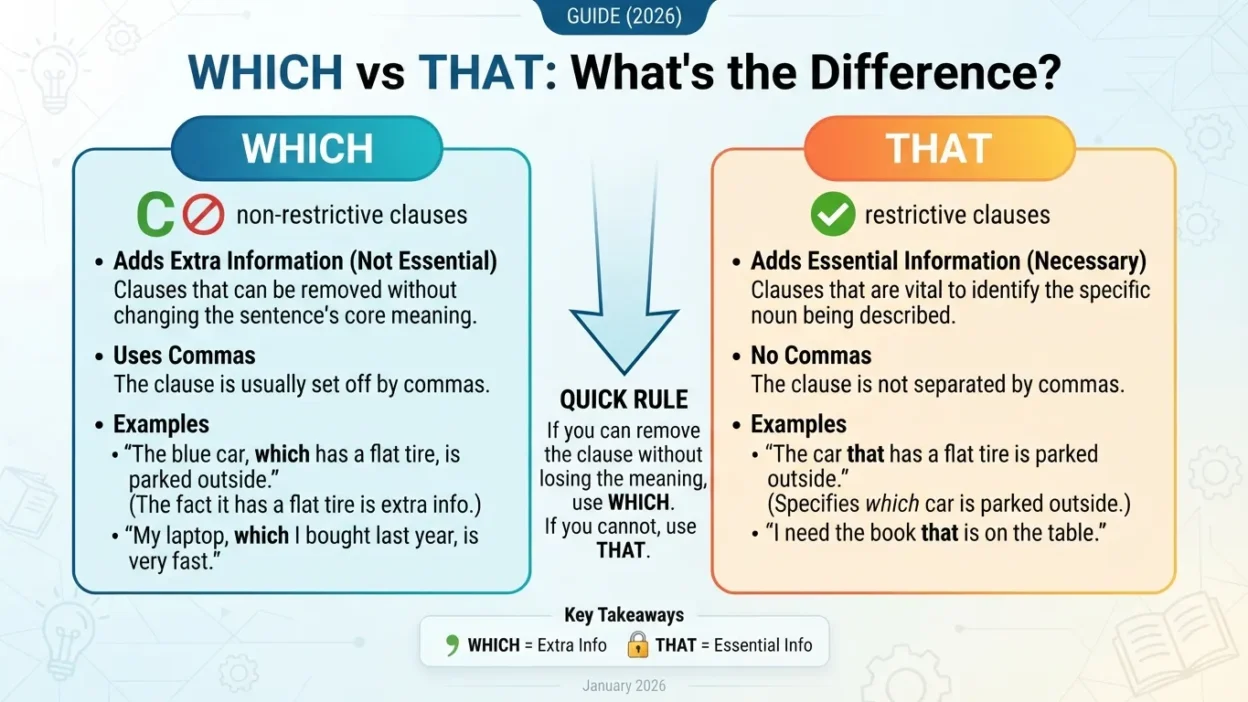
A nonrestrictive clause adds extra information. The noun is already clear, so the clause is a bonus that could be dropped without changing the core meaning. It is set off with commas.
My laptop, which I bought last week, already needs repairs.
Take the clause out and the sentence still works: “My laptop already needs repairs.”
Keep this distinction in mind, because the next section shows exactly how it decides between “which” and “that.”
The Core Rule
Now for the rule itself, which is simpler than most people expect:
- Use “that” for restrictive clauses, with no commas.
- Use “which” for nonrestrictive clauses, with commas.
Here it is in action:
The report that she submitted was late.
Which report? The one she submitted. The clause identifies the noun, so it’s essential, and “that” is the right choice.
The report, which she submitted on Monday, was late.
Here the report is already identified. The clause only adds a detail, so “which” and commas fit.
Two quick tests
The removal test. Delete the clause. If the sentence still points to the same thing and the meaning holds, use “which” with commas. If the sentence becomes vague or changes meaning, use “that.”
The pause test. Read the sentence aloud. If you naturally pause before and after the clause, it’s nonrestrictive, so use “which.”
At a glance
| Restrictive | Nonrestrictive | |
| Word | that | which |
| Commas | No | Yes |
| Role | Essential | Extra information |
| Example | The book that changed my life is on the shelf. | The book, which I finished yesterday, is on the shelf. |
Once you have this table memorized, you can handle most sentences you’ll ever write. The exceptions come later.
How the Choice Changes Meaning
The which vs that choice isn’t just a matter of polish. It changes what your sentence claims. Here are three pairs where the only differences are one word and a set of commas.
Pair 1: The boring books
Books that are boring should be avoided.
This says some books are boring, and those are the ones to skip. The clause narrows the group.
Books, which are boring, should be avoided.
This says all books are boring, so all should be avoided. The clause describes the entire group.
Pair 2: The sister
My sister who lives in Ohio is a nurse.
Without commas, the clause is restrictive. It implies you have more than one sister and you’re identifying the one in Ohio.
My sister, who lives in Ohio, is a nurse.
With commas, the clause is extra information. It implies you have only one sister, and she happens to live in Ohio.
(Note that “who” replaces “that” or “which” when the noun is a person, but the comma logic works the same way.)
Pair 3: The company policy
Employees that work remotely receive a stipend.
Only the remote workers get the stipend.
Employees, which work remotely, receive a stipend.
Every employee works remotely and gets the stipend. (In careful writing, you’d use “who” for people here, but the meaning shift is the same.)
Why it matters
In casual writing, a slip might go unnoticed. In contracts, policies, and news reports, it can mean the difference between a rule that applies to some people and a rule that applies to everyone.
Punctuation and “Which”
Punctuation is where most which vs that mistakes actually show up. The pronoun and the commas work as a team, so getting one right and the other wrong still leaves you with an error.
Nonrestrictive clauses need commas
A clause introduced by “which” is usually extra information, so it gets set off from the rest of the sentence.
The museum, which opened in 1920, attracts thousands of visitors.
For a stronger break, you can use dashes or parentheses instead of commas:
The museum, which opened in 1920, attracts thousands of visitors.
The museum (which opened in 1920) attracts thousands of visitors.
Don’t forget the closing comma
The most common slip is opening the clause with a comma and never closing it.
- Wrong: The car, which I bought last year broke down.
- Right: The car, which I bought last year, broke down.
Think of the commas as a pair of brackets. If one is there, the other must be too.
Never put a comma before restrictive “that”
A restrictive clause flows straight from the noun, because it’s part of the core meaning.
- Wrong: The car, that I bought last year, broke down.
- Right: The car that I bought last year broke down.
Starting a sentence with “which”
“Which is why I stayed home” is fine in informal writing and dialogue, but in formal writing it’s technically a fragment. Fix it by joining it to the previous sentence: “The roads were icy, which is why I stayed home.”
Special Uses and Edge Cases
The core rule covers most sentences, but a few situations trip up even careful writers.
After a preposition, use “which”
“That” can’t follow a preposition, so “which” is the only option there.
- Correct: The house in which I grew up is for sale.
- Also correct: The house that I grew up in is for sale.
- Wrong: The house in that I grew up is for sale.
“Which” can refer to a whole clause
Sometimes “which” points to an entire situation, not a single noun.
He arrived late, which annoyed everyone.
This is correct, but make sure the reference is clear. If readers can’t tell what “which” refers to, rewrite: “His late arrival annoyed everyone.”
You can often drop “that”
When “that” is the object of its clause, it’s optional: “The book (that) I read was excellent.” When it’s the subject, it must stay: “The book that won the prize is sold out.”
People take “who”
For people, use who, whom, or whose: “The teacher who inspired me retired.” Using “that” for people is common in speech, but careful writing prefers “who.”
Look-alikes that aren’t relative pronouns
- That as a conjunction: She said that she was tired.
- That as a demonstrative: That book is mine.
- Which as a question word: Which one do you want?
Where the Rule Is Contested
Here’s something that surprises many writers: the strict “that for restrictive, which for nonrestrictive” rule is more of a convention than a law of English.
A relatively young rule
The distinction was popularized in the early 20th century by usage writers, most famously H.W. Fowler, who admitted that even good writers didn’t follow it consistently. Writers had been using “which” in restrictive clauses for centuries before that, and many still do. Major dictionaries and usage guides acknowledge this history.
American vs. British English
American style guides tend to enforce the distinction. British writing is often looser, and “which” appears in restrictive clauses without much complaint. If your audience is British, you may see the rule applied less strictly.
What the style guides say
- AP Stylebook: use “that” for essential clauses and “which” for nonessential ones.
- Chicago Manual of Style: recommends the same distinction, while acknowledging that it isn’t universal.
Guides get revised, so check the current edition before quoting either one.
What to do in practice
- Follow the house style if you’re writing for a publication, employer, or client.
- Otherwise, use the distinction. Even where it isn’t required, it makes your meaning clearer, and readers who care about the rule won’t be distracted.
- Prioritize clarity. If a sentence sounds awkward with “that,” rework it instead of forcing the rule.
Common Mistakes
Even writers who know the rule slip up. Here are six errors to watch for.
1. Using “which” without commas
- Wrong: The phone which I ordered arrived broken.
- Right: The phone, which I ordered online, arrived broken.
- Or: The phone that I ordered arrived broken.
2. Putting a comma before restrictive “that”
- Wrong: The cake that she baked, was delicious.
- Right: The cake that she baked was delicious.
3. Using “which” to sound more formal
“Which” isn’t a fancier “that.” It does a different job.
- Stiff: The policy which was approved takes effect Monday.
- Better: The policy that was approved takes effect Monday.
4. Writing a vague “which”
When “which” follows a whole clause, readers may not know what it points to.
- Vague: The team lost the game, which was disappointing. (The game? The loss?)
- Clear: The team’s loss was disappointing.
5. Overusing “that”
- Cluttered: He said that he thinks that the plan that we made will work.
- Tighter: He thinks the plan we made will work.
6. Using “that” or “which” for people
- Wrong: The manager which hired me is retiring.
- Right: The manager who hired me is retiring.
A proofreading habit
Search your draft for every “which” and check each one for two things: is the clause really extra information, and does it have commas on both sides?
Then search for “that” and see how many you can delete without losing meaning. Most drafts improve after both passes.
Memory Tricks
Rules stick better when you attach them to something easy to recall. Try these shortcuts the next time you’re stuck between “which” and “that.”
1. “That” is necessary, “which” is whatever
Think of “that” as the necessary word: the clause can’t be removed. “Which” is the whatever word: nice to have, but the sentence survives without it. Since “whatever” clauses are optional, they get commas to set them apart.
2. Ask “which one?”
Read the sentence up to the noun and ask, “Which one?” If the clause answers that question, use that.
I love the cake ___ she baked.
Which cake? The one she baked. So: “the cake that she baked.”
If the noun is already clear and the clause just adds a detail, use which with commas: “Her cake, which took three hours, was gone in minutes.”
3. Listen for the pause
Say the sentence out loud. A natural pause before the clause signals which. No pause signals that.
4. Try the “witch” trick
Some writers remember it this way: “which” gets commas the way a witch gets a broomstick, always paired with something extra. A silly image, but silly images tend to stick.
5. Try dropping it
If you can delete “that” and the sentence still reads smoothly, you probably didn’t need it. This won’t help you choose, but it will make your writing leaner.
Pick one and use it
You don’t need all five. Choose the one that feels most natural, and practice it for a week. Within a few days, the choice will start to feel automatic.
Quick Reference Cheat Sheet
Bookmark this section, or screenshot it for your next editing session.
The rule at a glance
| That | Which | |
| Clause type | Restrictive (essential) | Nonrestrictive (extra) |
| Commas | No | Yes, before and after |
| Answers “which one?” | Yes | No |
| Can you delete the clause? | No, the meaning changes | Yes, the meaning holds |
| Example | The laptop that I bought is fast. | The laptop, which I bought online, is fast. |
The 10-second decision flow
- Is the noun a person? Use who, whom, or whose.
- Does the clause follow a preposition (in, of, to)? Use which.
- Does the clause answer “which one?” Use that, with no comma.
- Is the clause just a bonus detail? Use which, with commas.
Quick fixes
| If you wrote… | Change it to… |
| The car, that I bought, broke down. | The car that I bought broke down. |
| The car which I bought broke down. | The car that I bought broke down. |
| The car, which I bought last year broke down. | The car, which I bought last year, broke down. |
| The manager which hired me left. | The manager who hired me left. |
Remember
- That is necessary; which is whatever.
- Commas come in pairs.
- Follow your house style when it differs.
Practice Quiz
Time to test yourself. Fill in each blank with that, which, or who, and add commas where they’re needed. Answers are below.
Questions
- The movie ___ we watched last night was terrifying.
- Our office ___ opened in 2019 is downtown.
- The house in ___ she grew up has been sold.
- He missed the train ___ made him late.
- The teacher ___ inspired me has retired.
- Apps ___ drain your battery should be deleted.
- My phone ___ I bought last year has a cracked screen.
- The book ___ I read was excellent. (Can the blank be left empty?)
Answer key
- that. It identifies which movie, so no commas are needed.
- , which opened in 2019, The clause is extra information, so it takes commas.
- which. “That” can’t follow a preposition.
- , which It refers to the whole situation of missing the train.
- who. The noun is a person.
- that. It narrows the group to only the battery-draining apps.
- , which I bought last year, Extra detail, set off by commas.
- that (or nothing). “That” is the object of its clause, so it can be dropped.
Score yourself
- 7-8: You’ve got it.
- 5-6: Review the removal test in Section 3.
- Under 5: Reread Sections 3 and 5, then try again.
Real-World Fix-It Exercise
Editing someone else’s sentences, or your own old ones, is the best way to lock in the rule. Here’s a workplace email packed with which/that errors. Try to find all six before scrolling to the fixes.
The messy version
Hi team,
The report, that Sarah sent yesterday contains several errors. The client which we met last week wants the changes, that we discussed, by Friday. The software which crashed on Monday needs a patch. The manager which oversees the project, will review everything. Please fix the issues that, we found, and send a revised version.
The corrected version
Hi team,
The report that Sarah sent yesterday contains several errors. The client we met last week wants the changes that we discussed by Friday. The software that crashed on Monday needs a patch. The manager who oversees the project will review everything. Please fix the issues that we found and send a revised version.
What changed and why
- “The report, that Sarah sent…” A comma never goes before restrictive “that.”
- “The client which we met…” The noun is a person, so use “who” or “whom,” or drop the pronoun as we did here.
- “The changes, that we discussed,” The clause tells us which changes, so remove the commas.
- “The software which crashed…” The clause identifies the software, so “that” fits.
- “The manager which oversees the project,” A person takes “who,” and the stray comma splits the subject from its verb.
- “The issues that, we found,” Commas can’t interrupt a restrictive clause.
FAQs:
Can I use “which” without a comma?
In strict American usage, no. “Which” signals a nonrestrictive clause, and those take commas. Many British writers use “which” restrictively, so it isn’t always considered an error. If you’re unsure, switch to “that.”
Is it wrong to start a sentence with “which”?
As a question word, it’s fine: “Which option is better?” As a connector (“Which is exactly why I left”), it’s acceptable in informal writing and dialogue. In formal writing, join it to the previous sentence with a comma instead.
Can I drop “that” from a sentence?
Yes, when “that” is the object of its clause: “The movie (that) we saw was great.” Keep it when it’s the subject, as in “The movie that won the award is streaming now.” Also keep it if dropping it would make the sentence hard to read.
Does the rule apply in British English?
Less strictly. British writing often uses “which” in both kinds of clauses. If you’re writing for a British audience, check the publication’s style guide.
Should I use “that” or “who” for people?
Use “who,” “whom,” or “whose” in careful writing: “The teacher who inspired me retired.” “That” for people is common in speech, but many editors will change it.
Can “which” refer to a whole sentence?
Yes: “She passed the exam, which surprised everyone.” Just make sure readers can tell what “which” points to. If it’s unclear, rewrite the sentence.
Conclusion:
The which vs that choice looks like a tiny grammar detail, but as the examples showed, it can change what a sentence claims. Now you have the tools to get it right.
Use that when the clause is essential to identifying the noun, with no commas. Use which when the clause only adds extra information, with commas on both sides.

I’m Michael Carter, a writer passionate about education, general information, language, and the meaning behind words and phrases. At PrayersVibe.com, I create clear and useful content that helps readers understand topics without complicated language. I enjoy researching different subjects and sharing accurate information in a simple, reader-friendly way.