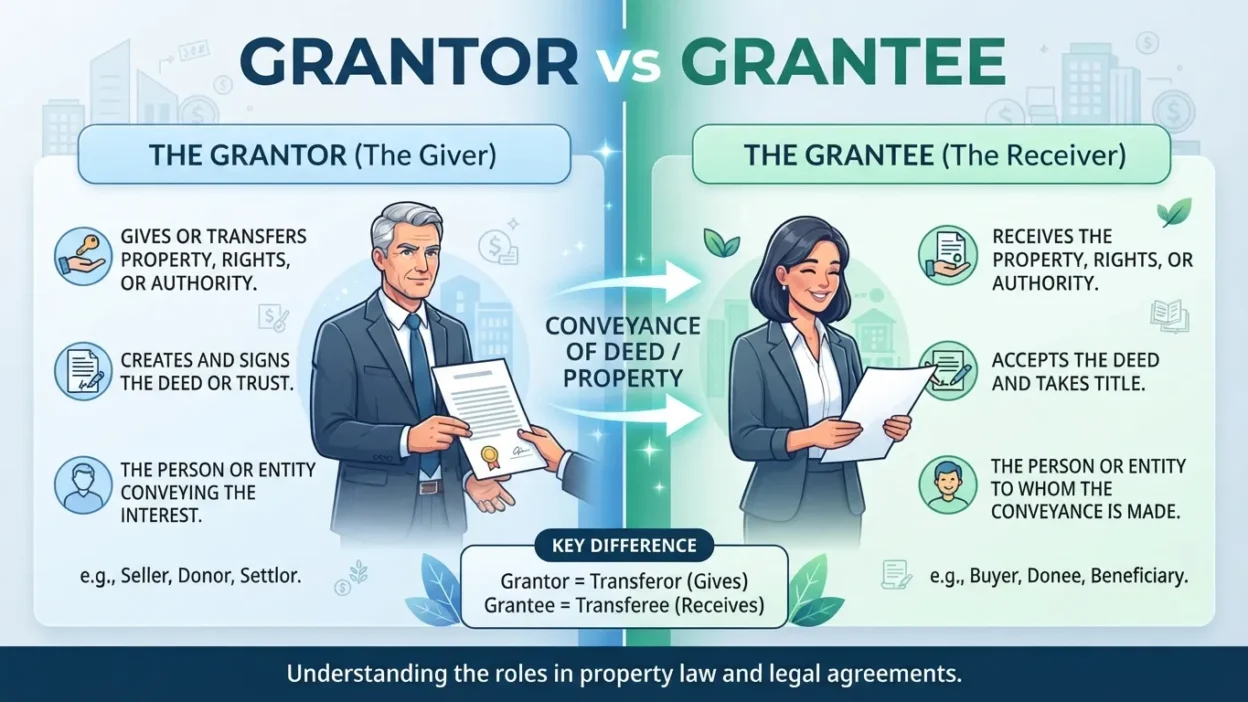
In real estate, the grantor is the person or entity that transfers a property interest, while the grantee is the person or entity that receives it.
In a typical home sale, the seller is the grantor and the buyer is the grantee. These terms commonly appear on deeds and other legal documents used to transfer property rights.
Key Takeaways
- The grantor gives or transfers a property interest.
- The grantee receives the property interest.
- In a normal home sale, the seller is usually the grantor and the buyer is the grantee.
- Grantor and grantee can also be used for gifts, trusts, easements, and other transfers.
- The type of deed can affect the warranties and rights involved in the transfer.
What Is the Difference Between Grantor and Grantee?
The difference between grantor vs grantee comes down to the direction of the transfer.
The grantor is the party transferring a property interest. The grantee is the party receiving that interest. Cornell Law School’s Legal Information Institute defines a grantor as someone who transfers an interest in real property and a grantee as the person or entity receiving that interest.
Think of it this way:
Grantor → gives or transfers
Grantee → receives
For example, imagine Sarah owns a house and sells it to James. Sarah is the grantor because she transfers her property interest. James is the grantee because he receives that interest.
This is why these terms are common on deeds and property records.
Easy Way to Remember the Difference
A simple memory trick is to focus on the endings:
- Grantor = the one granting
- Grantee = the one receiving the grant
The exact transaction can vary, but the basic direction stays the same: the grantor transfers an interest, and the grantee receives it.
Grantor Meaning in Real Estate
A grantor is a person or legal entity that transfers an interest in real property to another party.
In a typical real estate sale, the grantor is the seller. The seller transfers the property interest to the buyer through a deed or another legally recognized instrument.
However, a grantor does not have to be a seller.
For example, a homeowner might give a property to a child. The homeowner can be the grantor even though there is no traditional sale.
A person may also transfer an interest to a trust or transfer a particular property right, such as an easement. The label depends on what the document transfers and the role of each party.
What Does a Grantor Do?
The grantor is generally the party making the transfer. Depending on the document and applicable state law, this can involve:
- Signing the deed or transfer document
- Identifying the property being transferred
- Conveying the stated property interest
- Providing any warranties required by the type of deed
- Completing other requirements needed for the transfer
The grantor’s obligations can differ significantly depending on the type of deed and the laws of the state involved.
Grantee Meaning in Real Estate
A grantee is the person or entity that receives an interest in real property through a conveyance.
In a standard home purchase, the grantee is usually the buyer.
For example, if John sells his house to Maria:
| Party | Role |
| John | Grantor |
| Maria | Grantee |
| John | Transfers the property interest |
| Maria | Receives the property interest |
The grantee’s exact rights depend on what the deed transfers and the terms of the transaction.
A grantee may receive full ownership, a partial interest, an easement, or another type of property interest. Therefore, “grantee” does not always mean “person who bought a house.”
Grantor vs Grantee: Key Differences
| Feature | Grantor | Grantee |
| Basic role | Transfers an interest | Receives an interest |
| Typical home sale | Seller | Buyer |
| Direction | Gives or conveys | Receives |
| Common document | Deed | Deed |
| May be an individual | Yes | Yes |
| May be an organization | Yes | Yes |
| Can appear in non-sale transfers | Yes | Yes |
The most important difference is who is transferring the property interest and who is receiving it.
This distinction is more reliable than simply remembering “seller versus buyer,” because some property transfers do not involve a conventional sale.
Grantor vs Grantee on a Property Deed
A deed is a legal document used to transfer real estate title or an interest in real property. A county Register of Deeds glossary, for example, defines a deed as a legal document used to transfer real estate title and describes a grantor as a property transferor.
When you look at a deed, you may see language identifying one party as the grantor and another as the grantee.
A simplified example might look like this:
Alex Morgan, Grantor, conveys the described property to Taylor Morgan, Grantee.
In this example:
- Alex Morgan is transferring the interest.
- Taylor Morgan is receiving the interest.
The actual wording of deeds varies by state, deed type, and transaction.
Where Their Names Appear
The names of the grantor and grantee are generally part of the transfer document and may also appear in property records.
When researching a property’s ownership history, these names can help show how the property moved from one owner to another. The sequence of prior transfers can be important when examining a property’s chain of title.
Who Signs the Deed?
In many ordinary deed transactions, the grantor executes or signs the deed, while the exact signing, delivery, acceptance, notarization, and recording requirements depend on the applicable state law and document.
Do not assume that every property document follows exactly the same procedure. A mortgage, deed, easement, or other instrument can assign different roles to the parties involved.
Are the Seller and Buyer Always the Grantor and Grantee?
No.
They are the grantor and grantee in a typical property sale, but the terms describe the direction of the legal transfer rather than simply the commercial roles of seller and buyer.
Consider three examples.
Example 1: Home sale
A homeowner sells a house to a buyer.
- Homeowner = grantor
- Buyer = grantee
Example 2: Property gift
A parent gives a house to an adult child.
- Parent = grantor
- Child = grantee
There may be no buyer because the property is being gifted.
Example 3: Transfer to a trust
An owner transfers a property interest into a trust.
The person or entity transferring the interest may be the grantor, while the receiving party or entity is identified according to the structure of the transaction and document.
So, grantor and grantee describe the transfer relationship, not necessarily a sale.
Grantor and Grantee Examples
Here are some common scenarios:
Example 1: Buying a House
Emma sells her home to David for $350,000.
Emma = Grantor
David = Grantee
Example 2: Giving Property to a Child
Robert transfers his property to his daughter without selling it.
Robert = Grantor
Daughter = Grantee
This is still a transfer even though money may not change hands.
Example 3: Multiple Owners
Suppose two people jointly own a property and transfer it to one new owner.
The two existing owners may be the grantors, while the new owner is the grantee.
The exact names and interests should be confirmed from the deed and applicable state law.
How Deed Types Affect Grantor and Grantee
The terms grantor and grantee identify the parties, but the type of deed can affect what the transfer means and what protections accompany it.
Warranty Deed
A warranty deed generally provides the grantee with broader title warranties than a quitclaim deed. The precise warranties depend on the deed and applicable law.
This can create additional obligations for the grantor compared with a transfer that provides no title warranties.
Quitclaim Deed
A quitclaim deed generally transfers whatever interest the grantor has in the property without providing the same type of title warranties found in a warranty deed.
For example, a person may use a quitclaim deed when changing ownership between family members or resolving certain title matters.
A quitclaim deed does not automatically mean that the grantee receives a guaranteed clear title.
Grant Deed
A grant deed is another type of deed used in some U.S. jurisdictions. Its legal effect and implied warranties can vary by state.
This is one reason you should consider the state where the property is located rather than assuming that every deed works identically across the country.
Common Mistakes to Avoid
One common mistake is thinking that the grantor always means the homeowner and the grantee always means the buyer.
Those descriptions work well for a typical home sale, but they are not universal.
Another mistake is assuming that being named as a grantee automatically tells you everything about your ownership rights. The deed’s language, the property interest being transferred, other recorded documents, and state law can all matter.
It is also important not to confuse the deed with title. A deed is a legal instrument used to convey an interest in property, while title refers more broadly to the legal concept of ownership and the rights associated with it.
For a specific transaction, review the actual deed and applicable state requirements. When ownership, taxes, liens, or legal rights are at issue, a qualified real estate attorney or title professional can help interpret the documents.
FAQs:
Is the buyer the grantor or grantee?
In a typical real estate sale, the buyer is the grantee because the buyer receives the property interest. The seller is normally the grantor because the seller transfers that interest. However, these terms describe the transfer itself, so they can apply to transactions that are not ordinary purchases.
Is the seller the grantor or grantee?
The seller is generally the grantor in a normal property sale. The seller transfers an ownership interest to the buyer, who is the grantee. The exact legal role should always be determined from the document and the type of transaction.
Who is the grantee on a deed?
The grantee is the person or entity receiving the property interest described in the deed. In a normal home purchase, this is usually the buyer. A grantee can also receive property through a gift or another type of conveyance.
Who is the grantor on a deed?
The grantor is the person or entity transferring the property interest. In a standard sale, the grantor is usually the seller. The grantor’s obligations can depend on the deed type and applicable state law.
Can there be more than one grantor or grantee?
Yes. A deed can involve multiple grantors, multiple grantees, or both. For example, several co-owners may transfer a property to multiple new owners. The deed should identify the parties and the interests being conveyed.
What is the easiest way to remember grantor vs grantee?
Remember “grantor gives, grantee gets.” The grantor is the party transferring the property interest, while the grantee is the party receiving it. In a typical home sale, that means seller = grantor and buyer = grantee.
Conclusion:
Understanding grantor vs grantee is simple once you remember who gives and who receives. The grantor transfers a property interest, while the grantee receives it. In a typical real estate sale, the seller is the grantor and the buyer is the grantee.
These terms can also apply to gifts, trusts, easements, and other property transfers. The type of deed can affect the rights and protections involved, so always review the actual document and applicable state rules when a property transfer has legal or financial consequences.

I am Ernest Angelou, the heart and voice behind prayersvibe.com.
I am someone who believes that prayers are not just words, but a deep conversation between the soul and God.
I am here to share faith-filled prayers that bring peace, hope, and divine comfort into everyday life.