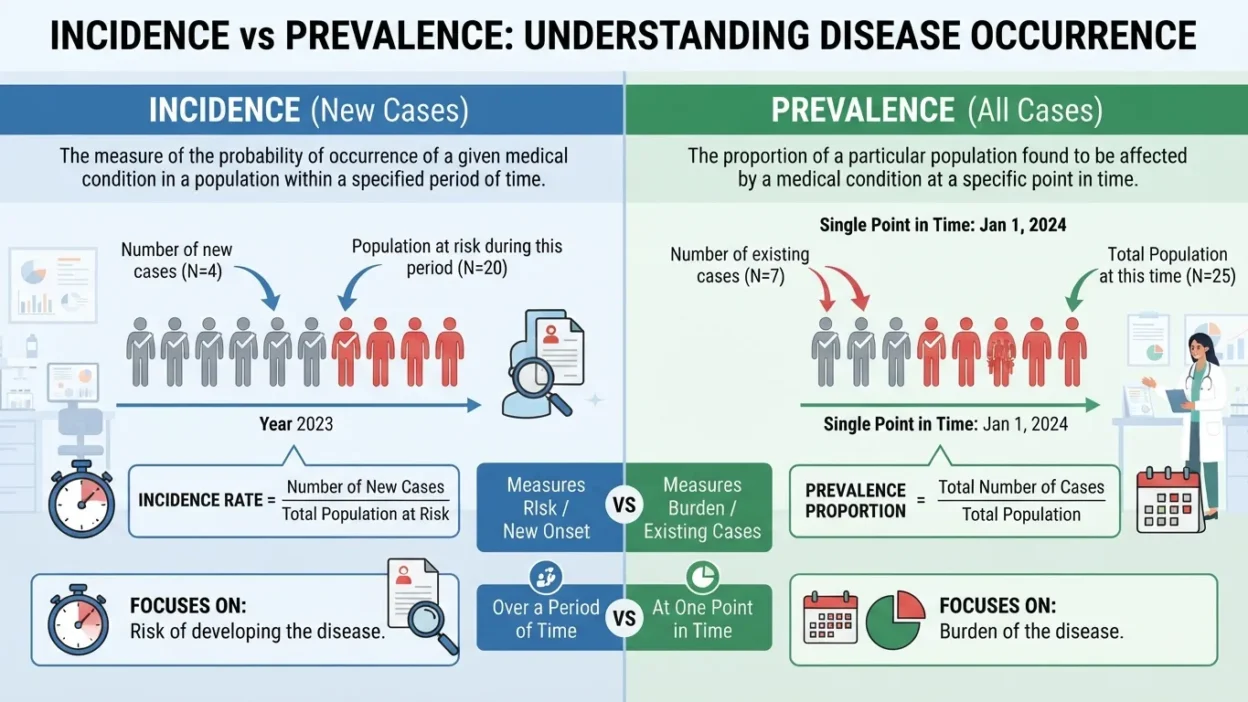
Incidence measures new cases of a disease or health condition that develop in a population during a specified period.
Prevalence measures all existing cases in a population at a particular point or during a period. In simple terms, incidence shows how often new cases occur, while prevalence shows how widespread a condition is.
Key Takeaways
- Incidence counts new cases that develop during a specified period.
- Prevalence includes people who already have the condition, including both new and existing cases.
- Incidence is useful for studying risk and the occurrence of new disease.
- Prevalence helps show the overall burden of a condition in a population.
- Disease duration can strongly affect prevalence.
What Is Incidence?
Incidence is a measure of new cases that develop in a defined population during a specified period.
For example, imagine a town has 10,000 adults who are initially free of a particular disease. During one year, 100 of them develop the disease.
The incidence proportion would be:
100 new cases ÷ 10,000 people at risk = 1%
The important word is new. People who already had the disease at the beginning are not counted as new incident cases.
The CDC describes incidence as the number of disease cases that begin during a prescribed period. It is often expressed as a rate.
Incidence is especially useful when researchers want to understand how frequently a condition is developing or investigate possible causes and risk factors.
A simplified formula is:
Incidence proportion = New cases ÷ Population at risk at the start
It is often expressed as a percentage.
For example, if 50 out of 5,000 people at risk develop a disease over one year:
50 ÷ 5,000 = 0.01 = 1%
So, the one-year incidence proportion is 1%.
Incidence Rate
An incidence rate accounts for the amount of time people are observed and at risk. It is commonly expressed using person-time, such as person-years.
The basic formula is:
Incidence rate = New cases ÷ Total person-time at risk
This is useful when people enter or leave a study at different times or are followed for different lengths of time.
What Is Prevalence?
Prevalence measures existing cases of a disease or health condition in a defined population.
Unlike incidence, prevalence is not limited to people who recently developed the condition. It can include both new and pre-existing cases.
For example, suppose a city has 10,000 residents. On a particular day, 300 residents are living with asthma.
The prevalence is:
300 ÷ 10,000 = 3%
So, the prevalence of asthma in this example is 3%.
Prevalence is often useful for understanding the overall burden of a disease or condition. It can help public health planners understand how many people may need ongoing care, treatment, or other services.
Point Prevalence
Point prevalence measures the proportion of a population that has a condition at a specific point in time.
For example:
On January 1, 2026, 500 of 20,000 people in a community had a certain condition.
The point prevalence would be:
500 ÷ 20,000 = 2.5%
The National Institute of Mental Health also distinguishes point prevalence from other forms of prevalence based on the timeframe being measured.
Period Prevalence
Period prevalence measures people who had a condition at any point during a specified period.
The period could be a month, year, or another defined timeframe.
For example, researchers might ask how many people had depression at any time during the previous 12 months.
This is different from asking how many people had depression on one specific day.
Incidence vs Prevalence: Key Differences
The easiest way to understand incidence vs prevalence is to focus on the type of cases being counted.
| Feature | Incidence | Prevalence |
| Main focus | New cases | Existing cases |
| Includes old cases? | No | Yes |
| Time element | Develops during a period | At a point or during a period |
| Common question | How many new cases occurred? | How many people have the condition? |
| Useful for | Risk, causes, prevention, surveillance | Disease burden and service planning |
| Example | 100 new cases this year | 500 people currently living with the disease |
The key difference is the numerator. Incidence counts cases that develop during the specified period, while prevalence counts cases present in the population during the relevant timeframe.
New Cases vs. Existing Cases
Think of incidence as new arrivals.
If 20 people develop an illness this month, those 20 cases contribute to incidence.
Think of prevalence as everyone currently in the group.
If 100 people already have the illness and another 20 develop it, prevalence can include all 120 people who have the condition, depending on the specific prevalence definition and timeframe.
Risk vs. Disease Burden
Incidence is closely connected to the risk of developing a condition because it focuses on new cases.
Prevalence gives more information about how widespread the condition is in a population.
This distinction matters because a disease can produce many new cases but still have relatively few existing cases if people recover quickly or die soon after developing it.
Incidence vs Prevalence Example
Consider a community of 10,000 people.
At the beginning of the year, 200 people already have a particular chronic condition. During the year, another 100 people develop it.
The incidence concerns the 100 new cases among the population at risk.
The prevalence concerns the existing cases in the population during the relevant measurement period. Depending on when prevalence is measured, it can include people from both groups.
This example shows why the two numbers are not interchangeable.
A prevalence figure does not tell you exactly how many people newly developed a condition. Likewise, an incidence figure does not tell you how many people are currently living with it.
How Are Incidence and Prevalence Related?
Incidence and prevalence are different measures, but they are connected.
One important factor is duration.
If people develop a disease and live with it for many years, cases can accumulate. This can result in relatively high prevalence even when the number of new cases is not very large.
On the other hand, a condition may have many new cases but remain at relatively low prevalence if the condition is short-lived.
The CDC notes that prevalence reflects both new and pre-existing cases and can be influenced by how long people remain affected.
The Role of Disease Duration
Imagine two diseases.
Disease A produces 1,000 new cases each year, but most people recover within a few days.
Disease B produces only 200 new cases each year, but people may live with it for many years.
This is why looking at only one measure can give an incomplete picture.
High Incidence and Low Prevalence
A disease can have high incidence but low prevalence when new cases occur frequently but affected people recover quickly or leave the population for other reasons.
Some short-duration infections can show this pattern.
Low Incidence and High Prevalence
A disease can have relatively low incidence but high prevalence when people live with the condition for a long time.
This pattern is common when studying long-lasting chronic conditions. WHO’s epidemiology guidance gives diabetes as an example of a condition that can have high prevalence with relatively low incidence, while short-duration illnesses can show the opposite pattern.
When Should You Use Incidence or Prevalence?
The right measure depends on the question being asked.
Use incidence when you want to study:
- New cases
- Risk of developing a condition
- Disease occurrence over time
- Potential risk factors
- Prevention efforts
- Changes in disease emergence
Use prevalence when you want to study:
- How widespread a condition is
- The existing disease burden
- Healthcare planning
- The number of people currently affected
- Long-lasting health conditions
Researchers may use both measures because they answer different questions. A PubMed-indexed review describes incidence and prevalence as measures used for different research purposes and questions.
Common Mistakes to Avoid
1. Treating incidence and prevalence as synonyms
They are related, but they are not the same.
Incidence = new cases.
Prevalence = existing cases.
2. Forgetting the population at risk
Incidence calculations generally focus on people who can develop the condition being studied.
For example, a study of a disease that affects only a particular population should define the appropriate population at risk.
3. Ignoring the time period
Incidence always involves the occurrence of new cases during a defined period.
Prevalence also needs a clearly defined timeframe when reporting point or period estimates.
4. Assuming high prevalence always means high incidence
It does not.
Prevalence is influenced by incidence and by how long people remain affected. A condition with long duration can have substantial prevalence even when relatively few new cases occur.
FAQs:
Is incidence the same as risk?
Not exactly. Cumulative incidence, often called incidence proportion, can be interpreted as the proportion of an initially disease-free population that develops the condition during a specified period. An incidence rate instead uses person-time in its denominator. These measures are related but should not be treated as identical.
What is the difference between incidence rate and prevalence?
Incidence rate measures the occurrence of new cases relative to person-time at risk. Prevalence measures the proportion of a population with an existing condition at a particular point or during a specified period.
Which measure is useful for chronic diseases?
Prevalence is often especially useful for chronic diseases because it describes how many people are living with the condition. Incidence can still be important when researchers want to understand how many new cases are developing.
Can incidence and prevalence both increase?
Yes. If more new cases develop, incidence can increase. At the same time, prevalence can increase if those cases add to the number of existing cases and people remain affected. Changes in recovery, mortality, migration, and population size can also affect prevalence.
What is the easiest way to remember the difference?
Remember:
Incidence = incoming new cases.
Prevalence = people already affected.
If the question asks “How many new cases developed?”, think incidence.
If it asks “How many people have the condition?”, think prevalence.
Conclusion:
The main difference in incidence vs prevalence is simple: incidence measures new cases, while prevalence measures existing cases.
Incidence helps researchers understand how frequently new cases develop and is useful for studying risk, causes, surveillance, and prevention.
Prevalence shows how widespread a condition is and can help describe the overall burden on a population.
The two measures work together. Looking at both can provide a clearer picture of how a disease develops, how long it lasts, and how widely it affects a population.

I am Scottking, the heart and voice behind PrayersVibe.com, where faith meets real-life emotions.
I am here to share powerful prayers, spiritual comfort, and words that heal the soul.
I am walking this journey of faith with you one prayer, one hope, one blessing at a time.