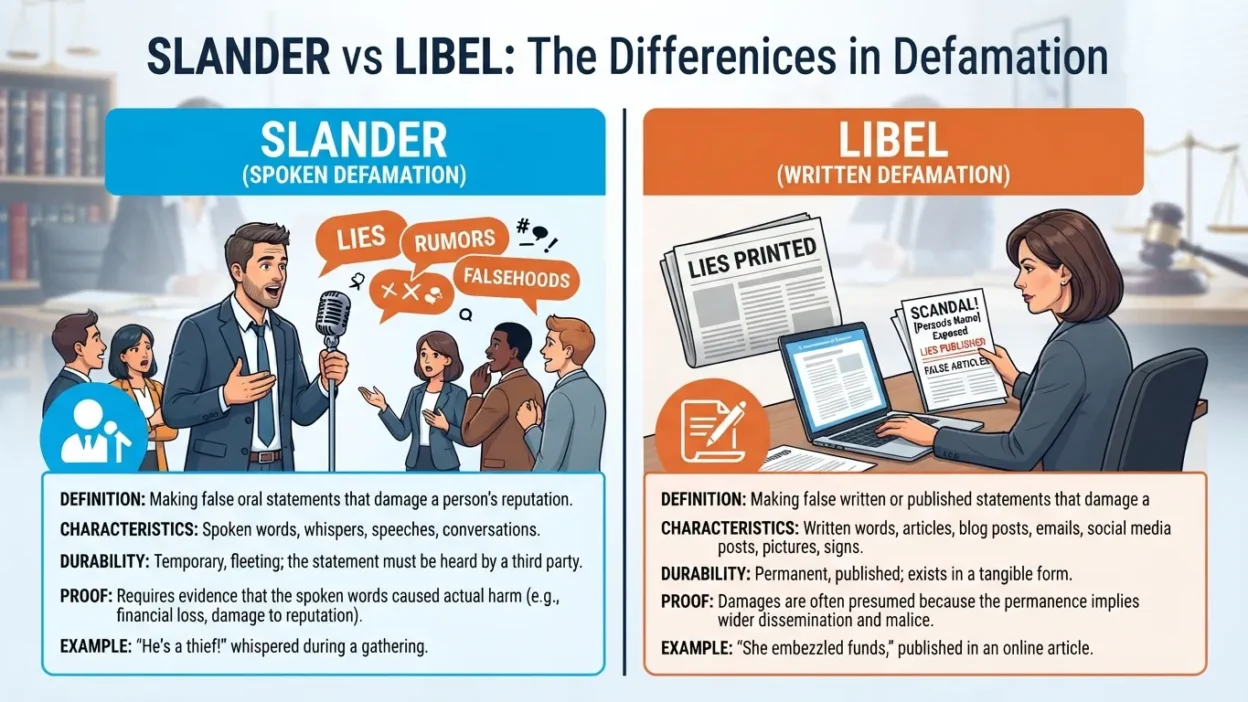
Slander vs libel refers to two forms of defamation. Slander generally involves a defamatory statement that is spoken, while libel generally involves a defamatory statement that is written, published, or recorded.
Both involve more than simply saying something mean: a claim generally concerns a false statement of fact that harms someone’s reputation, subject to state law and constitutional protections.
Key Takeaways
- Slander generally means spoken defamation.
- Libel generally means written, published, or recorded defamation.
- Both are forms of defamation.
- A false statement of fact is generally more important legally than a simple insult or opinion.
- Defamation rules differ among U.S. states, and public figures may face a higher fault standard.
What Is Defamation?
Defamation is a legal term for a false statement that harms another person’s reputation. In the United States, defamation generally includes two traditional forms: slander and libel.
The basic distinction is the way the statement is communicated. Slander generally involves spoken statements, while libel generally involves written or otherwise recorded statements.
However, not every rude, offensive, or untrue statement is automatically defamation.
A potential defamation claim usually involves a statement presented as a fact, rather than a statement that is clearly opinion. The statement also generally must be communicated to someone other than the person being discussed, and the applicable law may require proof of fault and reputational harm. Exact requirements vary by state.
What Makes a Statement Defamatory?
Consider these two examples:
“I don’t like Mark’s restaurant.”
That is generally an opinion.
Now consider:
“Mark’s restaurant uses expired meat.”
If that statement is false and presented as a factual claim, it raises a different legal issue because it can potentially be proven true or false.
The distinction between fact and opinion depends on context. The U.S. Supreme Court has explained that simply putting the words “in my opinion” before an otherwise factual accusation does not automatically protect the statement.
Slander vs Libel: The Main Difference
The easiest way to remember slander vs libel is:
| Slander | Libel |
| Generally spoken defamation | Generally written or recorded defamation |
| Often involves speech | Often involves articles, posts, messages, or other published material |
| Can include certain verbal communications | Can include permanent or recorded forms of communication |
| Part of defamation law | Part of defamation law |
This traditional distinction is useful, but modern communication can make the classification less simple.
For example, television, radio, online video, livestreams, podcasts, and recorded audio do not always fit neatly into the old spoken-versus-written categories. The legal treatment can depend on the medium and the law of the relevant jurisdiction.
What Is Slander?
Slander generally refers to spoken defamatory communication.
For example, imagine someone falsely tells several coworkers:
“John stole money from the company.”
If the statement is presented as a fact, is false, and meets the other requirements under applicable law, it could potentially support a slander claim.
The important point is that simply saying something negative about someone does not automatically make it slander. The statement must meet the applicable requirements for defamation.
What Is Libel?
Libel generally refers to defamatory statements that are written, published, or recorded.
Examples may include:
- A newspaper article falsely accusing someone of a crime
- A false statement in a blog post
- A defamatory written review
- A false accusation in an online comment
- A defamatory social media post
The exact legal classification and requirements can vary by jurisdiction.
Slander vs Libel Examples
Here are some simple examples:
Example of possible slander:
During a business meeting, someone falsely says, “Sarah stole money from her employer.”
Example of possible libel:
Someone publishes a social media post stating, falsely, “Sarah stole money from her employer.”
The last statement may be unpleasant, but an opinion is not automatically defamatory. Courts look at whether the statement can reasonably be understood as asserting an actual, objectively verifiable fact.
Is Social Media Slander or Libel?
Social media creates an important modern example.
A written Facebook post, X post, Instagram caption, or online comment containing a potentially defamatory factual claim will generally be analyzed as a form of written or published defamation, traditionally associated with libel.
A spoken statement made during a video or livestream can raise different classification questions depending on the circumstances and applicable state law.
The bigger legal question is not simply whether the communication happened online. Courts may consider whether the statement was factual, false, defamatory, communicated to others, and made with the required level of fault.
What Must You Prove in a Defamation Claim?
The exact elements differ by state, but a typical U.S. defamation claim involves several important questions.
A False Statement of Fact
The statement generally must contain a false assertion of fact.
Truth is generally a complete defense to defamation because falsity is an essential part of the claim.
A statement that cannot reasonably be understood as an assertion of fact may receive First Amendment protection.
Communication to a Third Party
The statement generally must be communicated to someone other than the person who is the subject of the statement.
For example, if someone sends you a private message containing a false statement about you and nobody else receives it, the publication element of a traditional defamation claim may not be satisfied.
If the person sends that statement to other people, the analysis can be different.
Identification
The statement generally must be about an identifiable person or entity.
A person does not necessarily have to be named directly. Identification can sometimes occur through enough details for others to recognize who the statement concerns.
Fault
The person making the statement generally must have some legally required level of fault.
The required standard can depend on the plaintiff’s status, the subject of the speech, and state law. Private plaintiffs may in some circumstances need to establish negligence, while public officials and public figures may face the constitutional actual malice standard in relevant cases.
Reputation or Legally Recognized Harm
A defamation claim generally concerns harm to reputation or another legally recognized injury.
Some jurisdictions recognize categories of defamation per se, where certain particularly serious statements can receive different treatment concerning proof of damages. The categories and consequences vary by state.
Public Figures and the “Actual Malice” Standard
Defamation law also has important First Amendment protections.
When applicable, public officials and public figures may have to prove actual malice. In this legal context, “actual malice” does not simply mean that the speaker disliked the person or acted out of spite.
It generally refers to publishing a statement with knowledge that it was false or with reckless disregard for whether it was false.
This constitutional rule comes from the U.S. Supreme Court’s defamation decisions and is one reason the legal standard can be more demanding in cases involving public figures or public officials.
The exact analysis depends on the circumstances, including the plaintiff’s status and the nature of the speech.
Common Defenses to Slander and Libel
Several defenses can affect a defamation claim.
Truth
If a statement is true, the falsity requirement for a traditional defamation claim generally cannot be established. Truth is therefore a major defense.
Protected Opinion
Statements that cannot reasonably be understood as stating actual facts may receive constitutional protection.
However, calling something an “opinion” does not automatically make it protected. A statement framed as an opinion can still imply a factual accusation that can be tested for truth or falsity.
Privilege
Certain communications may be protected by absolute or qualified privileges.
For example, statements made in judicial proceedings can receive absolute privilege when the applicable requirements are met. Other forms of privilege depend on the circumstances and state law.
Because defamation law varies significantly among states, a defense that applies in one situation may not apply in another.
Slander vs Libel: Quick Comparison
| Question | Slander | Libel |
| Basic meaning | Spoken defamation | Written, published, or recorded defamation |
| Part of defamation law? | Yes | Yes |
| Typical example | False spoken accusation | False online post |
| Must the statement generally be false? | Yes | Yes |
| Is opinion automatically defamatory? | No | No |
| Does state law matter? | Yes | Yes |
| Can First Amendment protections matter? | Yes | Yes |
The most important distinction is therefore the form of communication, but the underlying defamation rules are broader than simply asking whether something was spoken or written.
FAQs:
Is slander spoken or written?
Slander generally refers to spoken defamation. Libel generally refers to written, published, or recorded defamation. However, modern forms of communication such as broadcasts, videos, and online media can create classification questions that depend on the jurisdiction and circumstances.
Is a social media post libel?
A written social media post containing a potentially defamatory factual statement is generally treated as written or published communication and may be analyzed under libel principles. But whether the post creates legal liability depends on factors such as falsity, fault, identification, harm, defenses, and applicable state law.
Can an opinion be libel or slander?
A genuine opinion is generally protected when it cannot reasonably be interpreted as asserting a provably false fact. But labeling a statement as an opinion does not automatically protect it. Courts can consider whether the statement implies an actual factual accusation.
Can you sue someone for slander or libel?
Potentially, but meeting the requirements for a defamation claim is more complicated than proving that someone said something hurtful. The applicable state law may require proof of a false defamatory statement, publication, fault, and legally recognized harm, among other requirements.
Is telling a lie about someone always defamation?
No. A false statement does not automatically create defamation liability. The statement generally must also meet other legal requirements, such as being defamatory, communicated to a third party, and made with the required level of fault. State law can also provide defenses and privileges.
Conclusion:
The key difference in slander vs libel is traditionally the form of communication. Slander generally involves spoken defamation, while libel generally involves written, published, or recorded defamation.
Both fall under the broader concept of defamation. A potentially actionable claim usually involves more than an insult or an unpleasant opinion. Issues such as falsity, factual content, publication, fault, reputation, damages, privileges, and First Amendment protections can all matter.
Because U.S. defamation law is primarily governed by state law, the exact rules can differ depending on where the dispute occurs.

I’m Michael Carter, a writer passionate about education, general information, language, and the meaning behind words and phrases. At PrayersVibe.com, I create clear and useful content that helps readers understand topics without complicated language. I enjoy researching different subjects and sharing accurate information in a simple, reader-friendly way.