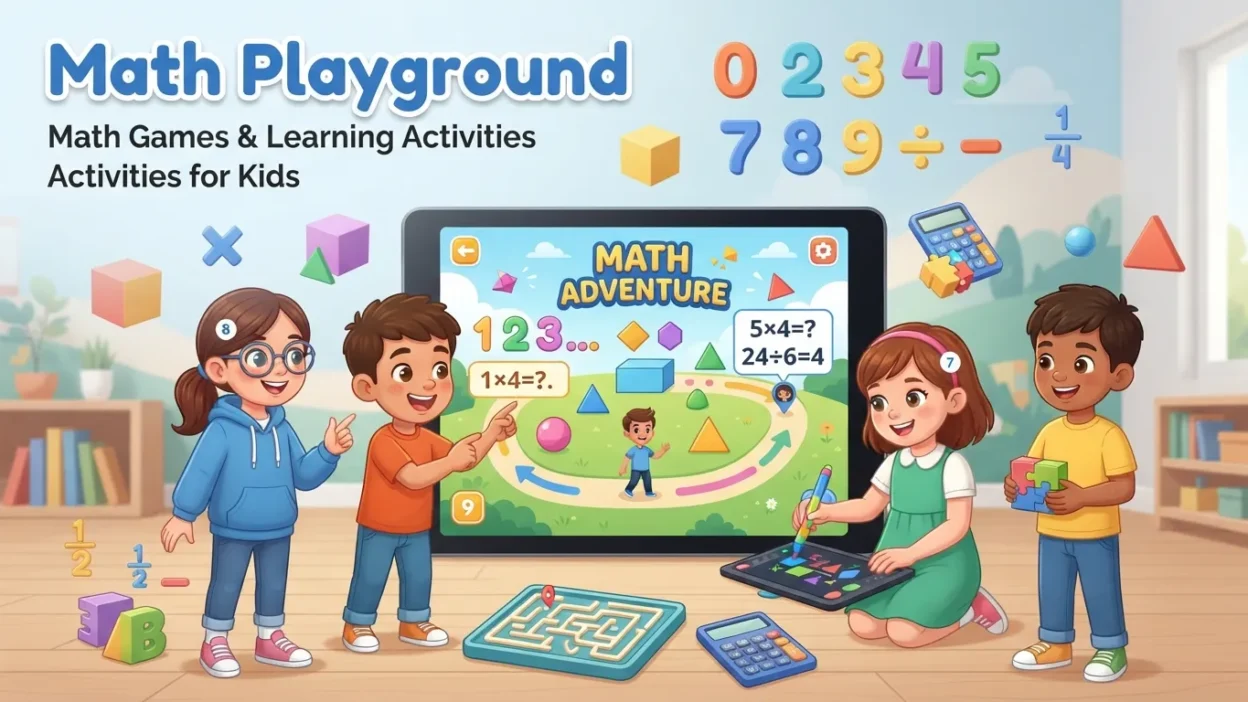
Math Playground is an online learning website where kids can practice math through interactive games, puzzles, challenges, and problem-solving activities. It is mainly designed for students in Kindergarten through Grade 6.
Instead of learning math only through worksheets, students can explore numbers, patterns, fractions, geometry, logic, and other skills through playful activities.
The official Math Playground describes its approach as purposeful play and powerful learning. The site includes hundreds of activities designed to help children build math thinking, problem-solving skills, and confidence.
What Is Math Playground?
Math Playground is an educational website focused on learning through games.
The website launched in 2002 and grew from an idea of using games and puzzles to make mathematics more engaging for children. Today, it provides math games, logic puzzles, problem-solving activities, explorations, and practice exercises.
The platform covers students from Kindergarten through Grade 6. Its content includes both direct math practice and games that develop broader thinking skills.
These activities can help children work on:
- Addition
- Subtraction
- Multiplication
- Division
- Fractions
- Decimals
- Percentages
- Ratios
- Geometry
- Algebra
- Word problems
- Place value
- Time
- Money
- Angles
- Area and perimeter
- Logic
- Spatial reasoning
- Problem solving
How Does Math Playground Work?
Math Playground works directly in a web browser.
Students can choose a game or activity and start playing without needing to install traditional desktop software. The site’s learning-games section says its activities can be played instantly in a browser without a login, installation, or account.
A typical activity combines a learning goal with a game challenge.
For example, a student may need to solve an equation before moving a character, identify a number to unlock a path, or use spatial reasoning to complete a puzzle.
This makes the math part feel connected to an action or goal.
Math Playground Games by Grade Level
Math Playground organizes many of its resources around grade levels.
Kindergarten Math Playground
Kindergarten activities can introduce young learners to basic numbers, counting, shapes, patterns, and early mathematical thinking.
Games at this level should focus on simple tasks and visual learning.
1st Grade Math Playground
First-grade activities can help children practice addition, subtraction, counting, place value, and basic problem solving.
Interactive games can give students repeated practice without making every activity feel like a worksheet.
2nd Grade Math Playground
Second-grade students can work on addition, subtraction, multiplication foundations, place value, measurement, and word problems.
This is also an important stage for building confidence with basic arithmetic.
3rd Grade Math Playground
Third-grade activities can introduce more advanced multiplication, division, fractions, geometry, and multi-step problems.
Some Math Playground games are specifically listed for Grade 3 and above.
4th Grade Math Playground
Fourth-grade learners can practice fractions, decimals, multiplication, division, geometry, angles, and problem solving.
Games can provide another way to review concepts introduced during class.
5th Grade Math Playground
Fifth-grade activities can cover more complex fractions, decimals, percentages, ratios, geometry, and algebraic thinking.
6th Grade Math Playground
Sixth-grade students can explore prealgebra, ratios, percentages, equations, geometry, and more challenging logic activities.
The official site currently lists dedicated math sections from Kindergarten through Grade 6.
Math Playground Addition Games
Addition games help students build speed, accuracy, and confidence with numbers.
Math Playground includes activities where children add numbers while completing another challenge.
This approach can make repeated practice more interactive.
Math Playground Subtraction Games
Subtraction games give children opportunities to practice taking away, comparing numbers, and solving subtraction problems.
Students can use these games for extra practice after learning the basic subtraction rules in class.
Math Playground Multiplication Games
Multiplication is one of the largest skill areas on Math Playground.
The official multiplication section is designed for Grades 2–6 and includes fact fluency, equal groups, arrays, area models, factors, multiples, multi-digit multiplication, and problem solving.
Games can help students practice times tables while also seeing how multiplication connects to other mathematical ideas.
Math Playground Division Games
Division games can help students understand sharing, grouping, division facts, and the relationship between multiplication and division.
Interactive problems can also give children a chance to practice accuracy and logical thinking.
Math Playground Fraction Games
Fractions can be difficult when students only see them as numbers.
Interactive fraction activities can provide visual models and challenges that help students explore parts of a whole, equivalent fractions, comparisons, and operations.
Math Playground includes fraction activities among its core math resources.
Math Playground Geometry Games
Geometry games can help children explore shapes, angles, area, perimeter, coordinates, and spatial relationships.
Activities such as Geoboard, Rocket Angles, area games, and shape puzzles give students ways to interact with geometric ideas.
Math Playground Logic Games
Not every Math Playground activity is a traditional arithmetic game.
The platform also has logic and problem-solving activities.
These games may require students to:
- Find patterns
- Plan several moves ahead
- Test an idea
- Change a strategy
- Recognize relationships
- Solve a puzzle
- Think about space and position
This type of activity can support mathematical thinking beyond simply calculating an answer.
Math Playground Problem-Solving Games
Problem solving is a major part of the platform.
For example, Duck Path asks students to solve equations and then plan a path through the level. The official game page identifies sequential reasoning, problem solving, spatial awareness, strategic planning, and perseverance as skills involved.
This shows how a game can combine computation with planning.
Math Playground Spatial Reasoning Games
Spatial reasoning involves understanding how objects relate to position, direction, shape, and space.
Math Playground includes a dedicated spatial-reasoning group with activities such as Red Block Returns, Jelly Slice, Slydrs, Parking Tight, Roboban, and other puzzles.
These activities can be useful when students need practice thinking visually.
Popular Math Playground Games
Math Playground has a large game library, so students can choose from many types of activities.
Some recognizable examples include:
- 2048
- Thinking Blocks
- Fraction Forest
- Math Push
- Monster Stroll
- Math Monster
- Rocket Angles
- Sum Blocks
- Number Sequence
- Code Panda
- Tangram Puzzles
- Geoboard
- PEMDAS Exhibit
The site’s current game directory contains categories for number games, addition, multiplication, fractions, percentages, order of operations, time, money, angles, area and perimeter, graphing, shapes, and more.
What Skills Can Kids Practice on Math Playground?
Math Playground can support several different learning skills.
Mathematical Fluency
Repeated practice can help students become more comfortable with basic operations.
Problem Solving
Many games require students to understand a problem and choose a strategy before acting.
Logical Thinking
Logic puzzles encourage children to identify relationships and make decisions based on available information.
Pattern Recognition
Number and visual patterns can help children notice mathematical relationships.
Spatial Thinking
Shape and movement games give students opportunities to reason about position and space.
Perseverance
Some puzzles require several attempts. Students can test an idea, learn from an unsuccessful attempt, and try another strategy.
The official site explains that many of its games encourage experimentation, pattern recognition, flexible thinking, and persistence.
Math Playground for Teachers
Teachers can use Math Playground as an additional practice resource.
A game can work as:
- A warm-up activity
- Math-center activity
- Independent practice
- Small-group activity
- Review activity
- Brain break
- Problem-solving challenge
The site’s learning-games section specifically describes classroom uses such as math centers, free-choice time, independent practice, small-group work, and blended learning.
Teachers can also choose activities based on a particular skill or grade.
Math Playground for Parents
Parents can use math games as an extra learning activity at home.
For example, a parent might choose a multiplication game for a child who needs more times-table practice.
Another child might benefit more from a logic or spatial puzzle.
The key is to match the activity to the child’s current skill level rather than simply choosing the most difficult game.
Is Math Playground Free?
Math Playground provides a large collection of free online learning games.
Its official learning-games page describes these activities as free and says they can be played in a browser without a login, installation, or account.
The website also offers an academic-only version called Math Playground Plus, according to its game directory.
Is Math Playground Safe for Kids?
Math Playground states that its games are selected according to content guidelines and that its games avoid violence, adult content, and foul language.
The company also says its advertising is child-directed and non-personalized and that it does not use behavioral targeting or cross-site tracking.
Parents and teachers should still use normal online-safety habits, including checking the specific activities children use and supervising younger students when appropriate.
Can Math Playground Be Used in the Classroom?
Yes.
Math Playground’s activities are designed to support classroom learning as well as independent practice.
For example, its Thinking Blocks resource provides interactive word-problem models and printable problems. The resource covers addition, subtraction, multiplication, division, fractions, decimals, percentages, and ratios for Grades 1–6.
Teachers can use these activities to connect gameplay with a lesson objective.
How to Choose the Right Math Playground Game
The best activity depends on the student’s goal.
If a child needs basic arithmetic practice, choose an activity focused on addition, subtraction, multiplication, or division.
If the goal is conceptual understanding, look for visual activities involving fractions, geometry, or number relationships.
For higher-level thinking, try logic, spatial reasoning, strategy, or problem-solving games.
A simple approach is:
- Choose the student’s grade level.
- Identify the math skill.
- Pick a game that matches that skill.
- Let the student try the challenge.
- Ask the child to explain the strategy.
- Move to a harder activity when the current one becomes comfortable.
Why Use Math Games for Learning?
Games cannot replace good teaching, but they can add another useful way to practice.
A traditional worksheet may ask a student to solve many similar problems.
A game can place the same skill inside a goal, puzzle, story, or challenge.
This can give students another reason to use the mathematical idea.
Math Playground’s own educational approach focuses on connecting play with mathematical understanding, rather than treating games simply as a reward after learning.
Frequently Asked Questions
What is Math Playground?
Math Playground is an educational website offering interactive math games, puzzles, logic activities, and problem-solving challenges, primarily for students in Kindergarten through Grade 6.
Is Math Playground free?
Many Math Playground learning games are available for free directly in a web browser. The site also offers Math Playground Plus for an academic-only experience.
What grades is Math Playground for?
Math Playground primarily serves students from Kindergarten through Grade 6. Its individual games can have their own recommended grade levels.
Does Math Playground have multiplication games?
Yes. Its multiplication collection includes practice for multiplication facts, equal groups, arrays, area models, factors, multiples, multi-digit multiplication, and problem solving.
Can teachers use Math Playground?
Yes. The platform provides activities that can be used for math centers, independent practice, small groups, review, and other classroom activities.
Final Thoughts
Math Playground brings math practice and playful problem solving together in one online learning environment.
Its resources cover a wide range of skills, from early counting and addition to fractions, multiplication, geometry, algebraic thinking, logic, and spatial reasoning.
For students, the main attraction is the game.
For teachers and parents, the value is that many activities connect play with a specific learning goal.
When the right game is matched with the right skill and grade level, Math Playground can be a useful addition to math practice at school or home.

I’m Jessica Morgan, a writer who loves covering lifestyle, entertainment, sports, trends, and everyday topics in a simple and engaging way. At PrayersVibe.com, I focus on creating helpful, easy-to-read content that informs and connects with readers. I enjoy researching new ideas and turning them into clear, useful stories that readers can enjoy.