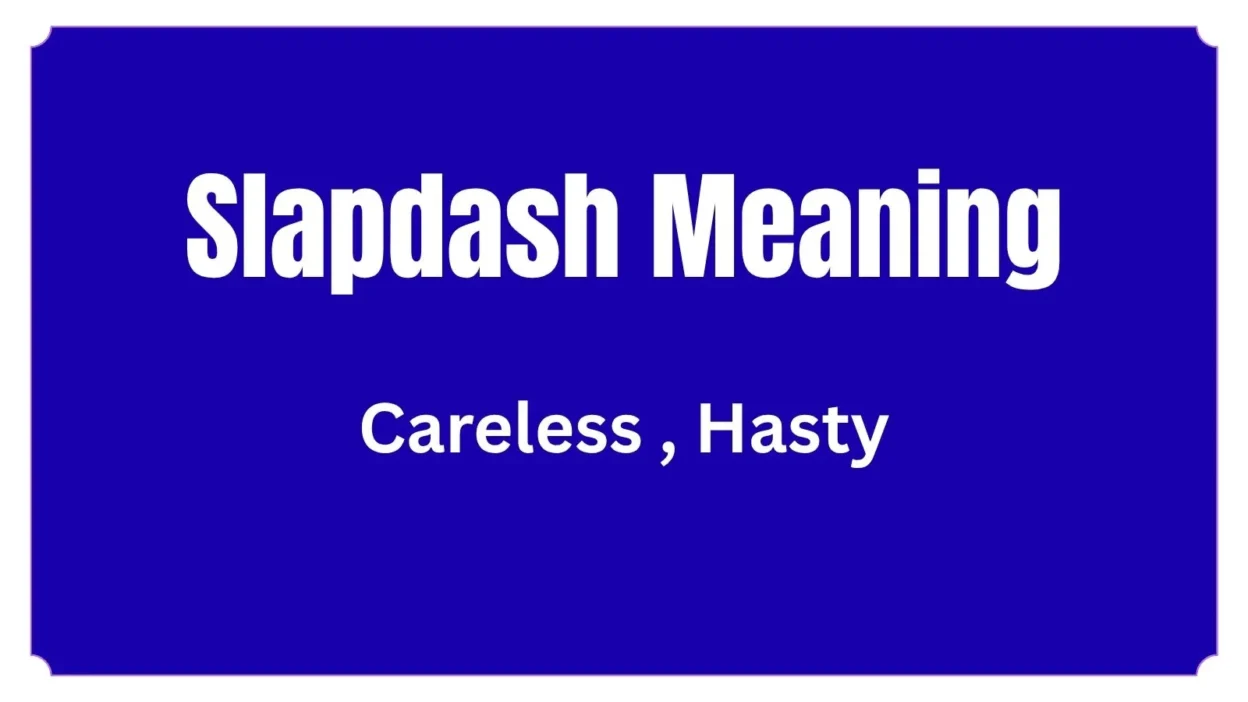
Have you ever done a task so fast that you did not check the small details? Someone might call that work slapdash. The word often describes something done in a rushed, careless, or messy way.
The slapdash meaning is simple: it means something was done quickly and without enough care. It can describe work, writing, planning, repairs, or even a person’s approach to a task.
For example, if someone paints a wall in a hurry and leaves uneven spots, you could call the job slapdash. The word usually carries a negative tone because it suggests that better care should have been taken.
In this guide, you will learn what slapdash means, where it comes from, how to use it, and how it differs from words such as careless, rushed, haphazard, and sloppy. You will also see easy examples that make the word simple to remember.
Quick Answer
Slapdash means done quickly and carelessly, without enough thought, planning, or attention to detail.
For example:
“The report looked slapdash because the writer did not check it before sending it.”
The word can describe a slapdash job, slapdash work, slapdash writing, or a slapdash approach to a problem.
It is usually used when speed has hurt the quality of the result.
Definition & Meaning
The slapdash meaning refers to something done in a rushed and careless way. A person may finish the task, but the result often lacks care, order, or quality.
Think of it this way:
Slapdash = fast + little care + poor attention to detail
The word does not always mean that the person had bad intentions. They may have been tired, busy, under pressure, or simply unwilling to spend enough time on the task.
For example:
- A slapdash essay may contain many errors.
- A slapdash repair may fail soon after it is completed.
- A slapdash plan may miss important details.
- A slapdash cleaning job may leave many areas dirty.
- A slapdash design may look unfinished.
The key idea is lack of care in how something gets done.
What Does Slapdash Mean in Simple English?
In very simple English, slapdash means “done too quickly and not carefully.”
Imagine that you need to clean your room before a guest arrives. You have only five minutes, so you throw things into drawers, push clothes under the bed, and wipe only the most visible surfaces.
The room may look better at first, but you did not clean it properly. That is a good example of a slapdash job.
The word often suggests that the person cared more about finishing than doing the task well.
Slapdash Meaning in a Sentence
Here are some simple examples:
- “The student gave a slapdash answer without reading the question.”
- “His slapdash work caused more problems later.”
- “The contractor did a slapdash repair.”
- “The article felt slapdash and needed more editing.”
- “She made a slapdash attempt to organize the files.”
- “The project failed because of its slapdash planning.”
- “Do not give me a slapdash solution; check the details first.”
- “The room looked clean, but the job was slapdash.”
- “His slapdash approach saved time but reduced quality.”
- “The final report seemed slapdash because it had many errors.”
Notice that the word often appears before a noun, such as work, job, effort, attempt, plan, or approach.
What Does Slapdash Mean at Work?
At work, slapdash usually describes poor-quality work caused by rushing or failing to pay attention.
For example, imagine an employee needs to prepare a report. Instead of checking the numbers, formatting the pages, and fixing spelling errors, the employee sends it right away.
A manager might describe the report as slapdash.
This does not simply mean the report has one small mistake. It suggests that the whole task shows a lack of care.
Common workplace phrases include:
- slapdash work
- slapdash report
- slapdash planning
- slapdash project
- slapdash effort
- slapdash approach
- slapdash solution
If quality matters, a slapdash approach can create extra work later.
Slapdash Meaning in Writing
When people describe writing as slapdash, they usually mean the writer did not spend enough time improving or checking the text.
A slapdash piece of writing may have:
- Spelling errors
- Weak grammar
- Repeated ideas
- Poor structure
- Missing details
- Confusing sentences
- Facts that were not checked
- Little editing
For example:
“The first draft was useful, but the final version felt slapdash.”
This sentence means the final version seemed rushed and poorly finished.
It does not necessarily mean that every sentence was wrong. Instead, the overall work showed a lack of care.
Slapdash Synonyms
Several English words have a similar meaning to slapdash, but they do not always carry exactly the same feeling.
Careless
Careless means not giving enough attention to what you are doing.
Example:
“His careless mistake caused a delay.”
This word focuses more on the person’s lack of care.
Haphazard
Haphazard means lacking a clear plan, order, or system.
Example:
“The books were arranged in a haphazard way.”
This word focuses more on disorder or a lack of planning.
Sloppy
Sloppy means poorly done or lacking care.
Example:
“The report contained sloppy errors.”
Sloppy and slapdash can be close in meaning, but slapdash often highlights rushing.
Rushed
Rushed means done with too little time.
Example:
“The rushed project needed more testing.”
Something can be rushed without being careless, so this word does not always have the same negative force as slapdash.
Half-hearted
Half-hearted means done without much effort, interest, or enthusiasm.
Example:
“He made a half-hearted attempt to help.”
This word focuses more on effort or enthusiasm than speed.
Slapdash vs. Similar Words
Understanding the differences helps you choose the right word.
| Word | Main Idea | Simple Example |
| Slapdash | Rushed and careless | “The repair was slapdash.” |
| Careless | Not paying enough attention | “He was careless with the details.” |
| Haphazard | No clear order or plan | “The files were placed haphazardly.” |
| Sloppy | Poorly done | “The work was sloppy.” |
| Rushed | Done with little time | “The answer was rushed.” |
| Half-hearted | Little effort or interest | “She made a half-hearted attempt.” |
| Thorough | Done with great care | “He gave the report a thorough review.” |
A useful way to remember the difference is this:
Slapdash focuses on rushed and careless work.
Haphazard focuses on a lack of order or planning.
Careless focuses on a lack of attention.
Rushed focuses on limited time.
Slapdash Antonym
An antonym is a word with an opposite meaning.
Good opposites for slapdash include:
- Careful
- Thorough
- Precise
- Detailed
- Methodical
- Diligent
- Well-planned
- Thoughtful
- Meticulous
For example:
“The first version was slapdash, but the second version was thorough and well planned.”
The contrast is clear. The first version lacked care, while the second received careful attention.
How to Use Slapdash Correctly
You can use slapdash as an adjective. It normally comes before a noun.
Common patterns include:
slapdash + noun
Examples:
- slapdash work
- slapdash job
- slapdash effort
- slapdash plan
- slapdash repair
- slapdash attempt
- slapdash solution
- slapdash writing
You can also use it after linking verbs.
Example:
“The work was slapdash.”
Another example:
“Their approach seemed slapdash.”
One useful tip: do not use slapdash simply because something is fast.
If someone completes a task quickly but does it well, calling the work slapdash would be unfair.
For example:
“She finished the report in one hour, but the work was accurate and well organized.”
That is fast, but not necessarily slapdash.
Is Slapdash Always Negative?
Almost always, slapdash has a negative meaning.
If you call someone’s work slapdash, you are saying that the work lacks care or quality.
For this reason, be careful when using the word about another person’s work.
For example:
“Your slapdash report is terrible.”
This sounds harsh and insulting.
A softer way to say it would be:
“The report seems rushed. Could we review the details before sending it?”
The second version gives useful feedback without attacking the person.
Common Mistakes With Slapdash
People sometimes use words like slapdash too broadly. Here are some mistakes to avoid.
Mistake 1: Thinking Slapdash Means Only Fast
Fast work is not always slapdash.
A skilled person can work quickly and still produce excellent results.
Mistake 2: Using It for Something Positive
Slapdash usually does not describe something you admire.
Instead of saying:
“She did a slapdash job. Great work!”
Use:
“She did a quick and efficient job.”
Mistake 3: Confusing It With Haphazard
The two words overlap, but they focus on different ideas.
A haphazard system may lack order. A slapdash job may lack care because someone rushed through it.
Mistake 4: Assuming It Describes a Person
Slapdash most often describes an action, task, effort, or result.
It is more natural to say:
“He did a slapdash job.”
Rather than:
“He is slapdash.”
The second sentence may be understood, but it is less natural in many everyday contexts.
How to Avoid Doing Slapdash Work
If you want to avoid a slapdash result, you do not always need to work much longer. You mainly need a better process.
Start by understanding the goal. Know what the finished task should look like.
Then make a short plan. List the most important steps before you begin.
Work at a steady pace instead of trying to finish as fast as possible.
When you finish, check the important details. Look for errors, missing information, weak points, or anything that seems unfinished.
Finally, ask whether the result actually solves the problem. A task is not complete just because you reached the end.
Quick Reference Checklist
| Situation | What to Check | Better Approach |
| Writing | Spelling, facts, structure | Read and edit before sending |
| Work project | Goals and key details | Use a simple plan |
| Repair | Safety and quality | Test the repair |
| Cleaning | Hidden or missed areas | Check the whole space |
| Schoolwork | Instructions and answers | Review before submitting |
| Business plan | Risks and details | Think through each step |
| Online content | Accuracy and usefulness | Fact-check and edit |
This simple process can help you replace a slapdash result with work that feels complete and reliable.
Slapdash Meaning: Easy Memory Trick
Here is an easy way to remember the word:
Slapdash = slap it together + dash away.
This is only a memory trick, not a formal definition or explanation of the word’s history.
Picture someone throwing a job together and rushing away before checking it.
That image captures the everyday sense of slapdash very well.
When you see the word, think:
“It was done too fast and without enough care.”
Why Context Matters
English words often change slightly in force depending on context.
For example:
“He gave a slapdash answer.”
This suggests that he did not think enough before answering.
But:
“He gave a quick answer.”
This only tells you that he answered fast. It does not say that the answer was poor.
That difference matters.
If you want to criticize quality, slapdash can be a strong word. If you only want to describe speed, use quick, fast, or rapid instead.
Context also affects how harsh the word sounds. Calling a serious professional project slapdash can sound much stronger than using it for a small household task.
FAQs:
What is the exact slapdash meaning?
Slapdash means done in a rushed and careless way, with too little attention to quality, detail, or proper planning. It usually has a negative meaning.
Is slapdash a negative word?
Yes. Slapdash normally has a negative tone because it suggests that something was done without enough care. It can criticize both the process and the quality of the result.
What is a simple synonym for slapdash?
Simple synonyms include careless, sloppy, rushed, and haphazard. However, each word has a slightly different focus, so the best choice depends on the sentence.
What is the opposite of slapdash?
Common opposites include careful, thorough, precise, detailed, methodical, and well-planned. These words describe work that receives proper attention.
Can slapdash describe a person?
It can describe someone’s way of working, but it more naturally describes the work, effort, job, or approach itself. For example, “a slapdash job” sounds more natural than simply calling someone “slapdash.”
What is an example of slapdash work?
A person who quickly writes a report without checking spelling, facts, numbers, or structure may produce slapdash work. The main problem is not just speed but the lack of care.
What is the difference between slapdash and haphazard?
Slapdash usually means rushed and careless, while haphazard usually means lacking order, structure, or a clear plan. Both can describe poor work, but they highlight different problems.
Conclusion:
The slapdash meaning is easy to remember: something done too quickly and without enough care. The word usually describes work, efforts, plans, repairs, writing, or other tasks that lack proper attention.
Slapdash is close to words such as careless, sloppy, rushed, and haphazard, but each has its own focus. Use slapdash when you want to show that rushing or poor care hurt the quality of the result.
When you see this word again, think: “It was thrown together without enough care.” That simple idea will help you understand and use slapdash correctly in everyday English.

I’m Michael Carter, a writer passionate about education, general information, language, and the meaning behind words and phrases. At PrayersVibe.com, I create clear and useful content that helps readers understand topics without complicated language. I enjoy researching different subjects and sharing accurate information in a simple, reader-friendly way.