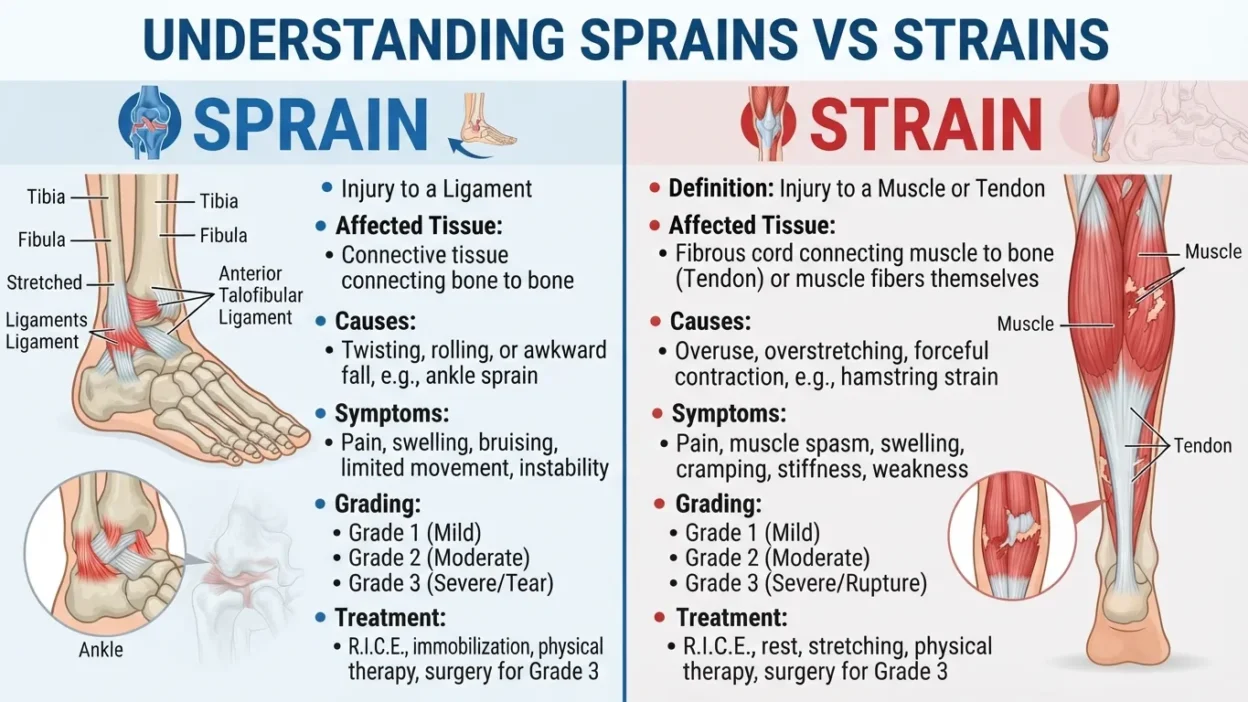
A sprain is an injury to a ligament, the tissue that connects one bone to another at a joint. A strain affects a muscle or tendon, which connects muscle to bone.
Both can cause pain, swelling, bruising, and limited movement, but the injured tissue is different.
Key Takeaways
- A sprain affects a ligament around a joint.
- A strain affects a muscle or tendon.
- Sprains commonly affect the ankle, wrist, knee, and thumb.
- Strains commonly affect the hamstring, back, calf, and other muscles.
- Both injuries can cause pain, swelling, bruising, and difficulty moving.
- Severe pain, numbness, instability, or inability to use the injured area may require medical evaluation.
What Is a Sprain?
A sprain happens when a ligament is stretched too far or torn. Ligaments are strong bands of tissue that connect bones and help stabilize joints.
For example, if you roll your ankle while running, the sudden movement can stretch or tear the ankle ligaments. This is one of the most common examples of a sprain.
Sprains can affect many joints, including the ankles, knees, wrists, thumbs, and fingers. Falls, sudden twists, sports injuries, and impacts can all cause them.
Common Causes of Sprains
A sprain can occur when a joint is suddenly forced beyond its normal range of movement.
Common causes include:
- Rolling or twisting an ankle
- Falling onto an outstretched hand
- Changing direction quickly during sports
- Landing awkwardly after a jump
- Receiving a direct blow to a joint
- Accidentally bending a joint too far
Common Sprain Symptoms
Symptoms depend on how much the ligament has been damaged. Common signs include:
- Pain around the joint
- Swelling
- Bruising or skin discoloration
- Tenderness
- Reduced range of motion
- Difficulty putting weight on the joint
- A feeling of instability
- A popping sensation or sound when the injury occurs
A severe ligament injury can make it difficult or impossible to use the affected joint normally.
What Is a Strain?
A strain is an injury involving a muscle or tendon. Tendons are strong tissues that connect muscles to bones.
You may also hear a muscle strain called a pulled muscle. A strain can happen when a muscle or tendon is stretched beyond its normal limit and becomes damaged.
Strains are common in the hamstrings, lower back, calves, and other muscles. They can happen suddenly, such as when sprinting or lifting something heavy, or develop gradually because of repeated use.
Common Causes of Strains
Some common causes include:
- Sprinting or jumping
- Lifting something heavy
- Sudden movements
- Repetitive activity
- Overusing a muscle
- Poor warm-up before exercise
- Using a muscle in an awkward position
For example, suddenly accelerating during a race can strain a hamstring. Repeated lifting or poor movement technique can also place too much stress on a muscle.
Common Strain Symptoms
A muscle strain may cause:
- Pain or tenderness
- Swelling
- Bruising or skin color changes
- Muscle weakness
- Muscle spasms or cramping
- Stiffness
- Limited movement
- Pain that becomes worse when using the affected muscle
More serious strains can involve a partial or complete muscle tear.
Sprain vs Strain: Key Differences
The easiest way to remember the difference is:
Sprain = ligament.
Strain = muscle or tendon.
| Feature | Sprain | Strain |
| Injured tissue | Ligament | Muscle or tendon |
| What ligaments do | Connect bone to bone | — |
| What tendons do | — | Connect muscle to bone |
| Common locations | Ankle, knee, wrist, thumb | Hamstring, back, calf, groin |
| Common causes | Twisting, falling, joint movement | Overuse, lifting, sprinting, sudden muscle force |
| Common symptoms | Pain, swelling, bruising, instability | Pain, swelling, weakness, spasms |
| Another common term | Ligament injury | Pulled muscle |
Both are considered soft-tissue injuries, and their symptoms can overlap. That means pain or swelling alone cannot always tell you exactly which injury occurred.
How Can You Tell if You Have a Sprain or Strain?
Think about where the pain is and how the injury happened.
If the pain is centered around a joint after you twisted, rolled, or forced it into an unusual position, a sprain may be possible.
If the pain is in a muscle after lifting, sprinting, stretching, or overusing it, a strain may be more likely.
For example:
Rolled ankle: You step on an uneven surface and your ankle twists. Swelling develops around the joint. This pattern is consistent with an ankle sprain.
Pulled hamstring: You sprint and suddenly feel pain in the back of your thigh. The muscle becomes tender and difficult to use. This pattern is consistent with a hamstring strain.
However, these examples are not a substitute for a medical examination. A fracture, tendon injury, severe ligament tear, or another condition can sometimes produce similar symptoms.
How Are Sprains and Strains Treated?
Treatment depends on the location and severity of the injury.
For many minor injuries, early care focuses on protecting the injured area, resting it, using cold therapy, compression, and elevation. Mayo Clinic describes this approach as P.R.I.C.E. for muscle strains, while R.I.C.E. is commonly used for sprains.
First-Aid Care
Protect: Avoid activities that increase pain or could make the injury worse.
Rest: Give the injured area time to recover. Avoid strenuous activity while symptoms are significant.
Ice: A cold pack wrapped in a towel can help reduce swelling and discomfort. Do not place ice directly against the skin.
Compression: An appropriate bandage or support may help control swelling.
Elevation: If practical, keep an injured limb elevated to help reduce swelling.
As pain and swelling improve, gradual movement and rehabilitation may help restore strength and range of motion. Some people may need physical therapy, a brace, crutches, or other treatment depending on the injury.
Severe ligament or muscle injuries may require more advanced medical treatment.
Sprain vs Strain: Which Is Worse?
Neither is automatically worse.
A mild sprain can be less serious than a severe muscle strain, and a severe sprain can be much more significant than a mild strain. The seriousness depends on how much tissue was damaged, where the injury occurred, and how well the affected area functions.
Healthcare professionals may grade some sprains and strains from mild injuries with little tearing to severe injuries involving complete tears.
So, comparing the names alone does not tell you which injury is more serious.
When Should You See a Doctor?
Some minor sprains and strains improve with home care. However, certain symptoms should be evaluated by a healthcare professional.
Seek medical attention if:
- You cannot put weight on or use the injured area.
- The joint feels unstable.
- You have numbness or tingling.
- Pain is severe or continues to worsen.
- You have significant swelling.
- You have pain directly over a bone after an injury.
- The injured area looks deformed.
- You heard or felt a pop and immediately had major difficulty using the area.
- Symptoms are not improving as expected.
These symptoms can sometimes indicate a serious ligament or muscle injury, fracture, or another condition that needs evaluation.
If you suspect a broken bone or have a severe injury, seek prompt medical care rather than assuming it is only a sprain or strain.
How Can You Prevent Sprains and Strains?
You cannot prevent every injury, but several habits can lower your risk.
Warm up before demanding exercise and build strength gradually. Avoid suddenly increasing the intensity or amount of activity.
Good footwear can also help during activities that place stress on your feet and ankles. Keeping muscles strong and flexible may help reduce the risk of some strains.
If you have already injured an area, returning to sports or strenuous activity too quickly may increase the chance of another injury. Follow your healthcare professional’s guidance about returning to normal activity.
FAQs:
Is a sprain or strain worse?
Neither injury is always worse. A sprain damages a ligament, while a strain affects a muscle or tendon. Either can range from mild stretching to a significant tear. The severity of the specific injury matters more than whether it is called a sprain or strain.
Can you have a sprain and strain at the same time?
Yes. A single accident can damage more than one type of tissue. For example, a fall or sports injury may affect a ligament around a joint and also injure nearby muscles or tendons. A healthcare professional can assess the injury and determine which tissues are affected.
How long does a sprain or strain take to heal?
Recovery time varies based on the location and severity of the injury. Mild injuries may improve relatively quickly, while partial or complete tears can take much longer. Some severe injuries may require rehabilitation or other medical treatment.
Can you walk on a sprain?
Sometimes. A mild ankle sprain may still allow you to walk, although it can be painful. More serious sprains may make weight-bearing difficult or impossible. If you cannot put weight on the injured area, or the joint feels unstable, medical evaluation is appropriate.
Should you use ice for a strain?
Cold therapy can help reduce pain and swelling after a muscle strain. Use a cold pack wrapped in a towel rather than placing ice directly on your skin. If the injury is severe or symptoms are getting worse, seek medical advice instead of relying only on home treatment.
Conclusion:
When comparing sprain vs strain, remember the tissue involved. A sprain affects a ligament, while a strain affects a muscle or tendon.
Their symptoms can look similar, so the way the injury happened, where it hurts, and how well you can use the area all matter.
If symptoms are severe, persistent, or associated with numbness, instability, deformity, or inability to use the injured area, get medical evaluation.

I’m Jessica Morgan, a writer who loves covering lifestyle, entertainment, sports, trends, and everyday topics in a simple and engaging way. At PrayersVibe.com, I focus on creating helpful, easy-to-read content that informs and connects with readers. I enjoy researching new ideas and turning them into clear, useful stories that readers can enjoy.