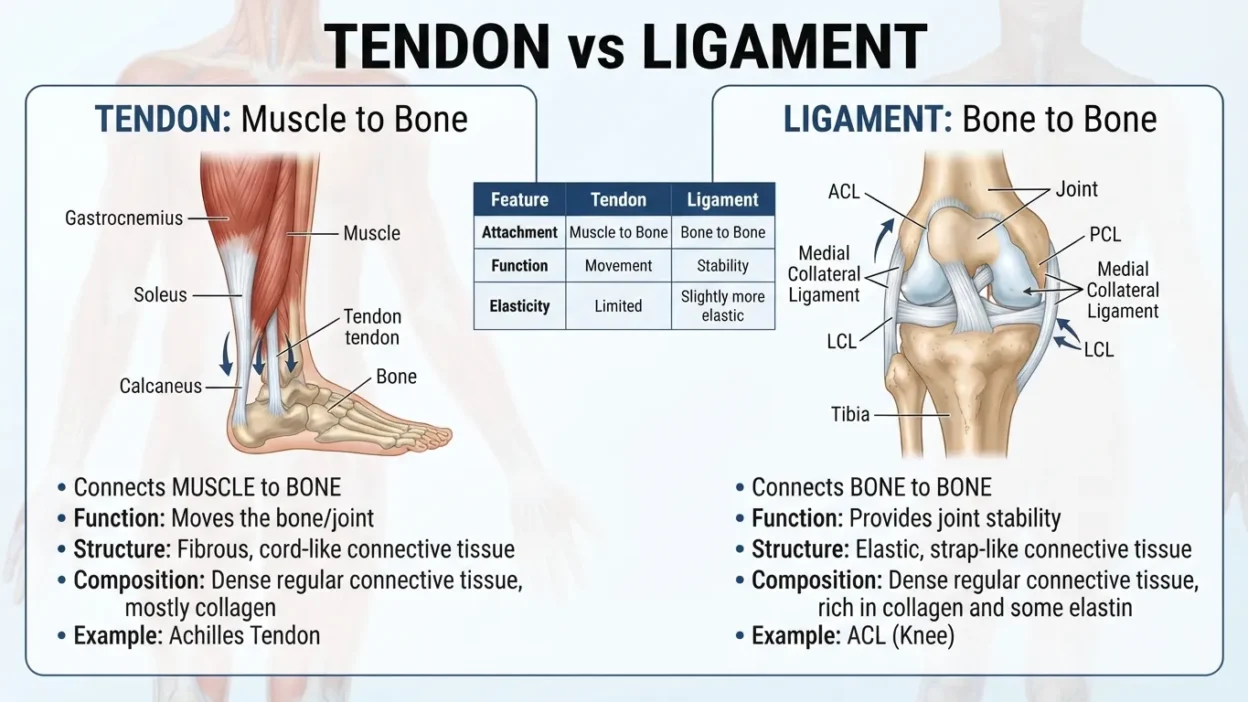
The main difference between a tendon and a ligament is what they connect and what they do. A tendon connects muscle to bone and transfers muscle force to create movement.
A ligament usually connects bone to bone and helps stabilize and guide a joint. Both are strong connective tissues, but they serve different roles.
Key Takeaways
- Tendons connect muscles to bones and help create movement.
- Ligaments connect bones to bones and help stabilize joints.
- The Achilles tendon is an example of a tendon.
- The ACL is an example of a ligament.
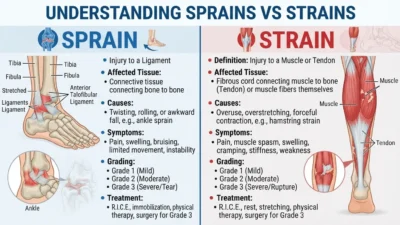
- A ligament injury is generally called a sprain, while a muscle or tendon injury is generally called a strain.
What Is a Tendon?
A tendon is a strong band of fibrous connective tissue that connects a muscle to a bone. Its main job is to transfer the force produced when a muscle contracts so the attached bone can move.
Think of a tendon as a bridge between a muscle and a bone.
When you decide to bend your arm, for example, your muscle contracts. The tendon transfers that force to the bone, helping create movement at the joint.
Tendons are found throughout the body. They help you walk, run, jump, grip objects, lift things, and perform countless everyday movements.
How Tendons Work
Tendons are designed to handle tension and transmit force. Their collagen fibers are generally organized in a way that supports force transfer along the length of the tendon.
This structure makes sense because muscles usually pull on bones in a specific direction.
A tendon does not create the movement itself. The muscle produces the force, while the tendon helps transfer that force to the skeleton.
Common Tendon Examples
Some well-known tendons include:
- Achilles tendon: Connects the calf muscles to the heel and helps with walking, running, and jumping.
- Quadriceps tendon: Connects the quadriceps muscles to the kneecap.
- Patellar tendon: Connects the kneecap to the tibia and helps transmit force for knee extension.
- Biceps tendon: Helps connect the biceps muscle to bones around the shoulder and elbow.
The knee is a useful example because it contains both tendons and ligaments. The quadriceps and patellar tendons help transmit muscle forces, while the knee ligaments provide joint stability.
What Is a Ligament?
A ligament is a strong band of connective tissue that usually connects one bone to another bone.
Its main job is to help hold a joint together and control excessive movement.
Think of a ligament as a support strap around a joint.
For example, the ligaments in your knee help keep the bones properly aligned while allowing the joint to move.
Ligaments are especially important during activities that involve turning, stopping, jumping, or changing direction.
How Ligaments Work
Ligaments help guide joint movement and limit motion that could place excessive stress on the joint.
The knee contains four major ligaments: the anterior cruciate ligament (ACL), posterior cruciate ligament (PCL), medial collateral ligament (MCL), and lateral collateral ligament (LCL). Together, these structures help control knee stability.
Ligaments and tendons are both collagen-rich connective tissues, but their structures and mechanical roles differ.
Common Ligament Examples
Common examples include:
- ACL: Helps stabilize the knee.
- PCL: Helps control backward movement of the tibia relative to the femur.
- MCL: Helps stabilize the inside of the knee.
- LCL: Helps stabilize the outside of the knee.
- Ankle ligaments: Help keep the ankle stable during walking and other movements.
Tendon vs Ligament: Key Differences
The easiest way to remember the difference is:
Tendon = muscle to bone.
Ligament = bone to bone.
| Feature | Tendon | Ligament |
| Connects | Muscle to bone | Bone to bone |
| Main job | Transfers muscle force | Stabilizes and guides joints |
| Main role | Helps produce movement | Helps control joint movement |
| Example | Achilles tendon | ACL |
| Common injury | Tendon strain or tear | Ligament sprain or tear |
| Common location | Throughout the body | Mainly around joints |
Both tissues are important for normal movement. A tendon helps transfer the force needed to move a bone, while a ligament helps make sure the joint remains controlled and stable.
How Tendons and Ligaments Work Together
Tendons and ligaments do different jobs, but they often work together around the same joint.
Consider your knee.
When you straighten your knee, muscles in your thigh contract. The quadriceps tendon and patellar tendon help transmit that force so the lower leg can move.
At the same time, the ACL, PCL, MCL, and LCL help control the movement of the knee and maintain stability.
This combination allows the joint to move while preventing excessive or unwanted motion.
That is why damage to either type of tissue can affect your ability to move normally.
Tendon Injuries vs Ligament Injuries
Tendons and ligaments can both become overstretched or torn, but the injuries are described differently.
Tendon Injuries
Tendon problems can develop from sudden trauma or repeated stress.
Common tendon problems include:
- Tendon strains
- Tendon tears
- Tendinopathy
- Tendinitis
Overuse can cause irritation and pain in a tendon. Sudden force can also cause a partial or complete tear.
For example, a person who repeatedly runs or jumps may develop problems involving the Achilles or patellar tendon.
Ligament Injuries
Ligament injuries often happen when a joint is suddenly twisted, forced beyond its normal range, or hit.
A common example is an ankle sprain. An ankle sprain occurs when supporting ligaments stretch beyond their limits and tear.
Knee ligament injuries can also happen during sports that involve cutting, pivoting, jumping, or direct contact.
Symptoms can include pain, swelling, tenderness, reduced movement, and joint instability.
Sprain vs Strain
This is one of the easiest ways to confuse tendon and ligament injuries.
A sprain affects a ligament. It happens when a ligament is stretched or torn.
A strain affects a muscle or tendon. It can also involve the connection between muscle and tendon.
For example:
- Twisted ankle with damaged ligaments → sprain
- Overstretched Achilles tendon → tendon injury/strain
- Torn hamstring muscle → strain
The terms describe different tissues, so a sprain and a strain are not the same injury.
Tendon vs Ligament: Which One Is Stronger?
It is not useful to say that one is simply “stronger” than the other.
Both tendons and ligaments are specialized tissues designed for different mechanical jobs. Tendons are primarily designed to transfer muscular force, while ligaments help control and stabilize joints.
Their strength and behavior also vary depending on the specific tissue, location, structure, and forces involved.
So the better question is not “Which is stronger?” but “What job is each tissue designed to perform?”
How Are Tendon and Ligament Injuries Diagnosed?
A healthcare professional may start by asking how the injury happened and where the pain is located.
A physical examination can help identify tenderness, weakness, limited movement, or instability.
Imaging may sometimes be needed. X-rays are useful for evaluating bones, while MRI can provide information about soft tissues such as tendons and ligaments. For example, AAOS notes that MRI can be used to evaluate ligaments, tendons, and other structures around the ankle when appropriate.
The appropriate test depends on the injury and the symptoms.
When Should You See a Doctor?
Consider getting medical evaluation after an injury if you have severe pain, significant swelling, major difficulty moving the affected area, inability to bear weight, obvious instability, or symptoms that do not improve.
For example, persistent ankle pain or swelling and difficulty putting weight on the ankle may require evaluation to rule out a more serious injury.
A suspected complete tendon or ligament tear also deserves professional assessment.
Do not try to diagnose a specific tear based only on where the pain occurs. Several muscles, tendons, ligaments, bones, and other structures can produce similar symptoms.
FAQs:
What connects muscle to bone?
A tendon connects muscle to bone. Its main role is to transfer the force produced by a muscle contraction to the bone, helping create movement.
What connects bone to bone?
A ligament usually connects bone to bone. Ligaments help hold joints together and control excessive movement. Examples include the ACL and MCL in the knee.
Is a tendon a ligament?
No. Tendons and ligaments are different types of connective tissue. A tendon primarily connects muscle to bone, while a ligament usually connects bone to bone. Their functions are also different.
Which heals faster, a tendon or ligament?
There is no simple rule that one always heals faster than the other. Recovery depends on the specific tissue, location, severity of the injury, blood supply, treatment, and other individual factors. More serious injuries can require longer rehabilitation.
Can you injure both a tendon and ligament?
Yes. An injury can affect more than one structure at the same time. For example, a knee injury may involve a ligament along with a tendon, meniscus, or other tissue. AAOS notes that knee injuries can involve multiple structures.
Conclusion:
The key difference in tendon vs ligament comes down to their connections and jobs.
A tendon connects muscle to bone and transfers muscular force to help produce movement. A ligament usually connects bone to bone and helps stabilize and guide a joint.
Both are essential for healthy movement, but they can suffer different types of injuries. A ligament injury is generally called a sprain, while an injury involving a muscle or tendon is generally called a strain.
Understanding this basic difference can make anatomy and common sports injuries much easier to understand.

I am Jane Austen, a soul that believes faith speaks best through quiet words and honest prayers.
I share reflections that blend timeless wisdom, gentle hope, and heartfelt devotion.
On PrayersVibe.com, my words are written to comfort hearts, strengthen faith, and remind you that you are never alone.