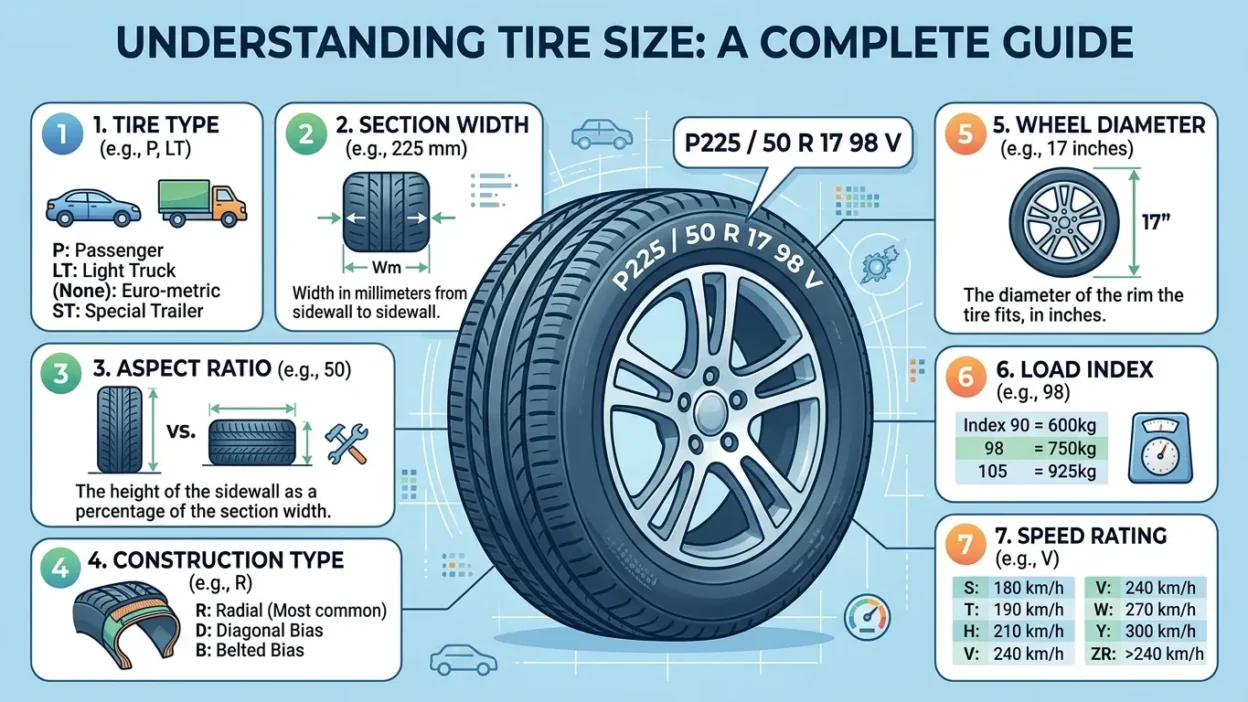
Have you ever looked at the side of a tire and wondered what all those numbers mean? You may see something like 225/55R17 97V and think it is just a code. It is not. Each part tells you something useful about the tire.
Understanding tire size meaning can help you choose the right tires, avoid a poor fit, and know what your car needs. The code can tell you the tire width, sidewall height, construction type, wheel size, load rating, and speed rating.
The good news is that you do not need to be a tire expert. Once you learn what each number means, reading a tire size becomes simple.
This guide breaks down tire size in plain English. You will learn how to read common tire codes, understand tire measurements, compare sizes, and avoid common mistakes when buying tires.
Quick Answer
Tire size meaning refers to the set of numbers and letters on a tire that describe its main dimensions and performance ratings.
For example, 225/55R17 97V means:
- 225 = tire width in millimeters
- 55 = aspect ratio
- R = radial construction
- 17 = wheel diameter in inches
- 97 = load index
- V = speed rating
Your vehicle may allow more than one tire size. Always check the vehicle placard or owner’s manual before changing sizes.
Definition & Meaning
A tire size is a measurement code printed on the tire sidewall. It gives you key information about how the tire is built and how it should fit the wheel.
A common tire size looks like this:
225/55R17
You can read it from left to right.
The first number gives the tire width. The second number gives the sidewall height as a percentage of the width. The letter shows the tire’s construction. The final number shows the wheel diameter.
Some tire markings also include a load index and speed rating.
For example:
225/55R17 97V
Here, 97 is the load index and V is the speed rating.
These markings help match the tire to the vehicle and wheel.
How to Read Tire Size Numbers
Let’s break down 225/55R17 one part at a time.
What Does 225 Mean on a Tire?
The 225 represents the tire’s nominal width.
The measurement is in millimeters, from one sidewall to the other under standard measurement conditions.
So, a 225 tire is about 225 mm wide.
A wider tire can have a different look and may affect handling, steering feel, fuel use, and road noise. But width alone does not tell you whether a tire will fit your car.
What Does 55 Mean on a Tire?
The 55 is the tire’s aspect ratio.
It means the sidewall height is about 55% of the tire’s width.
For a 225/55 tire:
225 × 0.55 = 123.75 mm
So, the sidewall height is about 124 mm.
A lower aspect ratio usually means a shorter sidewall. A higher aspect ratio means a taller sidewall.
This can affect ride comfort, steering response, and wheel protection.
What Does R Mean on a Tire?
The R means the tire uses radial construction.
Radial tires use internal cord layers that run across the tire from side to side. This design is common on modern passenger vehicles.
Do not confuse R with a wheel size. The wheel size comes after it.
What Does 17 Mean on a Tire?
The 17 means the tire fits a wheel with a 17-inch diameter.
This measurement uses inches, unlike tire width, which uses millimeters.
A tire marked R17 is designed for a 17-inch wheel.
A 17-inch tire will not fit a 16-inch or 18-inch wheel simply because the other measurements look close.
The wheel diameter must match.
Understanding Tire Size Meaning With a Full Example
Consider this tire code:
225/55R17 97V
Here is the complete breakdown:
| Marking | Meaning |
| 225 | Tire width in millimeters |
| 55 | Aspect ratio |
| R | Radial construction |
| 17 | Wheel diameter in inches |
| 97 | Load index |
| V | Speed rating |
This one code gives you several important details about the tire.
But there is more information on a tire sidewall. You may also see the tire brand, model name, manufacturing information, maximum pressure, and other markings.
What Is Tire Aspect Ratio?
The aspect ratio describes the sidewall height compared with the tire width.
For example, a 225/55R17 tire has a sidewall height of about 55% of its width.
A 225/45R17 has the same nominal width but a lower sidewall.
That difference matters.
The 45-series tire has a shorter sidewall than the 55-series tire. This can change how the car feels on the road.
A shorter sidewall can provide a more direct steering feel. A taller sidewall can offer more cushioning over rough roads.
However, you should not change the aspect ratio just because you like the look. The replacement size must work with your vehicle, wheel, suspension, and clearance.
What Is Tire Width?
Tire width is the first major number in the size code.
For example:
- 205 = about 205 mm wide
- 215 = about 215 mm wide
- 225 = about 225 mm wide
- 245 = about 245 mm wide
These are nominal sizes. The actual measured width can vary by tire model and wheel width.
A wider tire does not automatically mean better grip in every situation.
Tire compound, tread design, road conditions, tire pressure, vehicle setup, and driving conditions all matter.
What Is the Wheel Size?
The wheel diameter appears near the end of the basic tire size.
Examples include:
- R15 = 15-inch wheel
- R16 = 16-inch wheel
- R17 = 17-inch wheel
- R18 = 18-inch wheel
The tire must match the wheel diameter.
If your vehicle uses 17-inch wheels, you need a tire designed for a 17-inch wheel unless you are changing the complete wheel and tire setup.
Load Index: What Does It Mean?
The load index is a number that tells you the tire’s rated load capacity under specified conditions.
In 225/55R17 97V, the number 97 is the load index.
The number itself is not the load in kilograms. You use a load-index chart to find the corresponding capacity.
When replacing tires, use a load index that meets the vehicle maker’s requirements.
Do not choose a lower load rating simply because the tire costs less.
The correct load capacity matters for safe vehicle operation.
Speed Rating: What Does the Letter Mean?
The final letter in a tire code often represents the tire’s speed rating.
In 225/55R17 97V, the V is the speed rating.
Common speed-rating letters include:
- T
- H
- V
- W
- Y
Each rating corresponds to a defined maximum speed under specified test conditions.
The speed rating is not a suggested driving speed. It is part of the tire’s performance specification.
Your replacement tires should meet the vehicle manufacturer’s requirements.
Tire Size Meaning vs. Tire Diameter
People often confuse tire size with tire diameter.
They are related, but they are not the same thing.
A tire size such as 225/55R17 tells you several measurements. Overall tire diameter is the approximate distance from the ground to the top of the tire across the full tire.
You can estimate overall diameter with this formula:
Overall diameter = wheel diameter + two sidewall heights
For a 225/55R17 tire:
- Width = 225 mm
- Sidewall = 225 × 0.55 = 123.75 mm
- Two sidewalls = 247.5 mm
- 17-inch wheel = 431.8 mm
- Approximate overall diameter = 679.3 mm
This is an estimate. The actual mounted tire can vary slightly by tire model and measurement conditions.
Can You Change Your Tire Size?
Yes, people sometimes use a different tire size from the original equipment size.
This can be done for reasons such as wheel changes, handling goals, appearance, or specific tire availability.
But a size change needs care.
The replacement tire must have suitable:
- Load capacity
- Speed rating
- Overall diameter
- Wheel fit
- Width
- Suspension clearance
- Fender clearance
- Steering clearance
A large change in overall diameter can also affect the speedometer and vehicle systems.
For this reason, do not select a new tire size based on width alone.
Plus Sizing Explained
Plus sizing means changing the wheel and tire combination while keeping the overall tire diameter close to the original setup.
For example, someone may move to a larger wheel and use a shorter tire sidewall.
The goal is often to keep the overall diameter similar while changing the wheel diameter and tire profile.
A larger wheel can change the car’s ride and steering feel. A shorter sidewall can also provide less cushioning against potholes.
If you are considering plus sizing, check the vehicle manufacturer’s approved sizes and speak with a qualified tire professional.
How to Find Your Correct Tire Size
You do not have to guess your tire size.
Start with the driver-side door jamb or door-post tire information label. Many vehicles have a placard there that lists recommended tire sizes and inflation information.
You can also check:
- The owner’s manual.
- The tire currently fitted to the vehicle.
- The vehicle manufacturer’s information.
- A qualified tire professional.
The tire sidewall is useful, but it should not always be your only source.
A previous owner may have installed a non-standard size.
If the current tire differs from the vehicle placard, confirm the correct specification before buying replacements.
Common Tire Size Mistakes
Buying tires looks easy until you see how many sizes and ratings exist.
One of the most common mistakes is focusing only on the first number.
A buyer may see 225 and assume any 225 tire will fit. That is not true.
The complete tire specification matters.
| Mistake | Correct Approach |
| Looking only at tire width | Check the full tire size |
| Ignoring wheel diameter | Match the tire to the wheel |
| Choosing a lower load index | Meet or exceed the vehicle requirement |
| Ignoring speed rating | Use the required rating |
| Assuming all 225 tires are the same | Check width, aspect ratio, construction, and wheel size |
| Copying the current tire without checking | Confirm the vehicle’s recommended size |
| Changing size for looks only | Check clearance and vehicle requirements |
| Using the wrong tire pressure | Follow the vehicle placard or owner’s manual |
This simple check can prevent an expensive mistake.
Tire Size Meaning and Tire Pressure
Tire size and tire pressure are different things.
The tire size tells you what the tire is and what wheel it fits. Tire pressure tells you how much air the vehicle maker recommends.
Do not use the maximum pressure printed on the tire sidewall as your normal target unless the vehicle manufacturer specifies it.
Look for the vehicle’s tire information placard or owner’s manual.
Proper inflation helps the tire work as designed and can affect handling, tire wear, and comfort.
Does Tire Size Affect Fuel Economy?
It can.
A change in tire size may change rolling resistance, tire weight, wheel weight, aerodynamic drag, and other factors.
For example, a larger wheel and wider tire setup may have a different effect on fuel use than the original setup.
But you should not assume that every wider tire will reduce fuel economy or that every smaller tire will improve it.
The tire model and vehicle setup also matter.
If fuel economy is your goal, compare the full tire specification and tire model rather than looking at size alone.
Does Tire Size Affect Ride Comfort?
Yes, tire size can affect ride comfort.
A tire with a taller sidewall generally has more tire material between the wheel and road. That can provide more cushioning over bumps.
A shorter sidewall leaves less flexible tire sidewall between the wheel and road.
This can create a firmer road feel.
Still, ride comfort depends on more than aspect ratio. Tire construction, pressure, suspension, wheel size, and road surface also play roles.
Can Different Tire Sizes Be Used on One Vehicle?
Sometimes vehicles use different front and rear tire sizes. This is common on some performance vehicles.
However, you should not mix sizes randomly.
The vehicle manufacturer may specify exact front and rear sizes.
If your vehicle was designed for the same size on all four wheels, keep the recommended setup unless a qualified professional confirms another setup is suitable.
Also, many vehicles use systems such as all-wheel drive that can be sensitive to differences in tire circumference.
Quick Tire Size Reference
Use this table when reading a basic tire code.
| Part | What It Tells You | Example |
| First number | Tire width | 225 mm |
| Second number | Sidewall height as a percentage of width | 55 |
| Letter | Construction type | R = radial |
| Wheel number | Wheel diameter | 17 inches |
| Load index | Rated load capacity | 97 |
| Speed rating | Speed rating category | V |
Keep this reference handy when shopping for tires.
When Should You Replace a Tire?
Tire replacement does not depend on size alone.
Check the tread, sidewalls, wear pattern, age, and overall condition.
A tire may need replacement if you notice:
- Very low tread
- Cracks
- Bulges
- Cuts
- Uneven wear
- Damage from an impact
- Repeated air loss
If you see a bulge or serious sidewall damage, have the tire checked promptly.
Do not rely only on appearance. A tire professional can inspect damage that may not be obvious.
How to Choose a Replacement Tire
Once you know your tire size, you still have more decisions to make.
First, confirm the correct size for your vehicle.
Then check the load index and speed rating.
Next, consider the type of tire you need. Your choice may depend on climate, road conditions, driving style, and budget.
For example, someone who drives mostly in a warm city may have different needs from someone who regularly drives through snow.
The best tire is not simply the biggest or most expensive one. It is the one that matches the vehicle and your driving needs.
A Simple Tire Buying Checklist
Before placing a tire order, check these details:
| Check | What to Confirm |
| Tire size | Matches the vehicle requirement |
| Width | Correct nominal width |
| Aspect ratio | Correct sidewall ratio |
| Construction | Correct construction type |
| Wheel diameter | Matches the wheel |
| Load index | Meets vehicle requirement |
| Speed rating | Meets vehicle requirement |
| Tire type | Fits your climate and driving needs |
| Pressure | Follow the vehicle placard |
| Condition | No visible damage or defects |
This quick check can save you from buying the wrong tires.
FAQs:
What does tire size mean?
Tire size describes key tire measurements and ratings. A code such as 225/55R17 97V shows the tire’s width, aspect ratio, construction, wheel diameter, load index, and speed rating.
How do I know what tire size my car needs?
Check the tire information placard on the vehicle, usually near the driver’s door area, or check the owner’s manual. These sources are better than guessing from the current tire alone.
What does 225/55R17 mean?
The 225 means the nominal tire width is 225 mm. The 55 is the aspect ratio. R means radial construction, and 17 means the tire fits a 17-inch wheel.
What does the 55 mean in tire size?
The 55 is the aspect ratio. It means the sidewall height is about 55% of the tire’s nominal width.
Can I use a different tire size on my car?
Sometimes, but you should confirm that the new size works with your vehicle, wheels, load requirements, speed rating, clearance, and vehicle systems. Use approved sizes when possible.
Does a bigger tire make a car faster?
Not necessarily. A larger tire can change handling, acceleration, ride quality, gearing, and other vehicle characteristics. Tire size alone does not determine how fast a car will be.
Should all four tires have the same size?
Not always. Some vehicles use different front and rear sizes. Follow the vehicle manufacturer’s specifications rather than assuming all four must be identical.
Conclusion:
Understanding tire size meaning makes tire shopping much easier. A code such as 225/55R17 97V is not random.
It tells you the tire width, aspect ratio, construction, wheel diameter, load index, and speed rating.
The most important step is to confirm the tire size and ratings recommended for your vehicle. Do not choose a tire based only on appearance or one number.
Before buying, check the vehicle placard, owner’s manual, full tire code, load index, and speed rating. If you want to change tire size, get advice from a qualified tire professional.
A few minutes of checking can help you avoid the wrong fit and make a safer, smarter tire choice.