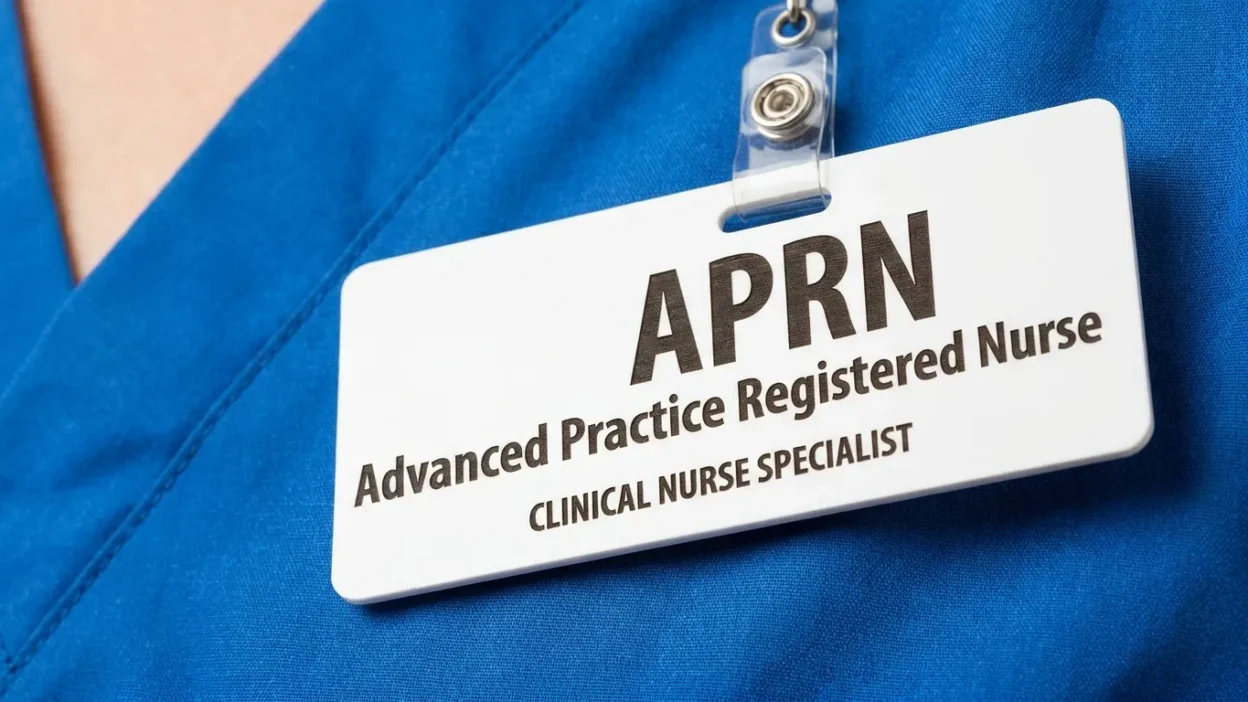
If you saw APRN after a nurse’s name and wondered what it means, you are not alone. The term can look like a simple nursing title, but it points to a higher level of nursing practice.
APRN means Advanced Practice Registered Nurse. In the United States, an APRN is an RN with graduate-level education, advanced clinical training, and preparation for an advanced practice role. APRNs can assess patients and, depending on their role and state rules, diagnose conditions, order tests, manage care, and prescribe medicines.
This guide explains the APRN definition in plain English. You will learn what APRN stands for, the four main APRN roles, how an APRN differs from an RN, what education and certification involve, and why state laws matter.
Quick Answer
APRN stands for Advanced Practice Registered Nurse.
An APRN is a registered nurse who has completed advanced graduate-level education and training for an advanced nursing role. The four roles recognized by the APRN Consensus Model are certified nurse practitioner (CNP), certified nurse-midwife (CNM), clinical nurse specialist (CNS), and certified registered nurse anesthetist (CRNA).
APRN practice can include patient assessment, diagnosis, treatment, disease management, health promotion, ordering tests, and prescribing medication. The exact authority depends on the APRN’s role, credentials, and state law.
APRN Definition: What Does APRN Stand For?
The full form of APRN is Advanced Practice Registered Nurse.
Think of APRN as an umbrella term. It does not describe only one job. Instead, it covers several advanced nursing roles.
The National Council of State Boards of Nursing (NCSBN) describes APRNs as registered nurses educated in a specific role and patient population at a master’s or post-master’s level.
Education and certification prepare them to assess, diagnose, and manage patient problems, order tests, and prescribe medications.
This is an important point: every APRN is an RN, but not every RN is an APRN.
An APRN builds on the knowledge and skills gained as a registered nurse. The advanced role then adds deeper clinical knowledge, more education, specialty training, and additional certification and licensing requirements.
What Does an APRN Do?
The daily work of an APRN depends on the specific role.
For example, a nurse practitioner may see patients in a primary care clinic. A CRNA may provide anesthesia during surgery. A nurse-midwife may provide reproductive and maternity care. A clinical nurse specialist may improve patient care at both the bedside and the health-system level.
Common APRN activities can include:
- Taking health histories
- Performing physical assessments
- Evaluating symptoms
- Diagnosing certain health conditions
- Creating treatment plans
- Managing acute and chronic conditions
- Ordering or interpreting diagnostic tests
- Providing health education
- Prescribing medications when legally authorized
- Providing preventive care
- Coordinating patient care
- Working with other health professionals
The exact scope is not the same everywhere. State licensing laws can change what an APRN may legally do.
The Four APRN Roles
The APRN roles recognized under the Consensus Model are distinct. Each has its own focus.
1. Certified Nurse Practitioner
A certified nurse practitioner (CNP) provides advanced patient care.
NPs can work in primary care, acute care, specialty care, mental health, pediatrics, adult-gerontology, women’s health, and other areas based on their education and certification.
Their work may include examining patients, diagnosing illness, managing health conditions, ordering tests, and prescribing medication when authorized.
For many people, “APRN” and “nurse practitioner” seem like the same thing. They are not.
A nurse practitioner is one type of APRN. APRN is the broader category.
2. Certified Nurse-Midwife
A certified nurse-midwife (CNM) provides advanced care related to pregnancy, childbirth, reproductive health, and women’s health.
CNMs can also provide primary and gynecological care within their education, certification, and legal scope of practice.
Their work goes beyond assisting during birth. Depending on their practice setting and state rules, they can provide care before, during, and after pregnancy.
3. Clinical Nurse Specialist
A clinical nurse specialist (CNS) is an APRN with advanced knowledge in a specialty area.
The role can focus on patients, nursing practice, and health care systems. A CNS may help manage complex conditions, improve clinical practices, support nurses, and promote evidence-based care.
This role shows why APRNs do not all work in the same way. Some focus heavily on direct patient care, while others also have major responsibilities in education, quality improvement, and health systems.
4. Certified Registered Nurse Anesthetist
A certified registered nurse anesthetist (CRNA) specializes in anesthesia and anesthesia-related care.
CRNAs can provide anesthesia care across different patient groups and health care settings. Their work may take place in operating rooms, hospitals, and other clinical environments.
This is another reason the term APRN is broad. A CRNA and a family nurse practitioner have very different daily jobs, even though both fall under the APRN category.
APRN vs RN: What Is the Difference?
The simplest way to understand APRN vs RN is to look at education, role, and scope.
An RN provides professional nursing care after completing an approved nursing program, passing the required licensing examination, and receiving an RN license.
An APRN starts with that RN foundation and then completes additional graduate-level education and advanced preparation for a recognized APRN role.
An RN may provide medications, monitor patients, educate families, and coordinate care. An APRN may have additional authority to assess, diagnose, treat, prescribe, and manage patient problems.
However, you should not assume that every APRN has the same legal authority.
State law matters.
APRN vs RN Comparison
| Area | RN | APRN |
| Basic nursing license | RN license | RN foundation plus APRN authorization |
| Education | Approved nursing education | Graduate-level APRN education |
| Clinical role | Professional nursing care | Advanced nursing practice |
| Diagnosis | Usually not the same diagnostic role as an APRN | May diagnose within role and state authority |
| Prescribing | Generally not an RN function | May prescribe when authorized by state law |
| Roles | Broad registered nursing roles | CNP, CNM, CNS, or CRNA |
| Scope | Defined by nursing law and license | Defined by APRN role, credentials, and state law |
The table gives a general U.S. comparison. It does not replace a state nurse practice act or licensing guidance.
APRN Requirements: How Does a Nurse Become an APRN?
The APRN requirements can vary by role and state, but the general path includes several important steps.
Start as a Registered Nurse
The person first needs the education and licensing required to become an RN.
This creates the foundation for advanced nursing practice.
Complete Graduate-Level Education
APRN preparation requires postgraduate education for the advanced role. The Consensus Model calls for education at the master’s or post-master’s level.
The exact degree path can vary by program and profession.
Some nurses also continue to doctoral education, such as a Doctor of Nursing Practice (DNP). A DNP is a practice-focused doctoral degree, but having a DNP does not by itself define every APRN role.
Choose an APRN Role and Patient Population
An APRN must prepare for a specific advanced role.
The Consensus Model identifies four roles and six population foci, including family/individual across the lifespan, adult-gerontology, women’s health, pediatrics, neonatal, and psychiatric/mental health.
This means advanced nursing education is not simply “more nursing school.” It prepares the nurse for a defined area of advanced practice.
Obtain National Certification
APRN preparation also involves national certification.
The Consensus Model calls for a nationally accredited certification examination that measures competencies for the APRN role and population focus.
Certification requirements depend on the specific profession and certifying body.
Meet State Licensing Rules
Education and certification are only part of the process.
The APRN must also meet the rules of the state where they practice. U.S. states do not all regulate APRNs in exactly the same way.
This difference matters when an APRN moves from one state to another or provides care across state lines.
Does an APRN Have the Same Authority as a Doctor?
No. An APRN and a physician are different health care professionals with different education, licenses, and professional roles.
At the same time, APRNs can have significant clinical responsibilities. Depending on the APRN role and state law, they may assess patients, diagnose conditions, develop treatment plans, order tests, and prescribe medications.
It is also important not to assume that all APRNs have identical authority.
Some states allow greater independence, while others place more limits on APRN practice. The legal scope depends on the state and the individual’s credentials.
So, if you need to know what a particular APRN can do, check the licensing rules in the state where that APRN practices.
Can APRNs Prescribe Medication?
Yes, APRNs may have prescribing authority, but the details depend on the APRN role and state law.
The APRN Consensus Model includes prescribing within advanced practice preparation. However, states differ in how they regulate APRN practice and prescribing authority.
This is why a general internet answer cannot tell you exactly what every APRN can prescribe.
If the question involves a real prescription or a specific provider, check the relevant state board of nursing and the provider’s credentials.
Where Do APRNs Work?
APRNs work in many parts of the health care system.
Depending on their role, they may work in:
- Primary care clinics
- Hospitals
- Surgical settings
- Specialty clinics
- Women’s health centers
- Mental health services
- Community health settings
- Long-term care
- Academic settings
- Health care organizations
The work setting often reflects the APRN’s role and population focus.
For example, a CRNA may spend much of the day providing anesthesia care, while a nurse practitioner may see patients for routine visits, acute illness, or long-term disease management.
Common Mistakes About APRN Meaning
The term can cause confusion because people often use “advanced nurse,” “NP,” and “APRN” as if they mean the same thing.
They do not.
Mistake 1: Thinking APRN Means Nurse Practitioner
Correct: Nurse practitioner is one APRN role. APRN also includes CNMs, CNSs, and CRNAs under the Consensus Model.
Mistake 2: Assuming Every APRN Has the Same Scope
Correct: Scope can differ by APRN role, credentials, population focus, and state law.
Mistake 3: Thinking a Graduate Degree Alone Makes Someone an APRN
Correct: Advanced nursing education is important, but APRN practice also involves preparation for a recognized APRN role, certification, and state authorization.
Mistake 4: Assuming APRN Rules Are the Same in Every State
Correct: State regulations vary. The NCSBN notes that jurisdictions have not adopted every element of the Consensus Model in the same way.
APRN Quick Reference Checklist
Use this quick checklist if you need to identify what APRN means or understand an APRN’s credentials.
| Question | Quick Answer |
| What does APRN stand for? | Advanced Practice Registered Nurse |
| Is an APRN an RN? | Yes, an APRN builds on RN preparation |
| Is an NP an APRN? | Yes, nurse practitioners are one APRN role |
| What are the four roles? | CNP, CNM, CNS, and CRNA |
| Does APRN education go beyond RN education? | Yes, APRN preparation requires graduate-level education |
| Can APRNs diagnose? | They may, depending on role and state authority |
| Can APRNs prescribe? | They may, depending on role and state law |
| Are APRN rules identical across states? | No |
| Should you check state rules for legal scope? | Yes |
Why the APRN Title Matters
The APRN title tells you that the nurse has advanced preparation beyond basic RN education.
It also helps describe the nurse’s professional role. But the title alone does not tell you everything about that person’s practice.
To understand an APRN’s actual scope, you need to consider:
- The APRN role
- The population focus
- Education
- National certification
- State license and regulations
- The practice setting
This is especially useful when reading a provider’s credentials online or trying to understand who is treating you.
Is APRN a Job Title or a Credential?
APRN is best understood as a broad professional designation for advanced nursing practice.
The person may have a more specific title, such as nurse practitioner, nurse-midwife, clinical nurse specialist, or nurse anesthetist.
You may also see additional letters after a nurse’s name. Those letters can identify certifications, degrees, or professional credentials.
Because credential formats can vary, it is better to look at the provider’s official profile or licensing record when you need to confirm exact qualifications.
Why APRNs Are Important in Health Care
APRNs provide care at an advanced level and can serve many different patient needs.
They may provide primary care, specialty care, anesthesia, reproductive care, chronic disease management, mental health care, education, or system-level clinical improvement.
Their role also reflects an important part of modern nursing: nursing practice can grow beyond traditional bedside duties while keeping patient care at its center.
Still, “advanced” does not mean “unlimited.” Every APRN must practice within the authority granted by their education, certification, license, and applicable laws.
FAQs:
1. What does APRN mean in simple terms?
APRN means Advanced Practice Registered Nurse. It describes an RN who has advanced graduate-level preparation and practices in an APRN role such as nurse practitioner, nurse-midwife, clinical nurse specialist, or nurse anesthetist.
2. Is an APRN the same as an RN?
No. An APRN is an RN with additional advanced education, clinical preparation, certification, and authorization for advanced practice. An RN and an APRN can have different scopes of practice.
3. Is a nurse practitioner an APRN?
Yes. A nurse practitioner is one of the four APRN roles recognized in the APRN Consensus Model. The other three are certified nurse-midwife, clinical nurse specialist, and certified registered nurse anesthetist.
4. Can an APRN prescribe medicine?
An APRN may have prescribing authority, but the rules depend on the role and state. Do not assume that every APRN has identical prescribing authority.
5. What degree does an APRN need?
APRN preparation requires graduate-level education for the advanced practice role. The specific degree and program requirements can vary by profession, certification body, and state.
6. What are the four types of APRNs?
The four roles are certified nurse practitioner (CNP), certified nurse-midwife (CNM), clinical nurse specialist (CNS), and certified registered nurse anesthetist (CRNA).
7. Can APRNs work without a doctor?
It depends on state law and the APRN’s role. Some states grant APRNs broad independent practice authority, while other states have requirements for collaboration, supervision, or other forms of physician involvement. Always check the current rules in the state where the APRN practices.
Conclusion:
The APRN meaning is simple: Advanced Practice Registered Nurse. But APRN is a broad term, not one single job.
The four main APRN roles are nurse practitioner, nurse-midwife, clinical nurse specialist, and nurse anesthetist. APRNs receive advanced education and certification and may assess, diagnose, treat, manage conditions, order tests, and prescribe medication within their legal scope.
The most important point is that APRN practice varies by role and state. If you need to confirm what a specific APRN can legally do, check the current licensing rules in the state where they practice.
Understanding the title makes it much easier to read nursing credentials, compare health care roles, and know what kind of advanced care a provider may offer.

I’m Jessica Morgan, a writer who loves covering lifestyle, entertainment, sports, trends, and everyday topics in a simple and engaging way. At PrayersVibe.com, I focus on creating helpful, easy-to-read content that informs and connects with readers. I enjoy researching new ideas and turning them into clear, useful stories that readers can enjoy.