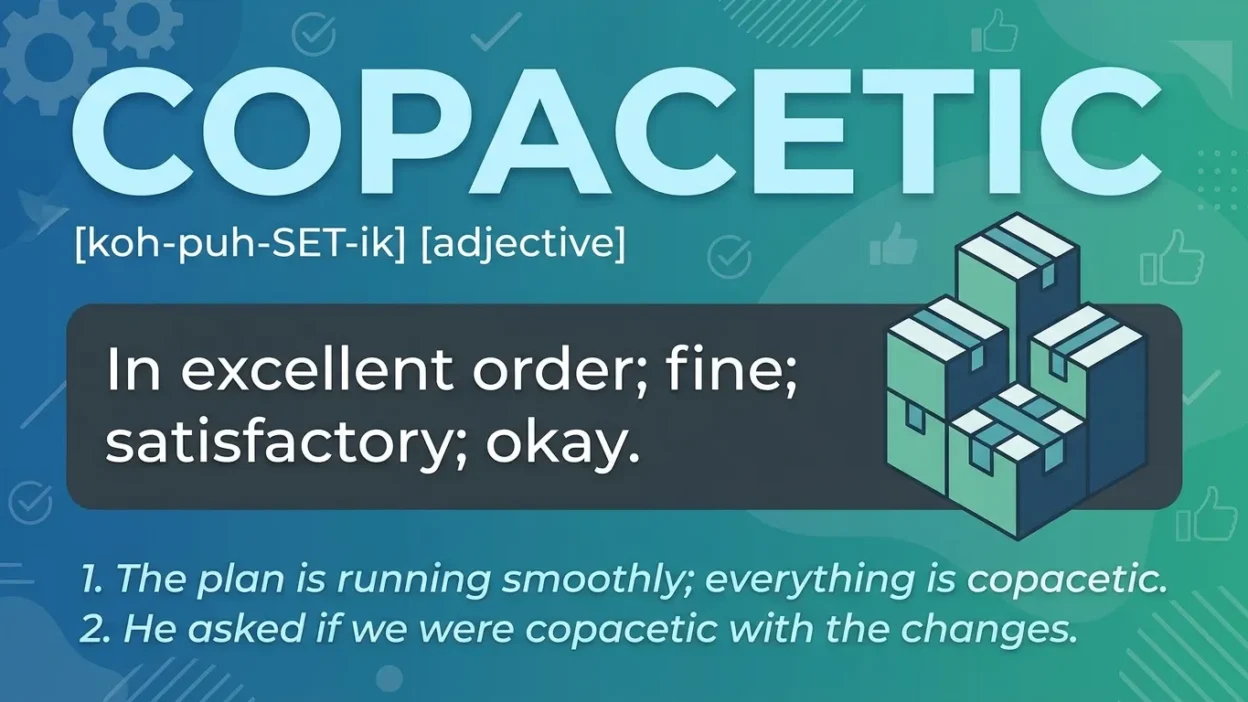
Have you ever heard someone say, “Everything is copacetic,” and wondered what they meant? The copacetic meaning is simple: everything is fine, good, or in proper order.
If a person says, “Things are copacetic,” they usually mean there is no problem. Life, work, or a situation feels calm and satisfactory.
The word sounds unusual, but its meaning is quite easy. In this guide, you will learn what copacetic means, where it may have come from, how people use it, and which words can replace it.
You will also see clear examples from daily life. By the end, you should know when copacetic sounds natural and when a simpler word may work better.
Quick Answer: What Does Copacetic Mean?
Copacetic means satisfactory, fine, or in good order.
For example:
“Don’t worry. Everything is copacetic.”
This means:
“Don’t worry. Everything is fine.”
The word often describes a situation that has no major problems. It can also suggest that things are going as they should.
Simple meaning: fine, okay, good, satisfactory, or all right.
Definition & Meaning of Copacetic
The adjective copacetic describes something that is completely satisfactory or in good condition.
You can use it to talk about a situation, relationship, plan, job, or general state of things.
For example:
- “The project is copacetic.”
- “Our plans are copacetic.”
- “Everything is copacetic at home.”
- “After we talked, things became copacetic.”
In each case, the speaker says that things are fine.
One useful point is that copacetic does not usually mean something is amazing or perfect. It often means that nothing is wrong.
So, if your car runs well, your work is on track, and your plans are settled, you might say things are copacetic.
What Does Copacetic Mean in Simple Words?
In very simple English, copacetic means “everything is okay.”
Think of these common phrases:
- All good.
- Everything is fine.
- No problem.
- Things are okay.
- Everything is in order.
- All is well.
These phrases can carry the same basic idea as copacetic.
The main difference is style. Copacetic sounds more unusual and informal than many everyday alternatives.
That can make it fun to use in conversation.
Copacetic Meaning in a Sentence
The easiest way to understand a word is to see it in context.
Here are some examples:
- “Is everything copacetic with the new schedule?”
This asks if the new schedule is okay. - “Yes, everything is copacetic.”
This means everything is fine. - “We had a small issue, but now things are copacetic.”
The problem has been solved. - “The team says the plan is copacetic.”
The team thinks the plan is satisfactory. - “After the payment arrived, everything was copacetic.”
The situation became settled and fine. - “Are things copacetic between you two?”
This asks whether the relationship is okay. - “The repairs are finished, so the house is copacetic again.”
The house is back in good condition.
Notice that the word often appears when someone wants to say that a situation has reached a good or acceptable state.
Is Copacetic a Positive Word?
Yes. Copacetic is generally positive.
It tells the listener that something is fine or satisfactory.
However, it does not always express strong excitement.
Compare these:
- “The food is copacetic.”
- “The food is fantastic!”
The first sentence says the food is satisfactory. The second shows strong praise.
So, copacetic is closer to “fine” or “all right” than “excellent.”
This small difference matters when you choose the right word.
Copacetic Origin: Where Did the Word Come From?
The exact origin of copacetic remains uncertain.
The word appeared in American English in the early 20th century. Researchers have suggested several possible sources, but no single origin has gained universal acceptance.
Some explanations connect it to African American English. Other theories link it to altered phrases or slang expressions. The popular idea that it comes from a supposed Hebrew phrase is not considered a proven explanation.
This is an important distinction when discussing word history: a proposed origin is not the same as a confirmed origin.
What we can say with confidence is that copacetic became established in American English as a word meaning satisfactory or fine.
Why Does Copacetic Sound So Unusual?
The word has an unusual sound and spelling. That is one reason people often notice it.
Words such as fine, good, and okay are short and common. Copacetic feels more colorful.
It can sound playful, old-fashioned, or deliberately casual depending on the speaker and setting.
For example:
“Everything is copacetic.”
has a different feel from:
“Everything is fine.”
Both can give the same basic message, but the first sounds more distinctive.
How to Use Copacetic in Everyday English
You can use copacetic as an adjective.
A common pattern is:
subject + is/are + copacetic
Examples:
- “Everything is copacetic.”
- “The situation is copacetic.”
- “Our plans are copacetic.”
- “Things are copacetic now.”
You can also use it after verbs such as seem or become:
- “Everything seems copacetic.”
- “The situation became copacetic after the meeting.”
The word works best when you want a relaxed way to say that things are fine.
Copacetic vs. Okay
Copacetic and okay can have nearly the same meaning.
The main difference is common use.
Okay is one of the most common words in English. People use it in almost every type of conversation.
Copacetic is much less common. It has a more distinctive and playful feel.
For example:
“Is everything okay?”
sounds completely normal.
“Is everything copacetic?”
also works, but it sounds more colorful.
If you are writing for a very broad audience, okay is usually clearer.
If you want a less common word with personality, copacetic can work well.
Copacetic vs. Fine
Fine usually means good enough, satisfactory, or without a problem.
That makes it one of the closest everyday synonyms for copacetic.
Consider:
“The plan is fine.”
and:
“The plan is copacetic.”
Both can mean that the plan is acceptable or satisfactory.
Still, fine can have many other meanings. It can describe quality, texture, or even a financial penalty.
Copacetic has a narrower use. It focuses on a satisfactory state.
Copacetic vs. Satisfactory
Satisfactory is a more formal word.
If a teacher says, “Your work is satisfactory,” the teacher means the work meets an acceptable standard.
If someone says, “Everything is copacetic,” the tone feels more relaxed.
So, the choice depends on the setting:
- Copacetic: casual and distinctive
- Satisfactory: formal and direct
- Okay: very common and simple
- Fine: common and flexible
Common Synonyms for Copacetic
Here are useful copacetic synonyms:
- Fine
- Okay
- All right
- Good
- Satisfactory
- Acceptable
- In order
- Going well
- Settled
- Sound
The best synonym depends on the sentence.
For example, “Everything is all right” sounds very natural in everyday speech. “Everything is satisfactory” sounds more formal.
“Everything is copacetic” adds a more unusual tone.
Common Mistakes When Using Copacetic
The word is easy to understand, but a few mistakes can make your sentence sound awkward.
| Mistake | Better Choice |
| Using copacetic to mean “perfect” | Use it to mean fine or satisfactory |
| Treating it as a noun | Use it as an adjective |
| Using it in every formal sentence | Choose satisfactory when formal wording fits |
| Assuming its origin is proven | Treat origin theories with care |
| Using it when you mean “exciting” | Choose exciting, excellent, or fantastic |
The biggest mistake is treating copacetic as a stronger word than it is.
It usually means that things are good enough, fine, or in proper order.
When Should You Use Copacetic?
Use copacetic when the context is relaxed and you want a word with some personality.
It can work well in:
- Casual conversations
- Friendly messages
- Creative writing
- Informal blog posts
- Humorous writing
- Dialogue
For highly formal documents, a word such as satisfactory, acceptable, or in order may sound more natural.
This does not mean copacetic is incorrect in formal writing. It simply has a more conversational and distinctive feel.
Is Copacetic Still Used Today?
Yes, people still use copacetic in modern English.
It is not as common as words like okay, fine, or good. Still, it remains a recognized English word.
You may see it in books, articles, conversations, and creative writing.
Because it is less common, some speakers use it to add humor or style.
For example:
“After three hours of fixing the printer, we’re finally copacetic.”
The speaker could simply say “fine,” but copacetic gives the sentence more character.
How to Remember the Copacetic Meaning
A simple memory trick can help.
Think:
Copacetic = Everything is okay.
Picture a messy situation becoming calm.
The work is done.
The problem is solved.
Everyone agrees.
The plan works.
Now you can say:
“Everything is copacetic.”
You do not need to remember a complicated definition. Just connect the word with “fine and in good order.”
Copacetic: Quick Reference
| What to Know | Quick Answer |
| Part of speech | Adjective |
| Basic meaning | Fine, satisfactory, or in good order |
| Tone | Usually casual or conversational |
| Common phrase | “Everything is copacetic” |
| Closest simple synonym | Fine / okay |
| Opposite idea | Bad, troubled, or unsatisfactory |
| Origin | Uncertain; several theories exist |
| Best use | Informal speech and writing |
Examples of Copacetic in Real-Life Situations
Imagine your friend asks about your work project.
Friend: “How is the project going?”
You: “Everything is copacetic.”
Your answer means the project is going well and has no major problems.
Now imagine two friends had an argument. They talk and solve the issue.
You could say:
“Things are copacetic between them now.”
That means their relationship is okay again.
You could also use the word for plans:
“Are our travel plans copacetic?”
Here, the speaker wants to know if the plans are settled and satisfactory.
These examples show why context matters. The word does not point to one specific object. It describes the state of a situation.
What Is the Opposite of Copacetic?
There is no single perfect opposite in every sentence.
Depending on the context, possible opposites include:
- Bad
- Troubled
- Unsettled
- Unsatisfactory
- Problematic
- Messy
- Difficult
- Out of order
For example:
“Everything is copacetic.”
The opposite idea could be:
“Everything is falling apart.”
The best opposite depends on what you are describing.
Can You Use Copacetic in Professional Writing?
You can, but think about your audience.
In a relaxed workplace message, this may sound fine:
“Everything is copacetic on our end.”
In a formal report, this may be clearer:
“Everything is in order on our end.”
Or:
“The current plan is satisfactory.”
Professional writing should always favor clarity over unusual vocabulary.
If your readers may not know copacetic, a simpler word can save them time.
A Simple Rule for Using Copacetic
Here is the easiest rule:
Use copacetic when you mean “fine,” “okay,” or “in good order,” especially in a relaxed setting.
Do not use it to mean:
- Perfect
- Amazing
- Exciting
- Beautiful
- Extremely successful
Those meanings go beyond the normal sense of the word.
For example, saying “The concert was copacetic” may suggest that the concert was satisfactory. It does not clearly tell the reader that the concert was outstanding.
FAQs:
1. What does copacetic mean?
Copacetic means fine, satisfactory, or in good order. If someone says, “Everything is copacetic,” they mean that everything is okay and there are no major problems.
2. Is copacetic a positive word?
Yes. Copacetic normally has a positive or reassuring meaning. It tells someone that a situation is satisfactory or under control. However, it does not usually mean “excellent” or “perfect.”
3. What is a synonym for copacetic?
Common synonyms include fine, okay, all right, satisfactory, acceptable, sound, and in order. The best choice depends on the tone and context of your sentence.
4. Where did the word copacetic come from?
The exact origin of copacetic is uncertain. Several theories exist about its history, but no single explanation has been firmly established as the proven source.
5. How do you use copacetic in a sentence?
You can say, “Everything is copacetic.” This means everything is fine. Another example is, “Things are copacetic between the two teams,” meaning their relationship is now satisfactory.
6. Is copacetic formal or informal?
Copacetic usually feels informal or conversational. It can appear in writing, but common words such as fine, okay, or satisfactory may fit better when you need very plain or formal language.
7. Does copacetic mean perfect?
No. Copacetic usually means satisfactory or fine, not perfect. A copacetic situation may still have small flaws. The key idea is that things are acceptable, settled, or free from major problems.
Conclusion:
The copacetic meaning is simple: fine, satisfactory, or in good order. It is a useful word when you want to say that a situation has no major problems.
Its exact origin remains uncertain, so it is best to avoid claims that present one origin theory as proven fact. In everyday English, copacetic works best in relaxed conversation, creative writing, and friendly communication.
When you need a simpler word, use okay, fine, or all right. When you want a more formal choice, try satisfactory or in order.
Once you connect copacetic with “everything is okay,” its meaning becomes easy to remember and use.

I am Ernest Angelou, the heart and voice behind prayersvibe.com.
I am someone who believes that prayers are not just words, but a deep conversation between the soul and God.
I am here to share faith-filled prayers that bring peace, hope, and divine comfort into everyday life.