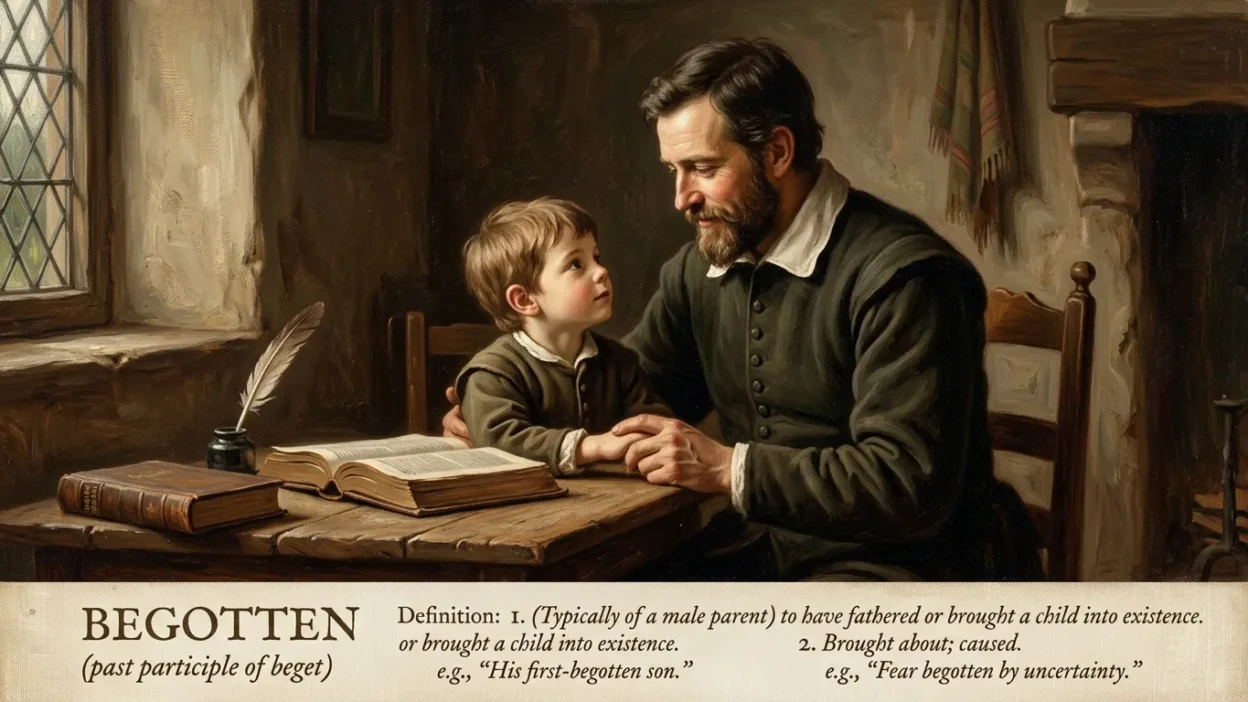
Have you ever read the phrase “only begotten Son” in the Bible and wondered what begotten meaning really is? The word can sound old or hard to understand because modern English does not use it much.
In simple terms, begotten is the past form of beget. In older English, it means fathered, brought forth, or caused to come into being. The exact sense depends on the sentence and, in Bible passages, the original language and context matter.
The word becomes especially important in Christian teaching because older Bible translations use “begotten” in verses about Jesus Christ. John 3:16, for example, says in the KJV that God gave His “only begotten Son.”
This guide explains the begotten definition, its everyday meaning, its biblical meaning of begotten, and why different Bible translations sometimes use different wording.
Quick Answer
Begotten meaning is fathered or brought forth, especially in older English. The word comes from beget, which means to father a child or bring something into existence.
In the Bible, begotten often appears in older translations, especially the KJV. The famous phrase “only begotten Son” describes Jesus in John 3:16. Modern translations often use phrases such as “one and only Son” or “only Son” instead.
So, when you see “begotten,” do not assume it always means simply “born.” Its meaning depends on the context and the original biblical term.
Definition & Meaning
The basic begotten definition comes from the verb beget.
To beget traditionally means:
- To father a child.
- To become the parent of a child.
- To bring something about.
- To cause something to happen.
- To produce or generate something.
Begotten is the past participle of beget.
For example:
“He begot a son.”
This means:
“He fathered a son.”
The word also appears in older writing with a wider sense. A person could “beget” an idea, result, or effect. In that setting, the word means to cause or produce something.
That is why context matters.
When reading an old Bible translation, it helps to ask, “What does this word mean in this verse?” rather than giving the word one fixed meaning in every passage.
Begotten Meaning in the Bible
The begotten meaning in the Bible needs special care because English translations do not always use the same word.
The KJV uses “begotten” in several important places. John 3:16 is perhaps the best-known example:
“For God so loved the world, that he gave his only begotten Son…”
The Greek text of John 3:16 uses the word μονογενῆ (monogenē), from monogenēs. Many modern translations render this idea as “one and only Son” or “only Son.”
This shows why a good Bible study should not depend on one English word alone.
The word “begotten” in an English Bible does not automatically mean that Jesus was created by God. Christian teaching about Jesus’ identity also comes from the wider New Testament, including passages about His eternal relationship with the Father.
What Does “Only Begotten Son” Mean?
The phrase “only begotten Son” is one of the most important places where people ask about the meaning of begotten.
John 3:16 in the KJV calls Jesus God’s “only begotten Son.”
Modern translations may use “one and only Son” or “only Son.”
The point is not that God created Jesus as though Jesus were one creature among others.
Rather, the phrase points to the unique and special relationship of Jesus to the Father. In Christian theology, Jesus is understood as the Son of God in a unique way.
This becomes clearer when you compare translations and read the surrounding verses.
A helpful rule is:
Do not build a major Christian belief on the English word “begotten” by itself. Read the whole passage and compare reliable translations.
Begotten vs. Born
People often ask whether begotten simply means born.
The two words can be related, but they are not identical.
Born usually focuses on the act of coming into the world through birth.
Begotten traditionally focuses more on fathering or generating.
For example, if an old text says that a man “begot a son,” the emphasis is on his fathering of that child.
The distinction becomes important when studying biblical language. A translation may use “begotten” because of the wording and tradition of an older English Bible, while a modern translation may choose wording that better communicates the meaning to today’s readers.
Comparison Table: Begotten vs. Born
| Word | Simple meaning | Main idea | Common use |
| Begotten | Fathered or brought forth | Generation or origin | Older English and Bible translations |
| Born | Came into the world through birth | Birth | Modern everyday English |
| Beget | To father or produce | Causing or generating | Older/formal English |
| Begat | Fathered | Past action | Genealogies and older Bible language |
The key lesson is simple: begotten and born can overlap, but they are not always exact synonyms.
What Does Begotten Mean in the KJV?
The King James Version uses the word “begotten” because of its older English style.
You can see it in famous passages such as:
- John 1:14
- John 3:16
- John 3:18
- Hebrews 1:5
- 1 John 4:9
The word also appears in genealogical passages through forms such as “begat.”
For example, biblical genealogies often use a pattern such as one person “begat” another. In that setting, the meaning is straightforward: the person fathered the next generation.
But passages about Jesus require more care.
John 3:16 uses monogenēs in the Greek text. The KJV translates it as “only begotten,” while several modern translations use “one and only” or “only.”
This translation difference is important for anyone studying the Bible.
What Does Begotten Mean in Genealogies?
One of the easiest ways to understand begotten meaning is to look at biblical genealogies.
In older English Bible language, “begat” normally means “fathered.”
For example, when a genealogy says that one man “begat” a son, it identifies a family relationship between the father and the child.
This use is much easier to understand than the theological use of “only begotten.”
It also helps explain why the word may feel confusing today. Modern English speakers rarely use beget or begotten in everyday conversation.
You may understand the sentence much faster if you mentally replace:
begat → fathered
and
begotten → fathered or brought forth
But always check the context before assuming that replacement works perfectly.
Begotten Meaning and Christian Theology
The word begotten has played a major role in Christian discussions about Jesus Christ.
A common mistake is to reason:
“If Jesus is begotten, then Jesus must have been created.”
That conclusion does not follow simply from the English word.
The New Testament contains several passages that Christians use together when explaining who Jesus is. John 1, for example, speaks about the Word and describes the Word in relation to God. John 3:16 speaks about God’s giving of His Son. Different passages contribute different parts of the Christian understanding.
This is why theology should not rest on one English translation or one dictionary definition.
The word begotten can describe generation or fatherhood in ordinary contexts. But when it appears in a theological statement about Christ, readers should study the whole passage and the underlying biblical language.
That approach is more careful and avoids common misunderstandings.
What Is the Meaning of Begotten in Simple English?
If you want the easiest possible explanation, remember this:
Begotten = fathered, generated, or brought forth.
Here are a few simple examples:
- “He begot a son” = “He fathered a son.”
- “His only begotten son” = “His unique or only son,” depending on the translation and context.
- “Begotten of the Father” = language describing a special relationship of origin or generation.
The word sounds formal because it belongs mainly to older English.
You will rarely hear someone say, “He begot three children” in normal conversation today. Most people would say, “He fathered three children.”
Is Begotten the Same as Created?
No. Begotten and created do not have the same basic meaning.
To create means to make something come into existence.
To beget traditionally means to father or generate.
That distinction matters in Christian theology.
The phrase “only begotten Son” should not automatically be read as “created Son.” Modern translations that render John 3:16 as “one and only Son” also show that the phrase carries a meaning that goes beyond a simple claim about physical birth.
If you are studying this question for Christian doctrine, look at the complete biblical teaching about Christ instead of using one English word as the entire argument.
Common Mistakes When Understanding Begotten
Many people make the same few mistakes when they first study the word.
Mistake 1: Treating “begotten” as a modern word
Modern English does not often use beget. This can make an old Bible verse seem harder than it really is.
Better approach: Replace the word with a simple context-based meaning such as “fathered,” “generated,” or “unique Son.”
Mistake 2: Assuming every use means the same thing
The word appears in genealogies and theological passages. The context can change how you should understand it.
Better approach: Read the whole verse and the surrounding passage.
Mistake 3: Ignoring Bible translations
The KJV uses “only begotten” in John 3:16, while modern translations may say “one and only Son” or “only Son.”
Better approach: Compare several trusted translations.
Mistake 4: Assuming “begotten” means “created”
This can create confusion about Christian teaching concerning Jesus.
Better approach: Study the word in its original context and compare it with other passages about Christ.
Comparison Table: Common Mistakes vs. Better Understanding
| Common mistake | Better understanding |
| “Begotten” always means “born.” | It can mean fathered, generated, or brought forth, based on context. |
| “Begotten” always means “created.” | Begetting and creating are different ideas. |
| “Only begotten” means Jesus was created. | The phrase must be understood through its biblical context and original language. |
| Every Bible translation uses the same wording. | Older and modern translations may translate the phrase differently. |
| A dictionary definition is enough. | Context, translation, and biblical usage all matter. |
How to Study Begotten in the Bible
If you want to study the word for yourself, you do not need advanced training.
Start with the verse where you found the word.
Then follow these steps:
- Read the entire verse.
- Read the verses before and after it.
- Check the Bible translation you are using.
- Compare two or three trusted translations.
- Look at the original-language term when needed.
- Check how the same term appears elsewhere.
- Avoid building a doctrine from one English word.
- Read the passage in its wider biblical context.
This method helps you move from a quick word definition to a more reliable understanding.
Quick Reference Table
| Question | Simple answer |
| What does begotten mean? | Fathered, generated, or brought forth. |
| What is beget? | To father or produce. |
| What does begotten mean in the Bible? | Its meaning depends on the passage and translation. |
| What does “only begotten Son” mean? | A traditional rendering describing Jesus’ unique relationship to the Father. |
| Does begotten mean created? | No, the two words have different basic meanings. |
| Why does the KJV say “begotten”? | It reflects its traditional English translation style. |
| Why do modern Bibles say “only Son”? | They may use wording intended to communicate the meaning clearly in modern English. |
| What should I do when I see “begotten”? | Read the context and compare translations. |
Why Different Bible Translations Matter
Bible translation is not simply a matter of replacing each original word with one English word.
Languages have different grammar, word ranges, and ways of expressing ideas.
John 3:16 provides a clear example. The Greek text uses monogenēs, while English translations differ in how they express it. The KJV has “only begotten,” while the NIV has “one and only Son,” and the ESV uses “only Son.”
That does not mean one translation is automatically useless.
It means readers should understand why translations can differ.
For serious Bible study, comparing translations can help you see the range of meaning without forcing one English word to carry more weight than it should.
Biblical Meaning of Begotten: What Should Christians Take Away?
The biblical meaning of begotten depends on where the word appears.
In genealogies, it can simply describe fatherhood.
In theological passages, especially those about Jesus, it can point to a unique relationship that older English translations expressed with the word “begotten.”
The most important lesson is that words must be understood in context.
John 3:16 is a good example. The KJV says “only begotten Son,” while other translations use “one and only Son” or “only Son.”
So, if someone asks, “What does begotten mean?” the best answer is not just one word.
A better answer is:
Begotten traditionally means fathered or generated, but its exact biblical sense depends on the passage, translation, and original language.
Actionable Checklist for Bible Study
Before deciding what begotten means in a verse, use this quick checklist:
- Identify the Bible translation.
- Read the full verse.
- Read the surrounding passage.
- Check whether the passage is a genealogy or theological text.
- Compare modern and older translations.
- Check the original-language term when the issue is important.
- Look at related Bible passages.
- Avoid assuming “begotten” means “created.”
- Focus on the full message of the passage.
- Use trusted Bible study resources when a major doctrine is involved.
This simple process can prevent many common errors.
FAQs:
1. What is the simple meaning of begotten?
Begotten simply means fathered, generated, or brought forth. It comes from the older verb beget. In everyday modern English, people usually use words such as “fathered” or “produced” instead.
2. What does “only begotten Son” mean?
“Only begotten Son” is the traditional wording found in the KJV in John 3:16. Modern translations may say “one and only Son” or “only Son.” The phrase describes Jesus’ unique relationship to God the Father.
3. Does begotten mean created?
No. Begotten and created are different words with different basic meanings. Begetting traditionally refers to fathering or generating, while creating refers to making something come into existence.
4. Why does the KJV use the word begotten?
The KJV uses older English wording that can sound unusual to modern readers. “Begotten” was a natural formal term in older English Bible language, especially in phrases such as “only begotten Son.”
5. Is begotten the same as born?
Not exactly. Born focuses on birth, while begotten traditionally focuses on fathering or generation. The two ideas can be connected, but they are not always interchangeable.
6. What does begotten mean in the Bible?
Its meaning depends on the passage. In genealogies, it can mean fathered. In passages about Jesus, older translations may use “begotten” to describe His unique relationship to the Father. The original language and context should guide interpretation.
7. Why do modern Bible translations remove “begotten”?
Many modern translations choose wording that they believe communicates the meaning more clearly to today’s readers. For example, John 3:16 is translated as “one and only Son” in the NIV and “only Son” in the ESV, while the KJV keeps “only begotten Son.”
Conclusion:
The begotten meaning is easier to understand once you connect the word with its older verb, beget. In basic English, it can mean fathered, generated, or brought forth.
The Bible gives the word added importance, especially in the phrase “only begotten Son.” The KJV uses this traditional wording in John 3:16, while modern translations often say “one and only Son” or “only Son.”
The safest way to study the word is to consider the context, translation, and original biblical language.
Do not assume that “begotten” simply means “created.” If you found this word in a specific Bible verse, read that whole passage before drawing a conclusion.

I’m Jessica Morgan, a writer who loves covering lifestyle, entertainment, sports, trends, and everyday topics in a simple and engaging way. At PrayersVibe.com, I focus on creating helpful, easy-to-read content that informs and connects with readers. I enjoy researching new ideas and turning them into clear, useful stories that readers can enjoy.