Have you ever helped someone without asking for anything in return? Maybe you gave your time to a friend, helped a stranger, or put someone else’s needs first. That simple choice is at the heart of the selfless meaning.
Being selfless means caring about other people without making your own gain the main reason for your actions. A selfless person may give time, support, kindness, money, attention, or love because they truly want to help.
But selflessness does not mean you must ignore yourself. Healthy selflessness leaves room for your own needs, limits, and well-being.
In this guide, you will learn what selfless means, what a selfless person looks like, how selfless love works, and how you can practice selfless acts in daily life. You will also learn the difference between being selfless and letting others take advantage of you.
Quick Answer
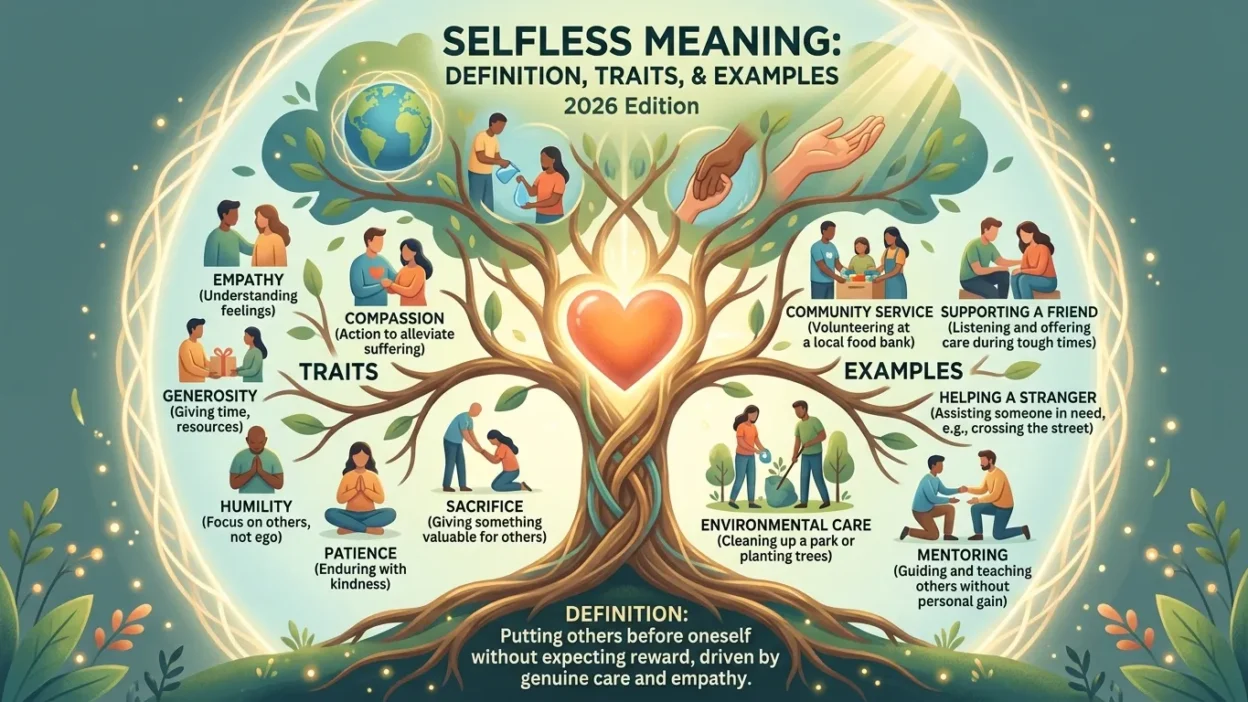
The selfless meaning is caring about others and helping them without expecting a reward, praise, or personal gain. A selfless person puts genuine care, kindness, and service ahead of selfish goals.
For example, helping a friend during a hard time without expecting anything back is a selfless act.
Selflessness can appear in small actions, such as listening, sharing, forgiving, helping, or giving your time.
Definition & Meaning
Selfless is an adjective that describes someone who thinks about the needs and well-being of others without focusing mainly on personal gain.
In simple words, selfless means:
Giving to others without making “What will I get?” the main question.
A selfless person may help because they care. They may give support even when no one will praise them. They may share what they have because another person needs it more.
The word has a clear contrast with selfish. A selfish choice puts personal wants first with little concern for others. A selfless choice gives serious thought to another person’s needs.
Still, selfless does not mean perfect.
Everyone has needs. Everyone gets tired. Everyone needs rest. A person can care deeply for others while also caring for themselves.
What Does Selfless Mean in Everyday Life?
The meaning becomes easier to understand when you see it in normal situations.
Imagine your friend has an important exam the next morning. You planned to watch a movie, but your friend feels worried and needs help studying. You decide to spend some time helping them.
You do not help because you expect money or praise. You help because you care.
That is a simple example of selflessness.
Selfless behavior can also be very small. You might let someone go ahead of you in a line when they are in a hurry. You might listen to someone who needs to talk. You might share credit with a teammate instead of taking all the praise.
These actions may seem small, but they show concern for other people.
What Is a Selfless Person Like?
A selfless person often shows care through actions rather than words.
They may notice when someone needs help. They may offer support before being asked. They may celebrate another person’s success without feeling the need to compete.
Common qualities of a selfless person include:
- Kindness toward others
- Empathy and understanding
- A willingness to help
- Generosity with time or resources
- Good listening skills
- Patience
- Compassion
- Humility
- A desire to support others
- Little need for praise
However, one kind act does not make someone completely selfless. People have many motives, and human behavior can be complex.
A person can act selflessly in one situation and act selfishly in another. What matters is the pattern of their choices and the care behind them.
What Are Selfless Acts?
Selfless acts are actions that help another person without making personal reward the main goal.
They do not need to be dramatic. In fact, many meaningful acts of kindness happen in ordinary moments.
Examples include:
- Helping an older people neighbor with groceries
- Listening to a friend who feels lonely
- Giving your seat to someone who needs it
- Helping a coworker meet a deadline
- Sharing food with someone who has none
- Volunteering in your community
- Teaching someone a skill for free
- Checking on someone who is going through a hard time
- Giving sincere encouragement
- Forgiving someone after a genuine apology
Selfless acts can also involve time. Your time has value, so giving attention to someone can be a real form of generosity.
The key point is not the size of the action. The key is the willingness to help without making personal reward the center of the choice.
What Is Selfless Love?
Selfless love means loving someone while caring about their needs, growth, happiness, and well-being.
It can appear in friendships, family relationships, marriage, parenting, and other close relationships.
For example, a parent may spend time helping a child learn a difficult skill. A friend may stay with someone during a painful season. A partner may support the other person’s goals even when those goals require patience and sacrifice.
Selfless love does not mean accepting every behavior.
You can love someone and still say no. You can care about someone and still set boundaries. You can forgive someone without allowing repeated harm.
That distinction matters because healthy love should include respect for both people.
Is Being Selfless Always Good?
Selflessness can be a wonderful quality, but it needs balance.
If you constantly put everyone else first, you may become tired, stressed, or resentful. You may also start giving more than you can safely give.
Healthy selflessness means helping others while respecting your own limits.
For example, suppose a friend asks you to help them move on the same day you have an important commitment. Saying, “I cannot help that day, but I can help you another time,” does not make you selfish.
It shows that you understand your limits.
True generosity does not require you to destroy your own health, finances, time, or peace for someone else.
Selfless vs. Selfish: What Is the Difference?
The easiest way to understand the difference is to look at what drives the choice.
A selfish choice mainly asks, “What do I want?”
A selfless choice asks, “What does this person need, and how can I help?”
Neither word means that every decision must fit one extreme. Most daily choices involve both personal needs and concern for others.
Here is a simple comparison:
| Selfish Behavior | Selfless Behavior |
| Focuses mainly on personal gain | Considers another person’s needs |
| Wants attention or praise | Can help without praise |
| Takes more than needed | Shares when sharing can help |
| May ignore others’ feelings | Tries to understand others |
| Seeks personal advantage | Seeks a fair or helpful outcome |
| Often asks, “What do I get?” | Often asks, “How can I help?” |
The goal is not to become a person who never thinks about themselves. The healthier goal is to develop a generous mindset without losing good judgment.
Selfless Meaning in Relationships
Selflessness can make relationships stronger when it comes with respect and balance.
Good relationships require people to give and receive. One person should not always sacrifice while the other person always takes.
A selfless friend may listen when you need support. A selfless partner may make compromises. A selfless family member may help during a difficult time.
But healthy relationships also allow you to receive help.
If you always give and never allow others to give back, the relationship can become uneven.
Selflessness works best when people care for each other rather than when one person carries everything.
Selflessness and Boundaries
One of the most important lessons about selflessness is that kindness and boundaries can exist together.
You can say no to a request and still be a caring person.
You can protect your time and still help others.
Boundaries tell people what you can and cannot do. They help prevent kindness from turning into constant sacrifice.
Try using simple statements such as:
- “I would like to help, but I cannot do it today.”
- “I can help for one hour.”
- “I cannot lend money, but I can help you find another option.”
- “I care about you, but I need some time to rest.”
These statements do not erase your kindness. They help you practice it in a healthier way.
What Is the Opposite of Selfless?
The most direct opposite of selfless is selfish.
Selfish behavior puts personal interests first, often without giving enough thought to how the choice affects other people.
There is also a related word: self-centered. A self-centered person may focus heavily on their own feelings, needs, opinions, or experiences.
But these words should not be used too quickly.
Wanting rest, money, privacy, success, or personal space does not automatically make someone selfish. People have legitimate needs.
The real issue is balance.
Caring for yourself is not the same as ignoring everyone else.
Is Selflessness the Same as Altruism?
Selflessness and altruism are closely related, but they are not always used in exactly the same way.
Selflessness usually describes a person’s attitude or behavior toward others. It focuses on putting another person’s needs or welfare ahead of personal gain.
Altruism is often used to describe behavior intended to benefit others, sometimes even when the person accepts a personal cost.
In everyday writing, the two words can overlap.
For simple conversations, you can think of them this way:
- Selfless: focused on helping others rather than personal reward.
- Altruistic: motivated by concern for the welfare of others.
- Generous: willing to give more than is required.
- Compassionate: notices suffering and responds with care.
These ideas are related, but each has its own shade of meaning.
How to Become More Selfless
You do not need to make huge sacrifices to become more giving. Start with small choices.
First, pay attention to people around you. Notice when someone seems to need support.
Second, listen more. Sometimes people need attention more than advice. Third, give what you can. This might be time, knowledge, encouragement, or practical help.
Fourth, avoid keeping score. If you help someone, do not assume they must immediately repay you.
Fifth, practice kindness when no one is watching. This can help you focus on the value of the action instead of the praise.
Finally, keep your boundaries. Sustainable kindness is better than giving so much that you become exhausted.
Simple Ways to Practice Selfless Acts Every Day
You can practice selflessness without changing your whole life.
Try one of these actions today:
- Send a kind message to someone who may need encouragement.
- Let another person speak without interrupting.
- Help with a task before someone asks.
- Give honest credit to someone who helped you.
- Share useful information with someone who needs it.
- Donate something you no longer need.
- Volunteer for a local cause.
- Be patient with someone having a hard day.
- Ask someone, “How can I help?”
- Listen without turning the conversation back to yourself.
These actions are simple, but they can change the way you relate to people.
How to Know If Your Selflessness Is Healthy
A useful test is to ask yourself a few questions before helping.
Am I helping because I want to, or because I am afraid to say no?
Can I afford the time, money, or energy I am giving?
Would I feel angry or deeply resentful if this person never returned the favor?
Does this action truly help the person, or am I trying to control the situation?
Am I ignoring an important need of my own?
These questions can help you tell the difference between healthy generosity and unhealthy people-pleasing.
Selflessness should come from care, not fear.
Common Mistakes About Being Selfless
Many people misunderstand selflessness. They think a good person must always say yes.
That is not true.
Another mistake is believing that selfless people never want anything for themselves. A person can have goals, dreams, money, hobbies, and personal needs while still being deeply generous.
Some people also use “selfless” to praise people who give too much. That can create an unhealthy idea of kindness.
The better approach is simple: care for others without abandoning yourself.
| Common Mistake | Healthier Approach |
| Saying yes to every request | Help when you reasonably can |
| Ignoring your own needs | Care for yourself too |
| Expecting praise for every good act | Help without needing recognition |
| Letting others take advantage of you | Set clear boundaries |
| Giving more than you can afford | Give within your limits |
| Thinking selflessness means weakness | See kindness as a choice |
| Trying to solve every problem | Offer support without taking control |
This balanced view makes selflessness more practical and sustainable.
Quick Reference: Selfless Meaning
Use this table when you need a simple reminder of the main ideas:
| Question | Quick Answer |
| What does selfless mean? | Caring about others without making personal gain the main goal |
| What is a selfless person? | Someone who often helps and considers others’ needs |
| What is selfless love? | Love that values another person’s well-being and growth |
| What are selfless acts? | Helpful actions done without focusing on personal reward |
| What is the opposite of selfless? | Selfish |
| Is selfless always good? | Usually positive, but healthy limits still matter |
| Can you be selfless and have boundaries? | Yes |
| Is selflessness the same as weakness? | No; it can involve strength, judgment, and compassion |
| How can you practice it? | Help, listen, share, encourage, and give within your limits |
Selfless Meaning in Real-Life Examples
Consider three simple situations.
Example one: Friendship
Your friend has had a difficult day. Instead of giving quick advice, you sit down and listen. You give them your full attention because you care.
That is a selfless act.
Example two: Work
A coworker helped you finish a project. During a team meeting, you give them credit instead of acting as if you did everything yourself.
That shows generosity and humility.
Example three: Family
A family member needs help with an important task. You change your plans because you have enough time and energy to help.
That can be selfless because you choose to put their need into your decision.
Notice that none of these examples require a huge sacrifice.
Selflessness often lives in ordinary moments.
Why Selfless Actions Matter
A kind action can affect more than one person.
When someone receives honest support, they may feel less alone. When people share credit, trust can grow. When neighbors help each other, communities can become more connected.
You do not need to change the whole world to make a difference.
Sometimes the most useful thing you can do is small and direct: listen, help, share, encourage, or show up.
That is one reason selflessness remains an important human value across many cultures and communities.
FAQs:
1. What is the simple meaning of selfless?
Selfless means caring about other people and helping them without making personal reward the main reason for your actions. It describes a person who can put another person’s needs into consideration instead of thinking only about themselves.
2. What is an example of being selfless?
Helping a friend study without expecting money, praise, or a favor in return is one example. Other examples include volunteering, listening to someone in need, sharing resources, or giving someone support during a difficult time.
3. What is the opposite of selfless?
The opposite of selfless is usually selfish. Selfish behavior focuses mainly on personal wants or benefits and may give little attention to the needs or feelings of others.
4. What does selfless love mean?
Selfless love means caring about another person’s well-being without making your own benefit the center of the relationship. It can involve patience, support, sacrifice, forgiveness, and genuine concern while still allowing healthy boundaries.
5. Is being selfless a good quality?
Yes, selflessness is generally seen as a positive quality because it can show kindness, compassion, generosity, and concern for others. However, healthy selflessness should not require you to ignore your own basic needs or accept harmful behavior.
6. Can a selfless person say no?
Yes. A selfless person can say no when a request goes beyond their limits. Saying no can protect your time, energy, money, and well-being. Healthy boundaries can help you continue helping others without becoming overwhelmed.
7. How can I become more selfless?
Start small. Listen to people, offer help, share credit, give encouragement, volunteer, and look for ways to make another person’s day easier. At the same time, keep reasonable boundaries so your kindness remains healthy and sustainable.
Conclusion:
The selfless meaning is simple: caring about others without making personal gain the main goal. Selfless people give time, attention, support, kindness, and help because they value other people’s well-being.
But true selflessness does not mean saying yes to everything. You can care for others while protecting your own needs and boundaries.
Start with small acts. Listen when someone needs to talk. Help when you have the ability. Give credit to others. Share what you can. Most of all, let your kindness come from genuine care rather than the need for praise.
Small selfless choices can make everyday relationships more caring, respectful, and meaningful.

I’m Jessica Morgan, a writer who loves covering lifestyle, entertainment, sports, trends, and everyday topics in a simple and engaging way. At PrayersVibe.com, I focus on creating helpful, easy-to-read content that informs and connects with readers. I enjoy researching new ideas and turning them into clear, useful stories that readers can enjoy.