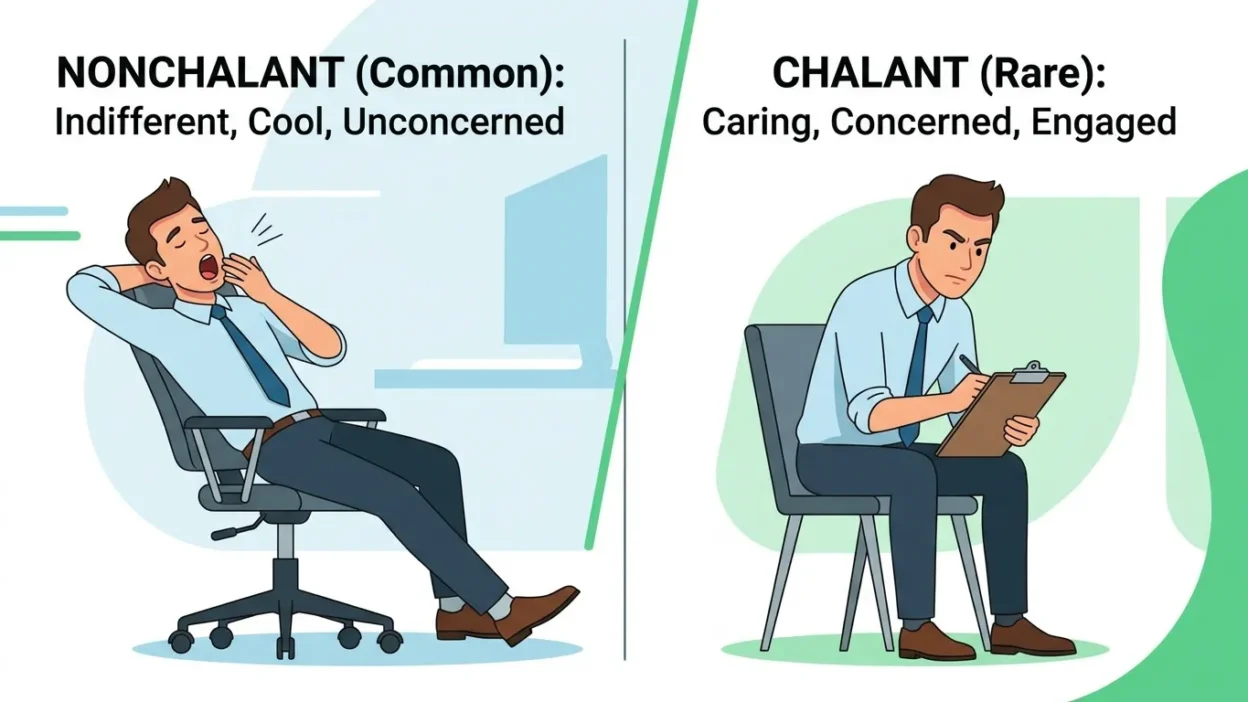
Have you ever seen the word “chalant” and wondered if it is the opposite of “nonchalant”? You are not alone. The word looks like it should be real. After all, nonchalant contains the word chalant, so it seems logical that removing “non-” should create the opposite.
But English does not always work that neatly.
The chalant meaning you may see online usually describes someone who cares, shows concern, or feels emotionally involved.
However, there is an important catch: “chalant” is not a standard English dictionary word in the way “nonchalant” is. Dictionary.com currently lists “chalant” as not being in its dictionary and presents the popular meaning as a possible modern usage.
This guide explains what people mean when they use chalant, whether it is correct English, where the idea comes from, and what words you should use instead.
Quick Answer
Chalant meaning usually refers to being concerned, interested, emotionally invested, or willing to show that you care.
However, chalant is not a standard dictionary word in modern English. People often create or use it as the supposed opposite of nonchalant.
For formal writing, use words such as concerned, interested, caring, engaged, attentive, involved, or emotionally invested instead of chalant.
Definition & Meaning
In informal modern use, chalant can mean showing that you care about something rather than acting calm, detached, or unconcerned.
For example:
“She was very chalant about the interview.”
The intended meaning is likely:
“She was very concerned about the interview.”
Or:
“She cared a lot about how the interview would go.”
The word often appears because people notice that nonchalant seems to contain a positive word hidden behind the prefix non-.
That creates a tempting assumption:
nonchalant = not chalant
Therefore:
chalant = concerned or interested
The idea makes sense from a word-building point of view, but that does not make chalant an established standard English word.
Is Chalant a Real Word?
This question needs a careful answer.
Chalant is used as a word by some people, especially in informal or playful language, but it is not a standard dictionary entry in major everyday English usage.
Dictionary.com currently states that chalant is not in its dictionary. Its page explains that the word is sometimes used to suggest the opposite of nonchalant, with meanings such as concerned, anxious, engaged, or invested.
So, if you use chalant in a casual conversation, many people may understand what you mean from context.
But if you are writing:
- a school paper
- a business email
- an academic essay
- a professional report
- a formal article
it is safer to choose an established word.
For example, instead of:
“He was chalant about the result.”
write:
“He was concerned about the result.”
That sounds natural and avoids confusion.
Chalant Meaning in Simple English
In simple English, chalant is often intended to mean:
“Someone who cares and does not hide that they care.”
It can suggest a person who:
- shows interest
- pays attention
- feels concern
- becomes emotionally involved
- wants a good result
- openly reacts to a situation
- does not act detached
Imagine two students waiting for exam results.
The first student sits quietly and acts as if the result does not matter.
The second student keeps checking the results page and talks about the outcome with friends.
Someone using chalant informally might call the second student “chalant.”
But standard English would usually describe that student as concerned, eager, nervous, interested, or invested.
Chalant vs. Nonchalant
The confusion comes mainly from nonchalant.
Nonchalant is a real and established English adjective. It describes someone who appears calm, casual, unconcerned, or indifferent.
For example:
“She gave a nonchalant shrug.”
This means she acted as if the matter did not bother her.
The word can describe someone’s outward behavior. A person may even care deeply inside while appearing nonchalant on the outside.
That is an important point.
Someone can look nonchalant without actually being indifferent.
The supposed opposite, chalant, is much less established.
| Feature | Chalant | Nonchalant |
| Standard dictionary status | Not generally established as a standard word | Established English word |
| Common intended meaning | Caring, concerned, interested | Calm, unconcerned, casual |
| Typical use | Informal, playful, internet language | Standard everyday English |
| Safe for formal writing? | No; use a clearer alternative | Yes |
| Example | “He seemed chalant about it.” | “He seemed nonchalant about it.” |
Why Do People Think Chalant Is the Opposite of Nonchalant?
The answer lies in how the word nonchalant looks.
Many English speakers naturally break words into parts. When they see:
nonchalant
they may assume:
- non = not
- chalant = concerned
That would make nonchalant mean “not concerned.”
The logic seems perfect.
But word history does not always follow the patterns that modern speakers expect.
Nonchalant comes from French nonchalant, which is related to an older French verb connected with a lack of warmth or concern. Dictionary.com traces the word through French and ultimately to Latin calēre, meaning “to be warm.”
That history does not mean English speakers once commonly used chalant as the normal positive form.
This is why you should not assume that every word beginning with a negative prefix has a commonly used opposite.
English has many words whose parts look meaningful today even though the full word developed in a different way.
What Does Chalant Mean in Texting?
In texting and social media, chalant can work as an informal or humorous word.
People may use it to say that someone is clearly invested in something.
For example:
“I was trying to act chill, but I was too chalant.”
The speaker probably means:
“I cared too much to act chill.”
Another example:
“He is so chalant about his new relationship.”
The intended meaning may be:
“He openly cares about his new relationship.”
This kind of use can be understood because readers know the contrast with nonchalant.
Still, understanding an informal word does not automatically make it standard formal English.
Examples of Chalant in Sentences
Here are examples showing how people may use the word informally.
Example 1
“She was too chalant to pretend she did not care.”
Meaning: She cared openly.
Example 2
“I tried to look nonchalant, but I was actually very chalant.”
Meaning: The speaker tried to look calm but was clearly emotionally invested.
Example 3
“He became more chalant when the interview started.”
Meaning: He showed more concern or interest.
Example 4
“My friend is never nonchalant about birthdays. She is very chalant.”
Meaning: She openly cares about birthdays.
Example 5
“I was not chalant about the test at all.”
This sentence is less clear because the speaker may mean they were not concerned. A better standard-English sentence would be:
“I was not concerned about the test.”
That example shows why established words often communicate the idea better.
Better Words to Use Instead of Chalant
If you want to express the meaning behind chalant, you have many strong choices.
Concerned
Use concerned when you care about a possible problem or result.
“She was concerned about the meeting.”
Interested
Use interested when you want to show attention or curiosity.
“He was interested in the project.”
Caring
Use caring when you want to describe kindness or emotional concern.
“She is a caring friend.”
Engaged
Use engaged when someone actively takes part in something.
“The students were engaged in the discussion.”
Invested
Use invested when someone cares strongly about an outcome.
“He was emotionally invested in the relationship.”
Attentive
Use attentive when someone pays close attention.
“The manager was attentive to the customer’s needs.”
Eager
Use eager when someone strongly wants something to happen.
“She was eager to hear the results.”
These words make your meaning clear without depending on an informal or disputed term.
Chalant Meaning vs. Similar Words
It helps to understand the difference between the possible meaning of chalant and established words.
Concerned focuses on worry or care.
Interested focuses on attention or curiosity.
Engaged focuses on active involvement.
Invested focuses on strong personal interest in an outcome.
Attentive focuses on paying attention.
Eager focuses on strong desire.
Nonchalant focuses on appearing calm or unconcerned.
So, if someone says “chalant,” you should look at the context before choosing a replacement.
For example, chalant could mean concerned in one sentence and emotionally invested in another.
Common Mistakes With Chalant
One common mistake is treating chalant as the official opposite of nonchalant.
That is too strong.
Another mistake is using chalant in formal writing without checking whether your audience will recognize it.
A third mistake is assuming that every reader will understand the intended meaning.
| Mistake | Better approach |
| Treating chalant as a fully standard opposite of nonchalant | Explain it as an informal or proposed opposite |
| Using chalant in academic writing | Use concerned, interested, engaged, or invested |
| Assuming everyone knows the word | Choose a clear standard word |
| Using chalant when you mean worried | Use concerned or anxious |
| Using chalant when you mean curious | Use interested |
| Using chalant when you mean emotionally involved | Use invested or engaged |
When Can You Use Chalant?
There is no need to avoid the word in every situation.
In casual conversation, humor, social media, or playful writing, chalant can be useful if your readers understand the joke or wordplay.
For example:
“I wanted to play it cool, but I was too chalant.”
The sentence has a playful effect because it contrasts chalant with nonchalant.
This type of language can be fun.
The key is audience and context. If your goal is humor, creativity, or casual conversation, the unusual word may work.
If your goal is precision, clarity, or formal correctness, use a standard synonym.
Is Chalant the Opposite of Nonchalant?
Informally, people often use it that way. Strictly speaking, you should not treat it as the established dictionary opposite.
The idea is easy to understand:
- Nonchalant: appears unconcerned or casual
- Chalant: supposedly concerned or openly caring
But English speakers normally express the second idea with words such as concerned, interested, caring, engaged, or invested.
This distinction matters because word meaning depends not only on logic but also on actual usage.
A word can look like it should exist without becoming a standard word.
How to Remember the Meaning
If you encounter chalant online, use this simple memory trick:
Chalant = the informal idea of showing you care.
Then remember the important note:
It is not the standard dictionary opposite of nonchalant.
For everyday English, choose a word that states your exact meaning.
For example:
- Care about it → concerned
- Want to know more → interested
- Take part → engaged
- Care strongly about the result → invested
- Want something badly → eager
- Pay close attention → attentive
That approach gives you much more precise English.
Quick Reference Checklist
Use this table when deciding whether chalant fits your sentence.
| Your intended meaning | Best word to use | Why |
| You care about a problem | Concerned | Clear and standard |
| You want to learn more | Interested | Shows curiosity |
| You care deeply about an outcome | Invested | Shows strong personal interest |
| You take an active role | Engaged | Shows involvement |
| You pay close attention | Attentive | Shows focus |
| You strongly want something | Eager | Shows desire |
| You act calm and unconcerned | Nonchalant | Standard English |
| You want playful internet-style wording | Chalant | Informal and context-dependent |
Why Clear Word Choice Matters
Good writing does not always mean using rare or clever words.
In many cases, the strongest word is the simplest one.
If you write:
“She was concerned about the result.”
your reader understands you at once.
If you write:
“She was chalant about the result.”
some readers may stop and wonder whether you used a real word.
That pause can weaken your message.
This is especially important in professional and academic writing. Your goal should be to make your meaning easy to understand, not to make the reader decode your vocabulary.
FAQs:
1. What does chalant mean?
Chalant is commonly used informally to mean concerned, caring, interested, or emotionally invested. However, it is not generally recognized as a standard English dictionary word. Dictionary.com currently marks it as not being in its dictionary.
2. Is chalant a real word?
It is used by some speakers and writers, especially in informal or playful contexts, but it is not an established standard word in the same way as nonchalant. For formal writing, choose a clearer established synonym.
3. Is chalant the opposite of nonchalant?
People often use chalant as the supposed opposite of nonchalant. However, that does not mean it is the official or standard opposite. Words such as concerned, interested, engaged, and invested are safer choices.
4. What is the opposite of nonchalant?
The best opposite depends on the context. Concerned, attentive, interested, eager, involved, engaged, and invested can all work. The exact choice should match what you want to say.
5. Why do people use the word chalant?
People use it because nonchalant looks as if it contains the word chalant. This makes it easy to imagine that chalant should mean the opposite. It also works as playful or informal internet language.
6. Can I use chalant in formal writing?
It is better not to. If you need formal, clear English, use concerned, interested, engaged, invested, attentive, or another precise word. This removes doubt about your meaning.
7. What is a simple synonym for chalant?
There is no single perfect synonym because the intended meaning can change. Concerned works when someone cares about a problem, while interested works for curiosity and invested works for strong personal involvement.
Conclusion:
The chalant meaning is easy to understand once you know the context. People often use chalant to describe someone who cares, shows concern, or feels emotionally invested.
But there is an important language lesson here: chalant is not a standard dictionary word simply because it appears inside nonchalant. Current dictionary evidence treats it as an informal or proposed usage, while nonchalant remains the established word.
So, use chalant carefully. It can work in casual, playful, or online writing. For formal English, choose a precise word such as concerned, interested, engaged, caring, or invested. Clear language will almost always serve your reader better.

I’m Michael Carter, a writer passionate about education, general information, language, and the meaning behind words and phrases. At PrayersVibe.com, I create clear and useful content that helps readers understand topics without complicated language. I enjoy researching different subjects and sharing accurate information in a simple, reader-friendly way.