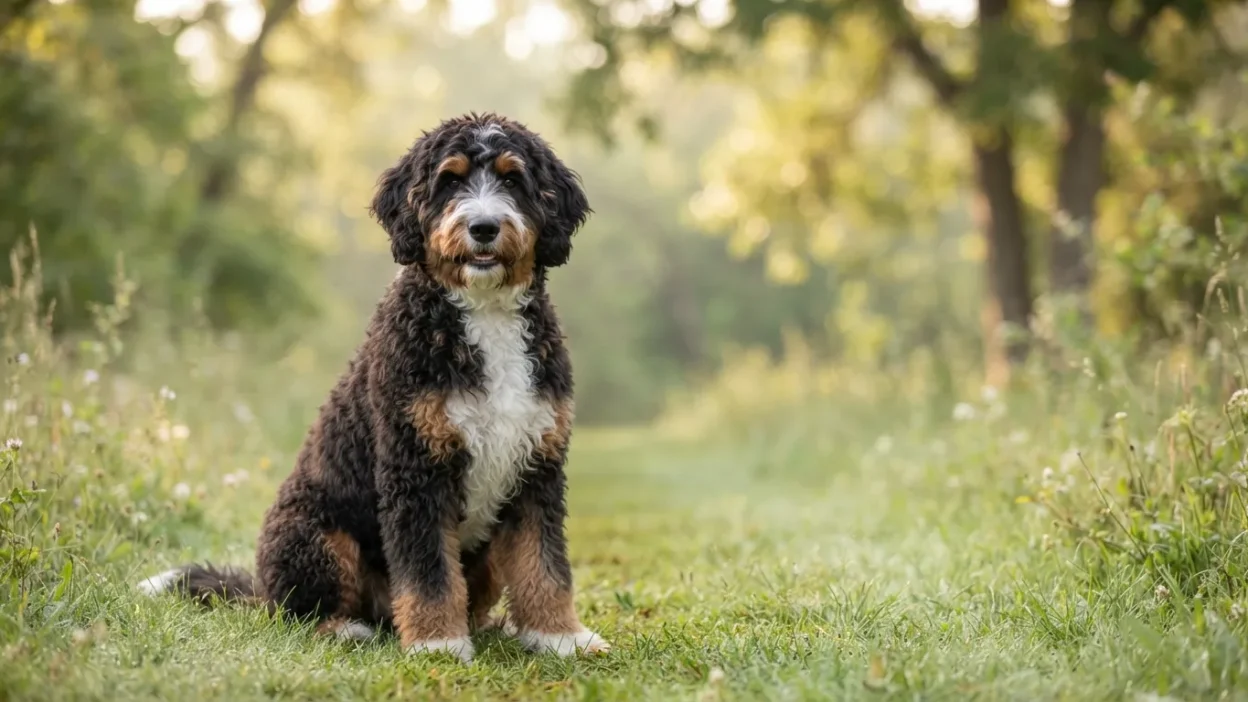
A Bernedoodle is a cross between a Bernese Mountain Dog and a Poodle. This popular designer dog is known for its friendly nature, fluffy coat, playful personality, and strong bond with its family.
Bernedoodles come in different sizes, colors, and coat types. Their personality can also vary because they inherit traits from both parent breeds.
Some are calm and affectionate like the Bernese Mountain Dog, while others may be more energetic and intelligent like the Poodle.
If you are thinking about getting a Bernedoodle, it is important to understand more than just how cute they look. Their grooming needs, exercise requirements, training, size, health, and temperament all matter.
This complete guide explains what you should know before bringing a Bernedoodle home.
What Is a Bernedoodle?
A Bernedoodle is a hybrid dog created by crossing a Bernese Mountain Dog with a Poodle.
The goal of this cross is to combine qualities from both breeds. Bernese Mountain Dogs are generally known for their affectionate and gentle nature, while Poodles are known for their intelligence and trainability.
Because a Bernedoodle is a mixed breed, there is no guarantee that every dog will have the same appearance or personality.
One Bernedoodle may have a wavy coat, while another may have a curlier coat. Their size can also vary greatly depending on the type of Poodle used in the breeding process.
Bernedoodle Appearance
Bernedoodles often have a fluffy appearance with a broad face, floppy ears, and a soft coat.
Many have the traditional black, white, and brown coloring associated with Bernese Mountain Dogs. However, Bernedoodles can appear in several other colors and patterns.
Common characteristics include:
- Floppy ears
- Dark eyes
- A fluffy or curly coat
- A sturdy body
- A long or medium-length muzzle
- A feathered tail
- Black, brown, white, or mixed coloring
Their exact appearance depends on genetics.
This is one reason two Bernedoodle puppies from the same litter can look noticeably different.
Bernedoodle Sizes
One of the most important things to understand about Bernedoodles is that they do not have one standard size.
Their size depends largely on the size of the Poodle parent.
The main types include:
| Type | General Size |
| Tiny Bernedoodle | Very small |
| Mini Bernedoodle | Small to medium |
| Medium Bernedoodle | Medium |
| Standard Bernedoodle | Large |
A Standard Bernedoodle can become a large dog and may need considerably more living space than a Mini or Tiny Bernedoodle.
When choosing a puppy, ask the breeder about the expected adult size and the sizes of both parents.
Bernedoodle Temperament
Bernedoodles are often described as affectionate, playful, social, and intelligent.
They commonly enjoy spending time with their families and may form strong bonds with their owners.
However, temperament is not determined by breed name alone.
Genetics, early socialization, training, environment, and individual personality can all affect how a Bernedoodle behaves.
A well-socialized Bernedoodle may enjoy meeting people and other dogs. Early positive experiences can help a puppy become more confident in new situations.
Are Bernedoodles Good Family Dogs?
Bernedoodles can be a good fit for families that understand their needs.
Their playful and affectionate nature can make them enjoyable companions. Many like being involved in everyday family activities rather than being left alone for long periods.
However, families should consider the dog’s size and energy level.
A large Standard Bernedoodle may accidentally knock over a small child during play. Young children should therefore always be supervised around dogs.
Parents should also teach children how to interact with dogs respectfully.
Are Bernedoodles Good With Kids?
Many Bernedoodles can live happily with children when they receive proper training and socialization.
Their playful personality can make them fun companions for older children.
Still, no dog should be assumed to be automatically safe with children.
Children should learn not to:
- Pull a dog’s ears or tail
- Take food away
- Disturb a sleeping dog
- Climb on the dog
- Chase the dog
- Hug a dog that wants space
Supervision is especially important with puppies because they are still learning appropriate behavior.
Are Bernedoodles Good With Other Dogs?
Bernedoodles can often get along well with other dogs when properly socialized.
Early exposure to friendly, vaccinated dogs can help puppies learn appropriate social behavior.
Controlled introductions are better than simply putting two unfamiliar dogs together.
A dog’s individual personality also matters. Some Bernedoodles may be highly social, while others may prefer more personal space.
Bernedoodle Intelligence and Trainability
Bernedoodles can be intelligent and responsive to training because Poodles are highly trainable dogs.
However, intelligence does not automatically mean easy training.
A Bernedoodle may become distracted, bored, or stubborn if training sessions are repetitive.
Positive reinforcement is usually a useful approach.
Reward desired behavior with things such as:
- Small treats
- Praise
- Toys
- Play
- Attention
Keep training sessions short and consistent, especially with young puppies.
Basic commands such as sit, stay, come, down, and leave it are useful foundations.
How Much Exercise Does a Bernedoodle Need?
Exercise needs depend on the dog’s age, size, health, and personality.
A young Standard Bernedoodle may need considerably more physical activity than a smaller adult dog.
Daily activities can include:
- Walks
- Fetch
- Training games
- Interactive toys
- Outdoor play
- Mental enrichment
Exercise should be appropriate for the dog’s age.
Young puppies should not be pushed into excessive high-impact activity while their bones and joints are developing.
Mental exercise is also important. Puzzle toys, scent games, and short training sessions can help keep an intelligent dog occupied.
Bernedoodle Grooming
Grooming is one of the biggest responsibilities of owning a Bernedoodle.
Their coats can range from wavy to curly, and some coats can become tangled or matted if they are not maintained.
Regular brushing helps remove loose hair and prevent mats.
A Bernedoodle may also need:
- Professional grooming
- Nail trimming
- Ear cleaning
- Dental care
- Regular bathing when needed
The exact grooming schedule depends on the individual dog’s coat.
A curly coat may require more maintenance than a shorter or less dense coat.
Do Bernedoodles Shed?
Bernedoodles can shed, but the amount varies.
Their coat type is influenced by genetics. Some Bernedoodles may shed relatively little, while others can shed more noticeably.
This is important because people sometimes assume that every Bernedoodle is automatically low-shedding.
That is not guaranteed.
If allergies are a concern, spend time around the specific dog before making a decision. No dog can be guaranteed to be completely hypoallergenic.
Bernedoodle Colors
Bernedoodles can have several different coat colors and patterns.
Common possibilities include:
- Black
- White
- Brown
- Black and white
- Black, white, and brown
- Sable
- Merle
- Phantom patterns
The classic tricolor Bernedoodle is especially popular because it can resemble the traditional coloring of a Bernese Mountain Dog.
Coat color should not be the main factor when selecting a puppy. Health, temperament, responsible breeding, and compatibility with your lifestyle are more important considerations.
Bernedoodle Lifespan
A Bernedoodle’s lifespan can vary based on size, genetics, health, nutrition, and overall care.
Smaller Bernedoodles may have different longevity expectations from larger ones.
Providing appropriate nutrition, regular veterinary care, exercise, dental care, weight management, and preventative healthcare can support a dog’s overall health.
There is no guaranteed lifespan for an individual Bernedoodle.
Bernedoodle Health Problems
Like other dogs, Bernedoodles can develop health problems.
Because they have Bernese Mountain Dog and Poodle ancestry, responsible owners should understand potential health concerns associated with both parent breeds.
Potential concerns can include:
- Hip problems
- Elbow problems
- Eye conditions
- Certain inherited disorders
- Skin problems
- Ear problems
- Dental disease
- Weight-related issues
This does not mean every Bernedoodle will develop these conditions.
A responsible breeder should perform appropriate health testing on breeding dogs and provide relevant health records.
Regular veterinary examinations are also important.
How Much Does a Bernedoodle Cost?
The price of a Bernedoodle can vary significantly.
Factors that can affect the price include:
- Breeder reputation
- Location
- Puppy size
- Coat color
- Pedigree
- Health testing
- Demand
- Early veterinary care
The purchase price is only one part of the cost of owning a dog.
You should also budget for:
- Food
- Grooming
- Veterinary care
- Vaccinations
- Training
- Toys
- Bedding
- Crate
- Leash and collar
- Emergency expenses
A lower purchase price does not necessarily mean a lower total cost over the dog’s lifetime.
How to Find a Responsible Bernedoodle Breeder
Choosing the breeder is an important decision.
A responsible breeder should be willing to answer questions about the puppy’s parents, health testing, living conditions, socialization, and veterinary care.
Ask questions such as:
- Can I see the puppy’s parents?
- What health tests were performed?
- Can I see the health records?
- How are the puppies socialized?
- What veterinary care has the puppy received?
- What happens if the puppy develops a serious inherited condition?
- Can you provide references or documentation?
Be cautious when a seller focuses heavily on rare colors or demands immediate payment without providing useful information about the dog’s health and background.
Bernedoodle Puppy Training
Training should begin as soon as your puppy comes home.
Start with simple skills and gradually introduce new experiences.
House training, crate training, leash training, recall, and basic obedience are valuable early goals.
Socialization is equally important.
A puppy can gradually experience different sounds, surfaces, people, environments, and safe social situations.
Positive experiences during puppyhood can help build confidence.
Bernedoodle Diet
Bernedoodles need a balanced diet appropriate for their age, size, activity level, and health.
Puppies have different nutritional needs from adult dogs.
Because Bernedoodles can vary greatly in size, feeding amounts should not be based only on breed name.
Your veterinarian can help determine an appropriate feeding plan.
Avoid constantly changing food or giving excessive treats. Maintaining a healthy body weight is important for supporting joints and overall health.
Bernedoodle vs Bernese Mountain Dog
A Bernedoodle and a Bernese Mountain Dog are not the same.
A Bernese Mountain Dog is a recognized breed, while a Bernedoodle is a cross between a Bernese Mountain Dog and a Poodle.
The Bernedoodle may inherit characteristics from both parents, so appearance and behavior can be less predictable.
If you want a more predictable breed standard, a purebred Bernese Mountain Dog may be different from what you are looking for.
If you prefer a dog with Poodle ancestry and enjoy the characteristics of a mixed breed, a Bernedoodle may fit a different lifestyle.
Bernedoodle vs Goldendoodle
Both Bernedoodles and Goldendoodles are Poodle mixes, but they have different parent breeds.
A Bernedoodle combines a Bernese Mountain Dog and Poodle.
A Goldendoodle combines a Golden Retriever and Poodle.
Both can be affectionate, intelligent, and social, but individual dogs can differ significantly.
Your choice should consider size, grooming, activity level, temperament, and your family’s lifestyle rather than appearance alone.
Are Bernedoodles High Maintenance?
They can be.
Their grooming requirements are an important consideration, especially when they have thick or curly coats.
They also need regular exercise, training, mental stimulation, veterinary care, and social interaction.
People looking for a dog that requires very little grooming or daily involvement may want to consider other breeds or mixes.
Can Bernedoodles Live in Apartments?
Some Bernedoodles can adapt to apartment living, but size and exercise requirements matter.
A small Bernedoodle with appropriate daily exercise may adapt more easily than a large Standard Bernedoodle.
The most important factors include:
- Daily exercise
- Mental stimulation
- Noise level
- Access to outdoor areas
- Training
- Time spent alone
Living in an apartment does not automatically make a dog unsuitable. However, owners need to meet the dog’s physical and mental needs.
Do Bernedoodles Like to Be Left Alone?
Many Bernedoodles enjoy being close to their families.
Because they can be social and people-oriented, some may struggle when left alone for long periods.
Gradual alone-time training can help puppies learn that being alone is safe.
Owners should avoid suddenly leaving a young puppy alone for an entire workday without preparation.
If a dog shows persistent distress when alone, speaking with a veterinarian or qualified behavior professional can be helpful.
FAQs:
Are Bernedoodles good dogs?
Bernedoodles can make affectionate and intelligent companions, but suitability depends on the individual dog and the owner’s ability to meet its grooming, exercise, training, and social needs.
Are Bernedoodles hypoallergenic?
No dog can be guaranteed to be completely hypoallergenic. Bernedoodles may shed less than some dogs depending on their coat, but individual coats vary.
How big does a Bernedoodle get?
Bernedoodle size varies because breeders may use different sizes of Poodles. Tiny, Mini, Medium, and Standard Bernedoodles can have very different adult sizes.
Do Bernedoodles bark a lot?
Individual dogs vary. Training, socialization, environment, boredom, and genetics can all affect barking behavior.
Are Bernedoodles easy to train?
Many are responsive to training because of their Poodle ancestry, but consistency and positive reinforcement are still important.
How often should a Bernedoodle be groomed?
The exact schedule depends on coat type and growth. Dogs with dense or curly coats generally need frequent brushing and regular professional grooming to prevent mats.
Final Thoughts:
A Bernedoodle can be an affectionate, playful, intelligent, and engaging companion.
But the breed is not the right fit for every household.
Before getting one, consider its expected adult size, grooming needs, exercise requirements, training needs, potential health concerns, and the amount of time you can spend with the dog.
Most importantly, look beyond color and appearance when choosing a puppy. Responsible breeding, health testing, temperament, proper socialization, and long-term care can have a much bigger impact on your experience as a dog owner.

I’m Jessica Morgan, a writer who loves covering lifestyle, entertainment, sports, trends, and everyday topics in a simple and engaging way. At PrayersVibe.com, I focus on creating helpful, easy-to-read content that informs and connects with readers. I enjoy researching new ideas and turning them into clear, useful stories that readers can enjoy.