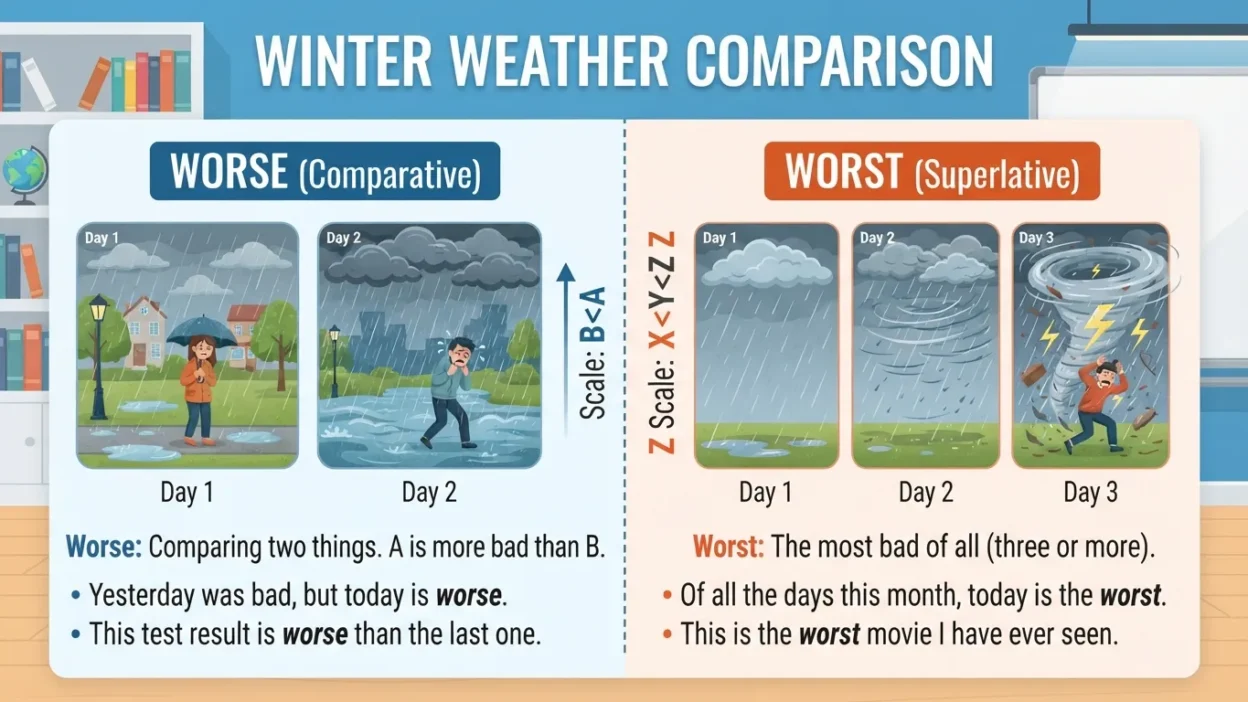
Worse is the comparative form of bad and usually compares one thing, situation, or condition with another.
Worst is the superlative form of bad and describes the lowest, most negative, or most unpleasant level. The basic pattern is bad → worse → worst.
Key Takeaways
- Worse means more bad, less good, or less favorable than something else.
- Worst means the most bad, least favorable, or lowest in quality.
- Use worse for comparisons and changes in condition.
- Use worst for the extreme or lowest point.
- The correct phrase is “worst-case scenario,” not “worse case scenario.”
What Does “Worse” Mean?
Worse is the comparative form of bad. It describes something that has a lower quality, condition, or degree than something else.
For example:
My headache is worse today than yesterday.
Here, two conditions are being compared: the headache today and the headache yesterday.
You can also use worse when something changes from a better or less serious state to a more negative one:
The weather is getting worse.
You do not need to name the second condition. The comparison can be understood from the situation. Cambridge lists worse as the comparative form of bad.
Examples of Worse
- This movie is worse than the first one.
- My cold is getting worse.
- The traffic is worse today.
- His second attempt was worse than his first.
- The problem became worse overnight.
- I thought the test would be difficult, but it was worse than expected.
A useful pattern is:
A is worse than B.
This restaurant is worse than the one across the street.
What Does “Worst” Mean?
Worst is the superlative form of bad. It describes the lowest quality, most unpleasant condition, or most negative point within the situation being discussed.
For example:
That was the worst meal I have ever eaten.
The speaker is not simply comparing two meals. The sentence identifies one meal as the most unpleasant among all the meals they have experienced.
Worst can also be used when the complete group is understood:
This is the worst day of my life.
The speaker means this day is at the most negative end of all the days they have experienced.
Examples of Worst
- That was the worst movie I have ever seen.
- Monday was the worst day of the week.
- This is the worst mistake I have made.
- She had the worst score in the class.
- That was the worst part of the trip.
- It was the worst weather we had all year.
A common pattern is:
X is the worst of all.
This is the worst option available.
Worse vs Worst: Side-by-Side Comparison
| Word | Grammar | Main use | Example |
| Worse | Comparative | Shows a lower or more negative degree | Today is worse than yesterday. |
| Worst | Superlative | Shows the lowest or most negative degree | Today was the worst day of the week. |
The easiest basic sequence to remember is:
Bad → Worse → Worst
This is similar to:
Good → Better → Best
Cambridge identifies worse and worst as the comparative and superlative forms of bad.
When to Use “Worse”
Comparing Two Things
Use worse when you compare one thing with another.
My old phone was slow, but my new phone is worse.
You can also use than when the second item is named:
This traffic is worse than yesterday’s traffic.
The sequel was worse than the original movie.
The comparison does not always have to involve two physical objects. You can compare two experiences, conditions, ideas, performances, or points in time.
Her second presentation was worse than her first.
Describing a Negative Change
Worse is also common when something becomes less favorable.
His cough is getting worse.
The situation became worse after the storm.
The traffic gets worse after 5 p.m.
In these examples, worse shows a change from one condition to another. You are not necessarily listing two separate things.
This is why the simple rule “worse is always for exactly two things” can be too narrow. The key idea is comparison or deterioration, not simply counting objects.
Using Worse as an Adverb
Worse can also function as the comparative form of the adverb badly.
I played badly yesterday, but I played worse today.
Here, worse describes how the action was performed.
Cambridge specifically notes that badly has the comparative form worse and the superlative form worst.
When to Use “Worst”
Describing the Lowest or Most Negative Option
Use worst when something represents the lowest point or most negative option in the situation.
Of all the restaurants we visited, this one was the worst.
That was the worst mistake in the report.
The group can be stated directly:
Of the three options, the third was the worst.
Or it can be understood from context:
That was the worst.
The important idea is not simply that there are always three or more items. Worst expresses the extreme or lowest degree.
Using Worst as an Adverb or Noun
Worst can also work as an adverb.
She performed worst on the final test.
It can also be used as a noun:
We were prepared for the worst.
In this sentence, the worst means the most serious or unpleasant thing that could happen.
So both words can have uses beyond their basic adjective forms.
Common Expressions With Worse and Worst
Some phrases make the choice between these words easier because the expression is fixed.
Worst-Case Scenario
The standard expression is:
worst-case scenario
It means the most serious or unfavorable possible outcome.
Example:
In the worst-case scenario, we may have to cancel the trip.
“Worse-case scenario” is a common mistake. Worst-case scenario is the established expression.
Turn for the Worse
The standard expression is:
take a turn for the worse
It means that a situation becomes less favorable or more serious.
Example:
The weather took a turn for the worse.
The phrase refers to a negative change, so worse is used.
Worse Comes to Worst
You may hear:
If worse comes to worst, we’ll find another solution.
The expression means that a bad situation develops into its most serious stage.
You may also encounter “if worst comes to worst.” Both forms are established in English, although usage varies by region and context.
For Better or Worse
Another common expression is:
for better or worse
It means regardless of whether the result is good or bad.
Example:
For better or worse, technology has changed the way we communicate.
Common Mistakes With Worse and Worst
Mistake 1: “This Is the Worse Day of My Life”
Incorrect:
his is the worse day of my life.
Correct:
This is the worst day of my life.
The sentence identifies one day as the most negative among the speaker’s experiences.
Mistake 2: “Today Is Worst Than Yesterday”
Incorrect:
Today is worst than yesterday.
Correct:
Today is worse than yesterday.
The sentence compares today with yesterday, so worse is needed.
Mistake 3: “One of the Worse Movies”
Incorrect:
It is one of the worse movies I have seen.
Correct:
It is one of the worst movies I have seen.
The phrase one of the selects an item from a larger group, so the superlative worst is normally used.
Mistake 4: “More Worse”
Incorrect:
This option is more worse.
Correct:
This option is worse.
Worse is already the comparative form of bad. Adding more is unnecessary.
Likewise, avoid “most worst.” The correct form is simply worst.
Easy Trick to Remember Worse vs Worst
Use this simple pattern:
Bad → Worse → Worst
Think of it as levels:
- Bad: negative
- Worse: more negative
- Worst: most negative
You can also connect the words to their positive forms:
Good → Better → Best
Bad → Worse → Worst
If you are comparing one condition with another, worse will often fit:
This is worse than that.
If you are identifying the extreme or lowest point, worst will often fit:
This is the worst.
One important reminder: do not rely only on counting. Worse can describe something becoming worse over time, while worst can describe an extreme without explicitly naming a group.
Worse vs Worst Examples in Sentences
| Correct word | Example | Why? |
| Worse | My headache is worse today. | It describes a negative change. |
| Worse | This test was worse than the last one. | Two tests are compared. |
| Worse | The traffic is getting worse. | The condition is deteriorating. |
| Worse | He performed worse than I did. | Two performances are compared. |
| Worst | That was the worst meal I had all year. | It identifies the lowest point. |
| Worst | She had the worst score in the class. | Her score was at the bottom of the group. |
| Worst | This is the worst option. | It identifies the least favorable option. |
| Worst | We prepared for the worst. | It means the most serious possible outcome. |
FAQs:
Is worse the comparative form of bad?
Yes. Worse is the comparative form of bad. It means something is more negative, less desirable, or lower in quality than another thing or state. The three forms are bad, worse, worst.
Is worst the superlative form of bad?
Yes. Worst is the superlative form of bad. It identifies the lowest, most negative, or least favorable degree. For example, “That was the worst mistake” identifies the mistake as the most serious one in the relevant group or context.
Is it “worse case scenario” or “worst-case scenario”?
The standard expression is “worst-case scenario.” It refers to the most unfavorable possible outcome. For example: “In the worst-case scenario, the event will be canceled.”
Is it “one of the worst” or “one of the worse”?
The standard form is “one of the worst.” For example: “That was one of the worst movies I have seen.” The phrase selects one item from a larger group.
Can “worse” and “worst” be used as adverbs?
Yes. Worse and worst can function as adverbs in certain contexts. For example, “I performed worse today” uses worse as a comparative adverb, while “She performed worst of all” uses worst as a superlative adverb. Cambridge documents these forms for badly.
Conclusion:
The difference between worse vs worst becomes much easier when you remember their relationship to bad.
Worse is the comparative form. Use it for a comparison, a negative change, or a lower degree:
The weather is worse today.
Worst is the superlative form. Use it for the lowest or most negative degree:
This is the worst weather we have had all year.
The simple pattern is bad → worse → worst. Once you understand that pattern and recognize common expressions such as worst-case scenario, turn for the worse, and for better or worse, choosing the correct word becomes much more natural.

I am Jane Austen, a soul that believes faith speaks best through quiet words and honest prayers.
I share reflections that blend timeless wisdom, gentle hope, and heartfelt devotion.
On PrayersVibe.com, my words are written to comfort hearts, strengthen faith, and remind you that you are never alone.