Texas and Oklahoma are neighboring states with different costs, taxes, cities, economies, and lifestyles. Oklahoma generally has lower housing and overall living costs, while Texas has a much larger population and economy.
Texas has no individual state income tax, while Oklahoma does. The two states are also famous for their college football rivalry.
Key Takeaways
- Oklahoma generally has lower housing costs and a lower overall price level than Texas.
- Texas does not impose an individual state income tax, while Oklahoma does.
- Texas has a much larger population, with about 31.7 million residents compared with Oklahoma’s 4.1 million in 2025 estimates.
- Both states offer large cities, outdoor recreation, and relatively broad geographic diversity.
- Texas and Oklahoma also meet every year in the famous Red River football rivalry.
Cost of Living: Texas vs Oklahoma
One of the biggest reasons people search for Texas vs Oklahoma is the cost of living.
Statewide data generally show Oklahoma as less expensive than Texas, particularly for housing. The U.S. Bureau of Economic Analysis uses Regional Price Parities to compare price levels across states. Its published data show Oklahoma below Texas in overall price level. In the BEA’s 2022 figures, Oklahoma had a regional price parity of 88.8, compared with 97.5 for Texas.
More recent comparison data also show a meaningful difference in housing costs. For example, a 2026 comparison using statewide housing and rental measures lists typical home values and two-bedroom fair-market rents substantially lower in Oklahoma than Texas.
| Factor | Texas | Oklahoma |
| Overall cost level | Generally higher | Generally lower |
| Housing | Usually more expensive | Usually less expensive |
| Major cities | Wide range of prices | Wide range of prices |
| Population | Much larger | Much smaller |
| State income tax | None | Yes |
These are statewide patterns, not rules for every city. Austin, Dallas, Houston, San Antonio, Oklahoma City, and Tulsa each have different housing markets.
Housing and Rent
Housing can make a large difference in a household budget.
Oklahoma’s lower statewide home values and rents can make it attractive to people who want lower housing expenses. Texas, however, has a much larger selection of metropolitan areas and housing markets.
Someone comparing Dallas with Oklahoma City, for example, is making a different comparison from someone looking at a small Texas town and a small Oklahoma town.
That is why city-level prices should be checked before making a moving decision.
Everyday Expenses
Food, transportation, utilities, insurance, and other expenses also vary within each state.
The BEA’s price data are useful because they measure broad differences rather than relying on one city or one household. The available data show that Oklahoma has historically had a lower statewide price level than Texas.
Taxes in Texas and Oklahoma
Taxes are another major difference between the two states.
Income Tax
Texas does not impose an individual state income tax. Oklahoma does have an individual income tax and publishes tax brackets for residents and qualifying nonresidents.
Oklahoma’s published individual income-tax schedule includes rates ranging from 0.25% through a top rate of 4.75% under the current schedule shown by the Oklahoma Tax Commission.
This does not mean Texas has no taxes. Residents still pay other state and local taxes, including sales and property taxes.
Sales Tax
Texas has a 6.25% state sales tax. Local jurisdictions can add up to 2%, creating a maximum combined rate of 8.25%.
Oklahoma’s state sales tax rate is 4.5%, with local taxes potentially added depending on the location.
So a simple comparison of state sales-tax rates does not tell the entire tax story. Local rates and the types of purchases subject to tax also matter.
Property Taxes
Property taxes are especially important for homeowners.
The amount paid can vary greatly based on the property’s assessed value, local taxing jurisdictions, exemptions, and other rules. Therefore, someone moving between the two states should compare the actual county and city where they plan to live rather than relying only on a statewide average.
Population and Major Cities
Texas is dramatically larger by population.
The Census Bureau estimated Oklahoma’s population at 4,123,288 on July 1, 2025. Federal data based on Census estimates put Texas at 31,709,821 for the same date.
Texas therefore has a much larger population and a larger collection of major metropolitan areas.
Important Texas cities include:
- Houston
- San Antonio
- Dallas
- Austin
- Fort Worth
- El Paso
Major Oklahoma cities include:
- Oklahoma City
- Tulsa
- Norman
- Broken Arrow
- Edmond
This difference matters when comparing employment options, transportation, entertainment, universities, and urban development.
Jobs and Economy
Texas has a large and diversified economy, with major industries including energy, technology, health care, manufacturing, transportation, finance, and professional services.
Oklahoma also has important energy, aerospace, manufacturing, agriculture, transportation, and service industries.
The size of Texas’s population and metropolitan economy creates a much larger overall labor market. Oklahoma’s smaller population can provide a different environment, particularly outside its largest cities.
Job opportunities are highly dependent on occupation and location. A software professional, health-care worker, teacher, engineer, or energy worker may see very different opportunities in each state.
Weather and Climate
Both Texas and Oklahoma experience hot summers, severe thunderstorms, and periods of strong weather.
Texas is geographically much larger, so its climate varies considerably. Coastal areas, the Hill Country, North Texas, West Texas, and the Panhandle do not have identical weather patterns.
Oklahoma also has a varied climate, with hot summers, cooler winters, thunderstorms, and a history of severe weather, including tornadoes.
For someone deciding between the states, climate should be considered at the city level rather than using one statewide description.
Lifestyle and Geography
Texas covers a huge area and offers everything from large metropolitan regions to ranch country, desert landscapes, pine forests, beaches, and Hill Country.
Oklahoma is smaller but still offers plains, forests, lakes, rivers, and outdoor recreation.
The lifestyle difference often comes down to the specific community.
A person who wants a large metropolitan area can find that in both states. Someone looking for a smaller community has many choices in both states as well.
Texas vs Oklahoma for Moving and Living
There is no single answer for every person comparing Texas and Oklahoma.
Oklahoma may appeal to someone whose main concern is keeping housing and general living expenses lower. Texas may appeal to someone who wants access to a larger population, broader metropolitan job markets, or a particular Texas city.
Taxes also need to be considered as a package. Texas has no individual state income tax, while Oklahoma does, but Texas has a 6.25% state sales tax and local sales taxes can raise the combined rate to 8.25%.
Before moving, compare:
- Home prices in the exact city.
- Rent for the type of home you need.
- Salary for your occupation.
- State and local taxes.
- Property taxes if buying a home.
- Commute and transportation costs.
- Schools and local services.
- Weather and outdoor preferences.
This approach gives a more useful answer than comparing state averages alone.
Texas vs Oklahoma Football: The Red River Rivalry
The phrase Texas vs Oklahoma also commonly refers to one of college football’s best-known rivalries.
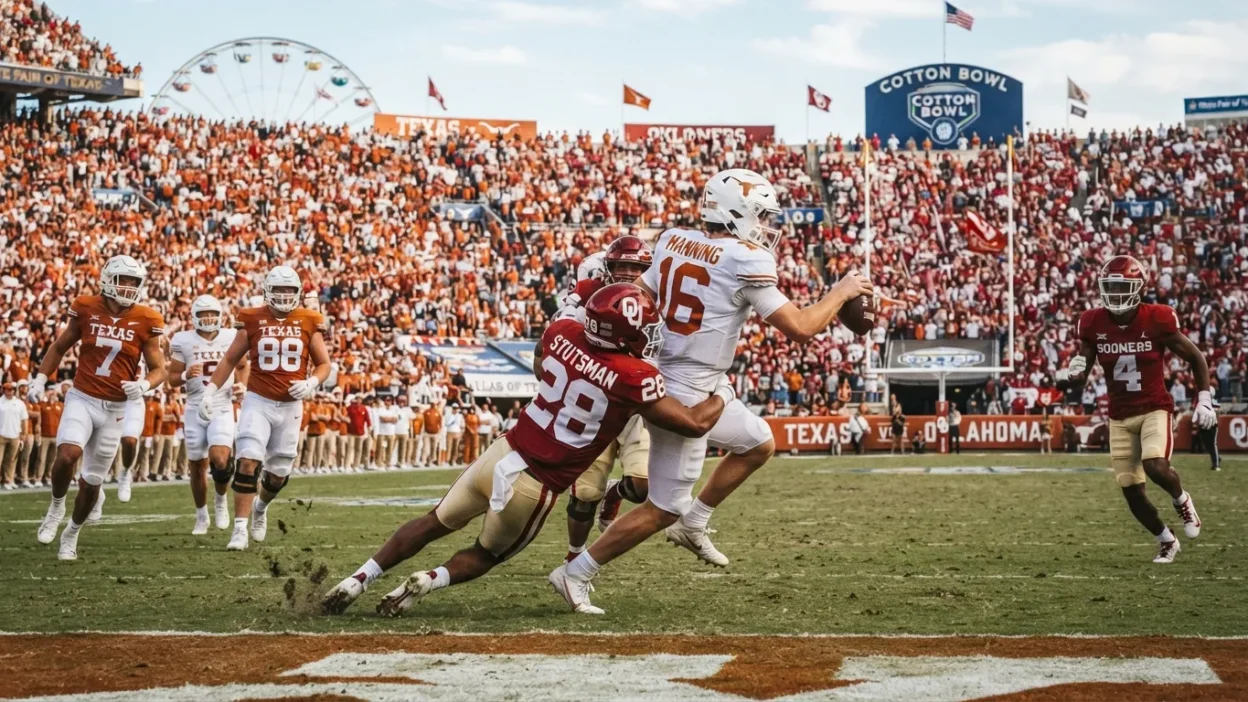
The University of Texas Longhorns and University of Oklahoma Sooners first met in 1900. The matchup became closely associated with the State Fair of Texas and the Cotton Bowl in Dallas.
The series is now commonly called the Red River Rivalry or Red River Showdown.
The game has a unique setup. Texas and Oklahoma fans occupy opposite sides of the stadium, creating a visual split between burnt orange and crimson.
The Golden Hat trophy is awarded to the winner of the annual game. The trophy tradition dates to 1941.
History of the Rivalry
The teams have played more than 120 times.
Current series databases list Texas with 65 wins, Oklahoma with 51 wins, and five ties through the 2025 meeting. Texas won the 2024 and 2025 games.
The most recent meeting before the 2026 game was on October 11, 2025, when Texas won 23–6.
Why the Game Is Played in Dallas
Unlike many college football rivalries, Texas and Oklahoma traditionally meet at a neutral site instead of alternating between their campuses.
The game has been played in Dallas for more than a century, and the modern tradition is tied closely to the State Fair of Texas.
The Cotton Bowl sits at Fair Park, making the football game part of a much larger annual event.
The 2026 Red River matchup is scheduled for October 10 at the Cotton Bowl in Dallas.
FAQs:
Is Oklahoma cheaper than Texas?
Generally, yes, based on statewide price-level and housing comparisons. BEA data have historically placed Oklahoma’s overall price level below Texas, while recent housing comparisons also show lower typical home values and rents in Oklahoma. Individual cities can differ significantly.
Does Texas have an income tax?
Texas does not impose an individual state income tax. It does, however, collect sales taxes and other state and local taxes. Texas’s state sales tax rate is 6.25%, with local taxes potentially bringing the combined rate to 8.25%.
Which state has more people?
Texas has far more residents. Federal 2025 population estimates put Texas at about 31.7 million people and Oklahoma at about 4.1 million.
Are Texas and Oklahoma football rivals?
Yes. The Texas Longhorns and Oklahoma Sooners have one of the longest-running rivalries in college football. Their annual game is associated with the State Fair of Texas and is played at the Cotton Bowl in Dallas.
Where is the Texas-Oklahoma game played?
The annual Red River game is played at the Cotton Bowl in Dallas, Texas. The venue is located at Fair Park, alongside the State Fair of Texas.
Conclusion:
Texas and Oklahoma share a border, regional history, and strong cultural connections, but they have important differences.
Texas has a much larger population and economy and does not levy an individual state income tax. Oklahoma generally has a lower statewide cost level and lower housing costs, while still offering major cities such as Oklahoma City and Tulsa.
For someone considering a move, the most useful comparison is not simply Texas vs Oklahoma. It is the specific city, salary, housing cost, taxes, commute, and lifestyle that come with each choice.
And for college football fans, the phrase has another meaning entirely: the annual Red River rivalry between Texas and Oklahoma at the Cotton Bowl.