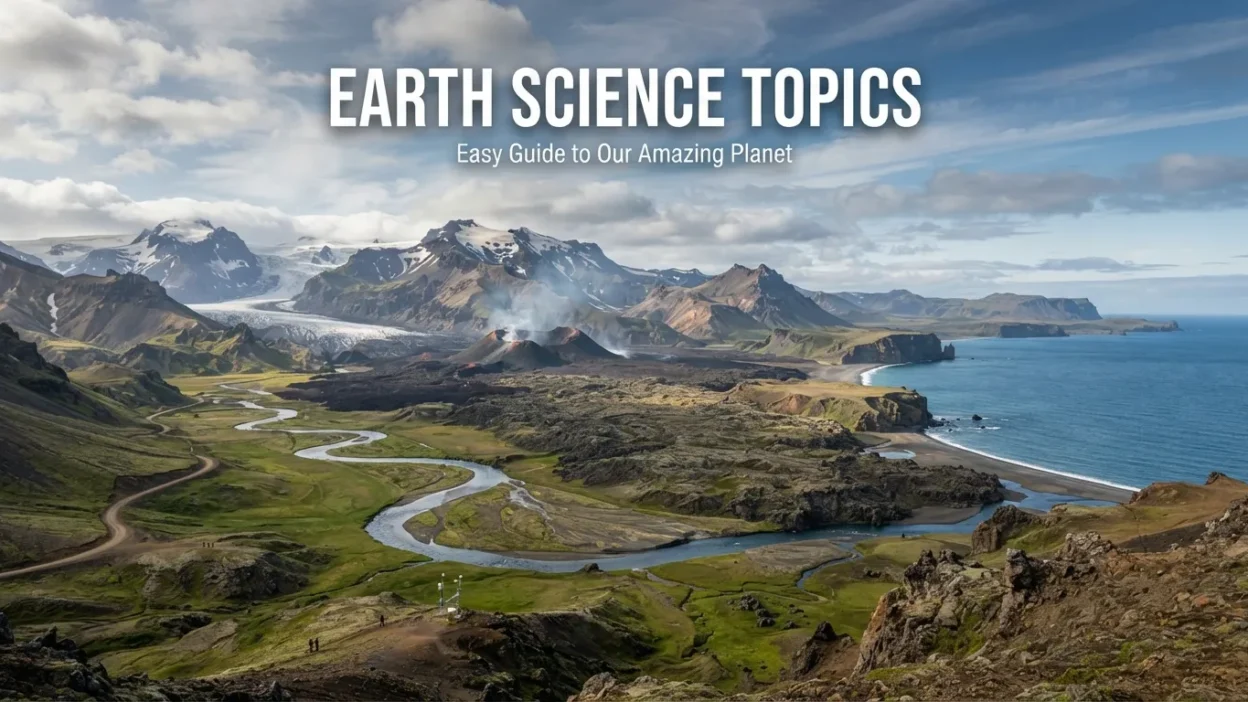
Look around you. The ground under your feet is part of Earth. The air you breathe is part of Earth. So are the clouds, oceans, rocks, and mountains.
But have you ever asked how Earth works?
Why do volcanoes erupt? Why do earthquakes happen? How do clouds make rain? Why do we have oceans? How do mountains grow?
These questions lead us to earth science topics.
Earth science helps us learn about our planet. It also helps us understand the forces that change it.
In this guide, we will explore the most important Earth science topics. Each one is explained in simple words, so you can learn without feeling lost.
What Is Earth Science?
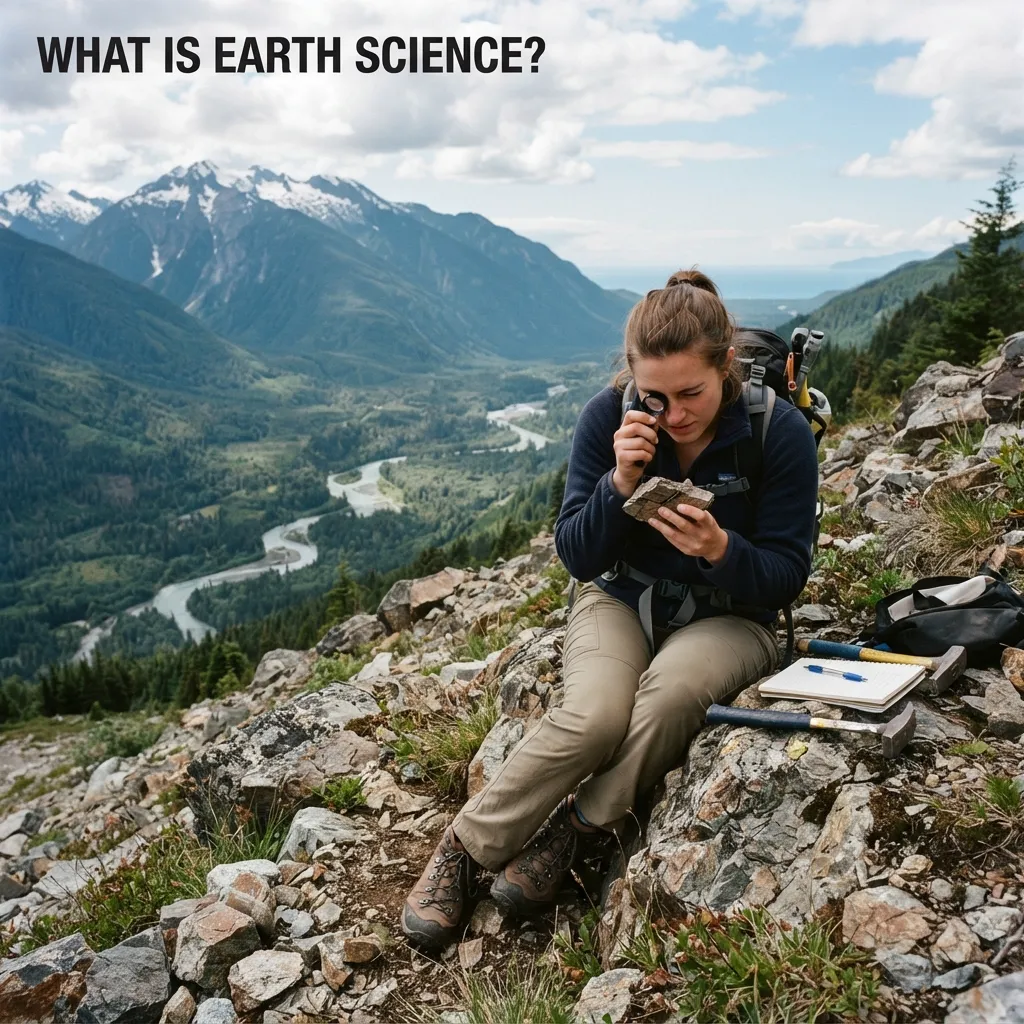
Earth science is the study of Earth and how it works.
It covers the land, air, water, rocks, oceans, and Earth’s inner parts.
Scientists study Earth in many ways. They visit places, collect rocks, study weather, use maps, and watch Earth from space.
Earth science has several main areas:
- Geology
- Meteorology
- Oceanography
- Hydrology
- Climate science
- Environmental science
- Earth and space science
These areas are linked. A change in one part of Earth can affect another part.
1. Geology
Geology is the study of Earth’s solid parts.
Geologists study rocks, minerals, mountains, volcanoes, and earthquakes.
They also study how Earth has changed over a very long time.
Some common geology topics are:
- Rocks
- Minerals
- Fossils
- Mountains
- Volcanoes
- Earthquakes
- Plate tectonics
- Erosion
- Earth’s layers
Geology helps us understand the ground below us.
It also helps us find useful resources such as metals and minerals.
2. Earth’s Layers
Earth has several layers.
You can think of Earth like a ball with layers inside it.
The main layers are:
- Crust
- Mantle
- Outer core
- Inner core
The crust is the thin outer layer. We live on it.
The mantle is much deeper. It contains very hot rock.
The outer core is made mostly of liquid metal.
The inner core is a very hot, solid center.
Scientists study these layers to learn how Earth works inside.
3. Plate Tectonics
Plate tectonics is one of the most important earth science topics.
Earth’s crust is made of large pieces called tectonic plates.
These plates move very slowly.
Sometimes they move toward each other. Sometimes they move apart. They can also slide past each other.
This movement can cause:
- Earthquakes
- Volcanoes
- Mountains
- Deep ocean trenches
- New land
Plate tectonics helps explain why many earthquakes and volcanoes happen in certain parts of the world.
4. Rocks and Minerals
Rocks are found almost everywhere on Earth.
A rock can contain one or more minerals.
There are three main types of rocks:
Igneous Rocks
These rocks form when hot melted rock cools.
Granite is one example.
Sedimentary Rocks
These rocks form from layers of material.
Sand, mud, and small pieces of rock can build up over time.
Metamorphic Rocks
These rocks change because of heat and pressure.
The rock cycle shows how rocks can change from one type to another.
5. Volcanoes
A volcano is an opening in Earth’s surface.
Hot melted rock from inside Earth can come out through this opening.
This melted rock is called magma when it is below the surface.
Once it reaches the surface, it is called lava.
A volcanic eruption may release:
- Lava
- Ash
- Gas
- Rock pieces
Volcanoes can create new land. They can also cause serious damage.
Scientists watch volcanoes to help people stay safe.
6. Earthquakes
An earthquake is a sudden movement of Earth’s crust.
Earthquakes happen when energy is released inside Earth.
This energy creates waves called seismic waves.
Earthquakes can cause the ground to shake.
Strong earthquakes may damage:
- Buildings
- Roads
- Bridges
- Homes
Earthquakes can also cause landslides and tsunamis.
Learning about earthquakes helps people prepare for them.
7. Weather
Weather tells us what the atmosphere is like right now or over a short time.
It can include:
- Rain
- Wind
- Clouds
- Heat
- Cold
- Snow
- Storms
Meteorology is the science of weather.
Meteorologists study the atmosphere. They use tools and computer models to make weather forecasts.
Weather can change quickly.
A sunny morning can become a rainy afternoon.
8. Climate
Weather and climate are not the same.
Weather changes over a short time.
Climate describes weather patterns over a long time.
For example, a place may have hot summers and cold winters.
Scientists study climate to learn how Earth’s temperature and weather patterns change.
Climate science is an important part of modern Earth science.
9. The Water Cycle
Water is always moving around Earth.
This movement is called the water cycle.
The water cycle has several main steps.
Evaporation
The Sun heats water. Some water turns into vapor and rises.
Condensation
Water vapor cools and forms tiny drops.
These drops help make clouds.
Precipitation
Water falls from clouds as rain, snow, sleet, or hail.
Collection
Water collects in rivers, lakes, oceans, soil, and other places.
Then the cycle starts again.
The water cycle is one of the easiest and most useful earth science topics to learn.
10. Oceanography
Oceanography is the study of oceans.
Oceans cover a large part of Earth’s surface.
They are home to many plants and animals.
Scientists study:
- Ocean water
- Waves
- Tides
- Currents
- Sea life
- The ocean floor
- Ocean temperature
Oceans also affect weather and climate.
They store heat and move it around the planet.
11. Ocean Currents
Ocean currents are large movements of water.
Some currents move warm water. Others move cold water.
These currents can affect weather in many places.
Ocean currents are caused by several things.
These include wind, differences in water temperature, and differences in salt levels.
Studying ocean currents helps scientists understand Earth’s climate system.
12. Hydrology
Hydrology is the study of water on and under Earth’s surface.
Hydrologists study:
- Rivers
- Lakes
- Rain
- Floods
- Groundwater
- Snow
- Water supplies
Water is needed by people, animals, and plants.
That is why water science is so important.
Hydrology also helps us understand floods and droughts.
13. Groundwater
Not all water is found in rivers and lakes. Some water is stored under the ground.
This is called groundwater.
Groundwater can fill spaces in soil and rock.
People can bring groundwater to the surface with wells. Groundwater is an important source of fresh water.
It must be used with care because it can take a long time to replace.
14. Soil Science
Soil is more than dirt.
It contains:
- Small rock pieces
- Water
- Air
- Minerals
- Organic matter
- Tiny living things
Soil helps plants grow.
It also stores water and supports many forms of life.
Scientists study how soil forms and how it can be protected.
Soil erosion is one problem they study.
15. Weathering and Erosion
Earth’s surface changes all the time.
Weathering breaks rocks into smaller pieces. Erosion moves those pieces to new places.
Water, wind, ice, and gravity can cause erosion. For example, rain can carry soil down a hill.
Wind can move sand across a desert.
Glaciers can move rocks as they slowly travel across land.
These processes help shape Earth’s surface.
16. Mountains
Mountains are large areas of land that rise high above the land around them.
Many mountains form when tectonic plates push against each other.
Some mountains are linked to volcanoes.
Mountains can affect weather, rivers, plants, and animals.
They also provide important habitats for many species.
Mountain building can take millions of years.
17. Glaciers
A glacier is a large mass of ice that moves slowly over land.
Glaciers form where snow builds up over many years.
The weight of the snow turns lower layers into ice.
Glaciers can shape the land as they move.
They can carve valleys and move rocks.
Scientists also study glaciers to learn about climate and changes in Earth’s ice.
18. Natural Resources
Earth gives us many useful resources.
These include:
- Water
- Soil
- Metals
- Minerals
- Coal
- Oil
- Natural gas
- Sunlight
- Wind
People use these resources for homes, food, transport, and energy.
Earth science helps us understand where these resources come from.
It can also help us use them in better ways.
19. Natural Hazards
Some natural Earth events can be dangerous.
These are called natural hazards.
Examples include:
- Earthquakes
- Volcanoes
- Floods
- Landslides
- Tsunamis
- Hurricanes
- Tornadoes
- Droughts
Scientists study these events to understand how and why they happen.
Their work can help people prepare for danger.
Good planning can save lives.
20. Earth’s History
Earth is very old.
Scientists think Earth formed about 4.5 billion years ago.
A lot has happened since then.
Continents have moved. Oceans have changed. New mountains have formed.
Many types of plants and animals have appeared and disappeared.
Scientists study rocks and fossils to learn about Earth’s past.
They use this information to build a story of our planet.
21. Fossils and Ancient Life
A fossil is the preserved remains or trace of an ancient living thing.
Fossils can be found in rocks.
They may include:
- Bones
- Teeth
- Shells
- Leaves
- Footprints
- Burrows
Fossils tell us about life from long ago.
They can also show what Earth’s environment was like in the past.
The study of fossils is called paleontology.
22. Climate Change
Climate change means long-term changes in Earth’s climate.
Earth’s climate has changed many times in the past.
Today, scientists are also studying changes linked to human activities.
One major concern is the rise in greenhouse gases.
These gases can trap heat in the atmosphere.
Scientists study temperature, oceans, ice, and other parts of the Earth system to understand these changes.
23. Environmental Science
Environmental science studies the relationship between people and nature.
It looks at problems such as:
- Air pollution
- Water pollution
- Waste
- Soil damage
- Deforestation
- Loss of habitats
It also looks at ways to protect natural resources.
Environmental science combines ideas from Earth science, biology, and chemistry.
24. Earth and Space Science
Earth is part of the solar system.
The solar system includes the Sun, planets, moons, asteroids, and comets.
Earth science can connect with space science in many ways.
Scientists study how the Sun affects Earth.
They also study Earth’s Moon, orbit, seasons, and tides. Satellites help scientists watch Earth from space.
They can collect information about clouds, oceans, forests, ice, and land.
Why Are Earth Science Topics Important?
Earth science is useful in everyday life.
Weather science helps us plan for storms.
Geology helps us understand earthquakes and volcanoes.
Hydrology helps us manage water.
Climate science helps us understand long-term changes.
Environmental science helps us protect nature.
In short, Earth science helps us understand the world around us.
It also helps us make safer and smarter choices.
Best Earth Science Topics for Students
If you need a topic for school, you have many choices.
Here are some simple ideas:
- Earth’s layers
- The water cycle
- Types of rocks
- The rock cycle
- Volcanoes
- Earthquakes
- Plate tectonics
- Weather
- Climate
- Ocean currents
- Soil
- Erosion
- Glaciers
- Fossils
- Natural resources
- Natural hazards
- Earth’s history
- The solar system
- Climate change
- Water pollution
Choose a topic that makes you curious.
When you enjoy the topic, learning becomes much easier.
Easy Earth Science Project Ideas
Need an Earth science project?
Try one of these ideas:
Make a Model of Earth
Create a simple model that shows Earth’s crust, mantle, outer core, and inner core.
Show the Water Cycle
Use a clear container to show how water can evaporate, form drops, and fall again.
Make a Volcano Model
Build a small volcano model and show how an eruption works.
Follow safety rules when doing any experiment.
Study Soil
Collect soil from different safe places and compare its color, texture, and ability to hold water.
Track the Weather
Record the temperature, clouds, wind, and rain each day.
Then compare your results.
How to Choose the Right Earth Science Topic
Choosing a topic can feel hard.
Start with a simple question.
Ask yourself:
What do I want to know?
For example:
Instead of choosing volcanoes, choose How do volcanoes erupt? Choosing weather, choose Why do clouds produce rain?
Instead of choosing rocks, choose How do rocks change?
A clear question can make your project much easier.
FAQs:
Q1. What are earth science topics?
Earth science topics are subjects that help us learn about Earth. They include rocks, weather, oceans, climate, earthquakes, volcanoes, soil, water, and Earth’s history.
Q2. What are the main branches of Earth science?
The main branches include geology, meteorology, oceanography, and Earth-space science. Hydrology, climate science, and environmental science are also important areas.
Q3. What is the easiest Earth science topic?
The water cycle, Earth’s layers, rocks, weather, and volcanoes are good topics for beginners.
Q4. Why should students study Earth science?
Earth science helps students understand the planet around them. It also teaches them about weather, natural hazards, water, resources, and the environment.
Q5. What is geology in simple words?
Geology is the study of Earth’s solid parts. It includes rocks, minerals, mountains, volcanoes, earthquakes, and Earth’s history.
Q6. What is the difference between weather and climate?
Weather describes short-term conditions, such as today’s rain or temperature. Climate describes weather patterns over a much longer time.
Q7. What is a good Earth science project?
Good projects include a model of Earth’s layers, a water cycle model, a volcano model, a rock study, or a simple weather journal. Choose a topic that you find interesting.
Final Thoughts:
Earth is an amazing planet.
It has huge oceans, tall mountains, deep valleys, hot volcanoes, moving plates, and changing weather. All these things are connected.
That is why learning earth science topics is so useful.
You do not need to learn everything at once. Start with one topic. Learn the basic idea. Then move to the next one.
Soon, you will see how rocks, water, air, climate, oceans, and life work together to shape our planet.